
In the annals of baseball history, the impact of global events often casts a shadow over America’s favorite pastime, revealing the intertwining stories of sport and society. The Korean War, which raged from 1950 to 1953, is one such instance where the world of baseball experienced profound change and adaptation. During these years, the war’s exigencies not only affected the way baseball was played but also how it was perceived by the American public.
The Korean War, often dubbed “The Forgotten War,” poses an intriguing backdrop for American baseball. Its timing disrupted the post-World War II sense of normalcy, yet, just as in earlier conflicts, baseball maintained its role as a symbol of American resilience and cultural identity. As the war efforts demanded manpower and attention, the baseball community responded with both hindrances and innovations, providing a unique lens through which to view the impact of war on sports.
Despite the complexities of war, baseball continued within the United States with notable adjustments made to accommodate the national spirit and economic turmoil. The era saw impactful stories of players who exchanged their uniforms for military gear, the continuity of Major League Baseball (MLB) under unusual circumstances, and the unique role baseball played on the home front. Baseball’s adaptability during this period paints the sport not merely as a game but as an enduring connective fabric of American society.
Baseball’s Role Amidst Conflict
As the Korean War unfurled, a pressing question emerged: how could America’s beloved pastime survive and thrive in the face of global conflict? Much like World War II, the Korean War saw numerous baseball players interchange the bat for the rifle. These athletes, icons in their communities, joined the ranks to serve their country, their absence felt deeply in the baseball world. Some notable players, already legends in the making, paused their careers to fulfill military obligations.
A significant shift carne in public perception. Suddenly, baseball was more than just sport; it embodied patriotic resilience. The Public saw these athletes not merely as entertainers but as fellow citizens contributing to the national effort. MLB, aware of its social role, worked to keep baseball on the radar of the American populace. The league strategically adjusted schedules, provided patriotic events at games, and coordinated with government authorities to demonstrate solidarity and support for servicemen abroad.
This period birthed initiatives like the National Emergency Council for the Armed Forces and veterans’ groups that worked closely with MLB to ensure entertainment and morale-boosting events were aligned with war efforts. Baseball games became gatherings of shared spirit and patriotic defiance against the encroaching shadows of war. The sport’s role as a source of familial comfort and community solidarity was reinforced during this tumultuous time.
The Players Who Served
The Korean War drafted more than just military personnel; it enlisted the talents of various baseball players whose lives were temporarily transformed by the call of duty. Players such as Ted Williams, a luminary in MLB’s pantheon, epitomized courage and sacrifice. Called back to active duty as a Marine Corps pilot, Williams’s absence left a stark void in the sport. His wartime service, marked by multiple missions and honors, underscored the dual roles these players occupied as both sportsmen and servicemen.
For less high-profile players, military service during the Korean War meant interrupting careers at pivotal moments. These young men, having barely established themselves in professional leagues, faced the prospect of leaving stiff competition and fans uncertain about their return to the field and their future career trajectories. The draft’s reach was broad, affecting every tier of the baseball pyramid, from prospects to established stars.
Stories of players’ transitions between service and sport reveal more than routines disrupted; they reflect a period of uncertainty mingled with personal and collective resolve. Returning veterans faced the disruption of missed seasons, physical toll of military service, and the challenge of reintegration into a fast-evolving game. Yet, their narratives often reinforced baseball’s community spirit and its deeper ties with American identities, both strengthened by shared trials and triumphs.
Adaptations on and off the Field
The Korean War era saw significant adaptations aimed at maintaining baseball’s presence amidst national conflict. On the field, teams had to creatively manage rosters depleted by the military draft. Managers and team owners explored untapped talent pools, often drawing from the amateur ranks or considering players previously overlooked. These adjustments, though perhaps compromising competitive consistency, injected fresh blood and occasionally surprising talent into the league.
Off the field, teams found innovative means to retain fan engagement. The league leaned into night-time games, then a growing novelty, accommodating the schedules of working-class Americans and maintaining audience numbers. The rise of television as a medium became instrumental; baseball games started being broadcast to wider audiences, maintaining national connectivity to the sport despite geographical separations brought on by military service.
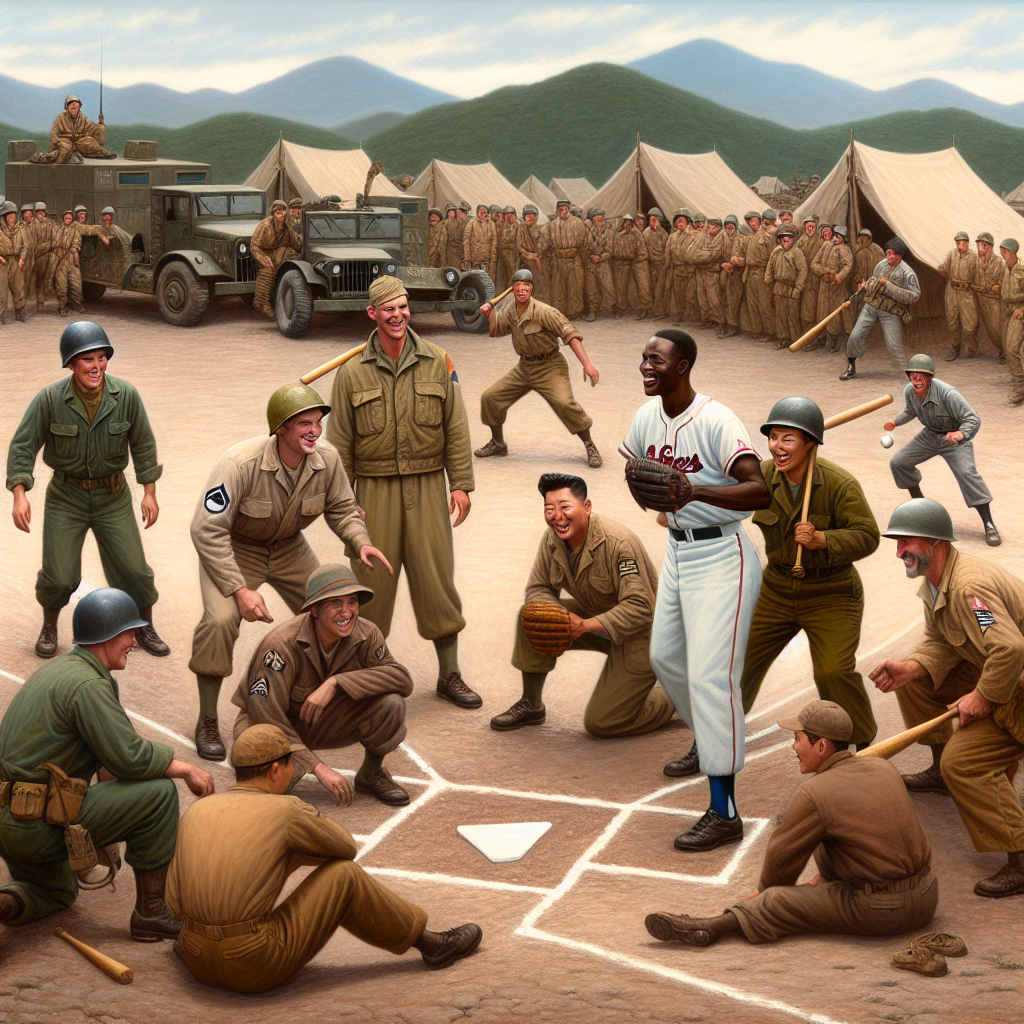
Furthermore, baseball’s role expanded beyond the boundaries of the United States. Military bases across the Pacific hosted ad-hoc games that combined recreation with moral sustenance, allowing troops to engage with a beloved pastime far from home. These impromptu games underlined the sport’s potential as an informal diplomatic tool and stress-reliever, bridging distances and differences in servicemen’s lives.
Baseball as a Cultural Force
In times of war, cultural expressions endure and evolve, and baseball was no exception during the Korean War. The sport retained its cultural capital, in part, due to its representation of American ideals such as grit, fairness, and community spirit. Baseball emerged as a cultural force that counterbalanced the era’s pervasive tension and anxiety, offering continuity in uncertain times.
Popularity of the sport during this period cannot be understated. Despite the war, baseball managed to recapture nationwide interest through compelling narratives, highlighted by young stars and veteran returns alike. Legendary feats on the field became modern sagas that captivated a public in need of escapism and collective celebrations.
For communities, local baseball events became focal points of social life, rallying points for collective support of both local troops and teams. Merchandising grew, with patriotic iconography becoming a staple in baseball memorabilia, further entrenching the sport as an emblem of national identity. These cultural developments underscored baseball’s place not only in recreational spheres but within the broader canvas of wartime America.
The Legacy of Baseball During the Korean War
The Korean War era, though often overshadowed by other historical epochs, left an indelible mark on baseball and its societal role. It proved an era of resilient adaptation and highlighted how deeply the sport was woven into the American social fabric. The lessons drawn from this time period about the intersection of national service and recreation echo down through subsequent decades, informing strategies for maintaining cultural touchstones during times of crisis.
Baseball’s resilience during the Korean War emphasized the sport’s enduring significance. It reinforced themes of hardiness and adaptability that continue to resonate through MLB and broader reflections on American life. Moreover, narratives of those who served both on the diamond and in war have become tales of valor and perseverance, enriching baseball history with layers of personal and national triumph.
The sport’s evolution during this time also set precedents for how professional leagues might handle future disruptions and challenges, preparing baseball for an increasingly interconnected and unpredictable world. The legacy is one of shared experience, enduring memory, and a sport’s inspiring continuity amidst global upheaval. As a result, understanding baseball during the Korean War is imperative for comprehending the richness of its historical journey.
Conclusion
Reflecting on baseball during the Korean War reveals a powerful narrative of adaptation, perseverance, and cultural significance. It demonstrates how America’s pastime served as both a source of allyship and solace against the grim backdrop of war — a game turned symbol, heroically entwined with social identity and community resilience.
These years were not merely an interruption but a reshaping. They cultivated new forms of engagement, catalyzed broadcasting growth, and revealed baseball’s power to unite and uplift spirits. Athletes serving on various fronts enriched the sport’s lore with compelling tales of duty, sacrifice, and eventual homecoming that still inspire and resonate with fans and historians today.
The Korean War chapter in baseball history, though less conspicuously celebrated, offers vital insights into the indomitable spirit of sports and society. It is a testament to how sport can thrive under adversity, embodying principles of endurance and adaptability that continue to shape baseball’s narratives.
As modern sports lovers and historians, appreciating this era invites a deeper understanding of baseball’s role during wartime and the sport’s capacity to reflect cultural shifts and societal resilience. It ultimately reaffirms why even during the darkest times, a simple game can carry profound significance, connect threads of collective memory, and offer renewal to the human spirit.