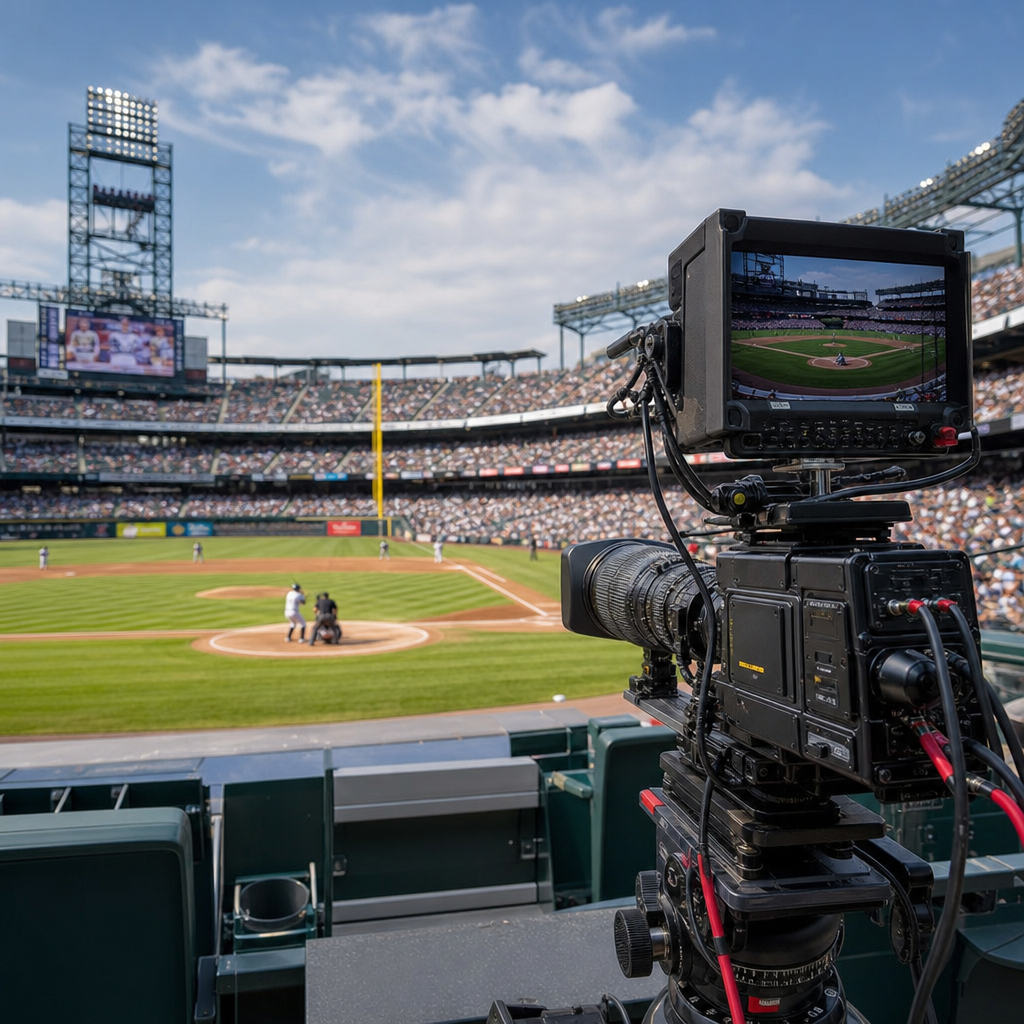
Baseball broadcasting is entering its biggest technical shift since high-definition television replaced standard definition, and the change will reshape how fans watch, analyze, and emotionally experience every pitch, swing, and defensive play. Ultra-HD, commonly called 4K, delivers roughly four times the pixel count of 1080p HD, while newer formats such as 8K, high dynamic range, high frame rate video, immersive audio, and cloud-based production expand quality beyond simple sharpness. In practical terms, the future of baseball broadcasting means clearer ball tracking, richer stadium atmosphere, more flexible viewing on phones and living room screens, and personalized feeds built around each fan’s habits.
This matters because baseball is uniquely difficult to televise well. The sport alternates between stillness and explosive action, asks cameras to follow a small white ball at high velocity, and depends on subtle visual details such as pitch grip, runner leads, outfielder positioning, and bat path. After years working around sports video workflows, I have seen that baseball exposes every weakness in a broadcast chain. Compression artifacts blur the ball. Poor dynamic range crushes shadows under caps. Low frame rates make close plays harder to judge. Fans notice, even when they cannot name the technical cause.
The next wave of innovation is not one invention but a stack of connected upgrades. Resolution, frame rate, color depth, audio capture, machine learning, graphics automation, direct-to-consumer streaming, low-latency delivery, and alternate viewing modes are all advancing together. Major League Baseball, regional sports networks, streaming platforms, equipment vendors, and connectivity providers are investing because the economics are shifting too. Younger viewers expect control, gambling and fantasy products require real-time data, and leagues want global distribution unconstrained by traditional carriage agreements.
For baseball organizations, broadcasters, and fans, the central question is no longer whether change is coming. It is which changes will matter most, which technologies will scale from showcase games to full-season coverage, and how quickly production teams can modernize without losing reliability. This hub article explains the future trends and predictions that define baseball broadcasting’s next era, from camera technology and AI-powered production to personalized streams, new business models, and the standards likely to shape the viewing experience through the next decade.
Ultra-HD, HDR, and high frame rate will become the new baseline
The future of baseball broadcasting starts with image quality, but the upgrade path is more nuanced than a simple jump from HD to 4K. Ultra-HD improves spatial detail, which is valuable for seeing seams on a pitch, dirt kick up around a stolen-base attempt, or an outfielder’s first step. Yet the more transformative improvement often comes from high dynamic range. HDR preserves bright highlights and deep shadows in the same frame, which is critical in baseball because games are played in mixed lighting, open roofs, harsh afternoon sun, and uneven shadow bands across the infield. In production tests, HDR consistently makes grass texture, uniform colors, and crowd depth look more lifelike than resolution alone.
High frame rate is the next major gain. Standard sports broadcasts in the United States have long relied on 59.94 fields or frames per second depending on format, but emerging workflows support cleaner motion rendering and higher-speed replay capture. For baseball, that means less blur on 95 mile-per-hour fastballs, better legibility on checked swings, and more precise replay in tag plays. Sony, Grass Valley, Canon, and Panasonic all market cameras capable of combining 4K capture with advanced replay speeds, and top-tier events already use these systems selectively. Over time, what is premium today will become routine for national telecasts and marquee local productions.
Adoption will not be uniform. A full season of 4K HDR baseball requires upgraded cameras, replay servers, switchers, graphics systems, storage, transport bandwidth, and consumer delivery paths. Stadiums also need consistent lighting and calibration discipline. That is why the near-term pattern is hybrid production: native 1080p HDR or 1080p high frame rate acquisition upconverted for certain outlets, with 4K reserved for lead cameras and isolated replay positions. This approach balances quality and cost while preserving a clear road map toward broader Ultra-HD operations.
Cloud production and IP workflows will redefine how games are made
Baseball broadcasts used to depend on large mobile units parked outside the stadium, tightly coupled hardware, and full onsite crews. Increasingly, that model is giving way to IP transport, remote integration, and cloud-based production. Under standards such as SMPTE ST 2110, broadcasters can move video, audio, and metadata as separate streams across managed networks instead of bundling everything through older baseband systems. In plain terms, this makes production more flexible. A director can switch a game from a centralized control room hundreds of miles away, replay operators can work from a hub facility, and graphics teams can support multiple games from one location.
I have seen remote workflows move from emergency workaround to strategic default because they solve several baseball-specific problems. Teams play almost daily, travel constantly, and generate enormous production volume across regular season, spring training, minor league, and shoulder programming. Centralized operations reduce travel costs, standardize quality control, and make it easier to launch alternate feeds without sending duplicate crews. They also help broadcasters cope with shrinking margins as rights fees rise and the regional sports network model remains under pressure.
Cloud production adds another layer. Replay clipping, highlights publishing, archive retrieval, metadata tagging, and even portions of graphics insertion can now run in elastic computing environments from providers such as AWS, Google Cloud, and Microsoft Azure. MLB has already been a visible technology partner in cloud-backed media and data operations, and that direction will continue. The strongest prediction is not that every live baseball telecast will become fully cloud native overnight, but that the production chain will become progressively software-defined, with hardware reserved for latency-critical switching, primary acquisition, and failover.
AI will power smarter cameras, better highlights, and personalized coverage
Artificial intelligence will not replace the craft of baseball broadcasting, but it will automate repetitive work and unlock coverage that is impossible to produce manually at scale. Computer vision systems can identify the ball, detect player positions, and recognize game states. Natural language models can summarize innings, generate clipping metadata, and assist researchers. Recommendation engines can tailor highlight packages to fan preferences. I have worked with automated tagging systems, and their greatest value is speed: producers receive usable markers for strikeouts, home runs, mound visits, and replay-worthy moments within seconds instead of after a labor-intensive logging process.
One immediate application is camera assistance. AI-based auto-framing already supports lower-level sports productions by tracking play and maintaining composition with fewer operators. In baseball, this is especially useful for developmental leagues, college games, and supplementary angles where budgets are tight. Another application is highlight generation. Systems can combine Statcast-style data, crowd noise spikes, scoreboard changes, and announcer excitement to identify likely key moments. Editors still make final judgments, but the candidate list becomes far stronger.
Personalization is where AI will have the broadest consumer impact. A fan could choose a “pitching lab” feed emphasizing release point overlays, spin axis visuals, and catcher targets, while another selects a betting-oriented view with win probability and situational tendencies. A casual viewer might get concise explainers when a balk, shift restriction, or challenge review occurs. The same base game can support multiple audience segments without rebuilding the whole production from scratch.
| Trend | What changes on screen | Likely baseball impact |
|---|---|---|
| 4K HDR | Sharper image, brighter highlights, deeper shadow detail | Better pitch visibility and more realistic stadium presentation |
| High frame rate | Smoother motion and clearer slow motion replay | Improved analysis of tags, swings, and pitch movement |
| Cloud production | More flexible live workflows and faster clip publishing | Lower operating costs and more alternate broadcasts |
| AI assistance | Automated tags, highlight suggestions, and custom feeds | Scalable coverage for every fan segment and every level |
| Low-latency streaming | Near real-time delivery to connected devices | Better social viewing, betting integration, and second-screen use |
Streaming, low latency, and direct distribution will overtake channel-first models
The business future of baseball broadcasting points toward streaming-led distribution. Linear television will remain important for years because it still delivers reach, habitual viewing, and local ad value, especially among older fans. But the center of gravity is shifting to direct apps and aggregated streaming bundles where leagues and rights holders control user data, entitlements, and merchandising opportunities. Fans increasingly expect to start a game on a phone, continue on a connected television, and clip or share moments instantly. That expectation is incompatible with delayed, inflexible delivery.
Low latency is essential. Traditional streaming often lags behind cable by 20 to 45 seconds, which is unacceptable for live sports when social media alerts, group chats, and betting markets move in real time. Newer delivery methods such as low-latency HLS, common media application format packaging, tuned content delivery networks, and edge-based optimization are narrowing that gap. For baseball, lower latency makes pitch-by-pitch betting viable, improves synchronization with radio, and reduces spoiler frustration for viewers following along with friends.
Direct distribution also opens the door to account-based features. Broadcasters can remember favorite teams, preferred camera angles, accessibility settings, fantasy rosters, and language options. Dynamic ad insertion lets operators target by geography or audience segment rather than forcing one commercial feed on everyone. The likely end state is a layered ecosystem: broad national packages, team-centric subscriptions, authenticated local options, and premium add-ons for advanced data, archival access, or multi-game mosaic viewing.
Data-rich storytelling will make broadcasts more useful, not just more flashy
Baseball has more structured event data than almost any major sport, and future broadcasts will use it more intelligently. MLB Statcast already tracks pitch velocity, spin, launch angle, sprint speed, catch probability, and field positioning. The next step is integrating those metrics in ways that help viewers understand strategy without overwhelming them. Good data graphics answer a clear question: Why did that pitch work, why was that route difficult, why did the manager make that move now? Bad graphics simply decorate the screen.
The strongest productions will blend data with context. If a reliever’s fastball shape changed after back-to-back appearances, show vertical break and command heat maps alongside a concise explanation from the analyst. If an outfielder shaded the gap unusually early, connect that alignment to batter spray tendencies and game situation. Fans do not need every metric on every pitch. They need the right metric at the right moment, framed in plain language.
Augmented reality will improve this storytelling. Virtual strike zones are already familiar, but newer overlays can map defensive positioning, projected home run trajectories, baserunning lanes, and pitch tunnels in three-dimensional space. When executed well, these tools reduce confusion and deepen understanding. When overused, they clutter the screen. The future belongs to restraint: fewer graphics, more meaning, and data that clarifies baseball’s hidden geometry.
Immersive audio, alternate feeds, and accessibility will expand the audience
Picture upgrades get headlines, yet audio often determines whether a baseball broadcast feels alive. Immersive audio formats and improved field miking will capture bat cracks, catcher targets, dugout reactions, and crowd swells with far more spatial realism. Baseball benefits enormously from this because sound fills the game’s quiet moments. A well-mixed crowd bed and accurate on-field effects create tension before the ball is even in play.
Alternate feeds will also grow. We already see youth-oriented broadcasts, analyst-driven streams, gambling-focused presentations, and creator-led watchalongs in other sports. Baseball is well suited to this format because the pace allows different storytelling styles. A traditional call can coexist with a coaching clinic feed, a sabermetrics stream, a Spanish-language presentation, or a condensed telecast designed for mobile users. Rights holders want these options because they extend inventory without requiring a separate event.
Accessibility will become a bigger design priority as platforms mature. Multiple language tracks, customizable captions, clearer audio mixes for speech intelligibility, and interface options for visually impaired users should be standard. Better accessibility is not just compliance. It increases total audience and improves usability for everyone.
What the next decade likely looks like for baseball broadcasting
Over the next ten years, the most likely outcome is a gradual but decisive modernization rather than a single disruptive leap. National games, postseason matchups, and showcase events will lead with native 4K HDR, advanced replay, cinematic shallow-depth specialty cameras where appropriate, and robust alternate streams. Regional and local coverage will migrate through 1080p HDR, remote production hubs, and software-driven graphics before reaching full Ultra-HD scale. Minor league and developmental broadcasts will use more automation, giving fans far more games with acceptable quality instead of a few games with premium staffing.
Some predictions are especially strong. First, streaming will become the primary product design center even when a game also airs on linear television. Second, data and personalization will be embedded at the account level, not added as occasional gimmicks. Third, cloud-connected production will dominate support functions, while onsite resources focus on acquisition, troubleshooting, and the most demanding live decisions. Fourth, baseball broadcasts will become more modular: one core game feed, many audience-specific expressions.
There are constraints. Bandwidth costs remain real, rights structures are complex, and not every household owns a display capable of showing the full benefit of 4K HDR. Production crews also need training; advanced tools fail if operators do not trust them or know when to override automation. Even so, the direction is clear. The future of baseball broadcasting is sharper, faster, smarter, more interactive, and more personal than the model fans grew up with.
For organizations building within the broader Innovations and Changes in Baseball landscape, this subtopic is the connective tissue between technology investment and fan experience. Better broadcasts do more than polish the product. They create new revenue paths, deepen engagement, and make the sport easier to follow across generations and devices. If you are planning content, platform strategy, or media partnerships, use this hub as the starting point, then map each trend to your audience, budget, and rights position. The winners will be the groups that treat broadcasting not as a fixed distribution channel, but as a living product that can improve every season.
Frequently Asked Questions
What does Ultra-HD mean for baseball broadcasting, and how is it different from standard HD?
Ultra-HD, often called 4K, refers to a video format with roughly four times as many pixels as 1080p high-definition television. In baseball broadcasting, that increase in resolution matters because the sport is filled with small but important visual details: the spin of a breaking ball, the catcher’s glove movement, the chalk at the foul line, defensive positioning in the outfield, and subtle facial expressions from players, coaches, and umpires. Standard HD made games look cleaner and more lifelike than older broadcasts, but Ultra-HD pushes that realism much further by making the image sharper, denser, and more precise on larger screens.
The difference is not only about clarity. Modern Ultra-HD baseball coverage is often paired with technologies such as high dynamic range, wider color reproduction, and improved compression systems. That means brighter stadium lights, more realistic grass and uniform colors, deeper shadows during night games, and a more nuanced image overall. For viewers at home, the result is a broadcast that feels closer to actually sitting in the ballpark. For analysts and highly engaged fans, it also improves the ability to study pitch grips, bat paths, jumps in the outfield, and fine mechanical details that can influence how the game is understood.
How will 8K, HDR, and high frame rate technology change the way fans experience a baseball game?
These technologies build on Ultra-HD and move baseball broadcasting beyond simple sharpness. 8K increases resolution again, creating an even more detailed image, which can be especially valuable on very large screens or in zoomed-in replay situations. While 8K is still emerging and not yet standard across most sports broadcasts, it points toward a future where replays can be cropped tightly without losing image quality. That is useful in baseball, where broadcasters frequently isolate the pitcher’s hand, the batter’s front shoulder, the tag on a close steal, or whether a ball caught the corner of the bag.
HDR, or high dynamic range, may have an even more immediate impact on the viewing experience. It improves contrast, brightness, and color depth, making afternoon games look more natural in mixed sunlight and shadow, and night games appear richer under stadium lighting. High frame rate video improves motion smoothness, which matters in a sport where the ball can travel at extreme speeds and key moments happen in fractions of a second. A faster frame rate can make pitches easier to track, swings cleaner to analyze, and defensive plays more fluid to watch. Combined, these upgrades create a more immersive and informative broadcast that helps casual viewers enjoy the spectacle while giving dedicated fans better visual access to the game’s technical details.
Why is baseball especially well suited for next-generation broadcast technology?
Baseball is uniquely compatible with advanced video and audio formats because it combines quiet anticipation, explosive action, and a huge amount of visual nuance. Unlike some sports where the action remains in constant wide motion, baseball repeatedly shifts between highly focused moments and broad situational awareness. A pitch begins with extreme concentration on the mound, then can instantly expand into a full-field defensive play. That structure benefits from high-resolution cameras, enhanced replay tools, and intelligent production workflows that can capture both microscopic detail and the larger tactical layout of the field.
The sport also invites analysis in a way few others do. Fans want to see seam movement on a slider, pick up on catcher framing, examine infield shading, and understand how a hitter adjusts from pitch to pitch. Better image quality supports all of that. Immersive audio adds another layer by capturing the crack of the bat, glove pops, crowd reactions, dugout atmosphere, and even subtle field-level sound that deepens emotional connection. Because baseball has built such a strong culture around replay, statistics, and slow-motion breakdowns, it is a natural candidate for technologies that improve both storytelling and precision. In many ways, the future of baseball broadcasting is not just about making games look better; it is about revealing more of what has always been happening on the field.
What role will cloud-based production and remote broadcasting play in the future of baseball coverage?
Cloud-based production is one of the most important behind-the-scenes changes in modern baseball broadcasting. Traditionally, sports coverage relied heavily on large on-site production crews, extensive truck setups, and fixed hardware workflows at the stadium. Cloud and remote production models allow more video feeds, graphics systems, replay tools, and collaboration processes to be managed from centralized production hubs rather than entirely on location. That can make broadcasts more flexible, scalable, and efficient, especially over a long baseball season with many games happening across multiple markets.
For viewers, the impact can be substantial even if it is largely invisible. Broadcasters can integrate more camera angles, quicker replay turnarounds, richer statistical overlays, and more customized content for different platforms. Regional feeds, alternate broadcasts, team-specific commentary options, and digital-first experiences become easier to produce when infrastructure is software-driven rather than tied only to traditional equipment. Cloud workflows can also help rights holders deliver games across television, streaming apps, mobile devices, and social platforms with greater consistency. As the industry evolves, this approach is likely to support more personalized baseball viewing experiences, faster innovation, and broader access to premium production quality beyond only the biggest marquee games.
Will all fans benefit from these advances, or will next-generation baseball broadcasts be limited to premium viewers?
In the short term, access will vary. Not every fan has a 4K or 8K television, an HDR-compatible display, a surround-sound system, or internet bandwidth capable of handling the highest-quality live streams. Broadcasters and streaming platforms also differ in how aggressively they support advanced formats. Some games may be produced in 4K but distributed in lower quality depending on carriage agreements, platform limitations, or local infrastructure. So yes, early adoption can feel uneven, and premium setups will often showcase the benefits first.
Over time, however, these technologies typically move from premium to mainstream. That is exactly what happened with HD. As televisions improve, internet delivery becomes more efficient, and production standards evolve, features like Ultra-HD resolution, HDR, and improved audio tend to become normal expectations rather than luxury extras. Even fans without the newest equipment can still benefit indirectly from better source production, cleaner compression, smarter camera work, and enhanced replay quality. The broader trend is clear: baseball broadcasts are becoming more cinematic, more data-rich, and more immersive. While the best experience may arrive first for highly equipped viewers, the long-term direction points toward a better experience for nearly everyone who watches the game.