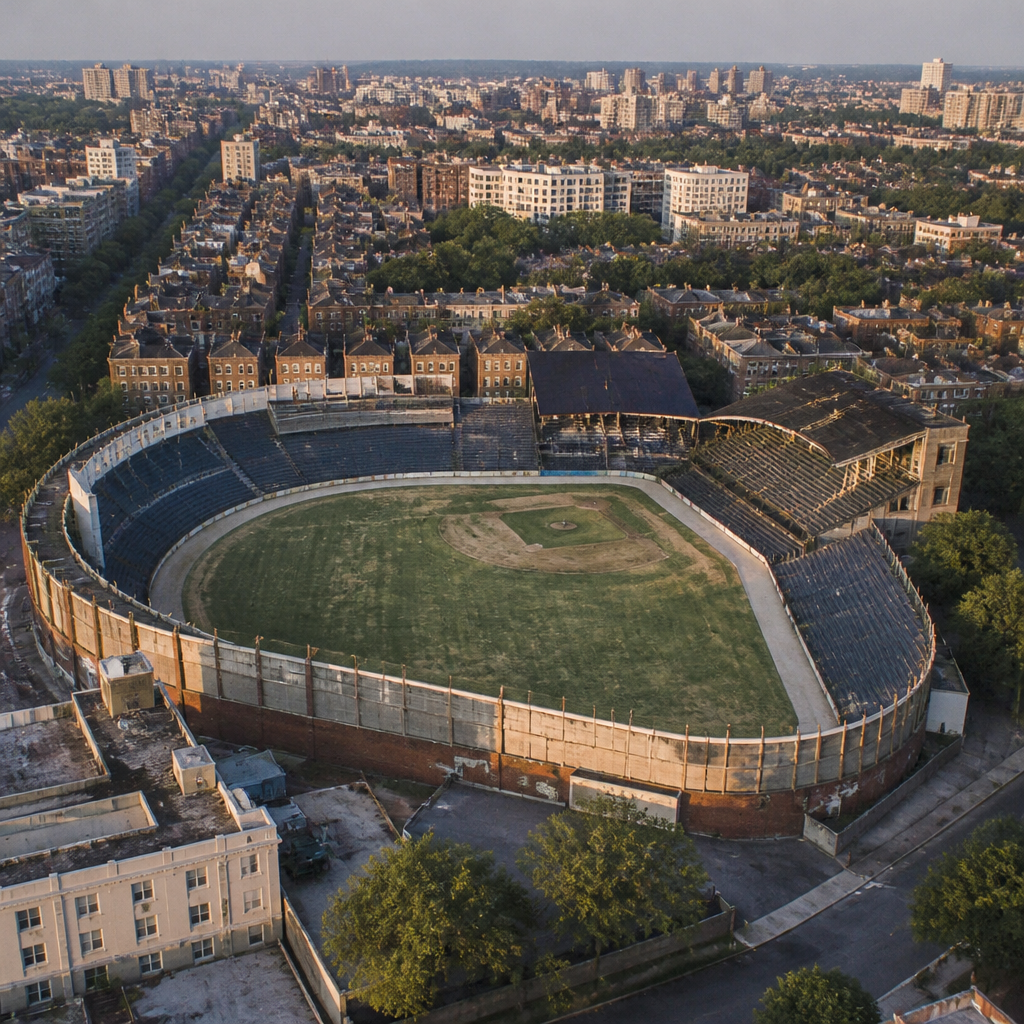
Hilltop Park, the Highlanders’ home before Yankee Stadium, stands at the center of any serious discussion of lost MLB ballparks because it captures how early baseball parks shaped teams, neighborhoods, and the modern major league experience. Opened in 1903 in Manhattan’s Washington Heights, the venue officially served the New York Highlanders, the American League club that would later become the New York Yankees. Although demolished long ago, Hilltop Park still matters because it explains where the Yankees began, why so many early parks disappeared, and how urban growth, fire codes, transit patterns, and revenue demands remade baseball architecture across the twentieth century. For readers exploring iconic ballparks, this is the essential hub for understanding lost MLB ballparks: not only Hilltop Park itself, but the wider pattern of vanished fields such as the Polo Grounds, Ebbets Field, Sportsman’s Park, and Baker Bowl. A lost ballpark is more than a demolished stadium. It is a former major league site whose physical structure no longer hosts baseball in its original form, yet whose legacy survives through records, maps, photographs, and the evolution of the franchise that once played there.
I have spent years working through old site plans, Sanborn maps, newspaper sketches, and club histories, and Hilltop Park repeatedly emerges as a key origin point. It was primitive by later standards, but it solved an urgent business problem for Ban Johnson’s upstart American League: the need to establish a stable New York foothold in direct competition with the National League Giants. The park was built quickly on elevated ground bounded by Broadway, 165th Street, Fort Washington Avenue, and 168th Street, giving the team both its “Highlanders” identity and a home reachable by expanding transit lines. Its famous hilltop location, huge outfield dimensions, and unfinished feel reflected an era when owners improvised within tight timelines and uneven finances. Understanding Hilltop Park helps explain why many early ballparks were short-lived, why clubs moved so often before 1920, and why the surviving legends of later generations, like Fenway Park and Wrigley Field, are rare exceptions rather than the norm.
This article serves as a complete overview of lost MLB ballparks through the lens of Hilltop Park. It defines what made these venues functional, why they vanished, which ones left the deepest marks on baseball history, and how fans can still study them intelligently today. If you want one page that connects the Highlanders’ first home to the larger story of vanished major league landscapes, start here.
What Hilltop Park Was and Why It Mattered
Hilltop Park opened on April 30, 1903, and from the start it reflected baseball’s transition from improvised nineteenth-century grounds to purpose-built major league enclosures. The New York Americans, soon commonly called the Highlanders, leased the site after negotiations to place the club elsewhere failed. Team ownership needed speed more than elegance, so the first version of the park was largely wooden, with a single grandstand and extensive standing-room space. Contemporary accounts describe an unfinished environment, and photographs confirm it: exposed structural elements, asymmetrical fencing, and a vast outfield that looked more practical than polished.
The dimensions mattered. Hilltop Park reportedly measured around 365 feet to left, 542 feet to center, and 400 feet to right in its early years, though exact figures varied by source and by later modifications. That deep center field was not unusual in dead-ball baseball, but it dramatically influenced strategy. Extra-base hits were harder to convert into home runs, outfielders covered enormous ground, and pitchers benefited from the suppression of long balls. This was the baseball environment in which stars like Jack Chesbro built value. In 1904, Chesbro won 41 games, still the American League record, and Hilltop Park’s playing conditions formed part of that story.
The park also mattered symbolically. Before the Yankees became the sport’s most recognized brand, they were tenants of an experimental league fighting for legitimacy. Hilltop Park provided physical proof that the American League intended to stay in New York. That mattered in the 1903-04 period, when league stability was not guaranteed and territorial competition was intense. In practical terms, Hilltop Park was a beachhead.
How Hilltop Park Fits the Story of Lost MLB Ballparks
Lost MLB ballparks generally disappeared for one or more recurring reasons: fire risk in wooden structures, limited seating capacity, poor revenue design, neighborhood pressure, transportation changes, structural obsolescence, and franchise relocation. Hilltop Park checks several of those boxes. It was built fast, expanded incrementally, and eventually could not match the earning power or prestige available elsewhere. Once the Highlanders began sharing the Polo Grounds with the Giants in 1913 after a fire damaged the National League club’s park and a replacement was erected, the logic of keeping Hilltop Park weakened. By 1923, the franchise had its own steel-and-concrete palace in Yankee Stadium.
That pattern repeats across baseball history. Early parks were often constrained by city blocks, lacked modern concourses, and generated less ticket, concession, and premium-seat revenue than later facilities. Owners did not preserve them out of nostalgia because the economics rarely justified it. In many cases, there was no preservation movement at all. Cities treated old ballparks as real estate opportunities, and teams treated relocation or replacement as ordinary business.
| Ballpark | Primary Team | Opened | Closed/Demolished | Main Reason It Was Lost |
|---|---|---|---|---|
| Hilltop Park | New York Highlanders | 1903 | 1912/1914 | Obsolescence and move to better venue |
| Ebbets Field | Brooklyn Dodgers | 1913 | 1960 | Relocation and redevelopment |
| Polo Grounds | New York Giants | 1911 | 1964 | Team relocation and aging facility |
| Baker Bowl | Philadelphia Phillies | 1887 | 1938 | Structural problems and safety concerns |
| Sportsman’s Park | St. Louis Browns/Cardinals | 1902 | 1966 | Relocation, decline, and replacement |
For a sub-pillar hub on lost MLB ballparks, the key point is this: Hilltop Park is not simply a curiosity from Yankees prehistory. It is an archetype. It shows how quickly a team could outgrow a field, how unstable early major league geography could be, and how little permanence many “iconic” places actually possessed at the time.
The Highlanders, the Site, and the Shift to Yankee Stadium
The Highlanders played at Hilltop Park from 1903 through 1912. During those years, the club was competitive at times but not yet a dynasty. The famous 1904 pennant race remains the park’s defining baseball moment. On the final day, Chesbro threw a wild pitch in the ninth inning against Boston, allowing the winning run to score and costing New York the pennant. That game has been mythologized ever since, and because there was no World Series in 1904, Hilltop Park became the setting for one of the era’s most consequential near-misses.
The site itself influenced the fan experience. Washington Heights was developing rapidly, and the extension of elevated and subway access made attendance feasible, but the neighborhood still lacked the dense entertainment ecosystem later associated with ballpark districts. Hilltop Park was more destination than seamless urban theater. Fans climbed to a relatively isolated ground, watched a game in a windswept park, and returned downtown. Compared with later baseball cathedrals, it was functional, not immersive.
The move away from Hilltop Park was not a romantic farewell but an operational decision. Sharing the rebuilt Polo Grounds initially gave the club access to a superior structure with better amenities and central visibility. When Babe Ruth transformed the Yankees into a gate attraction after 1920, even the Polo Grounds became inadequate because the team needed a venue it controlled completely. Yankee Stadium, opened in 1923 in the Bronx, answered that need with scale, concrete permanence, and a revenue model built for a superstar era. Hilltop Park then looked exactly like what it was: an early solution for a franchise that had not yet become the Yankees known to history.
What Fans Should Know About Other Lost MLB Ballparks
Hilltop Park belongs in a larger family of vanished major league venues, and understanding that family helps readers navigate the lost ballparks subtopic with clarity. Ebbets Field is the classic case of emotional legacy outlasting physical preservation. Opened in 1913 and beloved for its intimate urban form, it still could not survive the combined pressures of parking limitations, ownership conflict, and the Dodgers’ move to Los Angeles. The Polo Grounds lasted longer in public memory than in practical usefulness; its odd bathtub shape and dramatic sightlines were unforgettable, but by the time the Giants left for San Francisco after 1957, the park no longer matched the direction of the sport.
Shibe Park, later Connie Mack Stadium, illustrates another pattern: a structurally significant park can remain beloved and still become economically unsustainable. The first steel-and-concrete ballpark in the American League, it set design standards in 1909, yet eventually suffered from neighborhood decline, shrinking attendance, and maintenance burdens. Baker Bowl shows the harsher side of the equation. It was notorious for cramped dimensions, weak infrastructure, and dangerous conditions, including a 1927 grandstand collapse that injured spectators. In plain terms, some lost ballparks disappeared because they were unsafe.
These examples matter because fans often treat all demolished parks as equally sacred. They were not. Some were masterpieces, some were flawed but memorable, and some were genuinely inadequate. A useful hub article should separate nostalgia from evidence. Lost MLB ballparks deserve study not because every one was ideal, but because each reveals the business and civic forces that shaped major league baseball at a specific moment.
How Historians Reconstruct Ballparks That No Longer Exist
When a ballpark is gone, the best reconstruction work relies on multiple source types rather than a single famous photograph. Historians use Sanborn Fire Insurance maps for lot boundaries and building footprints, newspaper diagrams for dimensions, team scorecards for seating references, aerial images where available, and city records for ownership changes. Baseball-Reference and Retrosheet help anchor dates, attendance patterns, and game events, while the Library of Congress, local historical societies, and newspaper archives often supply visual evidence. For Hilltop Park, these sources are especially important because surviving imagery is limited compared with later parks.
Site visits also matter. Even when the structure is gone, street grids can reveal orientation, scale, and access routes. At the former Hilltop Park location, now occupied by NewYork-Presbyterian’s Columbia University Irving Medical Center complex, the ballpark itself has vanished, but the broader terrain still explains the “hilltop” identity better than text alone. I always advise readers to compare a modern map with period diagrams; once you do, the relationship between geography and design becomes much clearer.
Good reconstruction also means accepting uncertainty. Early dimension figures often conflict because fences moved, temporary seating altered boundaries, and journalists rounded numbers. Responsible historians note those discrepancies instead of forcing false precision. That balanced approach is crucial if you want to understand lost MLB ballparks accurately rather than romantically.
Why Lost Ballparks Still Matter to Modern Fans
Lost ballparks matter because baseball history is inseparable from place. Teams do not develop identities in a vacuum; they absorb the dimensions, neighborhoods, transportation links, weather patterns, and crowd habits of their homes. Hilltop Park shaped the pre-Yankee identity of the Highlanders. Ebbets Field shaped Brooklyn’s civic mythology. The Polo Grounds influenced how generations remembered New York baseball’s vertical intensity and strange geometry. Remove the parks, and you lose part of the explanation for how those franchises became what they became.
They also matter because current stadium debates are rarely new. Questions about public subsidy, neighborhood impact, parking, transit, premium inventory, and replacement versus renovation all have precedents in the lost ballpark era. Owners a century ago pursued better revenue and control just as owners do now. Cities balanced civic pride against redevelopment pressure then, too. Hilltop Park’s short life is a reminder that “temporary” and “iconic” often overlap in sports history.
For anyone building knowledge of iconic ballparks, lost MLB ballparks provide the missing context that makes surviving parks easier to evaluate. They show why certain design features lasted, why others vanished, and how the sport moved from rough-edged wooden enclosures to monument-scale stadiums and then to the retro-modern parks of today.
Hilltop Park deserves recognition not just as the Highlanders’ home before Yankee Stadium, but as one of the clearest entry points into the full story of lost MLB ballparks. It explains the Yankees before they were the Yankees, the American League before it was fully secure, and New York baseball before monumental stadium culture took hold. Its short life from 1903 to 1912 as a major league venue reveals the core forces that erased so many early fields: rapid construction, limited revenue design, changing transit patterns, competitive pressures, and the constant search for a better facility.
As a hub for the lost ballparks subtopic, the lesson is straightforward. Study Hilltop Park first, then connect it to Ebbets Field, the Polo Grounds, Baker Bowl, Shibe Park, Sportsman’s Park, and other vanished venues. Together they form a map of how major league baseball evolved through demolition as much as through preservation. Some were beloved, some were flawed, and all of them tell us something concrete about the sport’s business, architecture, and civic footprint.
If you are exploring iconic ballparks in depth, use this page as your starting framework: understand the site, the team, the economics, the urban setting, and the reason the park disappeared. Then follow those threads into each individual stadium’s story. Lost MLB ballparks are gone physically, but they remain essential to understanding baseball as it was built, sold, remembered, and transformed.
Frequently Asked Questions
What was Hilltop Park, and why is it important in baseball history?
Hilltop Park was the original home of the New York Highlanders, the American League team that would eventually become the New York Yankees. It opened in 1903 in Manhattan’s Washington Heights neighborhood, at a time when professional baseball was still defining what a major league franchise looked like in New York City. Its importance goes far beyond being “the stadium before Yankee Stadium.” Hilltop Park represents a formative stage in the development of one of the most famous teams in sports, and it also reflects the larger story of how early 20th-century ballparks helped shape fan culture, urban identity, and the commercial growth of Major League Baseball.
The park mattered because it gave the Highlanders a true home at a crucial moment in franchise history. Before the Yankees became a dynasty in the Bronx, they were an emerging club trying to establish credibility, attract supporters, and compete in a city already dominated by National League baseball. Hilltop Park provided the physical setting where that struggle played out. It was where fans first built a connection to the team, where the Highlanders developed their local identity, and where some of the earliest chapters of the Yankees’ institutional history were written.
It is also important as a symbol of a vanished baseball era. Unlike later steel-and-concrete cathedrals such as Yankee Stadium, Hilltop Park belonged to a generation of parks that were often simpler, more intimate, and more directly tied to the neighborhoods around them. Discussions of lost MLB ballparks frequently return to Hilltop Park because it helps explain how the game evolved from a local urban attraction into a national business with iconic venues. In that sense, Hilltop Park is not just a lost field; it is a missing link between early baseball and the modern major league experience.
Why were the New York Highlanders called the Highlanders, and how did Hilltop Park influence that identity?
The nickname “Highlanders” came from the location of Hilltop Park in upper Manhattan, specifically Washington Heights. The ballpark sat on elevated ground, and that geographical detail became a natural way to distinguish the team within New York’s crowded sports landscape. In an age before branding was as polished and standardized as it is today, teams often picked up names organically from newspapers, fans, or local conditions. The Highlanders’ identity was rooted directly in the ballpark’s setting, which shows just how closely early baseball teams were tied to place.
Hilltop Park was central to that identity because the team’s name was not just a marketing label; it reflected the lived experience of attending games there. Fans associated the club with the neighborhood, the climb uptown, and the sense of a team playing on the city’s heights. That connection between topography and team identity would have been obvious to contemporary New Yorkers, making the ballpark part of the club’s personality in a way that feels especially distinctive today.
Over time, the “Highlanders” nickname faded as “Yankees” became the dominant name, but Hilltop Park remains the clearest explanation for why the original nickname existed in the first place. It reminds us that early baseball identities were often local and physical rather than abstract. The park did not merely host the Highlanders; it helped define who they were. Without Hilltop Park in Washington Heights, the Highlanders likely would not have been known by that name at all, and one of the most interesting early chapters in Yankees history would look very different.
Where was Hilltop Park located, and what was the ballpark experience like for fans?
Hilltop Park was located in Washington Heights in upper Manhattan, a setting that made it distinctive from other New York baseball environments of the time. Its position on elevated ground gave the park both its nickname connection and a memorable sense of place. In the early 1900s, the relationship between a ballpark and its neighborhood was especially important because the journey to the game, the surrounding streets, and the local atmosphere were all part of the fan experience. Hilltop Park was not an isolated entertainment complex; it was woven into the life of the city around it.
For fans, attending a game there would have felt much different from visiting a modern stadium. Early ballparks were generally more intimate and less standardized, with fewer layers of amenities and a stronger sense of immediacy. Spectators at Hilltop Park were there to watch baseball in a more direct, less corporate environment, where the connection between crowd and field was often closer and more personal. The experience would have included the sights and sounds of a growing city, the rhythms of neighborhood life, and a ballpark atmosphere that reflected baseball before the age of giant scoreboards, luxury seating, and highly engineered fan entertainment.
That said, Hilltop Park was also a product of baseball’s early modernization. It existed at a time when major league clubs were beginning to recognize the importance of permanent homes, reliable attendance, and stronger civic visibility. So while the fan experience there would have felt old-fashioned by later standards, it also represented progress for the Highlanders as a franchise. For historians and fans alike, imagining a day at Hilltop Park offers valuable insight into what baseball looked and felt like before the game moved into its larger, more monumental stadium era.
Why was Hilltop Park replaced, and how did the move to Yankee Stadium change the franchise?
Hilltop Park was replaced because the franchise outgrew the needs and limitations of its original home. As baseball became more commercially ambitious and the team’s identity evolved, the club required a venue with greater capacity, stronger infrastructure, and a broader stage for its future. Early parks such as Hilltop Park were essential to establishing teams, but many were not built to support the scale, spectacle, and revenue expectations that came to define major league baseball in the decades that followed.
The eventual move to Yankee Stadium marked a dramatic transformation. If Hilltop Park represented the team’s formative years, Yankee Stadium symbolized arrival, confidence, and ambition. The franchise shifted from being an upper Manhattan club still finding its footing to becoming one of the central institutions in American sports. The new stadium offered a grander environment, a more enduring architectural presence, and a platform that matched the team’s growing aspirations and public stature.
Still, replacing Hilltop Park did not erase its importance. In fact, the contrast between the two venues makes Hilltop Park even more significant historically. You cannot fully understand what Yankee Stadium came to mean without first understanding what came before it. Hilltop Park tells the story of the team before the legends, before the monumental architecture, and before the Yankees became synonymous with championships and baseball power. It is the beginning point of that transformation, which is exactly why it continues to matter in serious discussions of the franchise’s origins.
Why does Hilltop Park still matter if the ballpark was demolished long ago?
Hilltop Park still matters because lost ballparks are often most valuable not for what physically survives, but for what they reveal about the evolution of the game. Even though the stadium itself is gone, its historical role remains clear. It was the first home of the franchise that became the Yankees, it anchored a team identity tied to geography and neighborhood, and it reflected a period when baseball parks were becoming essential civic spaces in American cities. That alone gives it lasting importance.
It also matters because Hilltop Park helps connect baseball history to urban history. The park’s story is about more than wins and losses; it is about Manhattan at the turn of the century, the rise of professional sports as a major public attraction, and the way teams used local identity to build loyalty. Historians, preservationists, and baseball fans return to Hilltop Park because it illustrates how stadiums once functioned as neighborhood landmarks rather than just entertainment venues. In that respect, its disappearance makes its story more meaningful, not less.
Finally, Hilltop Park matters because it deepens our understanding of the Yankees before they were the Yankees in the fullest cultural sense. It reminds readers that even the most famous franchises begin somewhere smaller, less polished, and more vulnerable. Before the dynasties, the mythology, and the grandeur of Yankee Stadium, there was a team playing on a hill in Washington Heights, trying to establish itself in New York. That origin story is essential, and Hilltop Park remains one of the best windows into it.