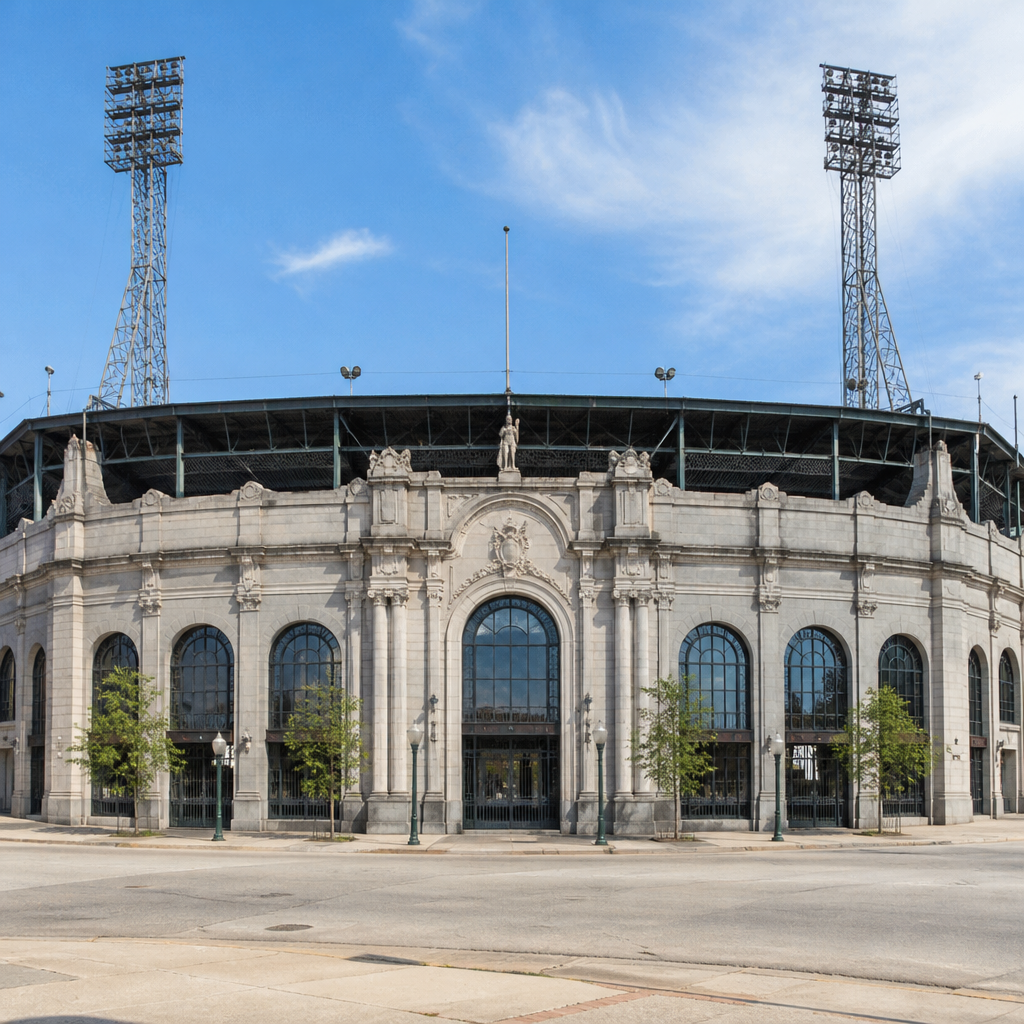
Before Crosley Field became synonymous with early Cincinnati baseball, the Palace of the Fans stood as one of the most ambitious and visually distinctive parks ever built for a major league club. Opened in 1902 for the Cincinnati Reds, this now-lost venue blended Beaux-Arts grandeur with practical baseball engineering, giving the city an ornate steel-and-concrete ballpark years before such construction became standard across the sport. For anyone studying lost MLB ballparks, the Palace of the Fans matters because it sits at the crossroads of architecture, urban growth, fan culture, and the business evolution of professional baseball.
The term lost MLB ballparks refers to former major league venues that no longer exist in active use and often survive only through photographs, maps, newspaper accounts, and scattered structural remnants. These parks range from fire-prone nineteenth-century wooden enclosures to transitional parks like Cincinnati’s Palace of the Fans, which anticipated the safer, more durable stadiums that followed. As a hub within the broader Iconic Ballparks topic, this article explains not only what made the Palace of the Fans remarkable, but also how it helps organize the wider history of vanished major league grounds across the United States.
I have worked through Sanborn maps, period newspaper coverage, attendance reports, and surviving images of prewar parks, and the Palace of the Fans always stands out because it solved problems that plagued earlier venues while creating new lessons about location and longevity. It was built after the deterioration of the Reds’ previous home, League Park, on the same site at Findlay Street and Western Avenue. Team owner John T. Brush wanted something sturdier, more elegant, and more marketable. The result was a ballpark whose white façade, towers, and sculptural detailing made it look more like a civic monument than a sports enclosure.
That combination of beauty and function is why the Palace of the Fans deserves attention well beyond Cincinnati history. It illustrates how clubs used architecture to signal legitimacy, how neighborhood settings shaped fan access, and how rapidly changing expectations could make an advanced park obsolete within a generation. It also provides an ideal gateway into lost MLB ballparks overall: why they were built, why they disappeared, what they tell us about the game, and where they fit in the lineage from nineteenth-century grounds to modern retro-classic stadiums.
What the Palace of the Fans Was and Why It Was Built
The Palace of the Fans opened on April 17, 1902, replacing an older League Park that had become inadequate by the standards of the National League. The new park cost roughly $250,000, a substantial sum for the period, and used steel, concrete, and brick in ways that reflected the broader move away from timber-heavy grandstands. That shift was not cosmetic. Fires had destroyed or damaged many early ballparks, and unstable wooden structures posed constant safety and maintenance concerns. Cincinnati’s ownership chose permanence as a selling point, years before “fireproof” parks became a repeated industry claim.
The site remained constrained by city streets and the industrial West End environment, but the redesign aimed to maximize capacity and improve circulation. Contemporary accounts generally place capacity around 18,000 to 20,000, depending on standing room. More important than the raw number was the experience: wider passageways, more substantial seating sections, and a grandstand that conveyed prestige. In the dead-ball era, when clubs fought for gate receipts one customer at a time, appearing respectable and modern mattered. A handsome park suggested stable management, civic ambition, and a worthy place for families and business patrons.
Architecturally, the park became famous for its façade, colonnades, towers, and decorative urns. The nickname Palace of the Fans was not ironic. It intentionally evoked luxury and public theater. Yet beneath the ornament was a practical baseball building, carefully arranged to fit a tight urban block. Like many parks of its era, dimensions were irregular because streets dictated the footprint. That irregularity shaped play on the field while also becoming part of the park’s identity, much as odd outfield walls later defined Fenway Park and Ebbets Field.
For the larger story of lost MLB ballparks, this origin is instructive. Most vanished parks were responses to immediate business and safety pressures, not exercises in nostalgia. Owners built them to solve current problems: deteriorating stands, limited revenue, neighborhood access, or league-image concerns. The Palace of the Fans is one of the clearest examples because it visibly announced that major league baseball in Cincinnati intended to look permanent, urbane, and prosperous.
Design Features That Made It One of Baseball’s Most Ornate Parks
What set the Palace of the Fans apart was the confidence of its design. Early photographs show a bright exterior with classical detailing unusual for a ballpark, including corner pavilions and towers that framed the structure as an urban landmark. The grandstand’s steel-and-concrete skeleton supported more durable seating and roof coverage than many predecessors. In practical terms, that meant better sightlines, improved weather protection for premium seats, and a lower risk of catastrophic fire. In symbolic terms, it told fans that baseball deserved architecture comparable to theaters, exposition halls, and municipal buildings.
The park also featured one of the game’s earliest clearly monumental entrances. That matters because entry design shapes fan psychology. When a stadium presents itself as an event space before a pitch is thrown, attendance becomes a social outing rather than merely a sporting purchase. Cincinnati grasped that earlier than many clubs. The Reds were selling an afternoon at a palace, not just a game. Even today, successful parks use the same principle with plazas, gates, statues, and promenades.
At field level, however, the Palace of the Fans remained a dead-ball-era park with all the quirks that implies. Foul territory was generous by modern standards. Sightline compromises existed because support columns were common in early grandstands. The playing surface and drainage systems were less sophisticated than later parks, and weather could affect conditions heavily. This balance is crucial when evaluating lost MLB ballparks. Aesthetic innovation did not always eliminate operational limitations. Some parks looked advanced while still asking players and spectators to tolerate issues that would later be unacceptable.
| Feature | Palace of the Fans | Why It Mattered |
|---|---|---|
| Primary materials | Steel, concrete, brick | Improved durability and reduced fire risk compared with wooden parks |
| Architectural style | Classical, highly ornamental | Elevated baseball’s public image and strengthened civic identity |
| Urban footprint | Street-constrained, irregular | Created unique field dimensions and a distinctive spectator experience |
| Capacity | Roughly 18,000 to 20,000 | Supported larger gate revenue in a growing major league market |
| Fan amenities | Substantial grandstand and improved circulation | Made attendance safer and more comfortable for paying customers |
When I compare the Palace of the Fans with other lost MLB ballparks from roughly the same period, such as Washington Park in Brooklyn or South Side Park in Chicago, Cincinnati’s venue looks especially self-conscious about prestige. It was not simply trying to house baseball. It was trying to stage baseball. That distinction helps explain why the park retains such fascination in stadium history despite its relatively short life.
Baseball at the Palace: Teams, Players, and the Fan Experience
The Cincinnati Reds played at the Palace of the Fans from 1902 through 1911, a period that covered the dead-ball era’s strategic, low-scoring style. Fans there watched games shaped by bunting, hit-and-run tactics, stolen bases, and strong pitching rather than home run barrages. This context matters because the ballpark experience of that era was closely tied to intimacy and pace. Crowds followed every small tactical move, often sitting close enough to hear player chatter and umpire disputes with unusual clarity.
Several notable Cincinnati figures passed through the park during those years, including Hall of Fame manager Clark Griffith as a player-manager late in his playing career and stars such as Cy Seymour. The Reds were not a dynasty in the Palace years, but the venue still hosted meaningful National League baseball and reflected the daily rhythms of a city that treated the club as a civic institution. Newspaper coverage from the period repeatedly emphasized crowds, weather, transport, and the condition of the grounds, all reminders that a ballpark was inseparable from local urban life.
The fan experience likely mixed grandeur with the rough edges typical of the time. Spectators entered an ornate structure, but they still dealt with cigar smoke, exposed weather in cheaper sections, and less personal space than modern attendees expect. Segregation practices, class distinctions in seating, and uneven amenities reflected the social realities of the era. Lost MLB ballparks should never be romanticized without acknowledging those limitations. They could be beautiful, but they were not universally comfortable or equitable spaces.
Still, the Palace of the Fans represented a real advance in the business of attending baseball. More durable materials improved perceptions of safety. The park’s visual splendor added status to an afternoon game. In an age before television, that atmosphere mattered enormously. The building itself was part of the entertainment product, much as modern teams use scoreboard shows, club spaces, and branded concourses to create a fuller event.
Why the Palace of the Fans Disappeared
Despite its ambition, the Palace of the Fans had a short major league life. By 1912 the Reds moved to a new park, Redland Field, later renamed Crosley Field. The reason was not that the Palace had failed artistically. It was that baseball economics and urban expectations moved quickly. The old site was hemmed in, limiting expansion and complicating crowd flow. Newer parks prioritized larger capacities, better orientation, and cleaner long-term development opportunities. Even a striking stadium could become functionally outdated if it lacked room to grow.
Location played a major role. The West End setting had advantages because it was urban and reachable, but it also imposed hard physical constraints. As attendance ambitions increased, clubs needed parcels that could support broader grandstands, more outfield space, and sometimes improved transportation access. This pattern appears across lost MLB ballparks. Teams did not always leave because a park was structurally unsound. They often left because the surrounding city block could not keep pace with baseball’s commercial scale.
After the Reds departed, the Palace of the Fans did not remain a major league venue. Portions of the site were repurposed, and the stadium was eventually demolished. Like many lost MLB ballparks, it vanished not in a single dramatic mythic moment but through ordinary urban change. That is typical. Demolition, redevelopment, road work, warehouses, parking, and housing have erased more baseball history than spectacular disaster ever did. The disappearance of these parks is therefore also a story about American land use.
The lesson is clear: innovation does not guarantee longevity. The Palace of the Fans was advanced for 1902, yet only a decade later Cincinnati pursued a larger solution. That accelerated obsolescence resembles later stadium cycles, including multipurpose parks replaced after only a few decades. Ballparks survive when design quality, location, and future adaptability align. The Palace excelled in quality and image, but adaptability proved limited.
The Palace of the Fans in the Wider History of Lost MLB Ballparks
As a hub for lost MLB ballparks, this article uses the Palace of the Fans as a model for interpreting other vanished venues. First, many lost parks were transitional buildings. They bridged eras rather than defining them permanently. Cincinnati’s ornate stadium connected wooden nineteenth-century grounds with the more mature steel-and-concrete generation that included Shibe Park, Forbes Field, and eventually Redland Field. Second, lost parks often mattered more locally than nationally during their lifetimes, then gained broader historical significance later through rarity and survival of imagery.
Third, nearly every lost MLB ballpark can be understood through four questions: why was it built, how did its site shape the game, what made fans remember it, and why was it abandoned? Apply those questions to the Polo Grounds, Sportsman’s Park, Baker Bowl, Ebbets Field, Braves Field, or original Yankee Stadium, and patterns emerge. Some were beloved but unsafe. Some were strategically placed but landlocked. Some were architecturally ordinary yet hosted extraordinary baseball. Others, like the Palace of the Fans, were visually extraordinary but too constrained to last.
For readers exploring this subtopic further, useful companion articles would include profiles of Ebbets Field, Baker Bowl, the Polo Grounds, South End Grounds, Exposition Park, and Seattle’s Sick’s Stadium. Together, those stories show how lost MLB ballparks illuminate labor history, transit systems, segregation, neighborhood change, fire codes, wartime material limits, and the rise of broadcast economics. Ballparks are not isolated sports sites. They are urban documents built in brick, steel, and memory.
Preservation research on vanished parks also depends on disciplined methods. Sanborn Fire Insurance maps help verify footprints and surrounding structures. Library of Congress photo archives, local historical societies, Retrosheet game logs, and period newspaper databases provide corroborating detail. When sources conflict on dimensions or capacity, the best approach is to state the range and explain why discrepancies exist. That standard matters because stadium lore often drifts into repetition without evidence. The Palace of the Fans deserves better than myth; it deserves careful historical reconstruction.
Why This Ballpark Still Matters to Modern Fans
The Palace of the Fans still matters because it proves that ballpark design has always been about more than seats and sightlines. More than a century ago, the Reds understood that architecture could express ambition, shape civic pride, and influence how spectators valued a ticket. Modern fans who admire Camden Yards, Oracle Park, or PNC Park are responding to the same idea: a memorable ballpark is both a baseball machine and a cultural statement. Cincinnati was experimenting with that formula long before the retro era gave it a new vocabulary.
It also matters because lost MLB ballparks sharpen our understanding of what survives. When fans visit today’s stadiums, they often focus on current amenities and team branding. Studying vanished parks adds perspective. It shows that every celebrated venue exists within a cycle of invention, wear, adaptation, and replacement. The Palace of the Fans was once modern, impressive, and future-facing. Then it became inadequate. That arc encourages a more critical reading of present-day stadium claims and a deeper respect for the places that helped shape the game.
For Cincinnati specifically, the Palace of the Fans is an essential chapter between primitive early grounds and the longer, more famous life of Crosley Field. It reminds us that the city’s baseball identity was built in layers, with each park solving one generation’s problems while creating another’s. If you are building a serious understanding of iconic and lost ballparks, start here, then follow the connections outward to other vanished parks, surviving records, and the neighborhoods that once carried the sounds of major league baseball.
Frequently Asked Questions
What was the Palace of the Fans, and why is it important in Cincinnati baseball history?
The Palace of the Fans was the Cincinnati Reds’ home ballpark from 1902 until 1911, and it holds a special place in baseball history because it represented both architectural ambition and a major step forward in ballpark design. Built before Crosley Field became the better-known symbol of early Reds baseball, the Palace of the Fans gave Cincinnati a strikingly modern venue at a time when many major league parks were still largely wooden and vulnerable to fire. Its steel-and-concrete construction made it part of the first wave of more permanent baseball stadiums, placing it ahead of many of its contemporaries in terms of durability and engineering.
Historically, the park matters for more than just its dates of operation. It reflected a moment when professional baseball was becoming more established, more commercially important, and more conscious of how a ballpark could shape a club’s identity. For Cincinnati, one of the oldest professional baseball cities in the United States, the Palace of the Fans was a visual statement that the Reds belonged among the sport’s serious, forward-looking franchises. Even though it no longer survives and was eventually overshadowed by Crosley Field in public memory, it remains one of the most fascinating lost ballparks in Major League Baseball because it combined civic pride, architectural flair, and practical baseball use in a way few parks of its era ever did.
Why was it called the “Palace of the Fans”?
The nickname “Palace of the Fans” was not accidental or ironic. It was meant to signal that this ballpark was designed to offer spectators something more grand, impressive, and comfortable than the rougher, more utilitarian grounds common in the late nineteenth and early twentieth centuries. The word “palace” suggested elegance, permanence, and public spectacle, while “of the Fans” framed the park as a place built for the paying public rather than just the team itself. That was an important message in an era when baseball owners increasingly understood that a successful franchise depended on drawing crowds and giving those crowds a memorable experience.
The name also fit the building’s unusually ornate appearance. The park featured Beaux-Arts styling, decorative elements, and a monumental look that made it stand apart from simpler ballpark structures. Instead of resembling a temporary enclosure for a game, it projected the image of a civic entertainment venue with architectural aspirations. In practical terms, the name helped market the park as an attraction in its own right. In historical terms, it captures exactly what made the venue so unusual: this was a baseball park that tried to impress people before the first pitch was even thrown.
What made the Palace of the Fans architecturally unique compared with other ballparks of its era?
The Palace of the Fans was architecturally distinctive because it merged advanced construction methods with decorative design in a way that was rare for baseball at the time. Opened in 1902, it used steel and concrete at a moment when many parks still relied heavily on wood. That alone made it significant, since more permanent materials improved safety and suggested a long-term investment in the franchise and the city. But what truly made the park memorable was that its designers did not stop at durability. They gave it a level of ornamentation more commonly associated with civic or cultural buildings than with sporting venues.
Its Beaux-Arts influence showed up in classical details and a sense of formal grandeur. Historical descriptions often emphasize its columns, decorative facade, and sweeping visual presence. Rather than presenting baseball as something casual or improvised, the park framed the sport within a setting that looked cultivated and ceremonial. This combination of engineering and aesthetics is why historians of ballpark development continue to discuss it. The Palace of the Fans was not merely an early concrete-and-steel stadium; it was an early attempt to make a major league ballpark architecturally impressive in its own right. In that sense, it anticipated later efforts to treat sports venues as landmarks rather than simple enclosures.
How did the Palace of the Fans influence later ballpark development, including Crosley Field?
The Palace of the Fans influenced later ballpark development primarily by demonstrating that a major league club could benefit from a more permanent, better-engineered, and more spectator-conscious facility. Its steel-and-concrete construction placed it among the early examples of the new direction baseball architecture was taking in the first decade of the twentieth century. As clubs moved away from flammable wooden parks and toward more durable structures, Cincinnati’s experiment showed that modern materials could be combined with large-capacity design and strong visual identity. That mattered because it helped validate the idea that a ballpark could be both practical and prestigious.
Its relationship to Crosley Field is especially important in the local historical narrative. Crosley Field, which later became the iconic home of the Reds, inherited the broader legacy of Cincinnati as a city willing to invest in meaningful baseball infrastructure. While Crosley eventually became more deeply associated with classic Reds history, the Palace of the Fans came first as the city’s bold architectural statement. It helped establish a precedent for expecting more from a baseball venue than basic seating and field boundaries. Even though Crosley Field developed its own personality and place in baseball memory, it followed a path the Palace of the Fans had already helped clear: treating the home ballpark as a defining part of the franchise’s identity and the fan experience.
Why did the Palace of the Fans disappear, and what is its legacy today?
Despite its innovation and visual appeal, the Palace of the Fans had a relatively short life as the Reds’ home, lasting only from 1902 to 1911. Ballparks of that era often faced limitations tied to their sites, maintenance demands, neighborhood conditions, and the evolving needs of professional baseball. Even ambitious parks could become outdated quickly as attendance expectations changed, urban pressures increased, and clubs sought facilities better suited to new business realities. The Palace of the Fans was ultimately replaced in the sequence of Cincinnati baseball homes, and over time the physical structure vanished while Crosley Field took over as the better-remembered landmark in the city’s baseball story.
Its legacy today is especially strong among historians, preservation-minded fans, and anyone interested in lost MLB ballparks. The Palace of the Fans stands as a reminder that some of baseball’s most important architectural experiments no longer exist, even though they shaped the sport’s development in lasting ways. It is remembered not simply as an old stadium, but as a bold early attempt to elevate the major league ballpark into a civic monument. For Cincinnati, it represents a chapter of baseball history that predates Crosley Field yet helps explain how deeply rooted the city’s baseball culture already was. For the broader history of the game, it remains one of the clearest examples of how early twentieth-century ballparks could blend beauty, innovation, and fan appeal long before such ideas became standard.