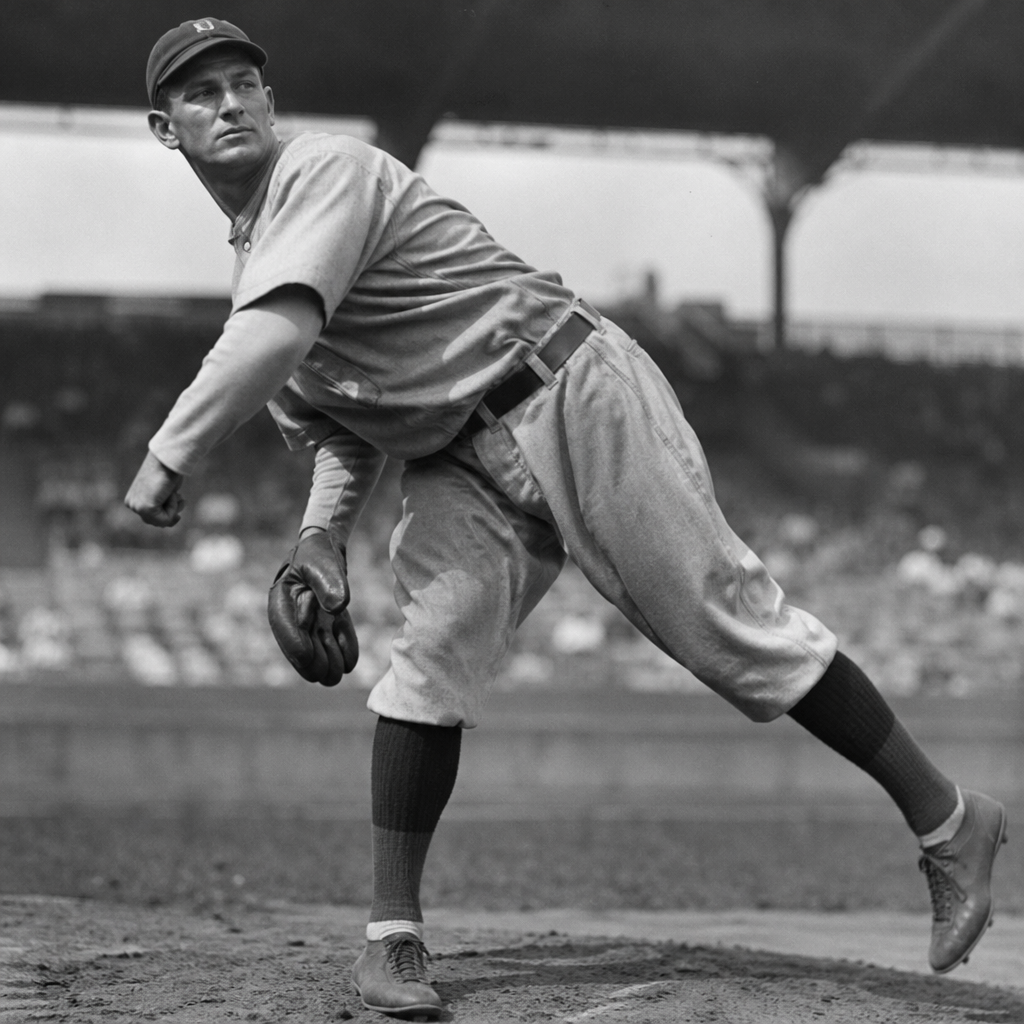
Amos Rusie stands at the center of any serious discussion of early baseball player profiles because his career connects individual brilliance, nineteenth-century rule changes, and the sport’s transition toward the modern game. Nicknamed “The Hoosier Thunderbolt,” Rusie was one of the most overpowering pitchers of the 1890s, a right-hander whose velocity, wildness, and durability made him both feared and unforgettable. For readers exploring legendary players, he is not simply another old star with faded statistics. He is a case study in how one player’s style can force baseball to adapt.
When historians say Rusie helped push the mound back, they are referring to one of the most important pitching rule changes ever made. In the earliest professional decades, pitchers delivered from a box far closer to home plate than today’s regulation sixty feet six inches. By the early 1890s, Rusie and a handful of other hard throwers made that shorter distance look increasingly unfair to hitters. The response was structural, not tactical: the pitching distance was increased in 1893, reshaping offense, defense, and pitcher usage across Major League Baseball.
That alone would justify his place among legendary players, but Rusie’s profile goes deeper. He debuted young, won big with the New York Giants, led the National League in strikeouts multiple times, and regularly worked workloads that would be inconceivable now. He also battled chronic control problems, labor disputes, arm trouble, and the harsh economics of nineteenth-century baseball. Those contradictions matter because they make him more than a mythic fastball. They make him one of the clearest windows into what elite pitching looked like before radar guns, pitch tracking, and modern medical care.
As a hub for player profiles, this article examines Rusie from every useful angle: biography, arsenal, statistics, historical context, rule impact, strengths, weaknesses, and legacy. If you want to understand why his name still appears whenever historians rank dominant nineteenth-century pitchers, this is the foundation. If you want a practical starting point for studying other legendary players, Rusie is ideal because his story touches almost every major theme in baseball history: talent, innovation, resistance to change, labor tension, and the constant search for competitive balance.
Who Amos Rusie Was and Why He Mattered
Amos Wilson Rusie was born in 1871 in Mooresville, Indiana, and reached the majors before his twentieth birthday. He entered professional baseball at a moment when the National League was still defining itself and when the position of pitcher was evolving from initiator of play into primary force. By the time he joined the New York Giants in 1889, teams were already valuing speed and deception, but Rusie operated on another level. Contemporary writers routinely described his fastball in superlatives, and opposing hitters treated a game against him as a physical ordeal.
His importance begins with performance. Rusie won 246 major league games despite a career shortened by disputes and injury. He captured 30 or more wins six times, led the league in strikeouts five times, and was a central figure on strong New York clubs. In 1894 he won 36 games and helped the Giants finish near the top of the standings. In 1891, 1892, 1894, and 1895 he struck out more batters than anyone else in the National League, showing that his stuff remained overwhelming even after the pitching distance changed.
His importance also comes from the type of pitcher he represented. Rusie was not a careful craftsman who survived by nibbling corners. He challenged hitters with power. Accounts from the era mention that catchers and batters dreaded his delivery because of both speed and movement. Control was inconsistent, yet that same wild force contributed to his intimidation factor. In an era before batting helmets and before modern protective equipment for catchers, facing a pitcher like Rusie was materially dangerous.
That combination of dominance and risk made him impossible to ignore. League officials, club owners, and sportswriters understood that if pitchers like Rusie kept operating from the old distance, offense could stagnate and injury concerns would rise. So when people call Rusie the pitcher who helped push the mound back, they are identifying his role as a catalyst. He was not the only reason for the change, but he was the most famous example of why the change became urgent.
How the Pitching Distance Change Happened
Before 1893, pitchers worked from a box with the front line fifty feet from home plate. Rules had gradually given pitchers more freedom overhand, more strategic authority, and more room to exploit velocity. Hitters were already at a disadvantage against elite throwers, and the shorter distance reduced reaction time further. Baseball’s leaders needed a structural correction. They replaced the box with a pitcher’s plate and moved the delivery point back to sixty feet six inches, the distance that still defines the sport.
Rusie’s pitching offered the clearest argument for reform. He led the league in hit batters repeatedly and issued huge walk totals, but those raw numbers need context. Umpiring standards were inconsistent, baseballs were less uniform, fields were rougher, and pitchers routinely worked complete games while fatigued. Even with that context, Rusie’s combination of speed and erratic command made at-bats feel chaotic. The league did not move the mound because he lacked talent. It moved the mound because his talent, applied under existing rules, had become too overpowering.
What changed after 1893? Offense increased sharply across the league because hitters gained a fraction more reaction time. Curveballs broke differently over the longer flight path, and straight fastballs lost some of their shock effect. Pitchers had to adapt with sequencing, command, and endurance rather than pure velocity alone. Rusie remained excellent, which is important evidence in evaluating him historically. The distance change did not expose him as a gimmick. It proved he was a real ace whose stuff was elite enough to remain dominant under tougher conditions.
| Era Element | Before 1893 | After 1893 |
|---|---|---|
| Pitching distance | 50 feet from front line of the box | 60 feet 6 inches from pitcher’s plate |
| Hitter reaction time | Shorter, favoring power pitchers | Longer, improving contact chances |
| Strategic emphasis | Velocity and intimidation | Mix, command, and pitch design |
| Rusie’s significance | Symbol of pitching dominance | Proof elite pitchers could still adapt |
Rusie’s Pitching Style, Strengths, and Weaknesses
I have always found Rusie most interesting when viewed as a full pitching profile rather than a legend reduced to one fastball. Yes, his speed was his defining tool. Every surviving account points to extraordinary pace, likely among the fastest of his century. But power alone does not explain the strikeout totals or the sustained success after the rule change. He paired velocity with a hard breaking ball, a fierce competitive temperament, and the stamina to keep attacking deep into complete games.
His strengths were plain. First, he missed bats at historic rates for his era. Strikeouts were less common in the nineteenth century than many assume because contact-oriented batting and uneven scoring conventions complicate comparisons, yet Rusie still separated himself clearly from peers. Second, he handled huge workloads. Managers expected their best pitchers to finish what they started, and Rusie regularly threw well over 300 innings. Third, he intimidated opponents. That has analytical value because rushed swings, defensive hacks, and altered approaches are real competitive effects.
His weaknesses were equally real. Rusie’s control was often poor even by nineteenth-century standards. He led the league in walks several times and hit many batters. Some of that reflected approach; some reflected mechanics; some reflected fatigue from relentless usage. Modern coaches would likely focus on repeatable release point, lower-half timing, and recovery protocols. He had none of that infrastructure. Instead, he relied on toughness and raw gifts until those gifts were stressed beyond sustainable limits.
That tension between dominance and disorder is exactly why Rusie belongs in any comprehensive player profiles hub. He illustrates a truth that still applies when evaluating legendary players from any era: greatness is not always neat. Some elite athletes dominate because they optimize every detail. Others dominate because their core tool is so overwhelming that the entire environment bends around it. Rusie was the second type, and baseball literally changed the environment.
Statistics That Define His Career
Rusie’s statistical record remains impressive even after adjusting for nineteenth-century context. He finished with a 246-174 record, a 3.07 earned run average, 1,934 strikeouts, and 392 complete games. His career ERA+ of 127 indicates he was twenty-seven percent better than league average at preventing earned runs after park and era adjustment. For historians, ERA+ is especially useful because raw ERA in the 1890s can mislead. League scoring levels changed sharply, and defensive conditions varied. The adjusted number confirms that Rusie was not merely durable. He was genuinely elite.
His peak seasons are even more revealing. In 1890, still just nineteen, he struck out 341 batters. In 1891 he posted 337 strikeouts. In 1892 he won 33 games. In 1894 he went 36-13 with a 2.78 ERA despite pitching in a high-offense environment after the distance change. In 1895 he struck out 201 and again established himself as the league’s most explosive arm. Those totals came while facing lineups multiple times in every outing, often without the defensive support or bullpen relief modern aces expect.
Advanced interpretation matters here. Rusie’s walk totals were enormous, and modern analysts should not ignore that. Yet command problems did not cancel out his value because strikeouts limited balls in play and because his raw stuff suppressed hard contact often enough to compensate. In contemporary language, he was the rare pitcher whose bat-missing ability could absorb inefficiency. The outings were stressful, but the results were frequently dominant.
One more number deserves attention: his Hall of Fame induction came in 1977, decades after his death. That delay reflects how difficult it can be to evaluate nineteenth-century stars whose careers do not fit later patterns. Voters eventually recognized what the best historical research had made clear. Rusie was not a curiosity from baseball’s distant past. He was one of the defining pitchers of his generation.
The Salary Dispute, Arm Trouble, and Career Decline
Any honest profile of Amos Rusie must address why a pitcher this good did not reach 300 wins or build a longer prime. The first reason was labor conflict. In 1896, after another strong season, Rusie clashed with Giants owner Andrew Freedman over salary. Baseball in that period operated under the reserve system, which gave players little leverage. Rusie refused to accept a pay cut, sat out the 1896 season, and lost valuable career time during what should have been a peak year. For modern readers, this dispute is a reminder that legendary players often fought economic battles as hard as competitive ones.
The second reason was physical decline. Rusie returned in 1897 but never fully recaptured his earlier durability. Workloads that once signaled greatness also carried a cost. Repeated complete games, minimal recovery science, and constant max-effort throwing likely damaged his arm and shoulder. Contemporary reports used broad terms such as “sore arm,” but the underlying issue was almost certainly cumulative overuse. Today, sports medicine would identify warning signs much earlier.
He was eventually traded to the Cincinnati Reds in a deal involving Christy Mathewson, a transaction that now reads as a passing of eras. Rusie appeared only briefly for Cincinnati and soon left the majors. His final career line still shines, but it also invites a counterfactual. If he had modern conditioning, financial security, and managed innings, he might have compiled one of the most overwhelming résumés in pitching history. Instead, his greatness arrived compressed, violent, and unforgettable.
Legacy Among Legendary Players and Player Profiles
Rusie’s legacy extends beyond his own numbers because he anchors several broader conversations in baseball history. First, he is central to discussions of rule-driven evolution. Few players can be linked so directly to a permanent structural change in how the sport is played. Second, he is indispensable in conversations about pitching velocity before measurement technology. We cannot assign him an exact miles-per-hour figure with confidence, but the unanimity of contemporary testimony leaves no doubt that he possessed elite speed by any era’s standards.
Third, he offers a template for comparing legendary players across time. When building player profiles, the right question is not whether Rusie looked exactly like a modern ace. Of course he did not. The right question is how far above his own environment he stood, how durable he was relative to his peers, and how much his presence changed strategy and policy. By those standards, he ranks extremely high.
He also remains useful for readers moving deeper into the Legendary Players topic. From Rusie, logical next comparisons include Cy Young for longevity, Christy Mathewson for command and polish, Walter Johnson for speed in a more documented era, and later power pitchers such as Bob Feller and Nolan Ryan for the recurring tension between velocity and control. Rusie sits near the beginning of that lineage. He is not an isolated antique. He is an ancestor of every intimidating power pitcher who ever made hitters feel late before the ball even left his hand.
Amos Rusie deserves his place in every serious collection of baseball player profiles because his story explains more than one career. It explains how exceptional talent can force a sport to change its rules, how dominance should be measured within historical context, and how fragile greatness can be when labor conflict and overuse collide. His record shows a strikeout artist with ace-level value. His reputation shows a pitcher opponents feared. His historical footprint shows a player influential enough to help shape the modern field of play.
For readers exploring legendary players, the main takeaway is simple: Rusie was not merely famous for throwing hard. He was a transformative figure whose fastball, workload, and results made baseball reconsider competitive balance. The mound moved back, offense changed, and the game took a decisive step toward its modern form. Few players can claim that kind of impact.
If you are building a deeper understanding of baseball history, use Amos Rusie as a starting point, then branch into adjacent player profiles from the same lineage of elite pitching. Study the stars before and after the 1893 change, compare their methods, and you will see the sport evolve in real time. That is the real benefit of this hub: it turns legendary names into connected history, and Rusie is one of the best places to begin.
Frequently Asked Questions
Who was Amos Rusie, and why is he such an important figure in early baseball history?
Amos Rusie was one of the most dominant and influential pitchers of the nineteenth century, and his importance goes well beyond wins and strikeouts. Nicknamed “The Hoosier Thunderbolt,” he became famous in the 1890s for overpowering hitters with extraordinary speed at a time when baseball was still evolving into its modern form. Rusie pitched primarily for the New York Giants and quickly built a reputation as a force of nature on the mound. He was the kind of player who could overwhelm opponents with raw stuff, but he also embodied the chaos and intensity of an era when the sport’s rules, equipment, and strategies were still being refined.
What makes Rusie especially significant is that his career sits at the crossroads of individual greatness and structural change in baseball. He was not just a star of his time; he was one of the players whose style and effectiveness helped expose the limits of the game’s earlier rules. His blazing fastball and intimidating presence highlighted how much advantage elite pitchers could gain under nineteenth-century conditions. That made him a central figure in discussions about fairness, offense, and the need to reshape the sport. In that sense, Amos Rusie is remembered not only as a legendary pitcher, but also as a player whose career helped push baseball closer to the modern game fans recognize today.
Why is Amos Rusie associated with the rule change that moved the pitching mound back?
Amos Rusie is closely linked to the decision to move the pitcher’s position farther from home plate because he represented the extreme end of pitching dominance in his era. In the late nineteenth century, pitchers worked from a shorter distance than they do today, which gave hard throwers a tremendous advantage. Rusie’s velocity was so exceptional that hitters often struggled simply to react. His fastball was widely considered one of the most explosive in baseball, and when combined with the already pitcher-friendly distance of the time, it made him one of the most feared men in the sport.
The mound was moved back in 1893, when the pitching distance was changed to 60 feet 6 inches, a number that remains the standard today. While this rule change was not made because of Rusie alone, he became one of the clearest symbols of why change was needed. His performances demonstrated how overpowering elite pitchers could be under the old setup, and baseball’s rulemakers were looking for ways to rebalance the contest between pitcher and hitter. Rusie’s career therefore serves as a vivid example of how a single player can influence broader conversations about rules and competitive balance. He did not merely adapt to a changing game; in many ways, his dominance helped force the game to change around him.
What kind of pitcher was Amos Rusie, and what made him so difficult for hitters to face?
Amos Rusie was the classic power pitcher before the modern age of radar guns, televised games, and advanced analytics. Contemporary accounts consistently described him as extraordinarily fast, to the point that his pitching seemed almost shocking for the period. He attacked hitters with force, confidence, and a willingness to challenge them repeatedly. That raw velocity alone would have made him dangerous, but Rusie’s effectiveness also came from how his stuff played within the conditions of the 1890s. Hitters of the era faced different gloves, rougher fields, less standardized balls, and a style of play that often put them at a disadvantage against a pitcher with premium speed.
At the same time, Rusie was known for his wildness, and that wildness was part of what made him so intimidating. He did not always have pinpoint command, which meant batters had to respect not only his speed but also the possibility that the ball might move unpredictably or come too close for comfort. In an age before extensive protective gear, that mattered. He was also durable, carrying heavy workloads that would be almost unimaginable for most modern pitchers. His combination of power, stamina, and volatility created a unique challenge for opponents. Facing Rusie was not just about trying to get a hit; it was about surviving an overpowering presence who could dominate a game through sheer force.
How successful was Amos Rusie during his major league career?
By the standards of his era, Amos Rusie was an extraordinary success. He won well over 200 games, posted several elite seasons, and led the league in major categories that underscored both his dominance and his durability. He was especially known for strikeouts, which stood out dramatically in an era when not every pitcher relied on overpowering hitters in the same way. Rusie won multiple pitching titles and regularly ranked among the National League’s most important players during the 1890s. His peak was strong enough to establish him as one of the defining stars of that decade.
His career, however, was not simply a story of uninterrupted greatness. Like many nineteenth-century players, Rusie dealt with the physical toll of heavy use, contract disputes, and the instability that often shaped baseball careers in that period. Those factors limited the length of his prime and contributed to an earlier decline than fans might expect from such a dominant talent. Even so, his accomplishments were more than enough to preserve his legacy. Historians and baseball scholars continue to place him among the premier pitchers of early professional baseball, and his eventual induction into the Baseball Hall of Fame confirmed that his impact was not temporary or anecdotal. He remains one of the clearest examples of a player whose brilliance defined an era.
What is Amos Rusie’s legacy in the broader story of baseball’s evolution?
Amos Rusie’s legacy is powerful because it combines performance, personality, and historical consequence. He is remembered as one of the game’s first truly terrifying flamethrowers, a pitcher whose speed inspired awe long before modern measurement tools could quantify it. That alone would make him noteworthy, but his deeper legacy lies in how clearly his career reflects baseball’s transition from a rough-edged nineteenth-century sport into a more standardized and balanced modern game. When people study Rusie, they are not just looking at an old box score legend; they are looking at a player who helps explain why baseball evolved the way it did.
His story also illustrates an important truth about sports history: sometimes the most influential athletes are the ones who reveal a flaw or imbalance in the rules of their time. Rusie’s dominance helped show that the old pitching distance gave too much power to elite arms, and the response to that problem permanently changed the geometry of the sport. Today, every pitch thrown from 60 feet 6 inches carries a faint historical echo of that era. For that reason, Rusie deserves recognition not only as a Hall of Fame pitcher, but also as a catalyst in baseball’s long development. He stands as one of the rare players whose legacy is written both in the record book and in the rules of the game itself.