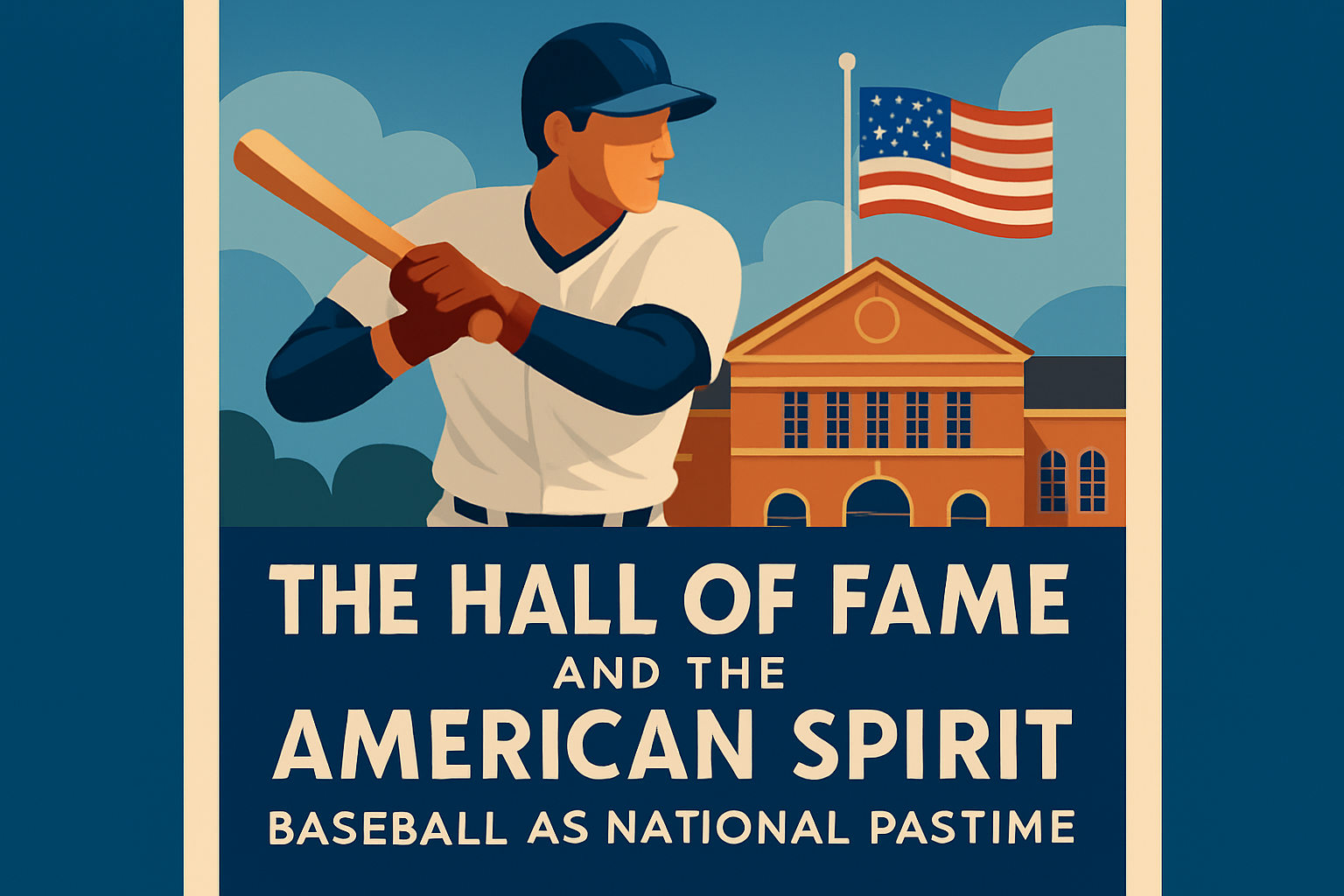
Baseball’s Hall of Fame is more than a museum in Cooperstown; it is a civic archive of the American spirit, preserving how a game became the national pastime and why its stories still shape the country’s identity. When I have walked through the Hall’s plaque gallery, the effect is immediate: bronze faces stare back not only as athletes, but as symbols of ambition, immigration, segregation, integration, labor, media, and memory. To understand the Hall of Fame and the American spirit, it helps to define both terms clearly. The National Baseball Hall of Fame and Museum, founded in 1939, honors players, managers, executives, umpires, and pioneers whose impact on baseball proved enduring. The “American spirit” is broader, but in this context it means the values and contradictions often attached to the United States: competition, reinvention, community, mobility, argument, and belief in shared rituals.
Baseball became the national pastime not because it was the only game Americans loved, but because it spread alongside the nation’s growth. Railroads connected teams and towns. Newspapers standardized statistics and heroes. Radio carried the crack of the bat into homes. Military service and factory shifts gave workers and soldiers a common language of innings, averages, pennant races, and legends. The Hall of Fame matters because it formalizes that language. It tells visitors which careers are considered exemplary, which eras are worth remembering, and which debates remain unsettled. For searchers asking what makes baseball different from football or basketball in national symbolism, the answer is that baseball built a deep historical record around everyday life. Its long season, local rhythms, and obsession with numbers turned it into a mirror of the country.
That mirror is not always flattering. The Hall and the sport carry triumphs and exclusions at once. The story includes Babe Ruth and Jackie Robinson, but also the Negro Leagues, labor disputes, performance-enhancing drug controversies, and long delays in honoring overlooked contributors. That complexity is exactly why the Hall of Fame remains relevant. It is a place where America’s ideals meet America’s habits, where myth and evidence sit side by side. Baseball as national pastime is not just nostalgia. It is a record of how Americans have chosen heroes, argued over fairness, measured excellence, and revised the past when new facts and values demanded it.
Why Cooperstown Became Baseball’s Memory Bank
Cooperstown, New York, became the symbolic home of baseball through a mix of civic promotion, mythmaking, and institutional timing. The old claim that Civil War hero Abner Doubleday invented baseball there in 1839 has been thoroughly discredited by historians, who trace the game’s development through bat-and-ball predecessors such as rounders and town ball. Yet the myth helped local boosters and baseball officials anchor the Hall in one physical place. That matters because national memory often needs a shrine. In my experience visiting sports museums, the strongest ones do not just display artifacts; they create a geography of belief. Cooperstown did exactly that.
The Hall opened in 1939 during baseball’s centennial celebrations, at a moment when Major League Baseball wanted permanence and prestige. The timing was strategic. The United States was emerging from the Great Depression and approaching global war. Institutions that promised continuity carried unusual power. Baseball offered that continuity through records, rituals, and famous names. The Hall transformed a commercial sport into a national heritage project. Today its collections include millions of items, from uniforms and scorecards to scouting reports and audio archives. For anyone asking what the Hall of Fame actually does, the practical answer is simple: it preserves artifacts, interprets history, and recognizes excellence through induction.
That recognition process is central to the Hall’s authority. The Baseball Writers’ Association of America votes on many modern candidates, while era committees consider others from specific historical periods. The standards are not purely statistical, and that is why Hall debates never end. Voters weigh performance, longevity, character, postseason impact, innovation, and historical significance. A player with 3,000 hits presents one type of case; a pioneer who changed scouting, integration, or player development presents another. The Hall’s power comes from being selective. Scarcity creates meaning. Induction tells fans that greatness is not only about fame, but about lasting consequence.
How Baseball Came to Represent the American Character
Baseball reflects the American character because its structure rewards both individual achievement and collective discipline. Every plate appearance is a personal test, yet no star can bat alone. That tension resembles American ideals about self-reliance within institutions. The sport also unfolds without a clock, which gives it a distinct cultural symbolism. Football and basketball are driven by time pressure; baseball is driven by situation, patience, and accumulation. In plain terms, a team must earn 27 outs, and no lead is secure until the final one is recorded. That open-ended drama has long suited a nation that tells stories about possibility and comeback.
The game’s statistical culture deepened that connection. Baseball generated box scores, earned run average, on-base percentage, Wins Above Replacement, and endless comparative records long before analytics transformed other sports. Americans have often trusted numbers as a language of fairness, even when those numbers are interpreted imperfectly. I have seen how fans use statistics to argue merit across generations, almost like a civic debate. Did Sandy Koufax’s peak outweigh another pitcher’s longevity? Does WAR capture defense well enough to compare shortstops from different eras? These are sports questions, but they also echo larger American habits: quantifying performance, ranking achievement, and treating data as evidence in public argument.
Baseball also became national through repetition and reach. By the early twentieth century, companies, schools, mills, and military units fielded teams. Immigrant neighborhoods used baseball to claim belonging. Small towns built identities around local diamonds. Big-city franchises became emotional infrastructure. The game scaled from sandlots to Yankee Stadium without losing its basic grammar: four bases, three outs, nine innings. That simplicity made it teachable, portable, and marketable. It also made baseball excellent material for newspapers and radio, two media systems that built national communities before television and social platforms existed.
The Hall of Fame as a Record of Inclusion, Exclusion, and Repair
No honest article about baseball and the American spirit can avoid race. For decades, organized baseball excluded Black players from the major leagues, even as Black excellence flourished in the Negro Leagues. The Hall of Fame now recognizes stars and executives from that world, including Satchel Paige, Josh Gibson, Buck Leonard, and Cum Posey, but those honors came after years of neglect. Jackie Robinson’s 1947 debut with the Brooklyn Dodgers is rightly treated as a turning point, yet integration was not a single event. It was a contested process involving scouting, ownership, fan behavior, travel discrimination, and unequal opportunity long after the color line officially broke.
The Hall’s evolution reflects that history. Its exhibits and inductions have gradually widened the frame from a narrow major league narrative to a fuller account of Black baseball, women in the game, Latin American influence, labor movements, and overlooked innovators. That shift matters because museums do not just preserve facts; they signal whose experiences count. When visitors see Robinson, Larry Doby, Minnie Miñoso, Roberto Clemente, or Effa Manley honored prominently, they learn that baseball’s national story was always multinational and multiracial, even when institutions failed to admit it.
| Figure | Why the Hall Recognition Matters | American Theme |
|---|---|---|
| Jackie Robinson | Integrated MLB in 1947 under extreme pressure | Civil rights and courage |
| Satchel Paige | Validated Negro Leagues brilliance on a national stage | Repairing historical exclusion |
| Roberto Clemente | Linked elite performance with humanitarian service | Dignity, citizenship, service |
| Effa Manley | Recognized Black executive leadership in Newark | Visibility beyond the field |
Repair, however, is not the same as completion. Historians still debate whether Hall standards adequately capture Negro Leagues records, pre-integration conditions, and the structural barriers that limited careers. Similar concerns apply to women’s baseball, represented in part through the All-American Girls Professional Baseball League, and to international pipelines that enriched Major League Baseball while often exploiting young talent. The best way to understand the Hall, then, is as a living institution. It is strongest when it admits that baseball’s heritage includes both celebration and correction.
Greatness, Controversy, and the Standards of Honor
One reason the Hall of Fame fascinates Americans is that it forces a hard question: what does a society honor when excellence and imperfection coexist? In baseball, this question surfaces around gambling, character clauses, sign stealing, and performance-enhancing drugs. Pete Rose owns the all-time hits record, yet his betting on games as a manager led to permanent ineligibility. Barry Bonds and Roger Clemens produced Hall-caliber careers by any statistical measure, but steroid allegations changed their candidacies. These cases attract lasting attention because the Hall is not simply a leaderboard. It is a moral and historical institution.
From an expert standpoint, there is no fully neutral standard. Baseball Reference WAR, JAWS created by Jay Jaffe, and milestone totals such as 500 home runs or 300 wins help compare players, but Hall voting always involves judgment. Character clauses sound straightforward until voters apply them unevenly across eras. Amphetamine use, segregation-era silence, spitball doctoring, and owner misconduct all complicate neat lines between acceptable and unacceptable behavior. In practice, Hall debates reveal how Americans negotiate fairness: we want rules, precedents, and evidence, yet we also reserve room for narrative, intent, and context.
This is where the Hall mirrors the country again. Americans admire redemption stories, but they also distrust institutions that appear selective or inconsistent. A museum that honors Ty Cobb’s ferocity, celebrates Ruth’s excess, condemns Rose’s gambling, and hesitates on steroid-era stars invites scrutiny. That scrutiny is healthy. It keeps the Hall from becoming pure mythology. When fans argue over who belongs, they are really arguing about the standards a national culture should use when memory becomes honor. Baseball remains the national pastime partly because it gives the public a recurring forum for those arguments.
Why the National Pastime Still Endures
Baseball no longer dominates television ratings the way the NFL does, and younger audiences divide their attention across streaming, gaming, and global sports. Still, baseball endures because national pastimes do not depend only on being the biggest current product. They depend on ritual depth, historical continuity, and intergenerational transmission. Opening Day still feels ceremonial in a way few sports dates do. Summer still belongs naturally to a ballgame on radio. Families still teach scorekeeping, card collecting, and park traditions as forms of inheritance. Those habits matter more than any single season’s ratings.
The Hall of Fame sustains that endurance by turning baseball into a usable past. It gives fans, researchers, and casual visitors a structured way to connect today’s game with nineteenth-century roots, Negro Leagues brilliance, midcentury pennant races, sabermetric revolutions, and modern stars. It also reinforces that baseball’s meaning lies beyond championships. A losing franchise can still produce a Hall of Famer. A regional fan base can still feel represented in the national story. That inclusive memory is one reason baseball remains culturally resilient.
For anyone asking whether baseball is still the national pastime, the best answer is yes, but in a historical and symbolic sense rather than a purely commercial one. It remains the sport Americans use to narrate continuity, citizenship, and change. The Hall of Fame is the institution that collects those narratives and tests them against evidence. Together, they show that the American spirit is not a slogan. It is a contested inheritance built from records, arguments, icons, and revisions. Visit the Hall, revisit the game’s history, and you will see why baseball still offers the country one of its clearest ways to remember itself.
Frequently Asked Questions
Why is the Baseball Hall of Fame often described as more than just a museum?
The Baseball Hall of Fame is often described as more than a museum because it preserves far more than bats, uniforms, and statistics. In Cooperstown, the story of baseball becomes a story about the United States itself. The Hall collects and interprets the people, conflicts, ideals, and turning points that helped shape the game, and in doing so it also captures major themes in American life. When visitors move through its galleries, they encounter immigration, industrialization, racial segregation, civil rights, labor struggles, media expansion, celebrity culture, and regional identity all through the lens of baseball. That is why the Hall feels less like a static exhibit space and more like a civic archive. It shows how a game became woven into everyday life and how generations of Americans used baseball to express ideas about fairness, opportunity, belonging, and national memory.
Its significance also comes from the role it plays in honoring collective memory. The plaque gallery is not simply a place where great players are recognized; it is a place where the country decides which stories deserve lasting public attention. The faces on those plaques represent excellence, but they also represent deeper cultural meaning. Some symbolize immigrant ambition, some the breaking of barriers, some the growth of mass entertainment, and others the complicated relationship between heroism and historical scrutiny. In that sense, the Hall of Fame serves as a public conversation about American values. It does not merely ask who played the game well. It asks what the game has meant, who got to belong, and how baseball has reflected the nation at its best and at its most conflicted.
How does baseball reflect the American spirit and national identity?
Baseball reflects the American spirit because the game has long been linked to ideas that Americans have historically celebrated: aspiration, reinvention, persistence, competition, and hope. For generations, baseball has offered a language through which people understand success and failure. A player can fail repeatedly and still be considered great, which mirrors a broader national faith in resilience and second chances. The rhythms of the sport also connect it to the country’s self-image. Baseball unfolds slowly enough to invite storytelling, reflection, and ritual, yet it also contains moments of sudden drama and transformation. That blend of patience and possibility has made it feel especially American to many fans and writers.
At the same time, baseball reflects national identity because it reveals the country’s contradictions as clearly as its ideals. The sport has been a site of inclusion and exclusion, unity and division, nostalgia and change. It has welcomed waves of immigrant communities who found in local teams and ballparks a way to enter American public life, yet it also enforced racial segregation for decades. It became a source of democratic feeling because anyone could follow it, debate it, and pass it down through family and community, but it also mirrored economic inequality, labor tensions, and battles over power. This is precisely why baseball remains so powerful as a national symbol. It does not offer a simple patriotic myth. Instead, it presents a more honest picture of America as a country constantly negotiating who it is and who it wants to become.
What role does the Hall of Fame play in preserving difficult parts of baseball history, such as segregation and integration?
The Hall of Fame plays a crucial role in preserving difficult parts of baseball history because the story of the national pastime cannot be told honestly without confronting exclusion, prejudice, and the long struggle for equality. Baseball’s history includes the color line that barred Black players from the major leagues, the rise and brilliance of the Negro Leagues, and the monumental significance of integration. By preserving artifacts, testimonies, records, and biographies connected to these eras, the Hall helps visitors understand that baseball was never separate from the larger moral and political battles taking place across American society. It becomes a place where triumph is acknowledged, but where injustice is also documented and remembered.
This matters because institutions of memory shape public understanding. When the Hall interprets figures such as Jackie Robinson, Satchel Paige, Buck O’Neil, and many others, it is not only celebrating athletic talent. It is showing how baseball became a stage on which the nation’s racial hierarchy was both enforced and challenged. Integration was not merely a sports milestone; it was an American turning point that revealed how change often comes through extraordinary courage under intense pressure. By preserving these stories in detail, the Hall of Fame encourages a fuller and more responsible form of remembrance. It reminds visitors that the American spirit is not only about pride and achievement, but also about the difficult work of reckoning with injustice and expanding the promise of inclusion.
Why does the plaque gallery in Cooperstown have such a powerful emotional effect on visitors?
The plaque gallery has a powerful emotional effect because it transforms baseball history into human presence. Visitors are not just reading names in a book or scanning numbers on a wall. They are standing in front of carefully crafted bronze likenesses that present players, managers, executives, and pioneers as enduring public figures. There is something immediate and almost solemn about that encounter. The gallery invites people to slow down and consider what each face represents, not only in terms of achievements on the field, but in terms of larger historical meaning. For many visitors, the experience feels ceremonial, as if they are entering a space where memory has been formalized and entrusted to the nation.
The emotional impact also comes from what the plaques symbolize collectively. Seen together, they tell a multigenerational story about talent, ambition, heartbreak, innovation, and transformation. One plaque may evoke family memories of listening to games on the radio. Another may recall a city’s civic pride, an era of social change, or a player whose career altered the boundaries of what seemed possible. The gallery gathers all of those private and public memories into one shared space. That combination of personal nostalgia and national storytelling is what makes the room feel so powerful. It reminds visitors that baseball is not simply a record of wins and losses. It is a repository of lived experience, passed across generations and attached to the country’s evolving sense of itself.
Why does baseball still matter to American culture even as other sports dominate headlines?
Baseball still matters to American culture because its significance has never depended solely on television ratings, trend cycles, or whether it is the loudest sport in the media at a given moment. Its power lies in how deeply it is embedded in the country’s memory, language, and civic life. Americans still use baseball metaphors to talk about politics, business, and everyday experience because the sport has shaped the national vocabulary of risk, effort, and opportunity. The game also remains tied to rituals that feel distinctly communal: opening day, summer afternoons at the ballpark, scorekeeping, family traditions, neighborhood teams, and stories handed down from one generation to the next. Even for people who do not follow the sport closely, baseball continues to function as a cultural reference point.
Just as importantly, baseball still matters because it offers a uniquely expansive historical record through which Americans can examine themselves. Other sports may dominate the immediate spotlight, but baseball’s long timeline allows the country to trace changes in race, labor, migration, urban growth, media technology, and celebrity across more than a century of public life. The Hall of Fame reinforces that importance by preserving the game as a national archive, not merely as entertainment. In that sense, baseball endures because it connects past and present in a way few institutions can. It gives Americans a place to revisit foundational questions about identity, fairness, belonging, and memory. That is why, even in a crowded sports culture, baseball remains central to understanding the American spirit.