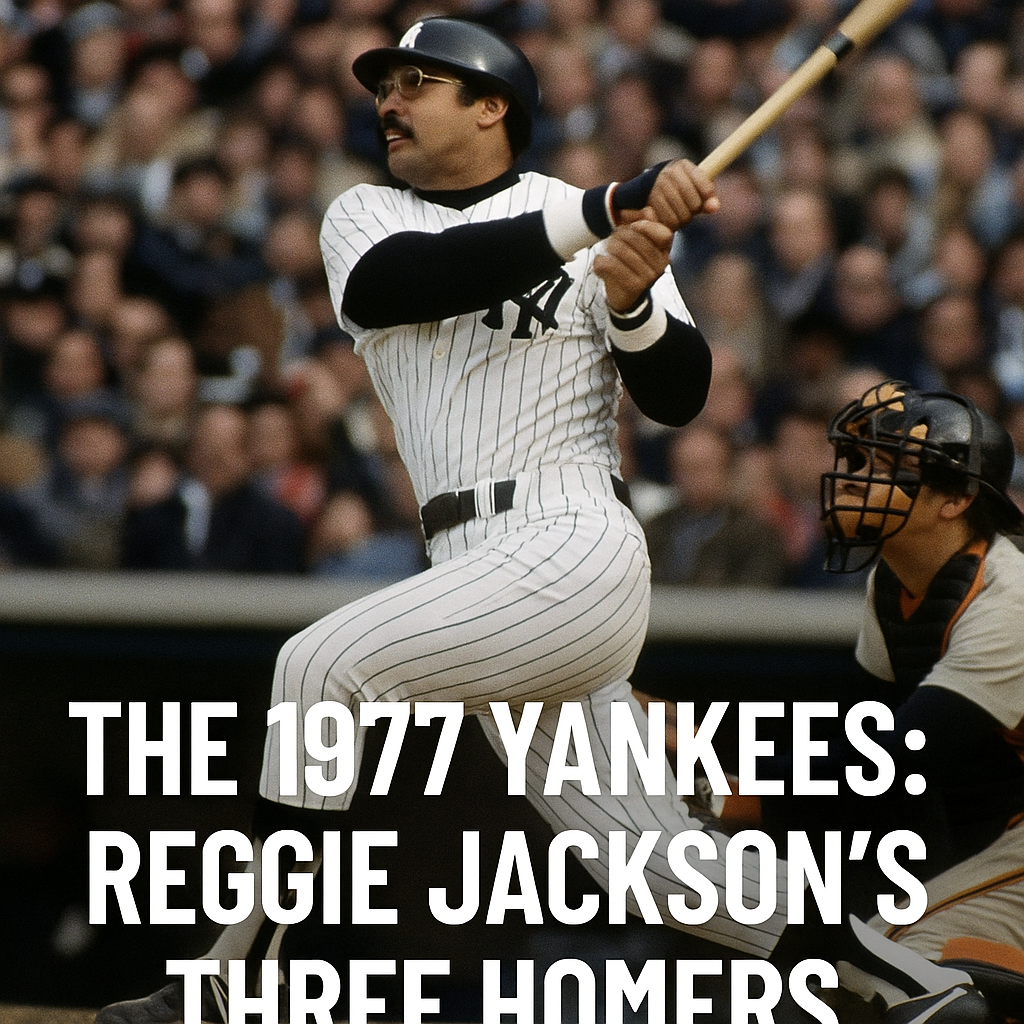
In the long and storied history of Major League Baseball, certain games are etched into the collective memory of fans and historians alike. One such game occurred on October 18, 1977, when the New York Yankees faced the Los Angeles Dodgers in Game 6 of the World Series. This game, played at Yankee Stadium, is remembered primarily for the extraordinary performance of Reggie Jackson, whose exceptional display of power cemented his legacy in the annals of baseball history. Known for his larger-than-life personality and remarkable talent, Jackson, who was nicknamed “Mr. October” for his postseason heroics, delivered a performance for the ages by hitting three home runs in a single World Series game. This feat helped lead the Yankees to a World Series title, marking their first championship since 1962 and revitalizing the franchise. The impact of Jackson’s achievement extends beyond his Hall of Fame career and speaks volumes about the rich tapestry of baseball moments that captivate fans year after year. Over the following paragraphs, we will delve deeply into the dynamics of that fateful night, explore Jackson’s career and character, analyze the significance of his performance, and reflect on the lasting impact of his achievement. Through this narrative, we aim to capture the excitement, drama, and implications of Reggie Jackson’s memorable night at Yankee Stadium in 1977.
The Build-Up to the 1977 World Series
The 1977 New York Yankees were a team in transition, laden with talent and drama in equal measure. Prior to the season, they had acquired Reggie Jackson, a powerful hitter and an enigmatic figure known for his outspoken nature. His arrival in New York was not without controversy, as tensions in the clubhouse often ran high. Manager Billy Martin, known for his fiery temperament, and Jackson clashed multiple times throughout the season, fueling a media frenzy that kept the Yankees constantly in the spotlight. Despite internal discord, the Yankees, thanks to their potent combination of skilled pitching and formidable batting lineup, clinched the American League East title. They battled through the playoffs to earn a spot in the World Series against the Los Angeles Dodgers.
The Dodgers, another historic baseball franchise, were formidable opponents. With key players such as Steve Garvey, Ron Cey, and Dusty Baker, the Dodgers had enjoyed a successful season and were eager to reclaim the title they last won in 1965. Both teams were renowned for their heavy-hitting lineups, setting the stage for an electrifying World Series. The series was hard-fought and intense, with each team bringing their best to the diamond, resulting in a thrilling scenario where the Yankees led the series three games to two coming into Game 6. Everything was on the line for the final game at Yankee Stadium, ready for an unforgettable showdown.
Reggie Jackson’s Three Home Runs
On the night of October 18, 1977, Reggie Jackson stepped into the limelight with a performance that would be etched into baseball lore. Yankee Stadium, teeming with anticipation and a capacity crowd of over 56,000 fans, provided the perfect backdrop for Jackson’s monumental feat. In a game where legends are made, Jackson seized the moment and immortalized his nickname, “Mr. October.”
Jackson’s first home run came in the fourth inning, shaking the stadium with his powerful swing. He faced Dodgers pitcher Burt Hooton and sent the ball out of the park on the first pitch he saw. The crowd erupted as the home run soared over the right-field fence, igniting a sense of belief amongst Yankee fans that victory was achievable. But Jackson wasn’t done. His second home run came in the fifth inning. This time, he faced Elias Sosa and once again sent the ball over the right-field fence on the first pitch of the at-bat. The power, precision, and timing of his swing were remarkable, and the fans, now in a fervor, sensed history in the making.
Jackson’s third home run, which came in the eighth inning, was the crowning moment of his extraordinary night. Tired but resolute, Jackson stepped to the plate to face knuckleballer Charlie Hough. As before, on the very first pitch, he launched the ball over the center-field fence. With that swing, Jackson became just the second player in baseball history, following Babe Ruth, to hit three home runs in a single World Series game. As the stadium exploded in sheer ecstasy, Reggie Jackson rounded the bases, cementing his legacy as one of the game’s all-time great performers on the biggest stage.
Understanding Reggie Jackson: The Context Behind the Player
Reggie Jackson’s rise to fame was not just a matter of talent but also a story of charisma and resilience. Born in Wyncote, Pennsylvania, in 1946, Jackson showcased his baseball skills early in school, eventually leading him to Arizona State University where he continued to impress scouts with his athletic prowess. In 1966, the Kansas City Athletics drafted Jackson, marking the start of his professional baseball career. His transition to the Oakland Athletics, who moved from Kansas City to Oakland, paralleled his development into a formidable force on the field.
During his time with the Athletics, Jackson honed his power-hitting skills, becoming an integral part of the A’s teams that won three consecutive World Series titles from 1972 to 1974. In Oakland, Jackson earned his first All-Star honors and solidified his reputation as a clutch performer in the postseason. However, financial disputes and a desire for a more national stage ultimately led to his departure.
Signing with the Yankees as a free agent in 1976 brought him to the heart of baseball’s biggest market. Jackson’s personality and ability made him tailor-made for the bright lights of New York. Yet, his first season was not free of strife. He was famously quoted as saying he was “the straw that stirs the drink,” which did not sit well with his teammates or manager, causing tension in the Yankees’ clubhouse. Despite these challenges, Jackson’s on-field performance was undeniable, and his dynamics with the media and fans helped create an aura that redefined the idea of a sports superstar.
The Impact of the 1977 World Series on the Yankees
Reggie Jackson’s heroics in Game 6 were pivotal in sealing the Yankees’ victory over the Dodgers, delivering the franchise its 21st World Series title. This triumph signified more than just athletic success; it was symbolic of the Yankees’ resurgence as a dominant force in baseball. The 1977 championship, underpinned by Jackson’s emphatic performance, reignited a winning culture that the Yankees would maintain for years to come.
For the players, management, and fans, the victory validated the choices made in assembling a talented, albeit volatile, team. Jackson, whose potential was often marred by his contentiousness, was now embraced as an undeniable hero. His performance became a benchmark for Yankees legends who would follow, reinforcing the ethos that postseason excellence is paramount at the club.
The Yankees, fueled by the momentum of their victory, continued to achieve success, claiming another World Series championship the following year. This period of success laid the groundwork for the Yankees of the future, instilling a tradition of winning and an insistence on the pursuit of excellence—a standard that has driven the franchise to this day.
Legacy of Reggie Jackson’s Performance
The three-home run game against the Dodgers in 1977 remains a defining moment not only in Reggie Jackson’s career but also in baseball history. His performance encapsulates the essence of clutch hitting and the ability to excel under pressure. “Mr. October” became a moniker synonymous with Jackson, and he embraced this identity throughout the remainder of his career.
Jackson’s legacy extends beyond his individual accolades and championships. His ability to uplift his teammates and capture the imagination of fans has left an indelible mark. The image of Jackson rounding the bases after each home run is a scene replayed countless times, and it continues to inspire future generations of players who aspire to perform at the highest level during the most critical moments.
Baseball’s narrative is rich with stories of unforgettable triumphs, and Jackson’s performance is a quintessential example of how one player’s remarkable effort can galvanize a team, city, and sport. For the Yankees, it reinforced their role as baseball’s marquee franchise, serving as a reminder of the power of resilience, preparation, and seizing the moment when the stakes are at their highest.
Conclusion
The events that transpired at Yankee Stadium on October 18, 1977, remain among the most celebrated in baseball history. Reggie Jackson’s three home runs in Game 6 of the World Series symbolized the quintessential element of sport: the ability of an individual to rise to the occasion and achieve greatness at a critical moment. This night transformed Jackson from an outstanding player into an icon of the game, embodying the thrill of postseason baseball and the relentless pursuit of excellence. For the Yankees, it marked the beginning of a new era of success and instilled a legacy of championship ambition that continues to this day. The story of Jackson’s three home runs is a narrative of triumph, legacy, and the timeless allure of baseball—a true testament to the sport’s enduring ability to captivate and inspire. By embracing the challenges, internal conflicts, and competitive rivalries, Jackson’s legacy is a beacon that reminds us that greatness is not just achieved but is forged under pressure, urgency, and the will to emerge victorious against formidable odds.
As we reflect on this legendary feat, we honor the spirit of sportsmanship and the transformative power of unforgettable performances that unite fans, inspire players, and define eras. Reggie Jackson, with his unique blend of charisma, talent, and determination, delivered a performance as iconic as any in the history of Major League Baseball, leaving an indelible mark that will be celebrated for generations to come.
Frequently Asked Questions
1. What is the significance of Reggie Jackson’s performance in the 1977 World Series Game 6?
The significance of Reggie Jackson’s performance in Game 6 of the 1977 World Series cannot be overstated. On October 18, 1977, at Yankee Stadium, Jackson delivered one of the most memorable performances in baseball history, cementing his nickname “Mr. October.” During this game, he hit three home runs off three different pitchers, with each blast coming on the first pitch. This achievement helped the New York Yankees clinch the World Series title against the Los Angeles Dodgers, marking their 21st championship win. Jackson’s explosive power display not only elevated him into baseball royalty but also made the game immortal in the annals of baseball lore. It was a night that showcased his flair for drama and ability to perform under immense pressure, solidifying his legacy as one of the game’s greatest postseason performers.
2. How did Reggie Jackson hit three home runs in one game?
Reggie Jackson’s feat of hitting three home runs in a single World Series game is both a testament to his prowess as a hitter and an example of perfect timing and pitch recognition. On that October night in 1977, Jackson faced off against three different Dodgers pitchers: Burt Hooton, Elias Sosa, and Charlie Hough. What made this remarkable was not just the number of homers, but the fact that each was hit off a different pitcher, and all on the first pitch. Jackson’s first home run came off Burt Hooton’s fastball, the second was a drive off Elias Sosa’s meatball down the middle, and the third, a majestic clout over the center-field fence, was against Charlie Hough’s knuckleball. His ability to adjust to different pitching styles and capitalize on the first good pitch he saw underscored his exceptional hand-eye coordination and quick reflexes. It was as if Jackson could predict each pitch, a true reflection of his keen baseball instincts and extraordinary skills.
3. What impact did Reggie Jackson’s three home runs have on his career and the Yankees?
Reggie Jackson’s performance in Game 6 of the 1977 World Series was pivotal not just for the immediate success of the Yankees, but also for his long-term career legacy. For Jackson, this incredible game solidified his reputation as a clutch performer, earning him the moniker “Mr. October.” This performance was pivotal in enhancing his status as a Hall of Fame-caliber player and ensuring his place in baseball history. For the Yankees, Jackson’s heroics provided the necessary spark to secure the 1977 World Series championship, a victory that not only reaffirmed their formidable presence in Major League Baseball but also marked the beginning of a new era of Yankees dominance. His performance bolstered the morale of the team and fanbase alike, contributing to the iconic and enduring image of the Yankees as perennial titans of the sport. Jackson’s three homers became a symbol of excellence and the pinnacle of individual and team success under pressure.
4. How did fans and the media react to Reggie Jackson’s three home runs during the game?
The reaction to Reggie Jackson’s historic three-home-run performance was nothing short of euphoric. Fans at Yankee Stadium witnessed something extraordinary and responded with overwhelming excitement and admiration. The “Reggie! Reggie!” chants echoed throughout the stadium, a testament to his impact on the game and his connection with the fans. For many, it was a once-in-a-lifetime experience to witness such a display of athletic greatness in person. The media also lavished Jackson with praise, with headlines across the nation heralding his heroics and relaying the narrative of “Mr. October” becoming more than just a nickname—it was a persona. Analysts and commentators highlighted his incredible ability to seize the moment, showcasing his capacity to deliver when the stakes were the highest. This collective acknowledgment not only immortalized this game in the annals of sports history but also propelled Jackson to new heights of fame and admiration.
5. How does Reggie Jackson’s performance in the 1977 World Series compare to other great performances in MLB history?
Reggie Jackson’s three-home-run game in the 1977 World Series stands as one of the greatest individual performances in Major League Baseball’s storied past. While baseball history is rich with remarkable feats, Jackson’s achievement is often placed alongside iconic performances like Babe Ruth’s own World Series heroics or Kirk Gibson’s legendary pinch-hit homer in 1988. What makes Jackson’s feat extraordinary is not just the statistical rarity but the dramatic context: the World Series, with the championship on the line, and the vivid personality and flair he brought to the field. Hitting three home runs in a single World Series game had only been done once before, and Jackson’s ability to do it in front of a rapt national audience further embellished its historic impact. His performance remains a benchmark for postseason excellence and is continually evoked as a measure of extraordinary clutchness and the defining capability of a superstar delivering under pressure. Few performances capture the spirit and drama of baseball as beautifully as Jackson’s iconic night in the Bronx.