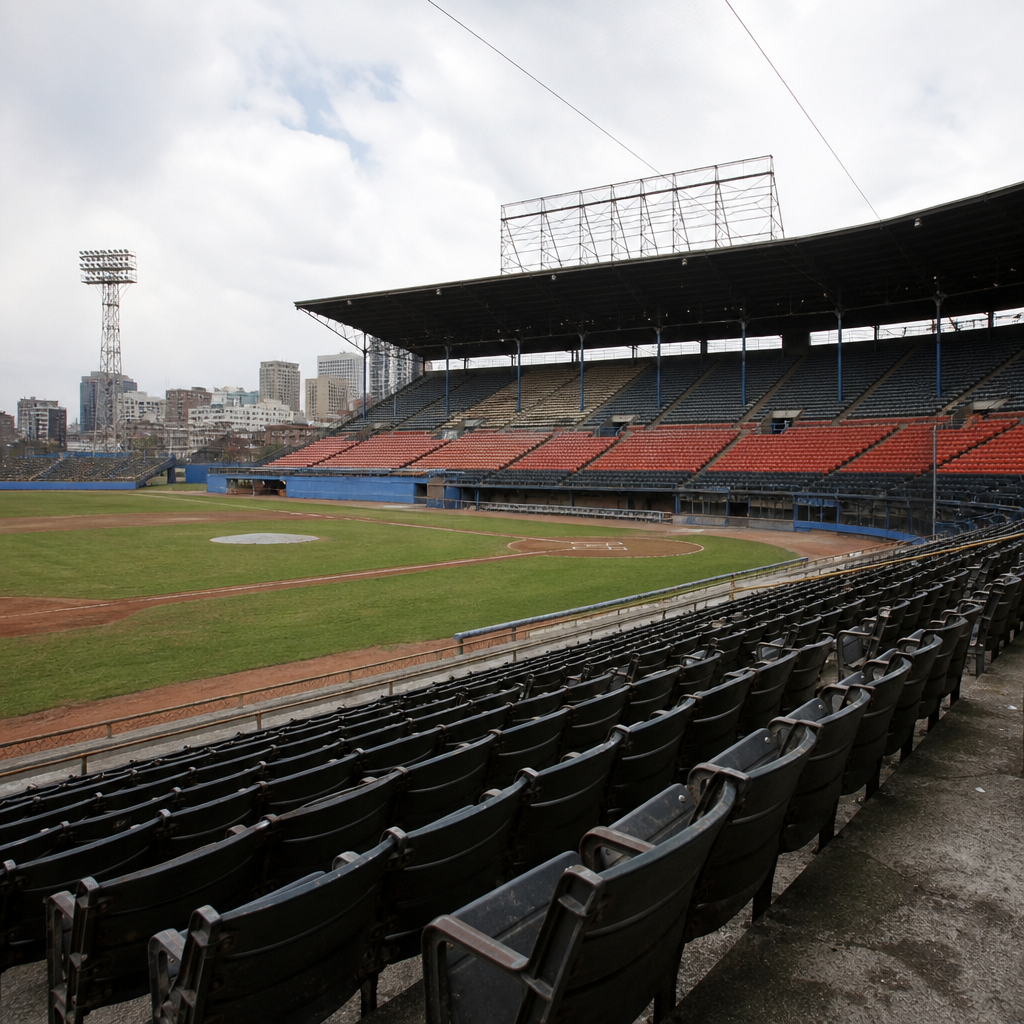
Sick’s Stadium occupies a peculiar place in baseball history: it was a beloved minor league park, a civic landmark in Seattle, and, for one chaotic major league season, the unsteady home of the expansion Seattle Pilots. When people ask why the Pilots failed so quickly, the cleanest answer starts with the ballpark. Sick’s Stadium was never designed for Major League Baseball, never fully rebuilt to meet that standard, and never given the time or capital required to become a true big league facility. As a result, it now stands at the center of any serious discussion of lost MLB ballparks, expansion misfires, and the fragile economics of professional sports venues.
For readers exploring lost MLB ballparks, Sick’s Stadium is an ideal hub story because it connects nearly every theme in the subject. It links the intimate scale of old minor league parks to the commercial demands of modern baseball. It shows how stadium financing, municipal politics, league pressure, construction delays, and fan expectations can collide. It also explains why some vanished venues are remembered fondly despite obvious flaws: they carried neighborhood identity, local tradition, and moments that matter beyond architecture. I have spent years reviewing old stadium plans, newspaper accounts, and franchise histories, and Sick’s repeatedly emerges as one of the clearest examples of a park that could charm a city while undermining a franchise.
Opened in 1938 as Rainier Field and later renamed for Emil Sick, the owner of the Seattle Rainiers of the Pacific Coast League, the stadium served minor league baseball well for decades. The problem was not that it lacked history. The problem was scale, infrastructure, and timing. A ballpark fit for the Pacific Coast League was not automatically fit for the American League in 1969, especially at a moment when MLB expansion clubs were expected to sell television inventory, premium seating, concessions, parking, and a credible fan experience from day one. Understanding that gap is essential to understanding both the Seattle Pilots and the wider story of lost major league venues.
From Rainier Field to Sick’s Stadium
Sick’s Stadium began life in South Seattle’s Rainier Valley, a neighborhood setting that gave it intimacy and local character. As Rainier Field, it hosted the Seattle Rainiers, one of the flagship clubs of the Pacific Coast League. In the prewar and early postwar eras, the PCL was not a trivial operation. It drew strong attendance, featured recognizable talent, and in some western cities functioned almost like a quasi-major league. Within that context, Rainier Field was entirely sensible: compact dimensions, a straightforward grandstand, modest amenities, and an atmosphere close enough to the action that fans felt involved in every inning.
When Emil Sick acquired the club, the stadium took his name and became even more closely tied to local baseball culture. For decades, Seattle fans accepted it for what it was: a serviceable, familiar park built for a regional baseball economy. That distinction matters. Older stadiums are often romanticized as interchangeable relics, but ballparks were products of their leagues, revenue models, and transportation habits. Sick’s Stadium was not competing with Dodger Stadium or the Astrodome when it was conceived. It was competing with other high-level minor league facilities, where expectations around luxury boxes, media workspaces, clubhouse size, and automobile access were far lower.
By the 1960s, however, baseball’s venue standards had changed sharply. Television was more important. Clubhouse operations were more complex. Press coverage was broader. Player amenities mattered more. So did parking, security, circulation, and code compliance. A stadium that could handle Pacific Coast League traffic did not necessarily have the physical footprint or structural flexibility to absorb major league demand. That is the central issue with Sick’s Stadium: not that it was old, but that it was old in the wrong way for the league that arrived.
Why the Seattle Pilots Landed There
The Seattle Pilots entered the American League in 1969 as part of baseball’s rapid expansion era. Seattle had long sought a major league franchise, and political pressure intensified after the city lost the minor league tradition that many believed deserved promotion to the top tier. The American League moved quickly, perhaps too quickly, to place a team in the market. An expansion franchise needed a home immediately, and there was no finished purpose-built major league ballpark available. That left Sick’s Stadium as the default solution.
In theory, upgrading an existing park seemed practical. In reality, it was rushed, underfunded, and compromised by deadlines. The city, franchise officials, and league leadership all had incentives to present the project as manageable. Nobody wanted to admit that the market had received a team before it had a stadium capable of supporting one. I have seen this pattern in other stadium histories: once a franchise award is announced, optimism becomes part of the sales pitch, and practical concerns are reframed as temporary inconveniences. At Sick’s Stadium, those inconveniences became defining weaknesses.
The Pilots were also trapped by broader financial realities. Expansion fees were rising, player costs were real, and ownership did not have endless liquidity. Spending heavily on a complete rebuild was difficult. Building a new park from scratch on a realistic timeline was impossible. So the organization pursued a middle path that satisfied nobody: renovate enough to pass, promise more for later, and hope attendance plus future financing would close the gap. That strategy might work in a stable context. It was disastrous in a debut major league season where first impressions shaped media coverage, fan trust, and league patience.
The Stadium’s Major League Deficiencies
Sick’s Stadium failed the big league test in ways both visible and operational. Seating capacity was a problem from the start. Expansion plans sought to increase the number of seats, but the park still felt constrained relative to major league expectations. Many seats were temporary or awkwardly integrated, sightlines were inconsistent, and circulation routes could become congested. Fans entering a major league environment expect not just a place to sit, but a venue that can move thousands of people efficiently before the game, between innings, and after the final out. Sick’s struggled with that basic requirement.
Infrastructure was an even greater issue. Clubhouses were inadequate. Press facilities were not at major league standard. Concession and restroom capacity lagged demand. Plumbing problems were notorious. There were reports of incomplete work, exposed construction issues, and areas that simply were not ready when the season began. These were not cosmetic flaws. They affected players, media, team employees, and paying customers every day. Major league baseball depends on routine, and Sick’s Stadium could not reliably provide it.
Location and access created another layer of difficulty. The neighborhood setting that once made the park charming became a constraint in the auto-oriented major league era. Parking was limited. Traffic management was imperfect. Surrounding infrastructure had not been built for sustained big league volume. Unlike some classic urban parks that benefited from dense transit networks, Sick’s sat in a context where access headaches directly reduced convenience for suburban fans, corporate buyers, and casual attendees deciding whether to return.
| Issue | Minor League Context | Major League Consequence in 1969 |
|---|---|---|
| Seating capacity | Adequate for PCL crowds | Limited revenue and strained expansion seating |
| Clubhouses and media areas | Basic facilities were acceptable | Players and press faced substandard working conditions |
| Restrooms and concessions | Manageable for smaller events | Long lines, fan frustration, and poor game-day experience |
| Parking and access | Neighborhood scale was workable | Traffic and convenience problems hurt attendance appeal |
| Construction readiness | Incremental updates were normal | Opening with unfinished work damaged credibility immediately |
What 1969 Looked Like on the Ground
The 1969 season exposed every weakness. Opening Day itself was delayed because the stadium was not ready, an extraordinary embarrassment for a new franchise trying to establish legitimacy. Temporary fixes became symbols of deeper disorder. Newspapers highlighted missing seats, unfinished installations, and the sense that the city had been handed a major league label without major league preparation. Fans were excited about having baseball at the top level, but excitement has limits when the venue feels improvised.
On the field, the Pilots were competitive at times but not strong enough to overcome off-field instability. Off the field, attendance was disappointing in part because the team was new and inconsistent, but also because the ballpark did not encourage repeat business. Families noticed the inconvenience. Corporate clients noticed the lack of polish. Broadcasters and writers noticed the gap between league branding and lived reality. Once that narrative hardens, it becomes self-reinforcing. A struggling club in a flawed park starts to look temporary even before anyone says relocation out loud.
It is important to avoid a simplistic claim that Sick’s Stadium alone destroyed the Pilots. Expansion franchises often struggle, and ownership finances were a major factor in Seattle’s one-year tragedy. Yet the ballpark sharply reduced the organization’s margin for error. A better stadium could have improved attendance, sponsorship appeal, player comfort, and civic confidence. Sick’s did the opposite. It amplified every weakness the franchise already had.
How Sick’s Fits the Lost MLB Ballparks Story
As a hub for lost MLB ballparks, Sick’s Stadium matters because it represents a category that differs from famous long-term parks such as Ebbets Field, the Polo Grounds, or Forbes Field. Those venues hosted generations of major league history before disappearing. Sick’s was instead a stopgap park, a place that briefly entered the majors without ever fully belonging there. That makes it especially valuable for understanding how not all lost ballparks are nostalgic cathedrals. Some are cautionary tales about timing, standards, and undercapitalized ambition.
Other lost MLB venues share pieces of this pattern. The Met in Minnesota began as a minor league park adapted upward before eventually giving way to the Metrodome era. Toronto’s Exhibition Stadium hosted baseball in conditions many considered unsuitable over the long term, particularly in weather and configuration. Even Montreal’s Jarry Park, while more successful as an interim solution for the Expos, demonstrated the compromises teams accept when a permanent home is delayed. Sick’s stands at the harshest end of that spectrum because the franchise did not survive long enough for the temporary arrangement to be redeemed.
For researchers and fans, this subtopic opens productive questions. What makes a ballpark major league ready? How much can atmosphere compensate for weak infrastructure? When does a temporary venue help a new club, and when does it poison the launch? Sick’s provides unusually clear answers: charm matters, but operational competence matters more; temporary homes can work if they are honest and functional; and if league expansion outruns stadium readiness, the franchise pays the price.
Demolition, Memory, and Seattle’s Baseball Afterlife
The Pilots left for Milwaukee after the 1969 season and became the Brewers, one of the most dramatic one-year franchise turns in modern North American sports. Sick’s Stadium lingered briefly after its brush with the majors, but its fate was sealed. The park was demolished in the 1970s, and the site was later redeveloped, with a school now occupying the location. Like many lost ballparks, it survives more in photographs, anecdotes, and arguments than in physical traces.
Yet its afterlife in Seattle baseball history is significant. The city’s eventual return to MLB with the Mariners in 1977 cannot be understood without the Pilots debacle. Seattle’s leaders and baseball advocates had learned a painful lesson: a major league city needs major league infrastructure, ownership depth, and realistic planning. The Kingdome, for all its own flaws as a multipurpose concrete stadium, represented an attempt to ensure Seattle would not again lose a team because it could not offer a viable home. Later, T-Mobile Park showed the full maturation of that lesson through baseball-specific design, retractable-roof climate planning, and revenue architecture built for modern operations.
That arc is why Sick’s Stadium still matters. It marks the point where civic desire outran venue readiness, then helped force the city toward a more durable model. For anyone building a broader understanding of iconic ballparks, lost MLB ballparks, or Seattle sports history, Sick’s deserves more than a footnote. It is the hinge between the Pacific Coast League past and the fully modern major league future.
Sick’s Stadium was never ready for the Pilots, and that truth explains far more than a single bad season. It explains why temporary venues can become permanent liabilities, why old parks must be judged within the standards of their moment, and why baseball history is shaped as much by plumbing, parking, and financing as by box scores. As a minor league home, Sick’s had identity, intimacy, and local affection. As a major league park, it lacked the capacity, amenities, access, and readiness the American League required in 1969.
For the larger story of lost MLB ballparks, Sick’s is indispensable because it broadens the category. Not every vanished stadium is remembered only for greatness. Some are remembered because they exposed structural weaknesses in a franchise or a city. Some illustrate the danger of expansion without infrastructure. Some show that nostalgia and suitability are not the same thing. Sick’s Stadium does all three, making it one of the most instructive lost venues in baseball history.
If you are exploring iconic ballparks or planning deeper reading on lost MLB ballparks, use Sick’s Stadium as the starting point. It connects to questions about expansion, relocation, interim parks, stadium finance, and urban baseball culture better than almost any other case. Follow that trail, and the rise and fall of many other vanished venues begins to make more sense.
Frequently Asked Questions
Why was Sick’s Stadium such a problem for the Seattle Pilots?
Sick’s Stadium was a problem because it was fundamentally a minor league park being rushed into service as a major league facility. For years, it had been a popular and familiar home for Seattle baseball, especially in the Pacific Coast League, but Major League Baseball required a very different level of infrastructure. The stadium lacked the seating capacity, clubhouse space, press accommodations, parking, and fan amenities expected at the big league level. Even more importantly, many of the upgrades that were supposed to make the park major league-ready were incomplete, delayed, or handled in piecemeal fashion.
That created an immediate image problem for the expansion Seattle Pilots. Instead of debuting in a polished venue that signaled permanence and ambition, the club opened in a ballpark that looked temporary and unfinished. Fans encountered construction issues, cramped conditions, and a stadium experience that did not compare favorably with established major league cities. Players and media noticed the same thing. In practical terms, Sick’s Stadium affected revenue, credibility, comfort, and public confidence all at once. When historians explain why the Pilots collapsed so quickly, the ballpark is often the first place they start because it symbolized the franchise’s larger instability.
Was Sick’s Stadium ever actually rebuilt for Major League Baseball, or was it just patched together?
The honest answer is that it was patched together far more than it was truly rebuilt. There were expansion and renovation efforts intended to bring Sick’s Stadium closer to major league standards, but those efforts were constrained by time, money, and the basic limitations of the existing structure. Rather than replacing the park with a purpose-built major league stadium, Seattle tried to adapt a beloved but outdated facility on a compressed schedule. That distinction matters. Renovating an old minor league ballpark is very different from designing a stadium from the ground up to handle major league crowds, broadcast needs, team operations, and modern spectator expectations.
In practice, this meant the Pilots inherited a stadium that was larger than it had been but still not truly finished. Temporary seating, incomplete facilities, and makeshift solutions undercut the idea that Seattle had secured a stable long-term home for its new franchise. The park could host games, but hosting games and functioning as a fully credible major league venue are not the same thing. That is why so many accounts of the 1969 Pilots describe Sick’s Stadium as an emergency answer rather than a real solution. It was upgraded enough to get through opening day, but not enough to eliminate the sense that the club had arrived before the city was fully prepared for it.
How did the condition of Sick’s Stadium affect fans, players, and the overall reputation of the Pilots?
For fans, the condition of Sick’s Stadium shaped the entire first impression of major league baseball in Seattle. Instead of entering a gleaming new ballpark that felt like a civic triumph, spectators often encountered congestion, unfinished sections, limited amenities, and an environment that could feel improvised. That matters more than it might seem. Expansion franchises rely heavily on novelty, optimism, and the belief that the team represents the city’s future. When the home ballpark feels temporary or inadequate, it weakens that emotional momentum. Fans may still be curious and loyal, but the overall product feels less substantial.
Players were affected too. Clubhouse quality, training space, travel logistics, and everyday comfort all influence how athletes and team staff experience a season. A substandard home park can wear on morale and reinforce the sense that an organization is underfunded or unstable. For the media and baseball establishment, Sick’s Stadium became visual evidence that the Pilots were operating under difficult conditions from the start. The reputation of the franchise suffered because the stadium made deeper financial and organizational problems impossible to ignore. In a very real sense, the ballpark told the story before anyone looked closely at the books: this was a major league team trying to survive in a facility that still belonged to another era.
Was the failure of the Seattle Pilots only about the stadium, or were there bigger issues involved?
No, the failure of the Seattle Pilots was not only about Sick’s Stadium, but the ballpark was one of the clearest and most visible signs of the franchise’s deeper problems. The organization faced serious financial strain, ownership instability, expansion pressures, and limited time to establish itself. Those are difficult obstacles for any new team. What made Sick’s Stadium so important is that it turned many of those abstract problems into something the public could see. A shaky facility suggested shaky planning. Incomplete renovations hinted at incomplete financing. A minor league park dressed up for major league use raised questions about whether the franchise had been rushed into existence before the foundation was secure.
So while it would be too simple to say the Pilots failed only because of the stadium, it would also be a mistake to treat the ballpark as a side issue. In sports business terms, the home venue is one of the franchise’s central assets. It drives ticket sales, concessions, premium seating opportunities, fan loyalty, and public perception. If that asset is inadequate, nearly every part of the business suffers. For the Pilots, Sick’s Stadium did not create every problem, but it amplified almost all of them. That is why the stadium remains central to the story of the club’s one-year existence in Seattle before moving to Milwaukee and becoming the Brewers.
Why does Sick’s Stadium still matter in Seattle baseball history?
Sick’s Stadium still matters because it represents both Seattle’s baseball passion and one of the city’s most painful sports near-misses. Long before the Pilots, the park had genuine local meaning. It was a community landmark and an important part of the region’s baseball culture, especially during the minor league era. That earlier history is worth remembering because it explains why the stadium was not viewed merely as an old structure. For many people, it was a beloved home for the game. The tragedy, historically speaking, is that the same park that had served Seattle well in one era was asked to perform a role it was never built to fill in another.
Its legacy also matters because it helps explain how Seattle eventually got a second chance with the Mariners. The Pilots’ collapse exposed what happens when major league ambitions move faster than facilities, financing, and long-term planning. Sick’s Stadium became a cautionary example in that process. Today, it endures in baseball memory not because it was a great major league park, but because it stands at the center of a larger lesson: civic enthusiasm alone is not enough to sustain a franchise. A city can love baseball, support a team, and still lose it if the infrastructure is not ready. That is why Sick’s Stadium remains such a compelling symbol in Seattle baseball history—part cherished landmark, part warning, and entirely unforgettable.