
The summer of 1961 will forever remain etched in the annals of baseball history. It was during this magical season that Roger Maris, a relatively unassuming outfielder for the New York Yankees, achieved a feat that had eluded many before him—he shattered Babe Ruth’s long-standing record of 60 home runs in a single season. This record, which had stood for 34 years, seemed nearly untouchable, yet Maris managed to hit 61 homers, clinching a spot in baseball immortality.
Maris wasn’t your typical Yankees hero. Born on September 10, 1934, in Hibbing, Minnesota, and raised in Fargo, North Dakota, Maris carved out his path with sheer grit and determination. Before joining the Yankees, he had stints with the Cleveland Indians and Kansas City Athletics, where he showcased his burgeoning talent. However, it was his time with the Yankees that would define his legacy.
Teamed with Mickey Mantle, Maris became part of the dynamic M&M Boys duo. The 1961 season was marked not just by Maris’s pursuit of the home run record, but also by an intense, almost cinematic rivalry with Mantle. As the season progressed, America watched with bated breath, wondering which one would surpass Ruth. Mantle’s pace slowed due to injury, leaving Maris to shoulder the pressure alone.
In this article, we delve into the backdrop of Maris’s iconic season, the challenges he faced, the controversies surrounding his record, and the profound impact it had on his life and career in the years that followed. The story of Roger Maris is not just about baseball statistics; it’s a testament to the human spirit, resilience, and the unpredictable nature of sports legends.
The 1961 Season: An Overview
When the 1961 baseball season commenced, few could have predicted the seismic impact it would have on the sport. The New York Yankees, stacked with talent, were a formidable team with the likes of Maris, Mantle, and Whitey Ford dominating the roster. The Yankees’ lineup was so powerful that many believed it was one of the best in the franchise’s storied history.
Maris’s campaign started relatively quietly. By the end of April, he had only hit one home run, a far cry from the pace needed to break Ruth’s record. However, things started heating up in May when Maris hit 11 homers, putting baseball fans on notice. As summer arrived, Maris’s bat seemed to catch fire. In June and July, he belted a combined 31 home runs, putting him on a trajectory that now had everyone talking.
The comparison between Maris and Ruth became a national conversation. The pressure from media and fans was immense. Every game, every at-bat was scrutinized. By the end of August, Maris had hit 51 home runs, but the path to 61 was fraught with tension. The commissioner of baseball at the time, Ford Frick, ruled that Ruth’s record had to be broken within 154 games, the length of the season when Ruth set the record in 1927. The Yankees now played a 162-game schedule, adding a layer of controversy to Maris’s pursuit.
This ruling meant that for Maris’s record to be considered legitimate, he needed to hit his 61st home run by the 154th game. The topic dominated headlines, with debates and heated discussions spilling over into living rooms and barbershops across the country.
Pressure & Controversy
As Roger Maris approached the coveted record, the external pressures mounted to unbearable levels. The media frenzy reached new heights, with journalists from across the nation chronicling his every move. For Maris, a private and reserved individual, this spotlight was far from welcome. The relentless scrutiny began to affect him physically and mentally, contributing to a noticeable thinning of his hair due to stress.
Not helping matters was the public’s perception of his pursuit. Many fans and members of the media despised Maris for daring to chase the beloved Ruth’s record. Letters branded with hate messages flooded his mailbox, questioning his worthiness and even his status as a true Yankee. In contrast, Mickey Mantle, a fan favorite, often received more support and goodwill, further amplifying the scrutiny on Maris.
The aforementioned ruling by Ford Frick added another layer to the already intense atmosphere. The decision effectively split Maris’s quest into two separate narratives—the pursuit of the “real” record within the first 154 games and the extended chase throughout the 162-game schedule. Every time Maris walked onto the field, this bifurcation loomed heavily over him. Fans were divided, and purists clung to the notion of Ruth’s superiority, tainting Maris’s potential achievement.
The cumulative effect of these challenges was overwhelming. Maris became increasingly isolated in the Yankees clubhouse, focusing solely on the game and avoiding interactions that might add to his distress. Despite the hostile environment, he persevered, each swing of the bat bringing him closer to that elusive 61st home run. Remarkably, Maris showcased not just his skill but an indefatigable willpower that continues to be revered in sports history.
The Historic 61st Home Run
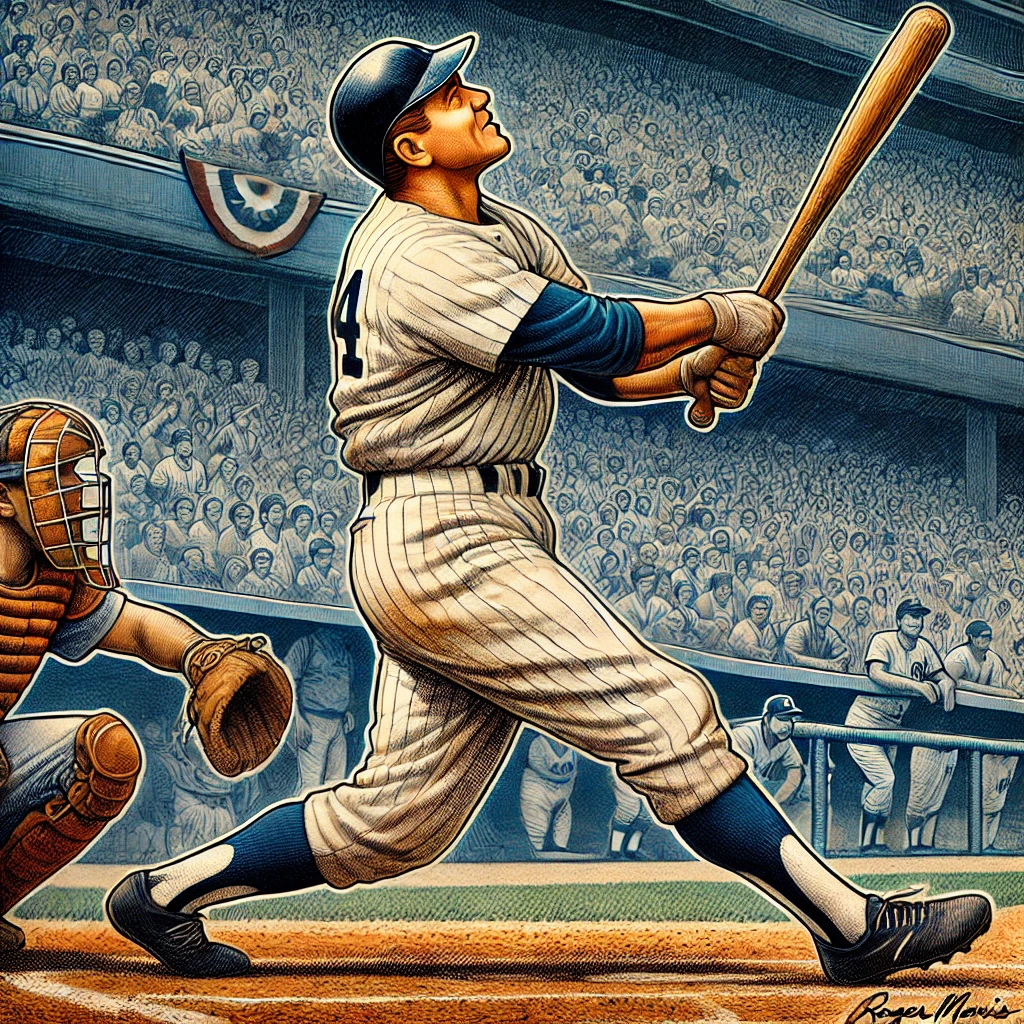
October 1, 1961, is a date long remembered by baseball aficionados. It was the final game of the regular season, and Maris stood at 60 home runs—tied with Ruth. Yankee Stadium was filled with anxious fans, each yearning to witness history. Maris’s 61st home run came in the fourth inning off of Boston Red Sox pitcher Tracy Stallard. With a smooth, unpretentious swing, Maris sent the ball sailing into the right-field stands, an evocative snapshot of triumph and relief.
The aftermath on the field was euphoric. Maris rounded the bases to a standing ovation, the roars of the crowd overwhelming the hallowed stadium. His teammates rallied around him, each understanding the enormity of the moment. However, the reaction off the field was more complicated. While many celebrated, a vocal faction continued to voice their discontent, viewing the achievement as inferior to Ruth’s, given the extended schedule.
Despite the criticism, Maris had secured his place in the annals of baseball history. The record was subsequently recognized with an asterisk, a controversial distinction only officially removed in 1991 by then-Commissioner Fay Vincent. For Maris, the day was bittersweet. While he had achieved what many thought impossible, the emotional toll of the pursuit lingered, casting a shadow over his moment of triumph.
Yet, that 61st home run remains a defining moment in the sport—a testament to Maris’s resilience, talent, and unyielding determination. It didn’t just break a record; it heralded a new era in baseball, challenging previously held notions of greatness and underscoring the inherent drama and unpredictability of the game.
The Aftermath: Pressures and Challenges
Post-1961, Roger Maris found himself in an unenviable position. He had achieved what was considered a once-in-a-lifetime milestone, yet the shadow of Ruth’s legacy and the controversy over the extended schedule never truly dissipated. While Maris continued to play at a high level, his subsequent seasons were plagued by injuries and the psychological toll of his record-setting season.
The immense pressure Maris faced during and after 1961 took a significant toll on his performance and well-being. Each new season brought comparisons to his 61-home run benchmark, a bar that even Maris himself struggled to reach again. Despite these challenges, Maris remained a crucial player for the Yankees, contributing significantly during their World Series victories in 1961 and 1962.
Injuries, however, soon became a recurring theme. Maris played through numerous physical ailments, pushing his body to the limit and beyond. His final years in New York were marked by diminishing returns, leading to his trade to the St. Louis Cardinals in 1966. With the Cardinals, Maris experienced a resurgence of sorts, helping the team to win the World Series in 1967. However, it was clear that his best years were behind him.
For Maris, the journey post-1961 was characterized by a desire to reclaim normalcy. While he cherished his record, the relentless comparisons and pressures overshadowed his achievements. Despite this, his contributions to the sport continued to be recognized, and he was viewed with newfound respect, particularly by his peers who understood the extraordinary pressures he had endured.
Legacy and Recognition
In the years following his remarkable 1961 season, Roger Maris’s legacy underwent a significant transformation. While initially overshadowed by controversy and skepticism, with time, the enormity of his achievement was universally acknowledged. Sports historians began to frame Maris’s 61-home run season as not just a record but a testament to human endurance and resilience.
Maris’s legacy wasn’t confined solely to his record-breaking season. His overall contribution to baseball was immense. A seven-time All-Star and three-time World Series champion, Maris’s career was distinguished by both individual and team accomplishments. In 1974, his number 9 was retired by the Yankees, ensuring his eternal presence in the franchise’s storied history.
Despite his undeniable impact, Maris’s candidacy for the Hall of Fame has sparked considerable debate among baseball aficionados. While some argue that his achievements warrant induction, others believe his overall career statistics fall short of Hall of Fame benchmarks. Nonetheless, several honors have been bestowed upon him posthumously, speaking volumes about the respect and admiration he commanded.
Maris’s story continues to inspire athletes across various sports. His ability to overcome immense external pressure and internal conflict serves as a blueprint for perseverance. The 1998 home run race between Mark McGwire and Sammy Sosa reignited interest in Maris’s story, with McGwire’s eventual 70 home runs prompting an even deeper appreciation for Maris’s accomplishment amidst lesser favorable conditions.
Conclusion
The unforgettable 1961 season, marked by Roger Maris’s pursuit and ultimate breaking of Babe Ruth’s home run record, remains one of the most compelling narratives in baseball history. Beyond the sheer athletic feat, Maris’s journey embodies the essence of human perseverance against overwhelming odds. His story is not merely one of success; it is a profound exploration of pressure, resilience, and the human spirit.
Maris’s legacy extends beyond statistics and records. It serves as a powerful reminder of the trials athletes often face behind the scenes—the relentless scrutiny, the burdens of expectation, and the personal sacrifices made in pursuit of greatness. His experience challenges us to view sports not just as a series of events but as a human endeavor brimming with stories that transcend generations.
As baseball continues to evolve, the tale of Roger Maris’s 61 home runs in 1961 will forever hold a special place. It reminds us of a simpler time, yet one filled with complexities and stakes that tested the mettle of those who dared to challenge the status quo. Maris stands as a symbol of triumph over adversity, and his story will undoubtedly inspire generations of fans and athletes alike.
In honoring Roger Maris, we are reminded to celebrate not just the moments of victory but the journey, the struggles, and the spirit that define true greatness. His 61st home run is more than a record; it is a beacon of what it means to dream, strive, and ultimately, succeed against all odds.