
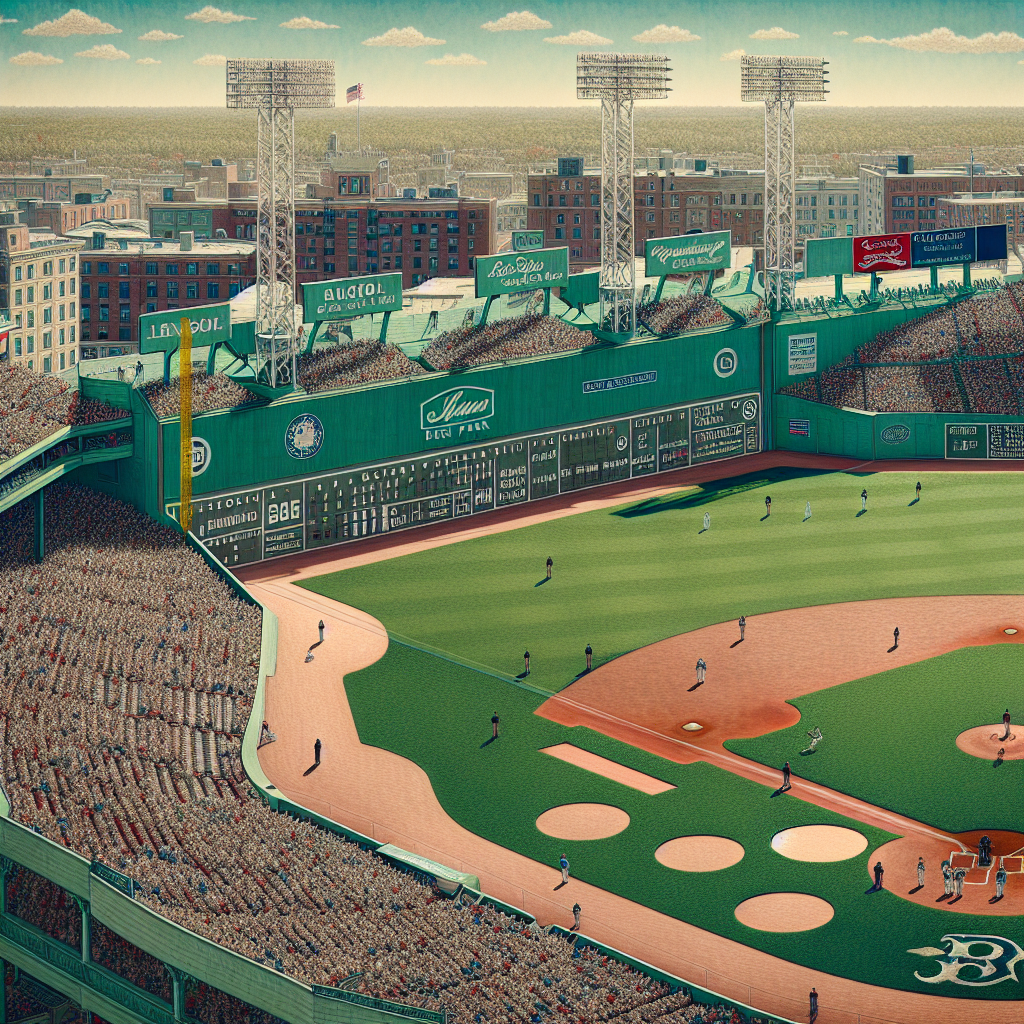
Few stadiums in the history of American sports capture the imagination quite like Boston’s Fenway Park. This legendary ballpark, which opened its gates in 1912, has garnered a reputation not only as a cathedral of baseball but as a cultural icon. One feature stands out above all others at Fenway Park: the Green Monster. This towering, 37-foot 2-inch left-field wall has defined a century of baseball moments and continues to inspire awe both among fans and players. Let’s dig deeper into the intimate corners of this architectural oddity and explore its impact on the sport and its place in baseball lore.
The Origins of the Green Monster
Back in the early 20th century, ballpark design didn’t adhere to a uniform standard. Every stadium was unique, often shaped by the urban landscape surrounding it. Fenway Park was no exception. When the ballpark was being constructed in the Fenway-Kenmore neighborhood of Boston, a new street car line determined the dimensions of the outfield, resulting in the peculiar left field layout. The Logical solution to maximizing spectator seating while containing home-run balls was a great big wall. The Green Monster was then born, originally topped by an even higher incline during its early years, adding another element of terror for fielders.
Initially known simply as “The Wall,” it wasn’t until 1947 when it was painted its iconic green. This period also saw the installation of manual scoreboards at its base, which remain a fundamental aspect of the fan experience at Fenway Park. Overtime, the Green Monster has proven to be more than just a barrier; it represents the intricate relationship between a ballpark’s physical boundaries and its mythical status.
A Field of Challenges
The Green Monster has communicated an unyielding message to batters and outfielders throughout its history: adaptability is key. Its sheer height has influenced numerous strategies for both offense and defense. For hitters, it turns a game of angles into a game of inches. Slugging the ball high over the Monster yields the rare and coveted home run, while hitting it lower can result in singles and doubles. The peculiar bounces of the Green Monster have also rewarded hitters with infamous “Wall Ball” doubles, thanks to hitting the scoreboard or angled corners.
For left fielders, the Green Monster is a constant adversary. It has claimed countless victims who misjudge its boundary, leading to awkward plays and lost opportunities. The most notable resident of this battlefield is undoubtedly Carl Yastrzemski, who made patrolling the area an art form. His adept handling of the corner caroms and deep line drives solidified his legendary status as one of Fenway Park’s most beloved figures. Navigating the space between the chalk line and the wall requires a blend of precision and instinct that only the best left fielders manage to cultivate.
Renovations and Modern Impacts
Fenway Park underwent considerable renovations in the early 2000s, but architects were careful to maintain the nostalgia of the Green Monster. One of the most impactful changes came in 2003 when seats were added atop the Monster, shifting it from a purely defensive feature to a highly coveted vantage point for fans. These new seats offer a view unparalleled in baseball, transforming an already unique aspect of Fenway Park into a centerpiece of its game-day experience.
This move not only bolstered attendance but also reinforced the cultural significance of the Green Monster. Today, watching a game from those seats is seen as a bucket list experience for baseball enthusiasts. They offer a front-row view of history in the making, with fans now becoming part of the narrative every time a ball is sent rocketing towards the towering wall.
The Green Monster in Popular Culture
Fenway’s Green Monster has transcended the world of sports to become a pop culture fixture. It has been featured in numerous films, from the sentimental, like “Field of Dreams,” to coming-of-age stories like “Fever Pitch.” Its emerald façade has inspired songs and even served as the backdrop for historic moments outside of baseball, including political speeches and concerts.
The wall’s compelling character has also seeped into the world of literature, appearing in books and essays that aim to dissect its mystique. It stands as a subject of academic analysis, with scholars exploring its symbolism and its architectural significance in the context of urban development and cultural heritage. The Green Monster isn’t just a wall; it’s a narrative medium that invites endless interpretation.
Iconic Moments at the Green Monster
Over the decades, the Green Monster has been witness to some of Fenway Park’s most unforgettable moments. From Carlton Fisk’s game-winning home run in Game 6 of the 1975 World Series, fortune favors those who dare to challenge this imposing structure. Ted Williams, the Splendid Splinter, struck numerous balls over its height, crafting his legacy one swing at a time. More recently, David Ortiz, known affectionately as Big Papi, created his own library of moments against the Monster. His 2004 playoff heroics, including the walk-off home run to keep the Red Sox alive against the Yankees, are engrained in the annals of baseball history. Ortiz’s deeds prove that while the Monster looms large, it humbles even the mightiest, engraving their feats in the pantheon of sporting lore.
The Green Monster as a Symbol of Innovation
Odd design, seemingly an arbitrary product of the urban setting, has been flipped on its head to become a symbol of innovation. Designers and engineers have leveraged its peculiarity to implement unique features such as the manual scoreboard, which endures as a tribute to baseball’s history amidst a digital age. The scoreboard operators add their secretive artistry to the game, providing fans with an undeniably authentic connection to the sport’s past. The Monster has helped pave the way for multi-dimensional fan experiences, serving as more than a field boundary but as a living museum. It challenges other sports facilities to blend their unique attributes with modernization efforts, demonstrating that history and innovation can coexist harmoniously. Conclusion: Embracing the Green Monster’s Legacy
Fenway Park’s Green Monster is much more than an obstacle; it’s an emblem. From its origins and influence on the sport’s strategy to its impact on popular culture and innovation, the wall has evolved from a mere structural necessity to a towering giant whose significance transcends baseball. It stands tall as a testament to the game’s history and spirit, continuing to inspire new generations of fans and players alike.
The Green Monster’s legacy reinforces that the ballpark is more than just a venue; it’s a living, breathing entity imbued with stories, aspirations, and eternal grandeur. As long as baseball is played, Fenway’s Green Monster will captivate imaginations, define careers, and serve as a touchstone for the dreams of countless baseball enthusiasts.