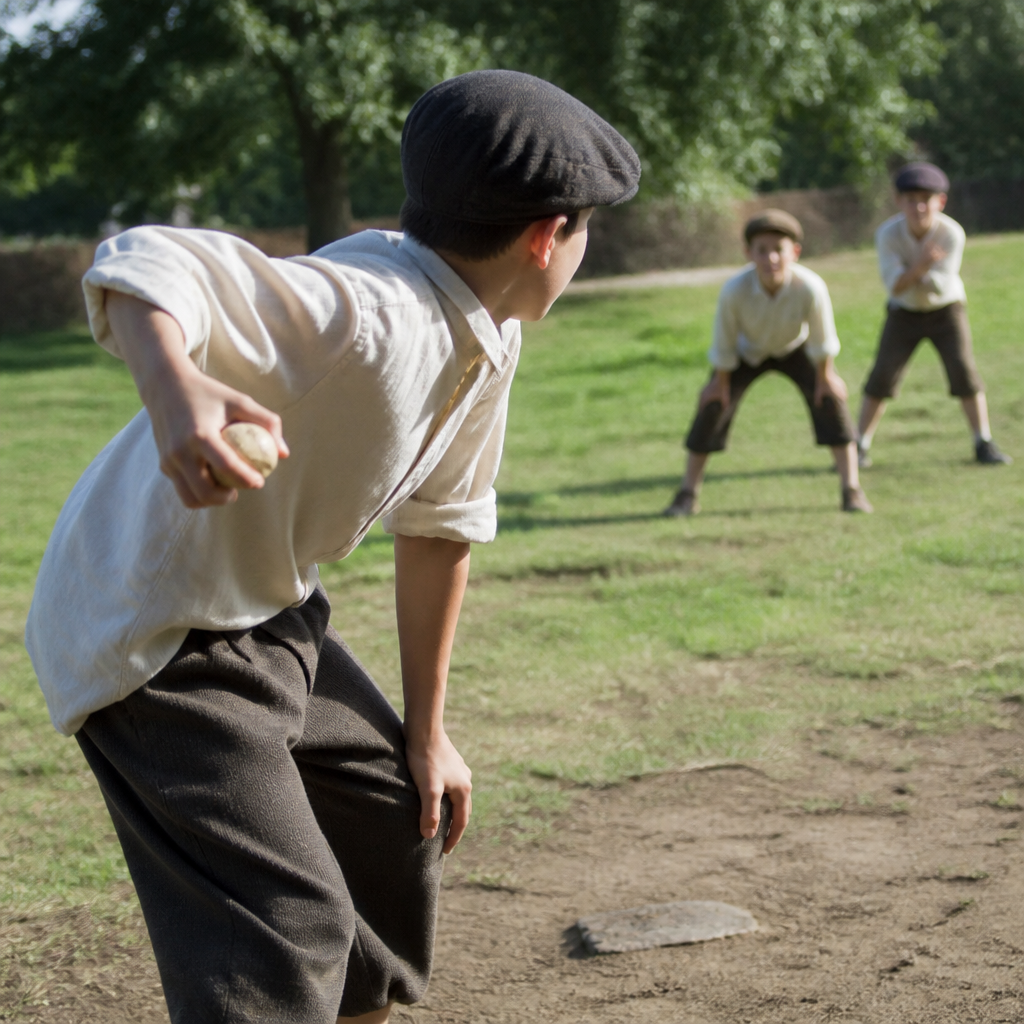
Long before professional leagues, scoreboards, and packed grandstands, children across Britain and North America learned the instincts of baseball through schoolyard bat-and-ball games such as one old cat and two old cat. These simple contests, played with a bat, a thrown ball, and a few willing participants, formed a practical bridge between older folk games and the codified sport that emerged in the nineteenth century. To understand early baseball, it is not enough to start with the Knickerbocker Rules or Abner Doubleday myths; the deeper story begins in playgrounds, village greens, and informal recreation where rules were negotiated on the spot and skill mattered more than structure.
Bat-and-ball origins refers to the family of games in which a player strikes a pitched or tossed ball and then runs, scores, or avoids dismissal according to local custom. That family includes English games such as stoolball, rounders, and cricket, as well as North American variants such as town ball, base, old cat, and one o’cat. Historians study these games because baseball did not appear fully formed. It evolved from repeated patterns: batting against a thrower, advancing between safe points, retiring runners with catches or force-like plays, and adapting field size to the number of players available. In my own work with nineteenth-century rulebooks and newspaper archives, old cat appears again and again as the game that taught timing, throwing accuracy, catching, and the geometry of baserunning before formal clubs standardized anything.
This matters because schoolyard games explain how baseball became both popular and practical. A nine-player side requires organization, equipment, and enough open ground. One old cat can begin with three children in a lane or pasture. Two old cat can involve six. Four old cat and town ball scale upward as more players arrive. That flexibility made these games ideal for communities with uneven attendance, changing ages, and limited gear. They also spread habits that later baseball preserved: underhand or overhand delivery contests, accepted strike zones, putouts by catch or by striking a runner with the ball in some local forms, and an emerging distinction between fair and foul territory. When people ask where baseball came from, the most accurate answer is not a single inventor but a long continuum of bat-and-ball play, with old cat occupying a central place in the chain.
What were one old cat and two old cat?
One old cat was a compact bat-and-ball game usually played by three participants: a batter, a pitcher, and a fielder often called a catcher or “cat.” The pitcher delivered the ball, the batter struck it, and the fielder attempted to catch or retrieve it quickly enough to retire the striker according to local rules. In some versions, the players rotated positions after an out, after a set number of swings, or after a successful hit. The genius of one old cat was efficiency. With only three players, children could practice the core actions of baseball without needing full teams or marked bases.
Two old cat expanded the concept to six players, commonly arranged with two batters, two pitchers, and two fielders at opposite ends. Each batter faced a pitcher from across a narrow field, creating simultaneous or alternating action depending on local custom. The setup resembled a stripped-down diamond with paired stations rather than a single circuit. Because players stood in recurring relation to one another, two old cat sharpened throwing lines, reaction speed, and the habit of moving between stations under pressure. It rewarded quick decision-making more than brute power, a feature later visible in early baseball’s emphasis on placement hitting and aggressive advancement.
The term “old cat” probably referred less to an exact universal ruleset than to a recognized class of youth games. Nineteenth-century memoirs, juvenile literature, and regional newspapers show that names varied, while underlying mechanics remained familiar. In New England one town might speak of old cat, another of one o’cat, and another of cat-ball. That variation is normal in folk recreation. What matters historically is that players recognized these games as related, and many adults who later joined baseball clubs had learned their first bat control and field awareness through them.
How schoolyard games shaped early baseball skills
Old cat and similar schoolyard games acted as training systems before anyone called them that. Batters learned to meet a moving ball squarely, first against gentle tosses and later against faster deliveries. Pitchers learned control because wild throws wasted everyone’s time. Fielders developed barehanded catching techniques, body positioning, and recovery after bad hops on rough ground. These are exactly the competencies early baseball demanded in the 1840s through 1860s, when gloves were absent or minimal and fields were far from perfectly groomed.
Just as important, these games taught players how to improvise within shared expectations. I have seen local rule descriptions in which a caught ball retired the striker immediately, while in other accounts one bound catches counted as outs, mirroring early baseball’s acceptance of bound catches. Some variants allowed plugging, also called soaking, where a runner could be put out by being hit with the ball. Baseball eventually rejected plugging at higher levels because it was rough and inconsistent, but its appearance in precursor games reveals a logical stage in development: when bases, gloves, and full defensive coordination were limited, throwing the ball at a runner was an accessible enforcement method.
Schoolyard games also encouraged constant participation. In a full cricket match, weaker players might wait long stretches for meaningful action. In one old cat or two old cat, everyone handled the ball repeatedly. That high repetition rate is one reason these games were effective teachers. Modern player development would call this dense repetition and constrained-space training. Nineteenth-century children simply called it play, but the effect was the same: rapid acquisition of transferable skill.
From stoolball and rounders to town ball and base
Baseball’s bat-and-ball origins are transatlantic, not exclusively English and not purely American. English stoolball, documented as early as the fifteenth century, involved striking a ball and defending a target. Cricket, whose formal laws date to the eighteenth century, contributed ideas about bowling, innings, field placement, and codification. Rounders, associated particularly with Britain and Ireland, supplied the recognizable pattern of running around bases after a hit. These games were neither identical to baseball nor irrelevant to it. They provided overlapping precedents that migrants carried, modified, and fused.
In North America, local forms such as town ball, round ball, and base became especially important. Town ball often used multiple bases and team play but kept rules flexible. “Base” or “goal ball” could differ from county to county, sometimes retaining plugging and often treating fair territory more loosely than later baseball. By the 1830s and 1840s, urban clubs in New York and elsewhere began selecting among these inherited customs. They reduced dangerous or disorderly features, regularized field dimensions, and fixed the number of players. What looks from a distance like invention was usually filtration.
Old cat sits neatly within this continuum. It was not the sole ancestor of baseball, but it was one of the best developmental forms linking household-scale play to organized club competition. Children who had learned old cat could move into town ball with little difficulty. Town ball players could adapt to emerging baseball rules with moderate adjustment. That progression helps explain why baseball spread so quickly once clubs, newspapers, and rail connections accelerated standardization.
Key bat-and-ball games and their relationship to baseball
When readers search for bat-and-ball origins, they usually want a clear comparison: which earlier games most directly influenced baseball, and how? The answer is that different games contributed different parts. Some shaped equipment and striking technique, others shaped running patterns or methods of retiring runners. The table below summarizes the most important relationships.
| Game | Core features | Likely contribution to baseball |
|---|---|---|
| Stoolball | Batting against a delivered ball while defending a target | Early striking-and-defending structure |
| Cricket | Pitched ball, bat, wickets, innings, formal laws | Codification habits, fielding roles, match organization |
| Rounders | Running around bases after contact | Base circuit and scorerunner logic |
| Town ball | Team bat-and-ball play with local rules | American team framework before standard baseball |
| Old cat | Small-number practice game with batter, pitcher, and fielder stations | Skill development, positional rotation, adaptable scaling |
| Base or round ball | Regional American running-and-retiring variants | Transition from folk play to club rules |
No serious historian argues that baseball came from one source alone. David Block, whose research on early baseball is foundational, has shown that references to base-ball and related bat-and-ball play appear well before the mid-nineteenth century. John Thorn has likewise emphasized complexity over origin myth. Their work matters because it replaces romantic stories with documentary evidence: diaries, children’s books, legal notices, and club records. Once those sources are read together, old cat becomes easier to place—not as folklore on the margins, but as one of the practical forms through which baseball culture reproduced itself.
Why old cat thrived in schools, streets, and farms
Old cat spread because it solved logistical problems. It needed little equipment, tolerated irregular numbers, and fit spaces too small for formal matches. A bat could be a shaped stick. The ball might be homemade, reused, or shared. Boundaries could be defined by a fence, a tree, or a pair of stones. For rural children, that meant a game could start between chores. For urban children, it meant a game could happen in a lane, vacant lot, or schoolyard despite crowding.
Teachers and parents did not always approve. Broken windows and bruised shins were common complaints, especially where plugging survived. But compared with some rough folk pastimes, old cat was relatively orderly and easy to interrupt. That practicality gave it longevity. Even after formal baseball clubs multiplied in the 1850s and 1860s, old cat persisted as a recess game and informal drill. Newspaper references from the late nineteenth century sometimes describe it as juvenile, yet that description misses its developmental role. Many accomplished ballplayers first learned to judge flight, throw on a line, and swing compactly in old cat situations.
The game also democratized entry into bat-and-ball play. A child excluded from elite club spaces could still participate. That broad access matters historically because baseball became the national game not only through clubs and commerce but through habits learned young. Schoolyard repetition created future spectators, amateur players, and club members. In that sense, old cat was part of baseball’s social infrastructure as much as its athletic prehistory.
Codification, myth, and the path to modern baseball
By the 1840s, clubs in and around New York were reducing the chaos of local custom. The Knickerbocker Rules of 1845 did not invent baseball from nothing, but they marked a turning point in standardization. They fixed foul territory, established three-out innings, prohibited plugging, and helped formalize a game suited to adult club competition. Those choices separated baseball from looser schoolyard forms while preserving the essential bat-ball-run sequence players already understood.
This is why the old Doubleday creation story fails under scrutiny. Baseball was not designed in one moment by one man in Cooperstown. It was assembled gradually from existing bat-and-ball traditions, then refined by clubs, printers, and governing bodies. Old cat belongs in that story because it shows how players actually encountered the game’s fundamentals before codifiers wrote them down. Rules become durable only when they fit skills people already possess. Old cat supplied those skills.
For anyone exploring the early history of baseball, the most useful approach is to treat bat-and-ball origins as an ecosystem. Start with older British precedents, move through American local variants such as town ball and base, then examine how compact forms like one old cat and two old cat transmitted technique across generations. From there, the emergence of club baseball makes practical sense. If you are building out your study of this topic, continue into deeper articles on rounders, town ball, the Knickerbocker era, and the debate over baseball’s true origins. The payoff is a clearer view of how a national pastime grew from ordinary play: one bat, one ball, and just enough children to begin.
Frequently Asked Questions
What were one old cat and two old cat, and how were they played?
One old cat and two old cat were simple bat-and-ball games widely played by children in schoolyards, fields, and village commons long before baseball became a standardized sport. They required very little equipment and could be organized quickly, which made them ideal for everyday play. In one old cat, a single batter faced a thrower or pitcher, with one or more fielders positioned to catch or stop the ball. The basic object was straightforward: the batter tried to hit the ball into play and avoid being put out, while the opposing players attempted to retire the batter by catching the ball, tagging, or throwing to a designated goal, depending on local custom.
Two old cat expanded the concept by introducing two batters and usually two opposing bases or stations. This setup created more movement, more decisions, and a stronger resemblance to later base-running games. Players had to judge when to run, when to stay put, and how to coordinate offense and defense with only a small number of participants. Because the rules varied from place to place, no single version can stand for all communities. That variation is actually part of the historical importance of the games. They were not formal league sports but living folk practices, shaped by local habits and available space. What remained consistent was their role as accessible, repeatable training grounds for hitting, catching, throwing, and quick tactical thinking.
Why do historians consider these schoolyard games important to the history of early baseball?
Historians value one old cat, two old cat, and related games because they reveal how the habits and skills associated with baseball existed before formal rulebooks and organized clubs. If we begin the story only with nineteenth-century teams such as the Knickerbockers, we miss the deeper cultural foundation that made baseball possible in the first place. Children did not suddenly invent batting technique, fielding instincts, or running strategy once adult clubs codified the game. Those abilities were already being learned informally through repeated play in youth settings.
These games served as a practical bridge between older British and European bat-and-ball traditions and the emerging North American game that would later be called baseball. They show that early baseball was not created from nothing but developed out of familiar recreational forms. In that sense, schoolyard games functioned as a kind of apprenticeship system. Players learned how to track a tossed ball, time a swing, judge a catch, and react under pressure. Just as importantly, they learned social rules: taking turns, settling disputes, choosing sides, and adapting play to uneven numbers. All of this mattered in a period when formal athletic instruction barely existed. The schoolyard was the laboratory, and old cat games were among its most effective experiments in shaping the reflexes and culture that baseball later absorbed.
How did one old cat and two old cat help children develop baseball skills?
These games were remarkably efficient skill builders. Because they were played with fewer participants than a full team game, each child was involved more often and had more chances to bat, field, throw, and react. In a large organized match, a young player might wait long stretches for the ball to come his way. In one old cat or two old cat, action was concentrated. That meant repeated practice in the exact kinds of movements that later became essential in baseball: hand-eye coordination at the plate, quick transfers in the field, accurate throwing, and split-second judgment.
They also trained situational awareness. A batter had to read the toss, decide whether to swing, and place the ball where fielders were not waiting. Fielders had to anticipate angles and recover the ball quickly. In two old cat especially, base-running judgment became more sophisticated. Players had to decide whether a hit gave them enough time to advance, whether a defender was out of position, and how to exploit hesitation by the opposition. These are not minor lessons. They are the core of baseball intelligence.
Another overlooked benefit was adaptability. Since local rules often varied, children had to negotiate the shape of the game and adjust their tactics accordingly. That flexibility likely helped generations of players transition into more formalized versions of town ball, rounders-style contests, and eventually baseball itself. In short, old cat was not merely a pastime. It was a compact, highly repetitive form of training that built both mechanics and game sense.
Were one old cat and two old cat direct ancestors of baseball, or just related games?
The most accurate answer is that they were closely related developmental games rather than single, direct ancestors in a strict line of descent. Baseball did not emerge from one source alone. It grew out of a family of bat-and-ball traditions that included rounders, town ball, base, old cat variants, and other local games played across Britain and North America. One old cat and two old cat were part of that family. Their importance lies less in being the one true origin than in showing how baseball-like play already existed at the everyday level.
This distinction matters because sports history is often oversimplified into neat origin stories. In reality, early baseball evolved through overlap, borrowing, and gradual standardization. Old cat games contributed key elements: batting against a thrown ball, fielding in open space, retiring runners or batters, and developing a rhythm of contest between offense and defense. At the same time, baseball eventually added more fixed rules, fuller team structures, defined innings, regulated distances, and a more stable scoring system.
So it is best to think of one old cat and two old cat as formative cousins and training grounds within the larger prehistory of baseball. They help explain how ordinary players became familiar with the logic of the later game long before the sport had its modern name, dimensions, and institutions. Without them, baseball’s rise would be much harder to understand, because the game depended on a public already comfortable with the basic grammar of bat-and-ball play.
Why should modern readers care about schoolyard games when studying the origins of baseball?
Modern readers should care because these games restore the human scale to baseball history. They remind us that the sport did not begin as a polished spectacle in enclosed parks but as a flexible, improvised form of play among children and amateurs. That perspective deepens our understanding of how sports actually take root. Rules may be written by clubs and committees, but instincts are shaped earlier, in informal spaces where players experiment, imitate, and compete for the sheer pleasure of the game.
Studying one old cat and two old cat also broadens the story beyond famous founders and milestone rulebooks. It highlights everyday participants who rarely appear in official records yet carried the tradition forward. Schoolyards, lanes, and vacant lots were where future players absorbed the feel of batting and fielding long before organized baseball claimed cultural prominence. In that sense, these humble games belong at the center of the story, not at its margins.
There is also a wider historical lesson here. When we examine old cat games, we see how major institutions often grow out of ordinary customs. Baseball became a national pastime, but its roots remained local, playful, and improvised. Recognizing that continuity makes the sport’s history richer and more believable. It shows that early baseball was not simply invented; it was assembled from practices children already knew well. For anyone trying to understand where baseball truly came from, schoolyard games are not a side note. They are essential evidence.