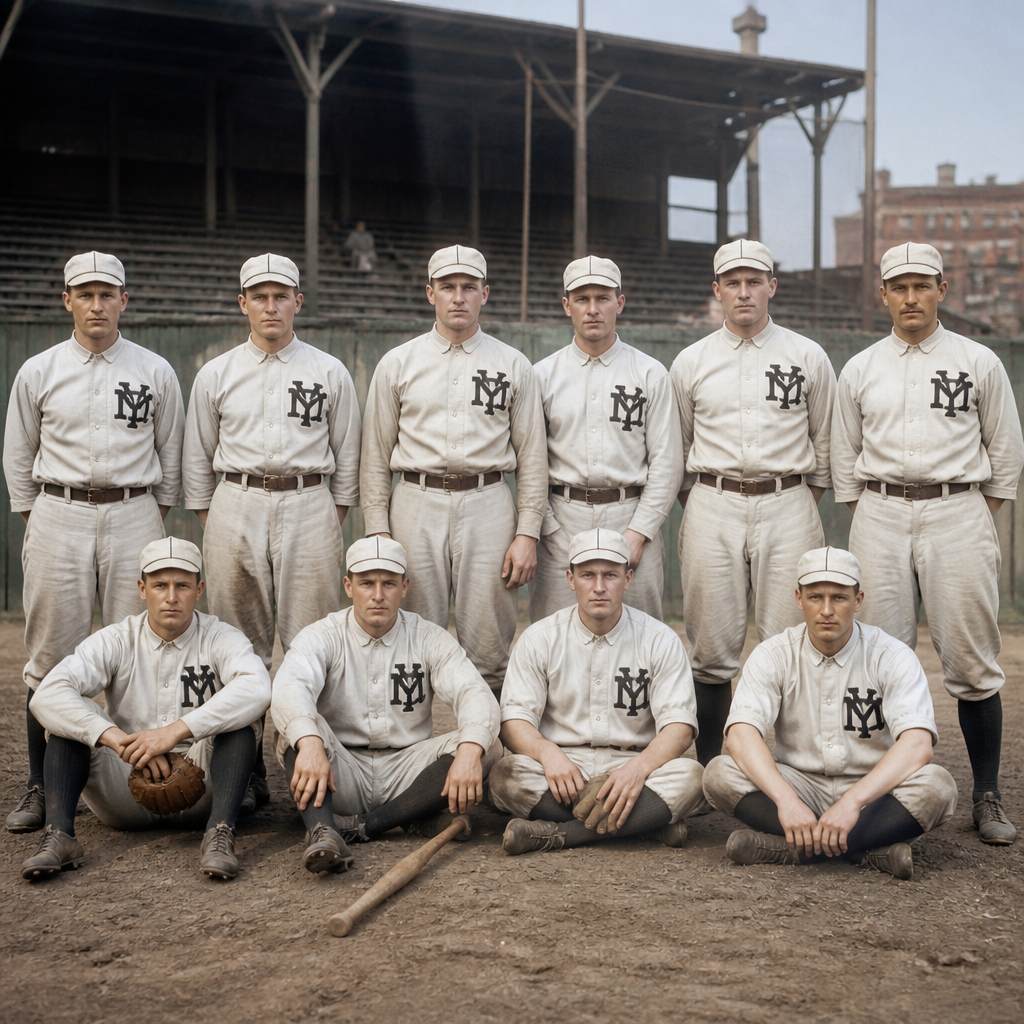
The Mutual Base Ball Club of New York stands at the center of early baseball history because its story connects volunteer fire company culture, amateur club rivalry, the commercialization of sport, and the birth of the professional game. Founded in New York City in 1857 and closely tied to the city’s Mutual Hook and Ladder Company, the club began as a social and athletic outlet for firemen who embraced the fast-growing New York game. In that era, “base ball” referred not to one fixed sport but to a family of bat-and-ball games, and clubs like Mutual helped standardize rules, schedules, and competitive expectations. As a hub within the broader subject of amateur clubs and early competition, the Mutual club matters because it reveals how loosely organized neighborhood teams evolved into disciplined institutions that drew crowds, charged admission, recruited talent, and eventually paid players. I have worked through scorebooks, convention records, and match reports from this period, and Mutual appears repeatedly whenever the sport takes a major step forward. To understand why baseball became a national game, it is not enough to study famous stars or modern leagues; you have to study clubs like Mutual, where civic identity, working-class pride, and competitive ambition met on the field.
Mutual’s importance also comes from timing. The club emerged during the years when the National Association of Base Ball Players, formed in 1857, became the main authority over the sport’s rules and customs. That association was initially amateur in principle, yet competition quickly pushed clubs toward semi-professional behavior. Teams traveled farther, sought stronger opponents, and quietly compensated players with jobs or expenses. Mutual operated within that changing environment and exposed its tensions. It was respected enough to compete with leading clubs such as the Knickerbockers, Eckfords, Atlantics, and Excelsiors, but it was also pragmatic enough to adapt when amateur ideals no longer matched reality. For readers exploring early baseball, Mutual serves as a bridge: it links antebellum club culture to postwar championship competition and then to openly professional baseball in the 1869–1871 period. That makes this article a practical starting point for the entire subtopic of amateur clubs and early competition, including club organization, rules reform, championship challenges, urban rivalries, player movement, and the transition from gentlemanly recreation to a spectator business.
Origins in New York Fire Company Culture
The Mutual club grew out of a world that modern fans often overlook: the volunteer fire companies of New York. Before a fully professional municipal fire department took shape, fire companies were community institutions with strong internal loyalties, uniforms, reputations, and neighborhood rivalries. Athletic competition fit naturally into that environment. Firemen already valued drill, strength, speed, and public display, so a base ball club attached to a company had built-in camaraderie and discipline. Mutual Hook and Ladder Company provided exactly that base. The club’s name announced mutual aid and solidarity, and those values carried onto the diamond. Early baseball clubs were usually social organizations first and sporting bodies second, with constitutions, dues, elected officers, and club colors. Mutual followed that pattern.
This connection to fire company culture also helps explain why early baseball spread so quickly in cities. Clubs did not have to invent social structure from nothing; they borrowed it from fraternal groups, militias, trade networks, and volunteer companies. In practical terms, that meant members already knew how to hold meetings, collect fees, discipline absences, and present themselves publicly. Mutual benefited from all of those habits. Match reports from the late 1850s and early 1860s show a club that was competitive but also highly organized, capable of arranging fixtures and turning out regularly against strong opposition. In the amateur era, that reliability mattered as much as talent. A club that could not field nine men, maintain grounds, or honor appointments did not last. Mutual did, and that longevity is one reason historians treat it as foundational rather than merely colorful.
How Amateur Clubs Worked in Early Baseball
To understand Mutual, it helps to understand how an amateur base ball club functioned before leagues and standardized seasons. Clubs elected a president, vice president, secretary, treasurer, and often committees for admissions or grounds. Members paid dues, attended meetings, and participated in practice matches. Challenges were issued by letter and accepted publicly, often through newspapers. Games were arranged under agreed rules, most commonly the New York rules endorsed by the National Association of Base Ball Players. Those rules differed sharply from modern baseball: pitchers delivered the ball underhand, fielders could record outs by catching a fair or foul ball on one bound in some periods, gloves were minimal or absent, and games were generally played to a set number of runs, usually 21 in the earlier years, rather than a fixed nine innings.
These structures made clubs like Mutual central to baseball’s early governance. There was no commissioner’s office and no formal league schedule. Instead, legitimacy came from recognition by peer clubs and from participation in association meetings. Mutual competed in that world with seriousness. It had to maintain enough financial stability to secure grounds and equipment, enough social coherence to keep members active, and enough on-field success to attract worthy opponents. Amateur did not mean casual. By the early 1860s, top clubs trained, practiced, and selected lineups with care. Newspaper readers followed challenge matches closely, and club reputations could rise or collapse on a single heavily attended game. Mutual’s record in this setting demonstrates how quickly baseball matured from pastime to organized competition.
Competition, Rules, and the Rise of Prestige
Mutual’s climb in status was tied to the broader competitive culture of New York and Brooklyn, then the sport’s power centers. Clubs did not merely seek recreation; they sought standing. A victory over a recognized first-rate nine signaled legitimacy, while repeated success could produce claims to championship status. Because no modern playoff system existed, championship recognition in the amateur era was informal and often contested, based on challenge conventions and public consensus. This ambiguity fueled intense rivalry. Clubs wanted not just to win, but to be seen as the rightful leading club. Mutual became part of that debate because it was durable, visible, and often formidable.
Rules standardization was equally important. The 1857 convention that created the National Association of Base Ball Players helped unify the New York game, setting expectations for club membership and match play. Subsequent conventions refined key details such as game length, pitching restrictions, and eligibility. Mutual participated in the competitive environment shaped by those decisions. This is one of the clearest examples of how amateur clubs built baseball’s infrastructure. They were not passive users of rules handed down from above; they created the standards collectively. When historians trace baseball’s evolution from local recreation to national sport, the policy work of clubs at conventions deserves nearly as much attention as game results.
| Feature | Early Amateur Club Era | Mutual’s Significance |
|---|---|---|
| Organization | Member-run clubs with elected officers and dues | Showed how stable institutions could sustain competition |
| Scheduling | Challenges arranged individually, not league fixtures | Built reputation through prominent matches |
| Rules | Standardized gradually through annual conventions | Operated during the key standardization period |
| Championships | Based on challenge custom and public recognition | Competed in the contested race for top-club status |
| Player status | Nominally amateur, often with hidden compensation | Illustrated the drift toward professionalism |
Mutual Among the Great Clubs of the 1860s
No hub article on amateur clubs and early competition is complete without placing Mutual among its rivals. The Knickerbockers are famous for codifying the New York game, but by the late 1850s they were no longer its strongest club. The Eckfords of Brooklyn, the Atlantics, the Excelsiors, and other leading nines pushed competitive standards higher. Mutual entered that upper tier through persistence and sharp club management. It did not possess the social aura of the Knickerbockers, yet it represented something just as important: the broadening base of baseball beyond elite circles. Its firemen roots and urban character reflected a sport becoming more democratic, more public, and more aggressive in competition.
Mutual’s matches against major clubs mattered because they drew attention to quality of play, not just social ceremony. Reports from the period often described fielding precision, batting placement, and strategic use of the “fly game” as standards improved. Even before overhand pitching and modern equipment, skill differentials were obvious to informed spectators. A top club had clean hands in the field, fast and accurate throwing, disciplined batting, and internal order. Mutual built a reputation for being able to meet those standards. This made it a useful case study for the subtopic as a whole: amateur baseball was not a primitive sideshow waiting to become real sport. It was already a sophisticated competitive culture, and clubs like Mutual proved it.
From Amateur Ideal to Professional Reality
The central tension in early baseball was simple: clubs celebrated amateur honor while behaving more and more like businesses. Strong players were valuable, and clubs found ways to secure them. Sometimes that meant offering employment through a supporter’s business, covering travel and lodging, or quietly paying expenses beyond what ordinary members received. By the late 1860s, this hypocrisy had become difficult to ignore. The Cincinnati Red Stockings’ openly salaried model in 1869 is usually treated as the great turning point, and rightly so, but the ground had been prepared by clubs that had already blurred the line between amateurism and professionalism. Mutual was one of them.
What made Mutual especially significant is that it did not vanish when the old ideal broke down. It adapted. In 1871, when the National Association of Professional Base Ball Players formed as the first professional league, Mutual joined as a charter member. That fact alone secures its place in baseball history. The club had traveled from a fire company’s social-athletic organization to the professional ranks within roughly fourteen years. The transition was not cosmetic. It required new financial expectations, more demanding travel, stronger roster management, and a different relationship with spectators, who were increasingly customers as well as supporters. Mutual’s survival across that divide shows how continuity worked in early baseball: professional clubs were not created from thin air; they emerged from ambitious amateur institutions that had already built governance, fandom, and competitive habits.
Why Mutual Matters in the History of Amateur Competition
As a hub topic, amateur clubs and early competition includes several recurring themes, and Mutual illuminates each one. First, club identity mattered. Teams were rooted in neighborhoods, workplaces, or associations, and those roots shaped loyalty. Second, rules and governance emerged from cooperation among clubs, not from a distant authority. Third, championship culture developed before formal leagues, creating prestige through public argument, newspaper coverage, and challenge traditions. Fourth, player movement and concealed compensation destabilized the amateur ideal. Fifth, the Civil War era and its aftermath expanded baseball geographically while preserving New York’s influence. Mutual appears at every stage.
It also helps correct common myths. Early baseball was not invented in a single moment, nor was it instantly professional after the Civil War. The actual process was incremental and messy. Clubs negotiated standards, copied successful practices, and improvised solutions to disputes over eligibility, travel, and competition. Mutual’s evolution demonstrates that baseball history is best understood as institutional history as much as athletic history. The most important question is not only who won, but how clubs built systems that made winning meaningful and visible to the public.
Legacy and Pathways for Further Study
Mutual’s later professional career, including its participation in the National Association and then the National League’s early orbit, belongs to the next chapter of baseball history, but its deepest significance remains rooted in the amateur age. For anyone studying early baseball, Mutual opens several pathways for further reading. One is the relationship between New York and Brooklyn clubs and the consolidation of the New York rules. Another is the role of newspapers such as the New York Clipper in creating a shared baseball public. A third is the social composition of clubs, from white-collar gentlemen’s nines to workingmen’s organizations. A fourth is the economics of grounds, gate receipts, and player recruitment before professionalism was officially accepted.
These pathways show why Mutual deserves treatment as a hub subject rather than a sidebar. Its history intersects with nearly every major development in the early game. If you are moving deeper into the early history of baseball, use Mutual as an anchor point: compare it with the Knickerbockers on rules, with the Atlantics on championship ambition, with the Eckfords on urban rivalry, and with the Red Stockings on professionalism. Doing so reveals a clear pattern. Baseball became national and professional because clubs first made it local, organized, and fiercely competitive. The Mutual Base Ball Club of New York exemplified that transformation from within.
The Mutual Base Ball Club of New York matters because it captures the full arc of baseball’s formative decades in one institution. It began in the civic world of volunteer firemen, matured within the disciplined structure of the amateur club movement, competed against the era’s strongest nines, and crossed into professionalism when the old amateur code no longer matched reality. That journey explains far more than the history of one club. It explains how early baseball worked. Clubs created rules, arranged matches, cultivated identity, argued over championships, and gradually built a paying audience for elite play. Mutual’s record shows that amateur competition was not a quaint prelude to the real story. It was the real story’s foundation.
For readers exploring the early history of baseball, the practical takeaway is clear. Start with clubs, not just stars. Study how organizations like Mutual formed, governed themselves, chose opponents, and responded to incentives that pulled them toward professionalism. From there, the larger map of nineteenth-century baseball becomes easier to read. You can trace the spread of the New York game, the growth of intercity rivalry, the influence of the Civil War, and the creation of professional leagues with greater precision. Mutual belongs at the center of that map because it connects all of those threads. If you are building out your understanding of amateur clubs and early competition, make this club your reference point and continue to the related histories of the Knickerbockers, Atlantics, Eckfords, Excelsiors, and the first professional associations.
Frequently Asked Questions
What was the Mutual Base Ball Club of New York, and why is it so important in baseball history?
The Mutual Base Ball Club of New York was one of the most influential clubs in the formative decades of organized baseball. Established in 1857, the club emerged at a moment when “base ball” was still developing from a collection of local bat-and-ball traditions into a more standardized urban sport. What makes the Mutuals especially important is that their story sits at the crossroads of several major historical developments: the rise of organized club baseball in New York City, the social world of volunteer fire companies, increasingly intense competition between elite amateur clubs, and the gradual shift from amateur ideals to openly professional play.
In practical terms, the Mutuals were not just another early team. They were part of the network of prominent New York-area clubs that helped define how the game was played, scheduled, and promoted. Their matches drew attention in an era when baseball was becoming a public spectacle rather than just a neighborhood pastime. As the sport matured, the Mutuals remained relevant through multiple phases of baseball’s evolution, from amateur competition under the National Association of Base Ball Players to the professional era that followed.
The club’s long arc also makes it historically valuable. The Mutuals began as a socially rooted organization with strong local identity, then adapted to the realities of a changing sports culture in which gate receipts, player movement, club prestige, and public demand increasingly shaped the game. Because of that trajectory, historians often look at the Mutual Base Ball Club as a case study in how early baseball moved from civic recreation to commercial entertainment. Their history helps explain not only who played the game, but also how the sport became organized, marketable, and professional.
How was the Mutual Base Ball Club connected to New York’s volunteer firemen?
The Mutual Base Ball Club was closely associated with the Mutual Hook and Ladder Company, a volunteer fire company in New York City. That connection was far more than a passing detail. In mid-19th-century urban America, volunteer fire companies were important social institutions. They were made up of local men who developed strong bonds through shared work, neighborhood loyalty, public service, and a highly visible masculine culture that prized toughness, reputation, and camaraderie. Those same qualities translated naturally into organized athletic competition.
For many early baseball clubs, social identity mattered as much as athletic ambition, and the Mutuals are a textbook example. Their roots in fire company culture meant the club was built on an existing network of trust and belonging. Members already knew one another, socialized together, and participated in a public-facing civic institution. Baseball became an extension of that world: a way to compete, represent the group, and build prestige both within the neighborhood and across the city’s growing sporting scene.
This connection also helps explain the character of the club. Early baseball was deeply tied to fraternal and associational life, and the Mutuals embodied that reality. They were not founded as a modern business franchise but as a club grounded in social membership and collective identity. Yet that same fire company culture also encouraged spirited rivalry, public performance, and loyalty to the team’s reputation—all traits that helped baseball thrive as a spectator sport. In that sense, the Mutuals’ firemen roots illuminate how community institutions helped launch baseball before commercial owners and formal leagues took control.
How did the Mutuals reflect the transition from amateur baseball to professional baseball?
The Mutuals are a particularly revealing example of baseball’s transition from amateurism to professionalism because they existed through the period when the sport’s values, economics, and structure were being renegotiated. In the club era of the 1850s and 1860s, baseball publicly celebrated amateur ideals such as gentlemanly conduct, civic recreation, and play for honor rather than wages. At the same time, leading clubs competed intensely for talent and prestige, and the line between pure amateurism and compensated play was often blurry.
As competition intensified, stronger clubs sought better players, larger crowds, and more consistent success. That environment created pressure to reward athletes, whether through jobs, expenses, indirect payments, or outright salaries. The Mutuals were among the clubs operating in this increasingly competitive world, where public rhetoric still praised amateurism but actual practices often moved toward professionalism. Like other major clubs of the period, they had to navigate a game that was becoming more demanding, more visible, and more commercial.
By the late 1860s and early 1870s, baseball had entered a new stage. Open professionalism, once controversial, became a defining feature of top-level competition. Clubs such as the Mutuals no longer functioned only as social-athletic associations; they became organizations expected to field strong teams, attract paying spectators, and compete in a marketplace of talent. Their development reflects the broader transformation of baseball from a recreational club culture into a business-oriented sport. That is one reason the Mutuals matter so much: they show that professionalism did not suddenly appear out of nowhere, but grew gradually out of existing clubs, rivalries, and competitive pressures.
What role did the Mutual Base Ball Club play in early organized baseball competition?
The Mutuals were active participants in the highly influential New York baseball scene, which was central to the codification and spread of the “New York game.” In the years after their founding, organized baseball was shaped by clubs that scheduled matches, followed increasingly standardized rules, and measured status through victories over respected opponents. The Mutuals competed in this environment at a time when baseball was shifting away from loosely defined local versions toward a more recognizable organized sport.
Their role in competition was significant because clubs like the Mutuals helped sustain the culture of interclub rivalry that drove baseball’s popularity. These games were not merely casual contests; they were social events, tests of local pride, and demonstrations of club discipline and skill. Strong clubs built reputations that extended beyond their immediate neighborhoods, and successful matches attracted both press attention and public interest. As a result, the Mutuals contributed to the growth of baseball as a spectator activity with recognizable teams and recurring competitive narratives.
They also belonged to the generation of clubs that bridged the game’s early associational phase and its league-based future. Before the fully modern league system took hold, prestige came through match-making, club reputation, and performance against notable rivals. The Mutuals’ presence in that world helped create continuity between early club baseball and later professional competition. Their history shows that organized baseball developed through institutions that were initially social and civic in character but became increasingly athletic, strategic, and commercially aware.
Why does the story of the Mutuals matter beyond sports history?
The story of the Mutual Base Ball Club matters beyond baseball because it opens a window onto urban life, class identity, voluntary associations, and the commercialization of leisure in 19th-century America. The club’s origins in a volunteer fire company reveal how sport grew out of existing civic and neighborhood institutions rather than emerging fully formed as entertainment businesses. In other words, the Mutuals help us see baseball as part of a larger social history of cities, working men, public identity, and organized recreation.
The club also illustrates how rapidly American culture was changing in this period. New York was expanding, newspapers were shaping public attention, and leisure activities were becoming more formalized and public-facing. Baseball fit neatly into that environment because it offered regular competition, visible heroes, and a structure that could attract repeat spectators. The Mutuals’ evolution from a socially rooted club into a participant in the professional game mirrors a broader shift in American life: activities once pursued for fellowship, honor, or local pride increasingly became commercial enterprises supported by audiences and money.
Finally, the Mutuals matter because they challenge overly simple stories about baseball’s origins. Early baseball was not just invented, standardized, and professionalized in a straight line. It was shaped by communities, rivalries, institutions, and cultural habits that often overlapped in messy but revealing ways. The Mutual Base Ball Club stands out precisely because its history captures that complexity. It connects the worlds of volunteer firemen, amateur club athletics, urban public culture, and professional sports, making it an essential subject for anyone who wants to understand not just early baseball, but the society that helped create it.