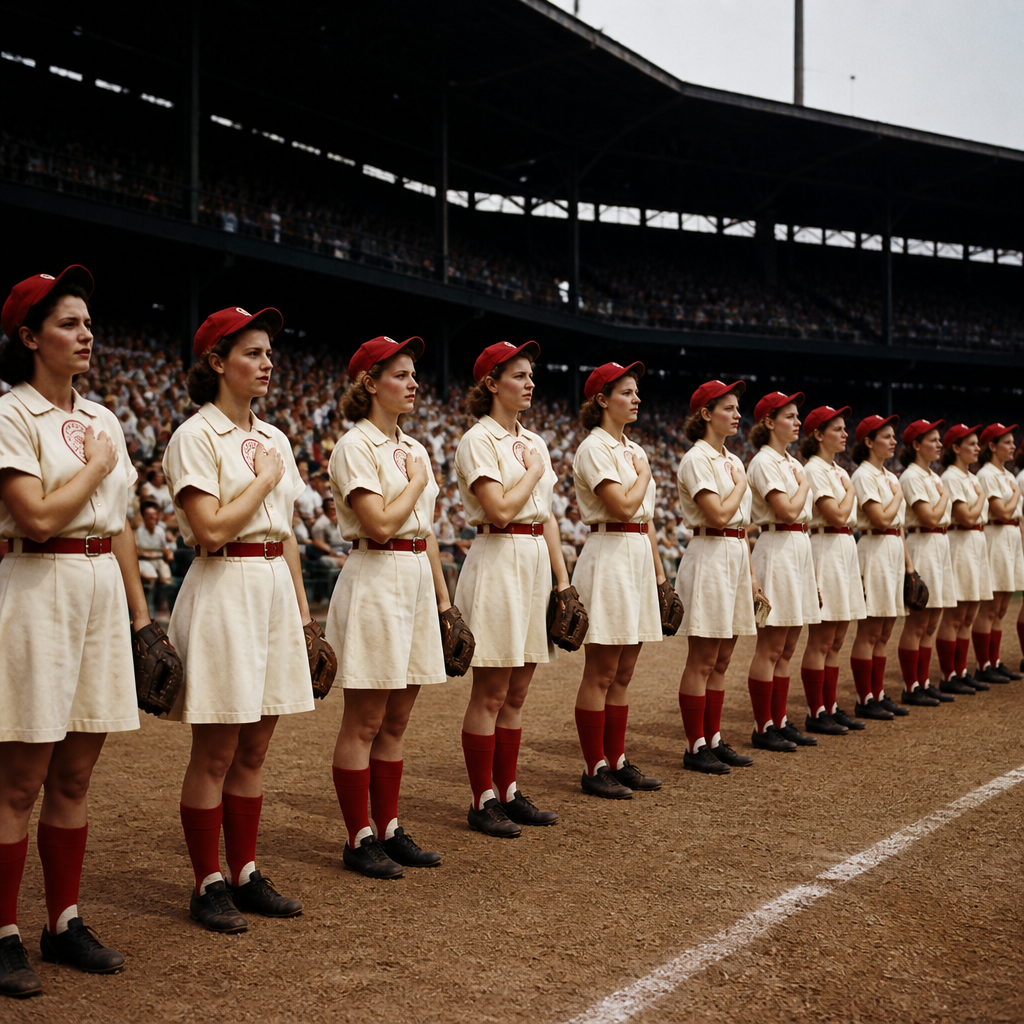
The All-American Girls Professional Baseball League was one of the most inventive and consequential experiments in American sports, a wartime league that became a proving ground for women athletes, a business case study, and a cultural landmark whose influence reaches far beyond the diamond. Founded in 1943, the league offered paid professional baseball for women at a moment when military service threatened Major League Baseball attendance and when social norms still treated women’s competitive sport as a novelty. For readers exploring women in baseball, this retrospective matters because the league sits at the center of several larger stories: gender and labor, professionalization, media representation, regional sports culture, and the long fight for historical recognition. It is not merely a footnote preserved by nostalgia or by the popularity of A League of Their Own. It was a real league with real owners, schedules, payrolls, scouting systems, training rules, and communities of fans who followed pennant races with the same intensity found in any serious baseball market.
Understanding the league begins with a few key terms. A professional league means players received salaries, signed contracts, traveled to scheduled games, and performed within a structured business organization. Women in baseball, in this context, refers not to softball generally but to women playing a baseball code that evolved throughout the league’s existence. Retrospective means more than recounting famous names; it requires looking at how the league started, how it changed year by year, why it succeeded for a time, why it declined, and what legacy it left. I have worked through league records, Hall of Fame materials, newspaper coverage, and player interviews over many seasons of studying women’s baseball history, and the same conclusion keeps emerging: the AAGPBL succeeded because it solved several problems at once. It gave Midwestern cities summer entertainment, gave owners a hedge against wartime uncertainty, gave women athletes a rare professional pathway, and gave baseball itself a public demonstration that skill, strategy, and drawing power were not confined to men.
Origins, wartime necessity, and the league’s founding model
The league was organized in 1943 under the leadership of Chicago Cubs owner Philip K. Wrigley and advertising executive Arthur E. Meyerhoff. Their initial concern was practical, not ideological. With World War II draining rosters and threatening attendance, baseball investors wanted a summer product that could keep ballparks active and fans engaged. The first teams were the Rockford Peaches, Racine Belles, Kenosha Comets, South Bend Blue Sox, and later that first season the expansion Milwaukee Chicks. The league’s early footprint in the industrial Midwest was deliberate. These towns already supported baseball, were connected by manageable travel routes, and offered dense local fan bases. In modern sports terms, the founders chose right-sized markets with strong civic identity and lower operating friction.
The original playing style was a hybrid. The ball was larger than a standard baseball, pitchers delivered underhand at first, and base paths were shorter, reflecting both softball influence and assumptions about women’s play that executives considered marketable. Yet from the start, the league moved steadily toward regulation baseball. The ball size shrank, pitching evolved toward sidearm and then overhand, and the game became faster and more recognizably baseball-oriented. That gradual transition is essential to any accurate account because it shows the league was not static. It adapted in response to player skill, fan expectations, and competitive ambition. Scouts recruited athletes from softball circuits across the United States and Canada, but once players entered the league, they developed into ballplayers operating at a highly refined professional level.
How the league worked: teams, salaries, rules, and player development
The AAGPBL functioned with more organizational rigor than casual summaries suggest. Players signed contracts, lived with host families in many cities, followed curfews, and attended spring training, most famously in places such as Havana, Cuba, in some early years and later in U.S. camps. Salaries varied by talent and season, but weekly pay generally ranged from about $45 to $85 in the early years, with stars earning more. That was meaningful money during the 1940s, especially compared with many conventional jobs open to women. Teams played demanding schedules, often exceeding 100 games, and travel was largely by bus. The physical and mental toll was real: dense schedules, hot summer conditions, public scrutiny, and constant performance pressure.
League administrators also imposed strict conduct and appearance standards. Charm school, lipstick, skirted uniforms, and rules about feminine presentation were built into the business model because management believed respectability and marketability were inseparable. This remains one of the league’s central tensions. On one hand, these policies constrained athletes and reflected the gender policing of the period. On the other hand, many players strategically navigated those rules because the league gave them access to elite competition, wages, and visibility they could not find elsewhere. Any honest retrospective must hold both truths together. The players were neither passive symbols nor purely liberated professionals. They were workers and competitors operating inside a system shaped by mid-century expectations.
| Aspect | Early League Approach | Later Development | Why It Mattered |
|---|---|---|---|
| Ball size | Larger than Major League baseball | Reduced over time | Moved the game closer to standard baseball |
| Pitching style | Underhand delivery | Sidearm, then overhand | Raised skill ceiling and changed strategy |
| Uniforms | Skirted tunics | Remained largely consistent | Balanced marketing goals with serious drawbacks for play |
| Player recruitment | Softball-heavy scouting base | Broader cross-border talent identification | Deepened competition and professionalism |
| League identity | Novel wartime attraction | Established regional professional circuit | Built durable fan loyalty in core cities |
Stars, teams, and the competitive history fans still remember
No retrospective is complete without the athletes and franchises that defined the league’s competitive life. The Rockford Peaches became the most widely recognized team later through film, but they were also a legitimate baseball power. The Racine Belles captured the first championship in 1943. The Milwaukee Chicks won in 1944 despite severe attendance and facility challenges. The Grand Rapids Chicks, South Bend Blue Sox, Fort Wayne Daisies, and later the Kalamazoo Lassies each contributed to the league’s rich competitive map. By its peak in 1948, the league had ten teams and drew nearly one million fans, a figure that confirms this was no marginal attraction.
Individual standouts gave the league star power and technical excellence. Dottie Kamenshek of the Rockford Peaches was renowned for defense at first base and all-around hitting; she impressed even male professionals, and Wrigley reportedly considered her one of the finest players in the organization. Sophie Kurys was a base-stealing phenomenon whose speed changed games and forced defensive errors under pressure. Jean Faut was a dominant pitcher and hitter, one of the clearest examples of two-way excellence in professional baseball history. Connie Wisniewski, Joanne Winter, Betty Foss, and Dorothy Schroeder were among many others whose records deserve regular citation. When evaluating talent, the important point is not symbolic participation but measurable performance: batting titles, stolen-base totals, strikeout rates, shutouts, and pennant-clinching contributions.
The league as a social institution: gender, labor, and community life
The AAGPBL mattered because it altered what communities could imagine women doing in public. In city after city, girls and women saw athletes who were not hidden in exhibition settings but featured in newspaper sports pages, radio mentions, and local advertising. That visibility changed aspirations. Parents brought daughters to games. Boys grew up watching women execute double plays and bunt defenses. Employers saw women associated with stamina, discipline, and teamwork. The league did not erase sexism, but it created a recurring civic scene in which female athletic competence was ordinary, ticketed, and cheered.
At the same time, the league should be understood as labor history. Players generated revenue while accepting extensive behavioral controls, unstable job security, and uneven conditions between clubs. Some cities supported teams robustly; others struggled with poor facilities or weak promotion. Most players did not become wealthy, and few had long-term institutional support after retirement. This gap between public entertainment value and private compensation is familiar across sports history, and it applies here as well. The players delivered a commercial product under conditions that mixed opportunity with limitation. That complexity is why the league remains such a fertile subject for scholars of women’s work, sport management, and American culture.
Why the league declined after its peak years
The league’s decline after the late 1940s was not caused by a single event. Instead, several pressures converged. First, wartime necessity faded. Men returned from military service, Major League Baseball stabilized, and the original hedge strategy lost urgency. Second, ownership cohesion weakened. Centralized leadership that had helped shape standards gave way to more club-level decision making, and not every operator marketed effectively or invested consistently. Third, entertainment competition increased. Postwar families had more choices, including television, other local sports, and broader leisure spending. Fourth, the league’s own identity became harder to define nationally. It was highly successful in certain Midwestern communities, but it did not fully secure a coast-to-coast profile that could counter regional fragility.
There were also baseball-specific issues. As the game moved closer to full baseball rules, the athletic product improved, but marketing narratives built around novelty were harder to maintain. Facilities, travel demands, and media coverage varied significantly. By 1954, the league folded. Importantly, closure did not prove lack of quality. Many excellent sports ventures disappear because financial ecosystems, media structures, and ownership alignment fail to keep pace with the product on the field. That distinction matters for anyone building a women in baseball hub today. The lesson is not that women’s professional baseball could not work. The lesson is that sustainable leagues require patient capital, coherent governance, consistent promotion, and distribution channels equal to the quality of play.
Media memory, historical recovery, and the league’s place in women in baseball
For decades after 1954, the AAGPBL survived mostly through reunions, local memory, scattered archives, and the determination of former players. The major turning point in public recognition came in 1988, when the National Baseball Hall of Fame and Museum in Cooperstown unveiled its Women in Baseball exhibit, honoring the league and the broader history of women on the diamond. That institutional recognition mattered because it moved the league from anecdote into the official historical record. Four years later, A League of Their Own transformed awareness again. The film captured the emotional truth of the experience for many viewers, even while fictionalizing names, timelines, and events. It became a gateway, not a substitute, for history.
Today, the league occupies a foundational place within the women in baseball conversation because it connects so many adjacent topics. If a reader wants biographies, the AAGPBL offers dozens. If they want the evolution of women’s baseball rules, the league provides a clear timeline. If they want labor history, wartime society, sports marketing, or media representation, the league supplies rich case material. It is the ideal hub subject for a miscellaneous section because it points outward to nearly every related article: pioneers before 1943, international women’s baseball, Black women in baseball history, the relationship between softball and baseball, Hall of Fame recognition, and current efforts to build new professional pathways.
The All-American Girls Professional Baseball League deserves to be remembered as a serious professional enterprise, not as a charming exception. It proved that women could sustain a high-level baseball league, attract paying crowds, and leave behind records worthy of rigorous analysis. It also revealed the structural obstacles that women’s sports have repeatedly faced: uneven investment, restrictive branding, and fragile media support. The most useful takeaway is practical. When people ask whether women belong in baseball, history has already answered. They always have. The better question is whether institutions will provide the resources, visibility, and long-term commitment that talent requires. Use this hub as a starting point: explore the players, teams, rule changes, and legacy threads that radiate from the AAGPBL, and you will understand women in baseball with far greater clarity.
Frequently Asked Questions
What was the All-American Girls Professional Baseball League, and why was it created in 1943?
The All-American Girls Professional Baseball League, often abbreviated as the AAGPBL, was a professional women’s baseball league founded in 1943 during World War II. Its creation was driven by both necessity and vision. With many male professional players entering military service, baseball executives and team owners worried that Major League Baseball could lose momentum, attendance, and public attention during the war years. The AAGPBL emerged as an inventive answer to that problem: it kept professional diamond sports in the public eye while opening paid athletic opportunities for women on an unprecedented scale.
The league was not simply a novelty or wartime placeholder. It was a serious commercial enterprise that combined sports entertainment, regional promotion, and athlete development. Organized primarily in Midwestern cities, it gave women the chance to play before paying audiences in an era when most female athletes had limited public platforms. In that sense, the league was groundbreaking. It proved that women could draw crowds, perform at a high level, and sustain a structured professional sports organization.
Its founding also reflected the contradictions of the era. On one hand, the league challenged assumptions about who belonged on a baseball field. On the other, it marketed players within strict expectations of femininity, requiring charm school, uniforms designed to appear ladylike, and behavioral standards off the field. Even so, the AAGPBL became one of the most important experiments in American sports history because it expanded the idea of who could be a professional athlete and demonstrated that women’s team sports had commercial and cultural value.
Did the players in the AAGPBL play baseball or softball, and how did the game evolve over time?
The simplest answer is that the league began as a hybrid and evolved into something much closer to traditional baseball. In its early years, the AAGPBL used elements drawn from both softball and baseball. The ball was larger than a standard baseball, pitching was initially underhand, and some field dimensions reflected softball-style influence. Those choices were partly practical, since many early recruits came from softball backgrounds rather than organized women’s baseball systems.
As the league matured, however, the rules shifted steadily toward baseball. The ball size decreased, base paths and pitching distance changed, and pitching styles progressed from underhand to sidearm and eventually to overhand. This transition is one of the clearest signs that the league was not static. It was actively refining its product, improving competitive quality, and asking its athletes to adapt to increasingly demanding standards. By the later years of the league, the style of play looked much more recognizably like baseball than softball.
This evolution mattered for several reasons. First, it highlights the athletic versatility of the players, who had to retrain techniques and adjust to changing game mechanics while competing professionally. Second, it complicates modern misunderstandings about the league. Popular memory sometimes blurs the distinction, but the AAGPBL was not merely a softball league with baseball branding. It was a dynamic professional league that moved deliberately toward baseball and developed athletes capable of playing a sophisticated, fast, and highly skilled version of the game.
How important was the AAGPBL for women’s sports and for the history of professional athletics in the United States?
The AAGPBL was enormously important, both within women’s sports history and within the broader development of American professional athletics. At a time when women’s competition was often minimized, underfunded, or dismissed as secondary, the league offered salaries, travel, structured schedules, team identities, fan followings, and media attention. That alone made it revolutionary. It created a visible professional pathway for women athletes decades before later gains in women’s sports infrastructure and public recognition.
Its importance also lies in how many boundaries it crossed at once. The league was a labor story, because women were being paid to perform athletic work in a professional setting. It was a business story, because owners and promoters had to market teams, build audiences, manage operations, and compete for public attention. And it was a cultural story, because every game challenged assumptions about gender, athleticism, and public life. Women in the AAGPBL were not participating as a ceremonial sideshow; they were competing to win, entertaining paying crowds, and helping define a professional sports product.
In retrospect, the league can be seen as a bridge between earlier women athletes who fought for legitimacy and later generations who benefited from expanded opportunities in school, collegiate, Olympic, and professional sports. Although it did not survive long enough to create a continuous women’s professional baseball tradition, its existence left a lasting blueprint. It showed that women’s team sports could be organized, monetized, and celebrated. For that reason, the AAGPBL remains a foundational chapter in the history of American sports progress.
What challenges and contradictions did players face while competing in the league?
Players in the AAGPBL faced a unique mix of opportunity and constraint. On the positive side, they gained access to professional competition, income, travel, and a level of public recognition that was rare for women athletes in the 1940s and 1950s. But those opportunities came with intense pressures. The league expected players to excel athletically while also conforming to narrow standards of femininity. They attended charm school, followed appearance rules, and wore skirted uniforms that were visually distinctive but often impractical and physically uncomfortable for sliding and fielding.
These expectations reflected the social climate of the time. League leaders understood that many fans and sponsors still viewed women’s sports skeptically, so they promoted players as both skilled athletes and conventionally feminine public figures. That strategy may have helped broaden acceptance, but it also meant players had to perform two roles simultaneously. They were expected to be tough, disciplined, and competitive on the field while projecting grace and propriety off it.
The players also dealt with the ordinary demands of professional sports: injuries, travel fatigue, roster competition, pressure to perform, and uncertainty about career longevity. In many ways, they lived the reality of professional athletes without always receiving the long-term recognition accorded to male counterparts. Their experience is part of what makes the league so historically compelling. It was empowering, but it was also restrictive. It opened doors while still operating inside a culture that wanted women athletes to justify their presence. Understanding that tension is essential to any serious retrospective on the league.
Why does the legacy of the AAGPBL still matter today?
The legacy of the AAGPBL still matters because it speaks directly to ongoing conversations about opportunity, visibility, and respect in sports. The league demonstrated, decades ago, that women could succeed in a demanding professional team environment, attract fans, and become part of the national sports conversation. That lesson remains relevant in an era when women’s leagues still fight for equitable investment, media coverage, facilities, and historical recognition.
Its significance also extends beyond sports. The AAGPBL is a case study in how social change often happens unevenly. The league emerged from wartime disruption, challenged entrenched ideas about gender, and created meaningful professional roles for women athletes, yet it also reflected the limitations of its era. That complexity makes it especially useful for historians, educators, and readers interested in how culture evolves. The league was not perfect, but it was transformative.
Finally, the AAGPBL endures because memory and representation matter. Renewed public awareness through historical scholarship, archives, museum recognition, and popular culture has helped restore the players to their rightful place in American history. Their stories remind us that progress in sports did not begin recently; it was built by earlier generations who competed without the advantages later athletes would inherit. Remembering the AAGPBL means recognizing women not as a footnote to baseball history, but as central contributors to the story of American professional sport itself.