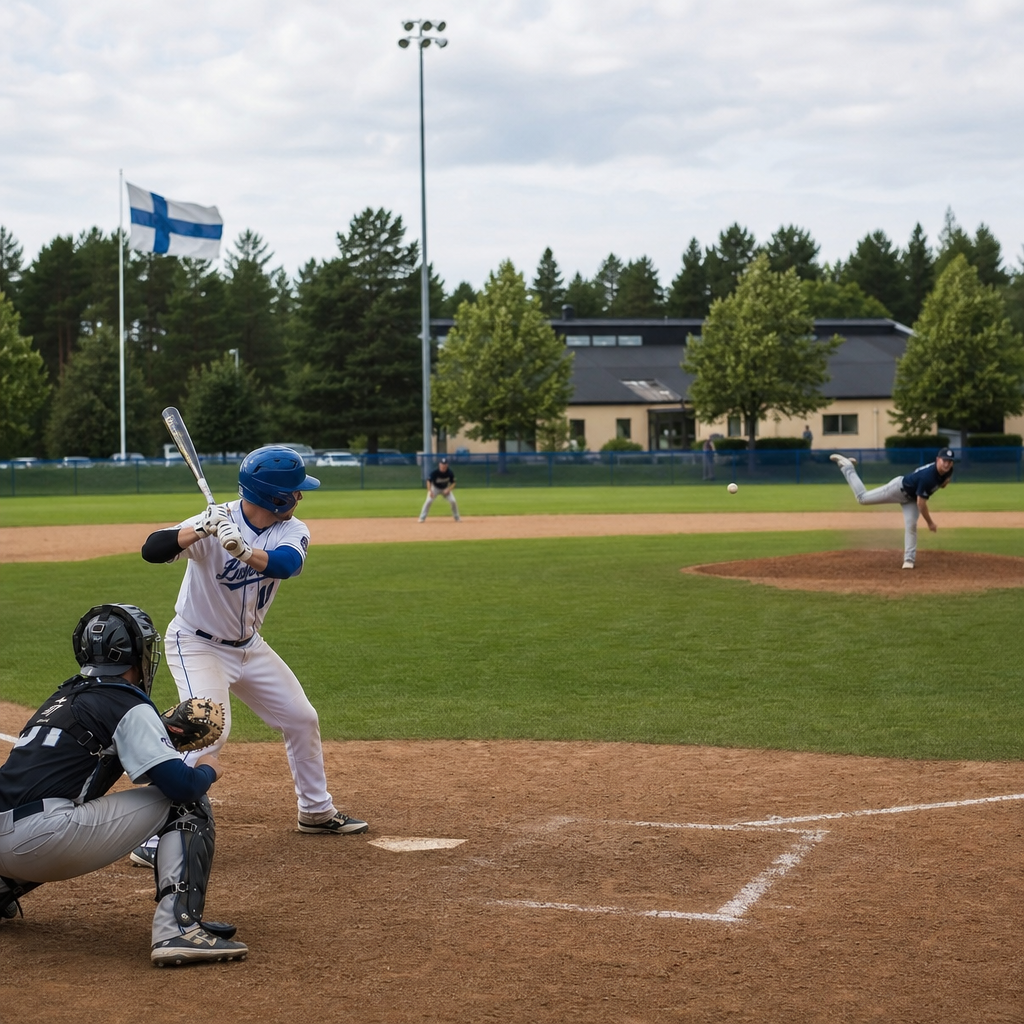
Baseball in Finland tells an unusual story because the country’s best-known bat-and-ball game is not baseball itself but pesäpallo, a fast, tactical Finnish variant developed in the early twentieth century. To understand the story of baseball in Finland, readers need to separate three related ideas: American baseball, softball, and pesäpallo. American baseball follows the familiar diamond, overhand pitching, and nine-player defensive structure. Softball uses a larger ball and often serves as an entry point for clubs and schools. Pesäpallo, created by Lauri “Tahko” Pihkala, adapts core bat-and-ball concepts into a distinctly Finnish sport with vertical pitching and different baserunning rules. That distinction matters because every discussion about baseball in Finland is shaped by pesäpallo’s cultural dominance, infrastructure, and public recognition.
In practice, I have found that many international readers assume Finland either embraced baseball like Japan or ignored it entirely. Neither view is accurate. Finland built a strong native bat-and-ball tradition, leaving limited space for American baseball, yet baseball has still developed through clubs, expatriate communities, youth outreach, and the work of the Finnish Baseball and Softball Federation. The sport remains niche, but it is organized, persistent, and internationally connected. That makes Finland a compelling case study within international baseball: it shows how a global game enters a market where a close local cousin already owns the calendar, fields, and public imagination.
This matters beyond trivia. Finland offers lessons about sports adoption, national identity, and the practical work required to grow baseball where competing traditions are entrenched. It also serves as a hub topic for broader coverage of miscellaneous international baseball stories, because Finland sits at the intersection of adaptation, coexistence, and cultural translation. Any serious overview of international baseball should include Finland precisely because the country demonstrates that growth does not always begin with mass popularity. Sometimes it begins with small clubs, borrowed facilities, imported equipment, and a long-term strategy built around community.
How Pesäpallo Shaped the Baseball Landscape
The first fact anyone should know is that pesäpallo has been the defining force in Finland’s bat-and-ball culture for a century. Developed in the 1910s and 1920s, it borrowed inspiration from older bat-and-ball games and from observations of North American baseball, then turned those ideas into something adapted for Finnish conditions. The result was a national sport with its own league structure, youth system, coaching culture, and municipal support. When people in Finland think about bats, gloves, innings, and summer competition, they are usually thinking about pesäpallo rather than Major League Baseball.
That dominance created both barriers and opportunities for baseball. The barrier is obvious: available athletes, coaches, media attention, and field time often flow to the established domestic sport. A municipality that already supports pesäpallo may see little reason to fund a separate baseball diamond. Parents may direct children toward the game they recognize, and sports journalists tend to cover what already has local audiences. Yet the opportunity is also real. Because Finland already values bat-and-ball skills, concepts such as hitting, throwing, catching, and tactical baserunning are familiar. Baseball does not have to explain the appeal of the genre; it only has to explain why its version deserves attention.
This is why baseball in Finland has often advanced through education rather than replacement. Coaches and organizers rarely position baseball as a superior alternative to pesäpallo. Instead, they frame it as a global version of a game family Finns already understand. That framing matters. It reduces resistance, helps athletes transfer skills, and opens doors for crossover participation, especially among players curious about international competition or opportunities abroad.
Origins and Early Development of American Baseball in Finland
American baseball arrived in Finland in modest, uneven stages rather than through one dramatic founding moment. As in many smaller European markets, the sport spread through cultural exchange, foreign residents, military and diplomatic contacts elsewhere in the region, travel, and media exposure. Television and later digital broadcasting helped Finns see Major League Baseball, but visibility alone did not create a domestic structure. Clubs, volunteer administrators, and federation work were needed to turn awareness into organized play.
The Finnish Baseball and Softball Federation became central to that process. National federations matter in emerging baseball countries because they do the unglamorous work: registering clubs, coordinating leagues, training umpires, managing national teams, handling international eligibility questions, and connecting with the World Baseball Softball Confederation and European governing structures. In Finland, those administrative foundations have been essential. Without them, baseball would remain an occasional recreational activity instead of a sport with championships, player pathways, and international representation.
Growth was never linear. Participation rose in some years and stalled in others, often depending on volunteer energy and access to facilities. That pattern is common in emerging baseball nations. A strong club can transform a region for a decade, then fade if key organizers relocate or funding shrinks. Finland has experienced those cycles, which explains why its baseball history is best understood as persistent development rather than sustained mass expansion.
Clubs, Competitions, and the Structure of the Finnish Game
Modern baseball in Finland is built around clubs rather than large commercial leagues. In practical terms, clubs are the engine of the sport. They recruit beginners, organize training, maintain equipment, and host domestic competition. Helsinki has naturally played an important role because capital cities attract international residents, students, and workers who may already know baseball. Other urban areas have also supported activity when a committed base of players and coaches exists.
Domestic competition usually reflects the realities of a small player pool. Rosters often mix experienced international players, Finnish converts from other sports, and complete beginners learning the game through league participation. This can create uneven quality, but it also accelerates development because new players gain meaningful game repetitions quickly. In larger baseball countries, a beginner might spend years in low-level recreational play. In Finland, motivated athletes can move into structured competition faster, which is helpful for retention.
Softball has also mattered to the ecosystem. In many countries, softball is not merely an adjacent sport; it is part of the same organizational survival strategy. Shared coaching, shared fields, and shared federation resources make the overall bat-and-ball community more resilient. Finland has benefited from that overlap. Mixed recreational environments can introduce newcomers to throwing mechanics, defensive positioning, and game rhythm before they commit fully to baseball.
| Area | Baseball in Finland | Pesäpallo in Finland |
|---|---|---|
| Cultural visibility | Niche, concentrated in clubs and international communities | Mainstream national sport with broad recognition |
| Facilities | Often adapted or shared spaces | Established municipal venues and league infrastructure |
| Player pathway | Federation and club driven, smaller talent base | Well-known domestic youth and senior systems |
| International connection | Direct link to European and global baseball competition | Primarily national, with cultural significance inside Finland |
The table captures the core reality: baseball in Finland does not compete on equal domestic terms with pesäpallo, but it offers a different value proposition. It connects Finnish players to an international sport with established pathways across Europe, Asia, and the Americas. For some athletes, that global link is the decisive attraction.
National Teams and Finland’s Place in European Baseball
Finland’s national baseball story is best viewed through European competition rather than expectations shaped by global powers such as the United States, Japan, South Korea, Cuba, or the Dominican Republic. In Europe, baseball depth varies widely. Countries like the Netherlands and Italy have long histories, stronger leagues, and deeper development systems. Emerging programs, including Finland, operate with smaller pools and more limited resources. That does not make international play unimportant; it makes it more significant. Every tournament becomes a test of organizational depth, player retention, and coaching quality.
National teams give Finnish baseball legitimacy. They provide goals for domestic players, a reason to standardize training, and a visible outcome for federation investment. They also force the sport to answer practical questions: Can Finland identify eligible players with Finnish heritage abroad? Can it retain athletes through multiple seasons? Can it prepare pitchers safely with limited competitive volume? These are not abstract issues. In countries with small baseball communities, roster management and player development are often the difference between merely fielding a team and building a program.
European baseball also exposes Finnish players to different styles. A Finnish team may face opponents shaped by Latin American coaching, American college experience, or long-established club systems in Central Europe. That exposure is valuable. It raises tactical understanding and helps local coaches benchmark what international standard actually looks like.
Facilities, Climate, and the Practical Challenge of Growth
If you ask why baseball remains small in Finland, climate and facilities are near the top of the answer. Finland’s long winters shorten outdoor playing seasons, complicate field maintenance, and make year-round repetition difficult. Baseball is a sport built on reps: pitchers need mound work, hitters need live swings, fielders need reads off the bat. Indoor training can cover mechanics, strength, and limited skill work, but it cannot fully replace outdoor game conditions.
Field design is another issue. A regulation baseball diamond requires specific dimensions, a maintained infield, safe outfield space, backstop protection, dugout areas, and ideally bullpen and batting infrastructure. Those standards are manageable in countries where baseball is established. In Finland, many clubs must adapt multipurpose fields or train in less-than-ideal settings. That affects player development. Infield hops change, warning track awareness is limited, and pitchers may not consistently work from regulation mounds.
Still, Finnish clubs have shown the creativity typical of emerging baseball nations. Indoor halls, school gyms, adapted surfaces, and seasonal scheduling are all part of the solution. Development in Finland depends less on perfect infrastructure than on making consistent use of available space. The countries that grow baseball outside its traditional centers are usually the ones willing to improvise without lowering technical standards.
Player Development, Recruitment, and Crossover Athletes
Recruitment in Finland often works best when baseball targets athletes who already possess transferable skills. Pesäpallo players may bring hand-eye coordination, fast decision-making, and confidence with bats and gloves, even if baseball timing and pitch recognition require major adjustment. Ice hockey players may offer rotational power, balance, and competitive discipline. Track athletes can add speed. Coaches in small baseball countries quickly learn that talent identification is less about waiting for lifelong baseball kids and more about converting athletes from other systems.
That conversion takes patience. Overhand throwing mechanics, fly-ball reads, cut-off responsibilities, pitch sequencing, and strike-zone judgment are not intuitive to newcomers. I have repeatedly seen clubs make the same mistake: they assume a strong all-around athlete will simply “figure out” baseball. In reality, baseball punishes technical shortcuts. The successful Finnish programs are the ones that teach fundamentals explicitly and early, especially throwing care, defensive footwork, and swing decisions.
Youth development is the long game. School visits, summer clinics, and beginner-friendly events matter because baseball cannot rely on cultural osmosis in Finland. Children are not surrounded by baseball references the way they are in North America or parts of Asia. If they are going to try the sport, someone has to put a glove on their hand and create a welcoming first experience. That is why grassroots coaching quality matters as much as elite performance.
Media, Community, and the Future of Baseball in Finland
Media exposure for baseball in Finland remains limited, but digital platforms have changed the equation. Streaming, social media, MLB highlights, and instructional content now allow Finnish players to study the sport in ways that were difficult twenty years ago. A young player in Helsinki can watch Shohei Ohtani’s mechanics, learn defensive drills from USA Baseball coaching materials, and follow European club baseball online in the same week. Access to knowledge is no longer the main barrier. Local application is.
Community is therefore the real growth lever. Baseball survives in Finland when clubs create belonging, not just schedules. International residents often strengthen this environment because they bring playing experience and cultural familiarity with the game. At the same time, long-term stability depends on Finnish participation, local coaches, and juniors who see baseball as their sport rather than a temporary imported novelty. The strongest model is a blended one: international expertise paired with local ownership.
Looking ahead, baseball in Finland is unlikely to displace pesäpallo, and it does not need to. Its realistic future is as a durable, respected minority sport with stronger youth pipelines, better coaching education, and more visible national-team ambitions. That is a worthwhile goal. Finland proves that baseball can grow even where a native cousin dominates, provided organizers respect local culture, build patiently, and define success correctly.
The story of baseball in Finland is ultimately a story of coexistence, adaptation, and persistence. American baseball never became the country’s primary bat-and-ball game, yet it developed a genuine foothold through federation work, club commitment, international links, and athletes willing to learn a demanding sport in a challenging environment. Pesäpallo shaped the landscape, but it did not erase baseball. Instead, it forced baseball in Finland to become intentional about identity, coaching, and community.
For readers exploring international baseball, Finland deserves attention because it reveals how the sport expands outside its traditional power centers. Growth here is not driven by television contracts or giant academies. It comes from volunteers preparing fields, coaches translating fundamentals for new players, and clubs building pathways where none previously existed. That makes Finland an essential miscellaneous hub topic within international baseball: it connects history, culture, infrastructure, and development in one case study.
The key takeaway is simple. Baseball in Finland matters not because it is huge, but because it is resilient and instructive. If you want to understand how baseball adapts across borders, start with places where it had to share space, negotiate identity, and earn every player. Explore Finnish clubs, follow the national program, and use this hub as a gateway to the wider world of international baseball.
Frequently Asked Questions
Is baseball popular in Finland, or is pesäpallo the country’s main bat-and-ball sport?
In Finland, the main bat-and-ball sport is pesäpallo, not American baseball. That distinction is essential for understanding the country’s sporting culture. While baseball does exist in Finland through clubs, local associations, school activities, and international communities, it has never become the dominant national game in the way it did in the United States, Japan, or parts of Latin America. Instead, pesäpallo developed into Finland’s best-known bat-and-ball sport and built its own strong domestic identity, fan base, league structure, and traditions.
Part of the reason is historical timing. Pesäpallo emerged in the early twentieth century and was adapted to Finnish conditions, tastes, and ideas about athletic training. Because it was homegrown, it fit naturally into national sports development during a formative period for modern Finland. Over time, that gave pesäpallo a cultural advantage that imported baseball never fully overcame. For many Finns, the word most closely associated with a bat, ball, bases, and summer competition is pesäpallo rather than baseball.
That said, baseball in Finland still has a real, if smaller, presence. American baseball appeals to players and fans who enjoy the global version of the sport, especially its international tournaments, Major League Baseball traditions, and strategic depth. Expatriate communities, international students, and Finnish athletes interested in worldwide baseball culture have all contributed to keeping the sport active. So the short answer is that baseball is present in Finland, but pesäpallo is unquestionably the country’s leading and most culturally established bat-and-ball game.
What is the difference between American baseball, softball, and pesäpallo in Finland?
Although the three sports are related, they are not interchangeable, and that is one of the most important points in the story of baseball in Finland. American baseball is the classic form most international audiences recognize: a diamond-shaped field, nine defensive players, overhand pitching from a mound toward home plate, and a game built around innings, base running, and the duel between pitcher and batter. It is the global reference point for professional baseball and the version used in major international competition.
Softball is closely connected to baseball but has its own identity. It typically uses a larger ball, a smaller field, and pitching styles that differ from baseball, often underhand in many formats. In Finland, as in many countries, softball can serve as both a competitive sport in its own right and an accessible entry point into bat-and-ball athletics. It is often easier for beginners to approach because the field dimensions and gameplay structure can feel more manageable, though competitive softball is highly skilled and demanding.
Pesäpallo, by contrast, is a distinct Finnish sport rather than simply a local nickname for baseball. Its most obvious difference is the style of pitching: the ball is delivered vertically upward near the batter rather than thrown overhand across the plate from a distance. That single change alters timing, hitting strategy, and the rhythm of play. The field layout, tactical choices, and emphasis on placement hitting also make pesäpallo feel very different from American baseball. In baseball, batters often focus on driving the ball into open areas or for power; in pesäpallo, precision, movement, and situational tactics are especially central.
In Finland, confusion sometimes arises because all three involve bats, balls, bases, and team offense and defense. But from a sporting, cultural, and historical standpoint, they should be treated as separate categories. American baseball is the international original, softball is a related bat-and-ball sport with its own pathways and formats, and pesäpallo is Finland’s national variant with a deeply rooted domestic tradition.
How did pesäpallo develop, and what does that mean for the history of baseball in Finland?
Pesäpallo developed in the early twentieth century and became one of the clearest examples of how an imported sporting idea can be reshaped into something locally distinctive. Rather than adopting American baseball unchanged, Finland created a variant that better suited its own sporting culture and practical needs. The result was not a minor rules adjustment but a full national game with different tactics, different pacing, and a different identity.
This matters enormously when telling the story of baseball in Finland because it explains why conventional baseball did not become the country’s primary bat-and-ball sport. Finland did not reject the broader bat-and-ball concept; instead, it transformed it. Pesäpallo was organized, promoted, and integrated into local competition in a way that allowed it to grow quickly. It became associated with Finnish athleticism, summer sport, and national pride. As that identity strengthened, there was less room for American baseball to dominate the same cultural space.
The development of pesäpallo also shows that Finland’s baseball story is not really one of absence, but of adaptation. If a reader simply asks, “Why didn’t baseball take off in Finland?” the answer is incomplete unless it includes the rise of pesäpallo. Finland did embrace a bat-and-ball sport at scale; it just embraced its own version. That shaped public interest, youth participation, media attention, and institutional support for generations.
At the same time, the existence of pesäpallo did not erase baseball entirely. Instead, it created a parallel landscape. Baseball remained a smaller, more internationally oriented sport in Finland, while pesäpallo occupied the mainstream domestic role. That dual history is what makes the Finnish case so unusual and so interesting compared with countries where American baseball spread without producing a major national variant.
Does Finland still play American baseball and softball today?
Yes, both American baseball and softball are still played in Finland today, even though they operate on a much smaller scale than pesäpallo. Their continued presence reflects international connections, grassroots enthusiasm, and the appeal of participating in globally recognized sports. Finnish players who are interested in international competition, Olympic pathways where relevant, or the broader baseball world often gravitate toward baseball or softball rather than pesäpallo.
In practice, the communities around baseball and softball in Finland are usually more specialized than those around pesäpallo. They may be centered in certain cities, clubs, schools, or university environments, and they often rely on dedicated volunteers, experienced coaches, and players with international backgrounds. These sports can attract a mix of Finns and non-Finns, including expatriates from countries where baseball or softball has a stronger tradition. That international element has helped sustain both games over time.
Softball can be especially important because it offers flexible participation opportunities and can introduce players to hitting, fielding, and tactical team play in a format that feels approachable. For some athletes, softball is the main sport; for others, it is a pathway into the wider baseball family. Baseball, meanwhile, tends to attract players who specifically want the classic international version of the game, with its familiar field geometry, pitching style, and strategic conventions.
So while neither baseball nor softball rivals pesäpallo in national prominence, they are very much part of Finland’s sporting landscape. Their significance lies not in mass popularity but in continuity, community, and connection to the global game.
Why is the story of baseball in Finland considered unusual compared with other countries?
The Finnish story stands out because the country did not simply import baseball and build a national culture around it. Instead, Finland developed pesäpallo, a related but distinct sport that became more important domestically than baseball itself. In many places, baseball either became popular in its American form or remained a niche activity. Finland followed a rarer path: it absorbed the broader bat-and-ball idea and transformed it into something unmistakably national.
That makes Finland unusual in both sporting and cultural terms. Usually, when people trace the international spread of baseball, they look at leagues, migration, military influence, schools, and trade links that helped the American game travel abroad. In Finland, however, the conversation quickly shifts from baseball as an import to pesäpallo as an adaptation. The result is a layered history in which baseball is present, but another sport born from similar foundations takes center stage.
This unusual development also creates a challenge for readers and researchers. If they hear that Finland has a major bat-and-ball tradition, they might assume that means baseball in the standard international sense. In reality, they need to distinguish carefully between American baseball, softball, and pesäpallo. Without that distinction, the country’s sports history can seem confusing or contradictory. Once those categories are separated, the picture becomes much clearer: baseball exists in Finland, softball has its own role, and pesäpallo became the national flagship.
Ultimately, the story is unusual because it is not about simple adoption. It is about reinterpretation. Finland’s relationship with baseball is best understood not as a straight line from American influence to local popularity, but as a branching story in which one international sport inspired the rise of a uniquely Finnish game that came to define the category at home.