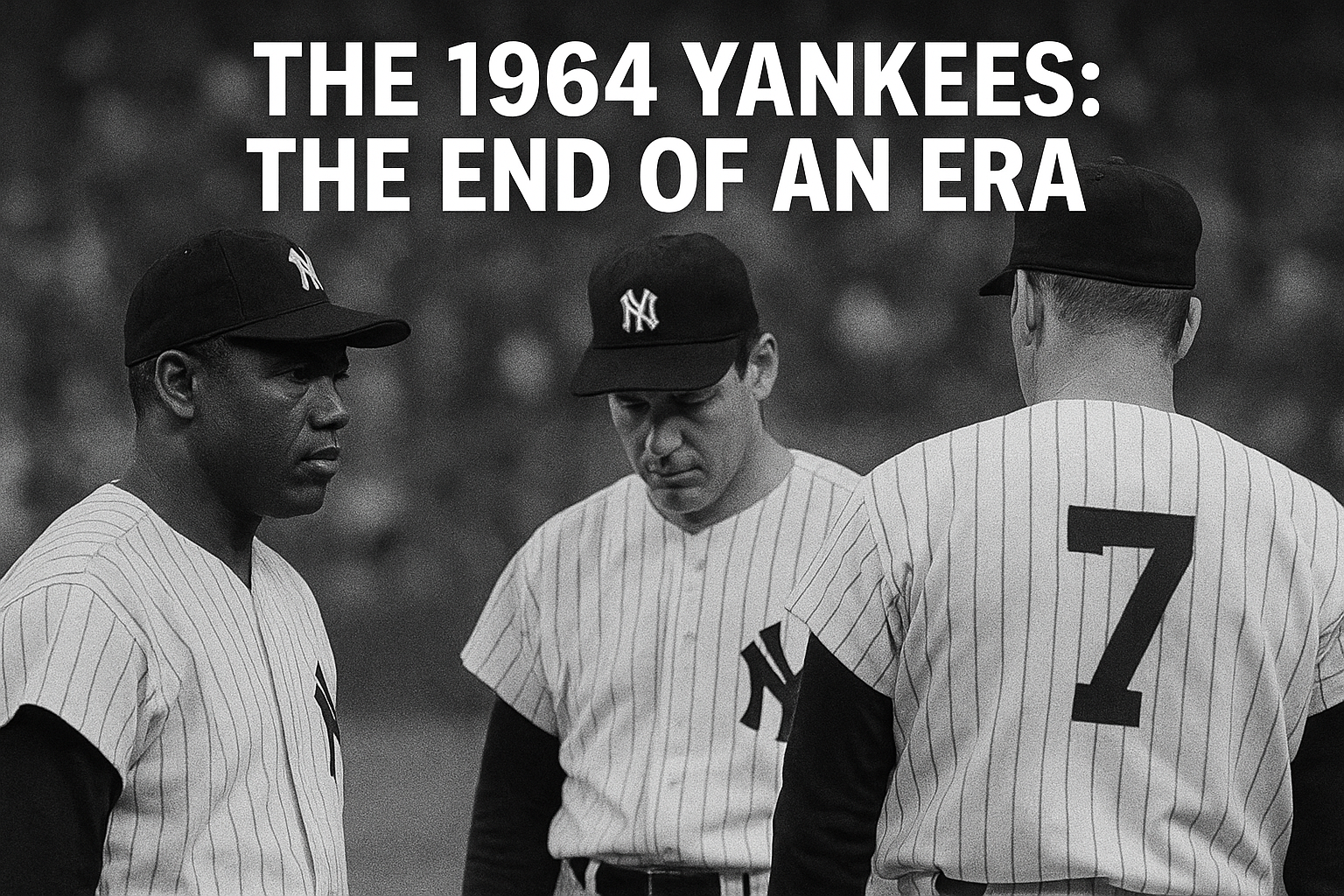
In the lore of Major League Baseball, few teams have managed to capture the imagination and admiration of fans quite like the New York Yankees. A franchise synonymous with success and a rich heritage of winning, the Yankees have boasted rosters filled with legends. However, the 1964 season marked a significant turning point for the team—a year often described as the end of an era. The Yankees of this period were ending a sustained period of dominance that began in the late 1940s, characterized by frequent pennants and World Series championships. The 1964 season encapsulates a pivotal moment in the Yankees’ storied history, as it signaled both the culmination of a glorious past and the onset of substantial challenges that shook the franchise’s core.
Prior to 1964, the Yankees were the epitome of baseball success, consistently setting the standard on the diamond with a relentless pursuit of excellence. By the mid-1960s, the team had won an astounding 29 American League pennants and claimed 20 World Series titles, an unmatched record. Underlining this period of triumph was a combination of managerial expertise, standout player performances, and a clutch ability to overcome any adversity. However, 1964 was the year where cracks began to reveal themselves. Managerial changes, aging players, and stronger competition heralded the end of their golden era. This exploration seeks to delve into the nuances of the 1964 Yankees, understanding both the successes of that season and what went wrong, forever marking it as a turning point in their illustrious history.
The Final Showdown: 1964 Season Overview
The 1964 Yankees team was still considered a formidable group at the outset of the season, yet the dynamics had subtly shifted. Ralph Houk, the manager who led the team to three consecutive pennants from 1961 to 1963, moved into the front office. Yogi Berra, one of baseball’s iconic figures, took the reins as manager. Despite his lack of managerial experience, Berra’s baseball IQ and rapport with players promised continuity. The team itself retained considerable talent—key figures included Mickey Mantle, Whitey Ford, Roger Maris, and up-and-comer Joe Pepitone.
Throughout the season, the Yankees played with the characteristic resilience that had defined previous years. With players like Mantle still displaying flashes of brilliance and key contributions from both veterans and rising stars, the Yankees secured another American League pennant, finishing with a commendable 99-63 record. The race was competitive, and the Yankees had to ward off a strong challenge from the Chicago White Sox and Baltimore Orioles. Notably, Mickey Mantle provided a steady force, overcoming personal injuries to aid in the team’s playoff push. Whitey Ford continued to be a pitching prodigy, although age was beginning to hint at the edge of its prime.
The Yankees faced off against the St. Louis Cardinals in the World Series. It was a captivating contest that showcased the best of baseball. The series extended to seven games, characterized by intense pitching duels, strategic plays, and individual heroics. The Yankees, despite their seasoned experience, ultimately succumbed to the Cardinals. Bob Gibson, the Cardinals’ ace, became a pivotal figure, leading his team to victory and earning MVP honors. For the Yankees, this defeat was a severe blow but also a testament to their legacy—they fought valiantly until the end. Despite the heartache, the 1964 season stood as a remarkable testament to the franchise’s enduring spirit.
Key Players and Their Impact
The 1964 season’s trajectory was heavily influenced by the contributions of key players who defined this era. Chief among them was Mickey Mantle, who remained the heartbeat of the team. Mantle, while grappling with injuries that had begun to impair his ability, still wielded enormous influence on games. His leadership and batting prowess provided crucial runs and morale lifts. Mantle’s presence alone could unsettle opponents, marking him as a significant asset till the very end of the season.
Whitey Ford, another towering figure, continued to anchor the Yankees’ pitching rotation. Ford’s precision and endurance on the mound were unmatched in his prime, and even in 1964, he avoided challenges older pitchers often face, delivering commendable performances that were vital for the Yankees’ push. However, it was evident that Ford’s arm was beginning to tire after years of stress at the elite level, signaling that change was on the horizon.
Roger Maris, who had previously broken Babe Ruth’s single-season home run record in 1961, was experiencing a period caught between former peak performances and mounting injuries. Nevertheless, Maris remained a threat at the plate, contributing essential plays during critical matchups. Joe Pepitone, meanwhile, began to find his footing in the major leagues. As a younger talent, Pepitone’s breakout year included moments of brilliance that gave fans a glimpse of a future building block.
Apart from these central figures, Clete Boyer, Elston Howard, and Bobby Richardson offered consistent performances, bridging gaps and exemplifying the team’s strength in depth. Collectively, these players were instrumental in sustaining the Yankees’ success during the 1964 season and underscored how individual excellence often concatenates into broader team achievement.
Transition and Turbulence in Management
At the heart of the Yankees’ 1964 narrative was the transition in management. Ralph Houk’s move from manager to an upper administrative role was more than just a logistical change; it was a symbolic shift. Yogi Berra, despite his unmatched credentials as a player, was stepping into an unknown landscape of tactical decisions and strategic leadership. Berra’s familiarity with the team was a significant asset, yet the pressures of management were a distinctly different challenge.
During the season, Berra’s decisions were under scrutiny, partly because of the inherent expectations that came with leading the Yankees during such a critical phase. His leadership style, marked by a unique blend of humor and insight, fostered a cohesive, supportive team environment. Yet, Berra’s choices, especially regarding pitching rotation and lineup management, were sometimes questioned in hindsight, especially pertaining to their World Series defeat. This kind of managerial post-analysis was inevitable given the stature of the team and the magnitude of a near-victory year.
Post-1964, Yankees management undertook significant changes, marking the beginning of a new chapter. Berra did not return as manager the following year, succeeded by Johnny Keane, who ironically managed the Cardinals to victory over the Yankees. Such decisions were emblematic of the underlying unease within the franchise, as they sought to recalibrate and respond to emerging trends wherein competition had begun to close the gap on their perennial dominance.
Challenges and the Changing Landscape of Baseball
The world of baseball was evolving rapidly during the 1960s, and the Yankees’ dynasty had to contend not just with on-field opposition but also broader shifts in the sport. The emergence of television, changes in player demographics and payroll structures, and the expansion of the league all contributed to the complexity of maintaining sustained dominance. The 1964 Yankees were operating in a climate where parity began to take root, diminishing the dynasty’s edge that had been so critical in previous decades.
The struggle to keep pace with these changes manifested in various aspects of Yankee operations. Scouting and player development regions were diversifying, prompting the Yankees to broaden their recruitment and development strategies. Financial disparities between teams started to narrow, with increased player salaries leading to a more competitive market for acquiring top talent. Consequently, the Yankees could no longer rely purely on their financial strength or storied history to lure players, necessitating more astute negotiation and clever management.
Moreover, other teams were learning from the Yankees’ success, replicating strategies and augmenting them with innovative tactics. The Yankees, in turn, found themselves needing to adapt continuously. The 1964 season acted as a wake-up call in this regard, highlighting the necessity for the Yankees to embrace modernization while not losing sight of the traditions that had brought them success.
Conclusion
The 1964 Yankees season marked the end of an era in more ways than one, standing as a testament to both the triumphs achieved over many decades and the challenges lying ahead. As baseball entered a new age, the Yankees’ sustained dominance was becoming increasingly difficult to maintain amidst mounting internal and external pressures. The franchise had reached the precipice of change, orchestrated through shifts in management, evolving player dynamics, and broader industry transformation. It was an emotionally charged experience that encapsulated the essence of sports dynasties: their rise, zenith, and eventual recalibration in the face of change.
For fans and historians alike, the 1964 Yankees encompass the duality of sports—with every high soared, there also comes an inevitable shift. In many respects, 1964 was not merely an end but a new beginning. It was a reminder of baseball’s cyclical nature, and the vital role resilience plays in a team’s legacy. The culture of excellence fostered by the Yankees remained, yet the challenges faced demanded innovation and adaptability. As history has shown, the Yankees would bounce back in the subsequent decades, but the memories of 1964 remain poignant, echoing a time where greatness met its existential test.
In recounting the 1964 Yankees, we are prompted to consider the fragility and fortitude inherent in all dynasties—how they form, endure, and evolve in response to the tides of time.
Frequently Asked Questions
1. Why is the 1964 Yankees team considered the “end of an era” in baseball history?
The 1964 Yankees team is considered the “end of an era” because it marked the decline of a dynasty that had enjoyed unparalleled success in Major League Baseball. From the late 1940s through 1964, the Yankees reigned supreme, routinely winning the American League pennant and often capturing the World Series title. This period was characterized by iconic players like Mickey Mantle, Whitey Ford, and Yogi Berra—figures who not only led the team to victory but also defined the sport itself. By 1964, however, there were signs of change. The team managed to reach the World Series but lost to the St. Louis Cardinals. Internal dynamics were shifting, with aging players and management changes on the horizon. The defeat in the 1964 World Series and the subsequent struggles in the latter half of the decade underscored the transition from a dominant force in baseball to a team in the midst of rebuilding, signaling the end of the Yankees’ golden era.
2. Who were some of the key players in the 1964 Yankees, and what impact did they have?
Several key players defined the 1964 Yankees. Mickey Mantle, a legendary center fielder known for his incredible power and speed, was central to the team’s competitive edge. Despite battling injuries, Mantle contributed significantly to the team, often turning games with his clutch performances. Roger Maris, famous for breaking Babe Ruth’s single-season home run record in 1961, provided powerful hitting ability. Yogi Berra, though transitioning into a managerial role, brought his catcher’s wisdom and leadership, essential for any cohesive unit in that era. Additionally, the pitching staff, led by the talented left-hander Whitey Ford, who had a reputation for being nearly unbeatable in the postseason, provided consistency on the mound. These players, among others, created a dynamic roster that within a decade defined the essence of Yankee success. However, their presence in 1964 also highlighted the age-related decline that loomed over the team’s future.
3. What changes within the Yankees organization heralded the end of their dominant era?
The end of the Yankees’ dominant era in 1964 was precipitated by significant changes within the organization. Key among these was the management transition. Yogi Berra, after a storied playing career, took on the role of manager in 1964. Although he led the team to the World Series, his tenure as manager was short-lived, ending after the season with his controversial firing, a move that shocked many fans and players alike. Furthermore, the team faced the natural decline of its veteran players, whose careers were reaching the twilight years. This aging roster needed a rejuvenation that management struggled to implement immediately. There was an evident shift in the American League as well, with emerging teams effectively closing the gap on, and eventually surpassing, the Yankees, who had relied heavily on their historical approach. These factors combined to dismantle the previously unyielding Yankees dominance, leaving a gap before their next rise to power took shape.
4. How did the Yankees’ 1964 season performance compare to previous years?
The 1964 season was paradoxically both successful and disappointing for the Yankees. Historically, from the late 1940s through the 1950s, the Yankees had not only reached the World Series more often than not but also claimed victory frequently. The Yankees of 1964 managed to uphold their reputation by navigating through the American League to secure the pennant. However, this achievement masked underlying struggles. Compared to the consistency and ease of earlier seasons, 1964 saw them grappling with tougher competition, tighter races, and, importantly, the inability to win the World Series against the St. Louis Cardinals. The season ended more chaotically than fans were accustomed to, with leadership changes and an uncharacteristically long hiatus from World Series participation following 1964. These elements indicated a performance decline compared to the glittering success of prior years, which had set exceedingly high expectations for any Yankees team.
5. What was the aftermath of the 1964 Yankees’ season, and how did it affect the franchise’s future?
The aftermath of the 1964 Yankees season was a period of reassessment and rebuilding. The immediate effect was the dismissal of Yogi Berra as manager, a decision that foreshadowed turbulent managerial turnover throughout the remainder of the decade. For the following years, the franchise faced a decline in performance, struggling to regain its footing as a dominant force in the league. This was compounded by the retirement and decrease in effectiveness of key players from the golden era, necessitating the development of new talent. During this time, other teams capitalized, intensifying competition within the league. These conditions persisted until the Yankees began a resurgence in the mid-1970s under new ownership and leadership, with a reinvigorated roster led by standout players like Thurman Munson and Reggie Jackson. The period post-1964 was pivotal as it set the groundwork for the eventual rebirth of the Yankees’ storied legacy, but only after enduring a chapter marked by significant changes and challenges.