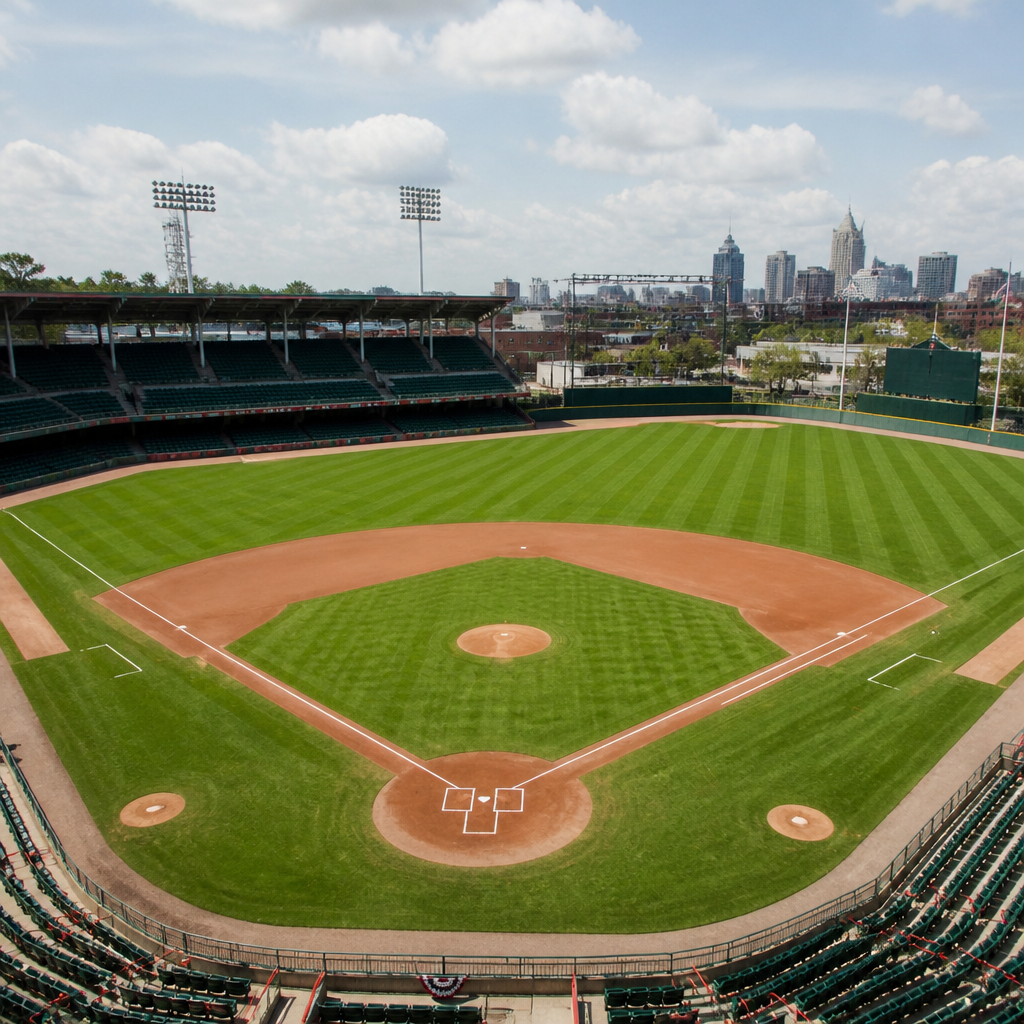
League Park in Cleveland stands as one of baseball’s most revealing surviving landmarks, a place where the early Cleveland Indians played in close quarters and where the broader story of lost MLB ballparks comes into focus. In baseball history, a lost ballpark is usually a former major league venue that has been demolished, radically altered, or reduced to fragments that no longer function as a full professional stadium. League Park is unusual because it is both lost and still partially present: the grandstand and ticket building remain, the field has been restored, and the site now works as a historical anchor for understanding how urban baseball evolved. That makes it the ideal hub for anyone exploring iconic ballparks, especially the vanished parks that shaped Major League Baseball before concrete multipurpose stadiums and modern retro designs changed the landscape.
When I first studied League Park closely, what struck me was not only the architecture but the scale. The park sat directly within Cleveland’s Hough neighborhood, pressed into the street grid and surrounded by homes and everyday city life. Fans were near the action, foul territory was limited, and the ballpark felt woven into the neighborhood in a way that modern facilities rarely do. Those qualities define many lost MLB ballparks: they were compact, idiosyncratic, and deeply local. They reflected streetcar transit, land constraints, and the economics of early twentieth century baseball. Because of that, League Park matters beyond Cleveland. It serves as a lens for understanding why so many classic parks disappeared, what was gained when teams moved, and what was lost when historic venues gave way to new construction.
This article covers League Park in Cleveland as both a specific place and a gateway to the larger category of lost MLB ballparks. It explains the park’s origins, design, teams, famous moments, decline, preservation, and continuing influence. It also compares League Park with other vanished or transformed major league venues so readers can place Cleveland’s old home in the wider map of baseball heritage. If you want to understand why early Indians baseball felt so intimate, why old parks continue to fascinate fans, and which features define the classic urban ballpark, League Park is the right starting point.
What League Park Was and Why It Mattered
League Park opened in 1891, initially as a wooden structure, and quickly became a central baseball site in Cleveland. It hosted the National League’s Cleveland Spiders and later the American League franchise that became the Cleveland Indians, now the Guardians. After a fire and redevelopment cycle common in that era, the park was rebuilt in steel and concrete in 1910, placing it within the first generation of durable urban baseball architecture that included parks such as Shibe Park in Philadelphia and Forbes Field in Pittsburgh. The redesign was handled during baseball’s rapid building boom, when owners recognized that fireproof construction, larger capacities, and improved sightlines could support growing attendance and rising civic expectations.
For the Indians, League Park was not merely an address. It was their principal home during foundational decades, including the period when stars like Nap Lajoie anchored the franchise and when Tris Speaker later helped transform the club into a champion. Cleveland also used Dunn Field, the formal name applied after owner James C. Dunn, though League Park remained the name that stuck in popular memory. The venue’s dimensions and urban setting encouraged a style of play different from what teams experienced in cavernous later stadiums. Left field was famously short, while other areas of the park demanded smart positioning and awareness. In practical baseball terms, the park rewarded contact hitters who understood angles, fielders who reacted quickly, and managers who adjusted strategy to the venue rather than assuming a neutral field.
League Park also mattered because it represented baseball’s role in city identity. Before television turned teams into national entertainment brands, ballparks were physical community institutions. They brought thousands of residents together and gave neighborhoods recurring economic activity. In Cleveland, League Park connected the game to local transit lines, corner businesses, and residential blocks. That pattern was repeated across many lost MLB ballparks, from Washington’s Griffith Stadium to St. Louis’s Sportsman’s Park. When these venues disappeared, cities lost more than seats and scoreboards; they lost civic landmarks with layers of memory built over generations.
The Intimate Design of Early Indians Baseball
The phrase intimate home is not nostalgia alone. League Park was physically intimate by design and by necessity. Unlike later suburban stadium projects built on expansive parcels, early city parks had to fit available land. At League Park, this produced asymmetrical dimensions, close spectator proximity, and a viewing experience that emphasized immediacy. Fans could hear infield chatter, track spin off the bat, and sense the pace of the game in real time. Modern parks sometimes try to recreate that atmosphere through retro styling, but at League Park it was an organic result of urban constraints.
Baseball architecture historians often note that the best early parks created distinct tactical environments. League Park did exactly that. The short porch in left made it inviting for certain right-handed pull hitters, yet wall height, angles, and weather could complicate easy assumptions about offense. Outfielders had to learn the caroms. Pitchers had to understand when a fly ball was harmless and when it was dangerous. Managers in that era paid attention to such details because roster construction could be shaped by home dimensions. I have found that when fans study lost ballparks seriously, they begin to understand baseball not as a standardized product but as a series of local games played under local conditions.
That intimacy also affected spectatorship. Seats were closer, visual obstructions existed in some sections, and amenities were simpler than modern fans expect. Yet closeness often outweighed comfort. League Park belonged to an era when attending a game meant entering a dense social setting rather than a self-contained entertainment complex. Street arrival, neighborhood noise, and the visible edge of the city all remained part of the experience. In that sense, League Park shares DNA with the Polo Grounds, Ebbets Field, and Comiskey Park: each offered a baseball environment impossible to copy exactly because each was shaped by a particular parcel of city land.
League Park as a Hub for Lost MLB Ballparks
As a subtopic hub, League Park helps organize the entire conversation about lost MLB ballparks because it touches nearly every major theme: early construction methods, urban siting, neighborhood identity, alternating uses, partial preservation, and memory after demolition. Some lost parks are gone completely, like Philadelphia’s Baker Bowl. Others survive only in markers, as with the original Yankee Stadium’s predecessor sites. A few retain fragments or restored fields, which makes League Park especially valuable because visitors can still interpret the original setting with unusual clarity.
To place League Park in context, it helps to compare it with other important lost or transformed major league venues.
| Ballpark | City | Primary significance | Status today |
|---|---|---|---|
| League Park | Cleveland | Early Indians home; surviving grandstand; urban neighborhood setting | Partially preserved and restored |
| Ebbets Field | Brooklyn | Dodgers landmark; classic intimate National League park | Demolished; apartment site |
| Polo Grounds | New York | Extreme dimensions; Giants history; football crossover use | Demolished; housing complex |
| Forbes Field | Pittsburgh | Pirates history; deep dimensions; partial wall remains | Fragments preserved on university grounds |
| Griffith Stadium | Washington | Senators home; major civic events; difficult hitter’s backdrop | Demolished; hospital and related site uses |
| Sportsman’s Park | St. Louis | Shared by Browns and Cardinals; layered franchise history | Demolished after adaptive institutional use |
The table shows why League Park is such a useful entry point. It belongs to the same family as those parks, but its preservation status lets readers connect abstract history to a tangible place. For a hub article, that matters. Readers can move from Cleveland outward to Brooklyn, New York, Pittsburgh, Washington, St. Louis, and beyond, comparing how geography, economics, and team ambition determined whether a ballpark was renovated, replaced, abandoned, or remembered only through photographs and Sanborn maps.
Historic Moments and the Players Who Defined the Park
League Park hosted some of the most important figures and events in early baseball. Nap Lajoie, one of the deadball era’s greatest hitters, gave the Cleveland club star power during years when player reputation could define a franchise. Shoeless Joe Jackson played there during his time with Cleveland before his move to Chicago. Most famously, the park was the scene of Game 5 of the 1920 World Series, when Bill Wambsganss completed the only unassisted triple play in World Series history. In the same game, Cleveland pitcher Jim Bagby hit a home run, and the Indians moved closer to the first championship in franchise history. Those are not minor anecdotes; they place League Park directly inside baseball’s permanent record.
The venue also connects to broader social and cultural history. Babe Ruth played there as a visiting star. Satchel Paige appeared in Cleveland in later eras tied to the city’s rich baseball culture. The park even hosted football and civic events, reflecting how major league ballparks often served as multiuse public stages before specialized venues became standard. When studying lost MLB ballparks, this multipurpose role is essential. A classic park was rarely just a baseball field. It was part theater, part gathering ground, part neighborhood landmark, and part commercial asset.
League Park’s split usage with Cleveland Municipal Stadium later in the twentieth century further illustrates a key transition in baseball history. Teams increasingly preferred larger venues for high-demand dates, parking capacity, and perceived modernity. Yet many clubs continued using older parks because intimacy, transit access, and familiar playing conditions still offered advantages. Cleveland’s dual-ballpark era mirrored tensions seen elsewhere, where franchises balanced tradition against expansion. That tension ultimately defines why so many old parks were lost: they remained beloved, but ownership economics, automobile culture, and municipal planning steadily pushed baseball away from neighborhood parks and toward bigger facilities.
Decline, Preservation, and What Visitors Can Learn Today
League Park declined as a full-time major league venue because its strengths became, in the eyes of later decision-makers, its limitations. Limited parking, aging infrastructure, constrained expansion options, and competition from larger stadiums reduced its practicality. By 1946, the Indians had largely shifted to Municipal Stadium, though League Park continued in other uses for years. Like many former baseball sites, it risked fading into neglect once top-level professional games ended. That pattern is familiar across lost MLB ballparks. Without an active tenant and clear preservation plan, even historically important structures deteriorate quickly.
Cleveland’s eventual restoration efforts are therefore significant. The remaining grandstand and ticket house were rehabilitated, and the site now includes the Baseball Heritage Museum. This approach follows a sensible preservation principle: when complete reconstruction is impossible, stabilize authentic remnants, interpret them well, and reconnect the site to public life. League Park does not pretend to be a frozen time capsule. Instead, it presents enough original fabric to teach visitors how the park functioned while using exhibits, signage, and the restored field to fill historical gaps. That is often the most honest way to preserve sports heritage.
For visitors, the lesson is immediate. You can stand where a major league crowd once gathered and grasp dimensions that photographs flatten. You can see how close the neighborhood remains, how little separation existed between daily life and professional baseball, and why old parks generated such strong attachments. If you are building a reading path through lost MLB ballparks, start with League Park, then branch into studies of Ebbets Field, the Polo Grounds, Forbes Field, and Griffith Stadium. Together, those stories explain how baseball’s physical past still shapes the way fans judge atmosphere, authenticity, and place.
League Park in Cleveland is more than an early Indians ballpark. It is the clearest starting point for understanding lost MLB ballparks as a whole: how they were built, how they shaped play, why they disappeared, and why their memory still matters. The park’s intimate dimensions, neighborhood setting, and historic events reveal what made classic urban baseball distinct from the standardized stadium experience that followed. Its partial survival adds a rare advantage, giving fans and researchers a physical bridge between archival history and present-day observation.
The main takeaway is simple. Lost ballparks are not interchangeable ruins from a distant era. Each one expressed the economics, transit patterns, architecture, and baseball strategy of its city and time. League Park expresses all of that with unusual clarity. It shows how Cleveland’s team grew, how fans experienced the game up close, and how preservation can rescue meaning even when a venue no longer hosts the majors. For an iconic ballparks hub, no site better introduces the category.
If you want to explore the subtopic deeply, use League Park as your foundation. Study its design, compare it with other vanished parks, and visit the restored site if you can. Once you do, the history of early Indians baseball and the broader world of lost MLB ballparks becomes far more vivid, specific, and unforgettable.
Frequently Asked Questions
What makes League Park in Cleveland such an important site in baseball history?
League Park matters because it connects several major threads of baseball history in one physical place. It was an early home of Cleveland’s American League club, the team that later became widely known as the Indians, and it served as a stage for important moments in the development of professional baseball in the city. Unlike many vanished major league venues that were completely erased, League Park still preserves enough of its original identity to help visitors understand how baseball once looked, felt, and sounded in an earlier era. That alone makes it historically valuable.
Its importance also comes from its intimacy. League Park was part of a generation of ballparks built before the massive multi-purpose stadium era, when fans sat much closer to the field and the geometry of the park had a stronger influence on the game. It reflects a time when neighborhood ballparks were deeply woven into urban life, with spectators arriving from nearby streets rather than surrounding parking seas. In that sense, League Park is not just about one team or one city; it represents a broader model of American baseball culture that has largely disappeared.
For historians, preservationists, and fans, League Park is especially revealing because it shows how a ballpark can be both a sports site and an artifact. Even in altered form, it helps explain how early major league clubs operated, how fans experienced games, and how stadium architecture evolved over time. Cleveland’s baseball story is richer and more legible because League Park still exists in part, offering a rare, tangible link to the formative decades of the sport.
Why is League Park often described as both a “lost” ballpark and a surviving landmark?
That description captures the unusual status of League Park better than any simple label could. In baseball history, a “lost ballpark” usually means a former major league stadium that has been demolished outright, replaced, or altered so completely that it no longer functions as anything close to its original form. By that definition, League Park qualifies because it is no longer a full major league venue and much of the original ballpark has disappeared. The complete, operating stadium where early Cleveland baseball unfolded is gone.
At the same time, League Park is not lost in the same way as parks that vanished without a trace. Parts of the historic structure and site remain, allowing people to see where baseball was actually played and to connect present-day Cleveland with its earlier baseball landscape. That partial survival makes League Park unusual among former major league parks. It occupies a middle ground between total disappearance and full preservation, which is exactly why it is so useful when discussing the fate of old baseball venues.
That dual identity is part of its power. League Park demonstrates that “lost” does not always mean invisible. Sometimes a ballpark survives in fragments, outlines, architectural remnants, or adapted spaces that still carry the memory of the game. In Cleveland, that means visitors are not just reading about history from a plaque or old photograph. They are encountering a place where the past remains physically present, even if the original major league ballpark experience cannot be fully recreated.
How did League Park reflect the intimate style of early Cleveland Indians baseball?
League Park reflected the intimate nature of early Cleveland baseball through its scale, neighborhood setting, and fan proximity. Ballparks of its era were designed for a different version of the sport experience than later stadiums. They were tighter, more embedded in the city, and more personal in the relationship between crowd and field. Fans at League Park were not watching from a distant bowl designed for automobiles and mass circulation. They were part of a closer, more immediate environment where the sounds of the game, the reactions of the spectators, and the dimensions of the park all felt direct and personal.
That intimacy shaped the identity of baseball in Cleveland’s early major league years. The park fostered a sense that the team belonged to the neighborhood and the city in a highly visible way. Games unfolded in a setting where architecture, street life, and local fandom all intersected. For supporters of the early Indians, League Park was not just a neutral venue. It was a place where Cleveland baseball developed its character, where players and fans shared a more compact and intense atmosphere than what would later become common in larger stadiums.
When people describe League Park as intimate, they are also talking about historical perspective. The surviving traces of the site help modern visitors imagine a time when baseball was less mediated and more physically rooted in place. You can better understand how different the game once felt: closer to the action, more shaped by the structure of the park itself, and more connected to everyday urban life. That is a major reason League Park remains such a compelling landmark in Cleveland baseball history.
How does League Park help explain the broader story of lost MLB ballparks?
League Park is an ideal case study because it illustrates what happened to many older major league ballparks while also standing apart from them. Across baseball history, numerous early parks were demolished as cities changed, teams moved, stadium economics shifted, and new construction standards took over. In many cases, the result was total disappearance. A parking lot, housing development, road project, or newer venue erased nearly all visible evidence that a major league ballpark had ever existed there. That pattern is central to the story of lost MLB ballparks.
League Park helps explain that story because it shows both the loss and the residue. It reveals how a once-important stadium can decline from premier major league use, become altered over time, and eventually survive only in partial form. But it also shows why these places still matter. Even fragments can preserve spatial memory, architectural context, and emotional significance. Instead of being just another name on a list of vanished stadiums, League Park allows people to study how baseball landscapes disappear gradually rather than instantly.
It also broadens the discussion beyond nostalgia. Lost ballparks are important because they tell us about urban development, public memory, preservation choices, and the changing business of sports. League Park invites those conversations in a concrete way. It helps fans and historians ask not only what was lost, but what remains, what can be interpreted, and how cities choose to remember their sporting past. In that sense, League Park is one of the most revealing surviving sites for understanding the life cycle of major league ballparks in America.
What can visitors and baseball fans take away from League Park today?
Visitors can take away a much deeper understanding of baseball history than they would get from statistics or team timelines alone. League Park offers something rare: a chance to stand within a real historical landscape connected to the early Cleveland major league experience. Even in its altered and partial state, the site helps people visualize how baseball once fit into the fabric of the city. It turns abstract history into something physical, making the story of early Cleveland teams and old major league parks more immediate and memorable.
For baseball fans, the site is especially meaningful because it encourages comparison. It highlights the contrast between early neighborhood ballparks and modern stadium culture, between intimate urban settings and later large-scale sports complexes, and between a time when parks evolved gradually and a time when they are often built and replaced through very different economic pressures. League Park reminds visitors that baseball was not always experienced in the same way, and that the setting itself shaped the game’s culture.
There is also a preservation lesson in visiting League Park. The site shows that sports history does not have to survive only in museums, books, or archival images. It can remain in the landscape, even imperfectly. That makes League Park valuable not just to Cleveland or to fans of the Indians’ early history, but to anyone interested in how cities remember their past. It stands as a powerful example of why even partial ballpark survival matters: because once these places disappear completely, the connection between community, architecture, and baseball history becomes much harder to recover.