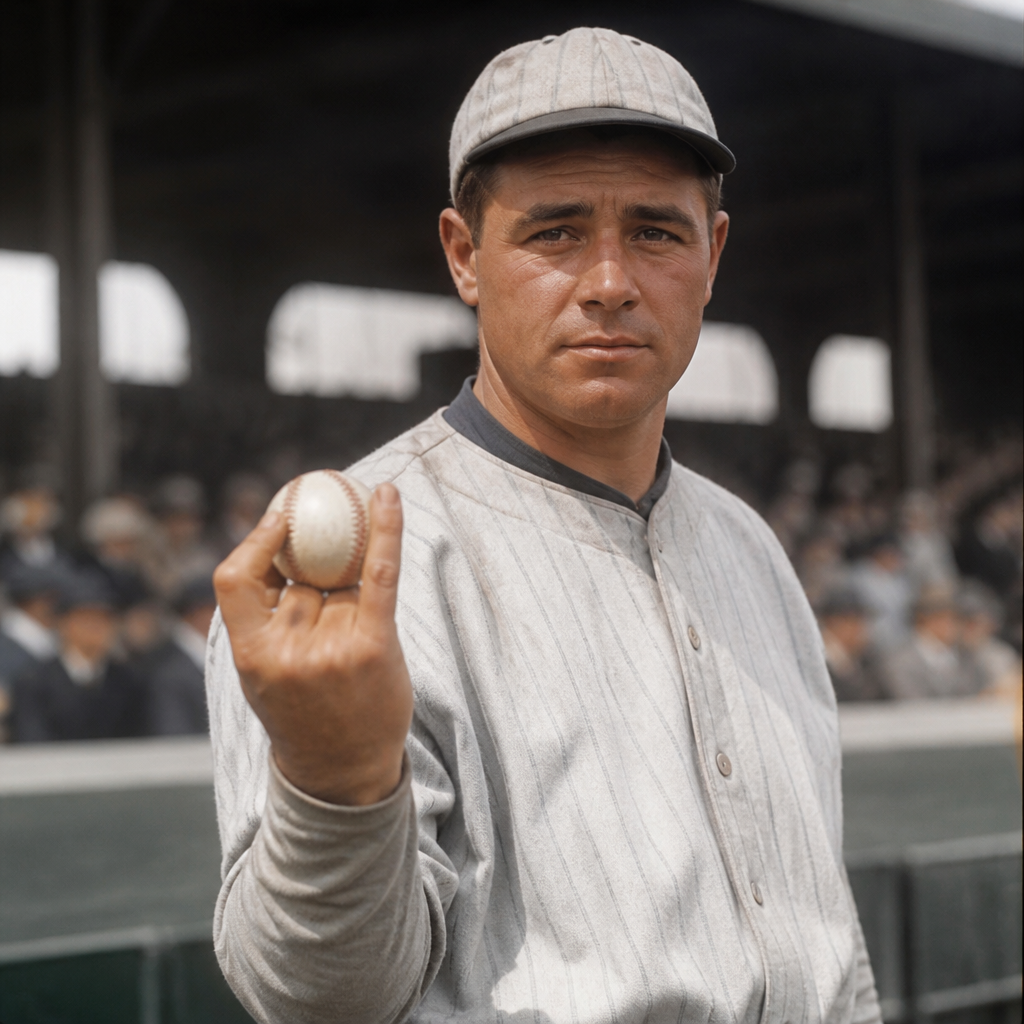
Mordecai Brown stands among baseball’s most compelling player profiles because his career joins elite performance, personal adaptation, and the evolution of pitching into one unforgettable story. Known to generations of fans as “Three Finger Brown,” he transformed a severe childhood hand injury into a mechanical advantage, creating one of the sharpest breaking balls of the dead-ball era and building a Hall of Fame résumé with the Chicago Cubs. For anyone exploring legendary players, Brown is essential not just because he won games, but because his life explains how resilience, biomechanics, and baseball intelligence can intersect at the highest level.
A player profile, at its best, does more than list statistics. It explains who a player was, what conditions shaped his game, how he performed against his era, and why his legacy still matters. Brown’s profile checks every box. He was born in 1876 in rural Indiana, lost normal use of parts of his right hand after a farm machinery accident, developed unusual movement on his pitches, debuted in Major League Baseball relatively late, and still became one of the dominant pitchers of the early twentieth century. His story matters because it corrects a common mistake in sports history: assuming physical difference automatically limits athletic excellence. In Brown’s case, difference became differentiation.
He also matters because his career sits at the center of an important baseball moment. The dead-ball era rewarded command, deception, fielding support, and strategic pitching rather than pure strikeout volume or home run suppression in the modern sense. Brown excelled in all the skills that defined winning baseball at the time. He pitched for the St. Louis Cardinals and, more famously, for the Cubs teams managed by Frank Chance, helping power Chicago to National League pennants and World Series championships. In an age before velocity was measured by radar guns, his reputation was built on movement, precision, toughness, and consistency against the best hitters in the league.
For readers using this player profile hub to understand legendary players, Brown provides a model for how to assess greatness across eras. You have to combine traditional numbers like wins and earned run average with league context, workload, role, and the tactical environment of the sport. Brown finished with 239 major league wins, a career 2.06 ERA, and extended stretches of dominance that compare favorably with nearly any pitcher of his generation. More importantly, those numbers came while facing heavy innings loads, pitching complete games routinely, and carrying the expectations of one of baseball’s defining dynasties.
Early life, injury, and the making of Three Finger Brown
Mordecai Peter Centennial Brown was born on October 19, 1876, near Nyesville, Indiana. His nickname came from a farming accident in childhood that damaged the index finger of his right hand and left parts of his hand permanently deformed. Accounts vary in exact detail, but the broad historical record is clear: Brown’s hand never resembled that of a conventional pitcher. Instead of ending his athletic future, the injury changed the way he gripped and released the baseball. Over time, that altered release became the foundation of his signature movement.
When I evaluate old pitcher profiles, I look first for the point where circumstance changed technique. With Brown, that point is obvious. His reduced and misshapen fingers created unusual pressure points on the ball. Teammates, opponents, and sportswriters repeatedly described his pitches as jumping, boring, or breaking late. Modern analysts would frame this in terms of spin axis, seam interaction, and release consistency. Brown did not have biomechanical labs or high-speed cameras, but he had something just as important: repeatable feel. He learned exactly what his hand could do, then refined it relentlessly in semipro and minor league competition.
That developmental path matters in any serious player profile. Brown was not a prodigy rushed through organized baseball as a teenager. He spent years proving himself in small towns and regional leagues, where command and durability were tested constantly. By the time he reached the majors, he understood hitters, trusted his movement, and knew how to pitch through contact. That maturity helps explain why he succeeded quickly despite arriving in the big leagues at an age when many modern prospects have already peaked or been discarded.
Pitching style: how Brown turned an injury into elite movement
The central question most readers ask is simple: what was the pitch that made Brown famous? The best answer is that it was not one isolated pitch but a movement profile. Brown threw a heavy, darting fastball and a vicious curve that hitters struggled to square up because the ball came out of his damaged hand with uncommon spin and angle. Contemporary observers often said his curve “snapped” more sharply than expected. Others focused on how his fastball seemed to run in on hitters or dip late as it approached the plate.
Pitch design was not a formal discipline in Brown’s era, yet he practiced it instinctively. He understood leverage, finger pressure, and deception long before those ideas had standardized language. His delivery paired with his hand structure to create a release point hitters did not see often. That unfamiliar look mattered. Baseball history shows repeatedly that unusual shapes and trajectories disrupt timing: think of submarine relievers, split-finger specialists, or knuckleball pitchers. Brown was an early example of the same principle. His body gave him a different toolset, and he built a complete craft around it.
Another reason Brown’s style worked was command. Movement without control becomes wildness. Brown was not wild. Across heavy workloads, he limited free passes and forced hitters into weak contact. His fielders benefited, but he created that environment. In plain terms, Brown made the ball difficult to hit hard, and he put it where hitters least wanted it. That is the core of run prevention in any era. Even without modern tracking data, his results leave little doubt that his stuff played at an elite level.
| Trait | How Brown used it | Why it mattered |
|---|---|---|
| Deformed grip hand | Created uncommon release and spin | Made pitches move differently from league norms |
| Sharp breaking ball | Changed eye level and bat path | Produced weak contact and late swings |
| Running fastball | Attacked hands and corners | Prevented clean contact even without overpowering speed |
| Command | Repeated targets over long outings | Turned movement into efficient run prevention |
| Durability | Handled complete-game era workloads | Increased value far beyond per-inning dominance |
Chicago Cubs years and dead-ball era dominance
Brown debuted in the majors with the St. Louis Cardinals in 1903, but his legend was forged after the Cubs acquired him in 1904. In Chicago, he joined a powerhouse built around Frank Chance, Joe Tinker, Johnny Evers, and strong pitching depth. Brown quickly became a cornerstone. From 1906 through 1910, he was one of the National League’s premier starters, helping the Cubs become the defining team of the period. Those clubs won pennants in 1906, 1907, 1908, and 1910, and captured World Series titles in 1907 and 1908.
The 1906 season remains one of the great landmarks in franchise history. The Cubs won 116 games, a total that stood as the modern major league record for decades. Brown was vital to that success, posting a 26-6 record with a 1.04 ERA. That earned run average was not simply good; it was historically overpowering even within a low-scoring environment. He followed with another exceptional year in 1907, going 20-6 with a 1.39 ERA, then 29-9 with a 1.47 ERA in 1908. Those are ace-level seasons by any standard, especially given the innings totals and pressure attached to pennant races.
When I compare dead-ball stars, I focus on whether they clearly separated themselves from peers facing the same conditions. Brown did. His ERA titles, win totals, and reputation among opponents all point the same direction. He was not merely a beneficiary of an era when offense was suppressed. He was one of the pitchers helping suppress it. His excellence also held up in meaningful games. Brown pitched in multiple World Series and high-stakes pennant contests, reinforcing his status as a big-game performer rather than a regular-season compiler.
Context is important here. Early twentieth-century pitchers worked differently from modern starters. Rotations were smaller, complete games were expected, and in-game adjustments depended heavily on catcher signals and personal instincts rather than scouting binders. Brown thrived under those demands. He fielded his position well, controlled tempo, and showed the kind of mound intelligence managers trusted in the tensest situations. That broader skill set is why his profile belongs in any serious hub on legendary players.
Stats, reputation, and Hall of Fame case
Brown’s career totals tell a persuasive story on their own: 239 wins, 130 losses, a .648 winning percentage, and a 2.06 ERA. He won at least 20 games six times and led the National League in earned run average more than once. Advanced metrics, though imperfect for his era, strengthen the case rather than weaken it. His ERA+, which adjusts for league and park context, places him comfortably among historically effective pitchers. In other words, once you correct for the low-scoring environment, Brown still stands out as exceptional.
His Hall of Fame election in 1949 recognized more than numbers. It recognized sustained dominance, championship impact, and a pitching identity that changed how opponents prepared. Brown was the kind of pitcher rival lineups talked about differently because his movement was unusual and his command made adaptation difficult. That matters in historical evaluation. Great players alter behavior around them. Managers stack lineups differently, hitters shorten swings, and teams play for one run because they do not expect many more. Brown inspired those adjustments.
There is also a durability component that modern box-score reading can miss. Brown threw more than 3,100 innings in the majors, often under conditions that were physically taxing and medically primitive. Recovery science was limited. Travel was harsher. Mound maintenance and baseball quality varied. Yet he remained effective across a long run, even as wear accumulated. He was not immortal; his production declined later, as happens to almost every pitcher. But the peak was long enough and high enough to secure his place among the game’s most accomplished right-handers.
Legacy, lessons, and why this player profile still matters
Brown’s legacy extends beyond Cooperstown plaques and old statistics. He remains one of the clearest examples in sports of an athlete converting a disability into a competitive strength without reducing his identity to inspiration alone. That distinction matters. Brown should not be remembered simply as a feel-good story. He should be remembered as a great pitcher whose physical difference directly shaped a sophisticated baseball weapon. The emotional appeal of his biography is real, but it becomes meaningful because it is attached to genuine excellence.
His story also offers a useful lesson for modern player development. Coaches now talk constantly about optimizing individual movement patterns rather than forcing every athlete into the same template. Brown embodied that principle a century ago. He did not succeed by imitating an idealized delivery built for a different hand. He succeeded by learning his own anatomy, repeating what worked, and building command around it. That is an enduring performance lesson, whether the athlete is a pitcher, golfer, or tennis player.
As a hub article for player profiles under the broader topic of legendary players, Brown’s career points readers toward the core questions worth asking in every profile. What physical tools did the player possess? What environmental factors shaped development? How did the player compare with contemporaries? What moments defined the legacy? And what larger truth about the sport does the career reveal? Brown answers each one clearly. His tools were unconventional, his environment was rural and demanding, his era comparison is elite, his defining moments came in pennant races and championships, and his broader truth is that baseball greatness often comes from adaptation rather than conformity.
The key takeaway is straightforward: Mordecai Brown became “Three Finger Brown” not in spite of his injury alone, but because he mastered the baseball possibilities hidden within it. He combined unusual movement, command, durability, and competitive intelligence to become one of the dead-ball era’s defining pitchers and a permanent part of Cubs history. If you are building a deeper understanding of legendary players, start here, then keep exploring connected player profiles with the same lens: context, craft, production, and lasting impact. That approach turns names from the past into fully understood careers, and Brown is one of the best places to begin.
Frequently Asked Questions
Who was Mordecai Brown, and why is he remembered as “Three Finger Brown”?
Mordecai Brown was one of the greatest pitchers of baseball’s dead-ball era and a central figure in the Chicago Cubs dynasty of the early 1900s. He is remembered both for his exceptional results on the mound and for the unusual physical story behind his success. Brown earned the nickname “Three Finger Brown” because of a severe childhood farm accident that permanently damaged his right hand, leaving him without the normal use and shape of several fingers. What might have ended many athletic careers instead became part of the reason he was so effective as a pitcher.
Brown’s legacy goes far beyond the nickname. He was an elite competitor whose control, movement, toughness, and consistency made him one of the most feared pitchers of his generation. He helped anchor dominant Cubs teams that won National League pennants and captured World Series titles in the first decade of the 20th century. His career has endured in baseball history because it combines achievement and identity in a rare way: he was not simply a great pitcher who happened to have an injury, but a player who adapted so completely that his physical difference became central to his pitching style and reputation.
How did Mordecai Brown’s hand injury become an advantage on the mound?
Brown’s hand injury is one of the most famous examples in sports history of adaptation turning into competitive advantage. As a child, he suffered an accident involving farm machinery that badly damaged the index finger of his throwing hand and affected the shape and function of other fingers as well. In ordinary terms, this was a serious disability. For a pitcher, whose craft depends on feel, grip, pressure points, and release, it could have been devastating. Instead, Brown learned to throw with the hand he had, and over time that altered structure helped him create unusual spin and movement.
The injury changed the way the baseball came off his hand. Because his grip and release were different from those of most pitchers, Brown could generate a sharp, late-breaking pitch that hitters struggled to track and square up. Contemporary accounts often described his ball as darting, dropping, or breaking with exceptional violence. In the dead-ball era, when run scoring was lower and every edge mattered, that kind of movement was especially valuable. Brown’s success was not accidental or magical; it came from repetition, intelligence, and adaptation. He learned how to control an unconventional delivery and transformed a physical limitation into one of the most distinctive weapons in baseball.
What made Brown’s breaking pitch so effective during the dead-ball era?
Brown’s signature breaking pitch was effective because it combined deceptive spin, unusual movement, and reliable command. Many pitchers can throw a ball that moves, but the truly great ones make that movement difficult for hitters to read while still placing the pitch where they want. Brown excelled in exactly that way. His altered hand gave him a different release, and hitters often had trouble picking up the ball cleanly. By the time they recognized the break, it was usually too late to adjust their swing path.
That mattered even more in the dead-ball era, when offenses relied heavily on contact, placement, bunting, and aggressive baserunning rather than home-run power. A pitcher who could induce weak grounders, poor contact, and defensive swings had enormous value. Brown’s pitch did not need modern radar-gun velocity to dominate; it disrupted timing, changed eye level, and forced hitters into uncomfortable at-bats. His control also separated him from pitchers who merely had “stuff.” He could use the movement strategically, not just dramatically, which made him consistently effective over full seasons and against top competition. In that environment, Brown’s breaking ball was not just impressive to watch; it was a practical, game-changing weapon.
How successful was Mordecai Brown with the Chicago Cubs?
Brown was tremendously successful with the Chicago Cubs and played a major role in one of the most dominant stretches in franchise history. During the Cubs’ powerhouse years in the first decade of the 20th century, he was one of the staff’s defining stars. He helped the team win National League pennants and contributed to World Series championships, becoming a trusted ace in an era when pitchers were expected to work heavily and deliver in the biggest games. His durability and consistency were crucial to Chicago’s success.
What stands out about Brown’s Cubs career is not just that he won often, but that he did so while facing the pressure of contending teams year after year. He was known for his poise, command, and ability to limit scoring, all of which fit perfectly with the style of baseball the Cubs played. He did not build his reputation on a short peak or a single postseason moment. Instead, he assembled a body of work that placed him among the elite pitchers of his time. That sustained excellence is one of the major reasons he was later elected to the Hall of Fame and remains such an important figure in baseball history.
Why does Mordecai Brown’s story still matter in baseball history today?
Brown’s story still matters because it speaks to more than statistics. He represents the intersection of talent, perseverance, innovation, and identity. In baseball history, many great players are remembered for numbers alone, but Brown is remembered for the way he redefined what was possible. He did not simply overcome adversity in a generic sense; he used adaptation as a form of athletic invention. That makes his career meaningful to fans interested in sports history, disability history, and the development of pitching mechanics alike.
He also remains important because his career helps explain the dead-ball era in human terms. Brown’s success shows how pitchers could dominate before modern velocity and analytics became part of the game’s vocabulary. He won through movement, intelligence, command, and feel, and his unusual hand made that style especially memorable. For modern readers, Brown offers a compelling reminder that greatness in sports does not always come from fitting the ideal physical mold. Sometimes it comes from understanding one’s body, mastering one’s craft, and turning a perceived weakness into a defining strength. That is why Mordecai “Three Finger” Brown remains one of baseball’s most enduring and fascinating legends.