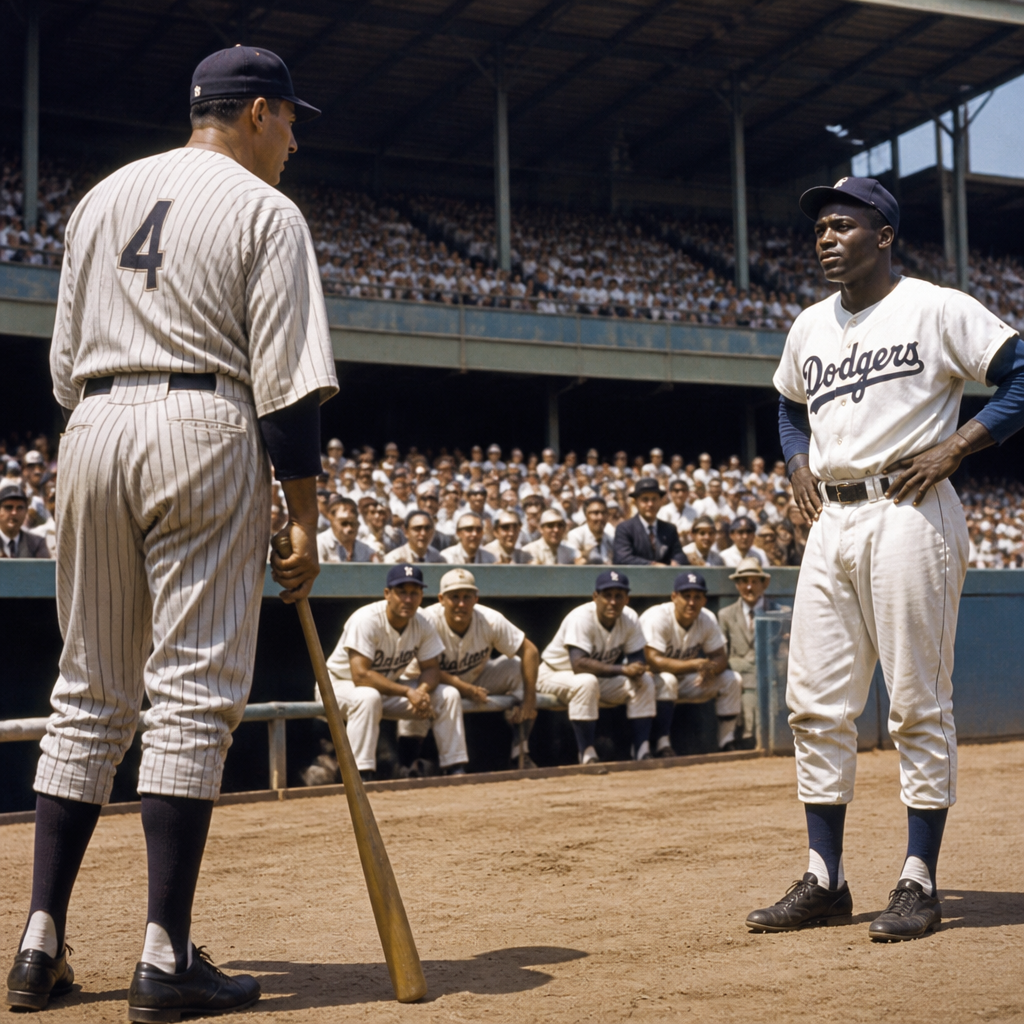
Baseball in the 1940s sits at the hinge point between the sport’s romantic early decades and its fully modern age. In one turbulent ten-year span, major league rosters were stripped by military service, night baseball and air travel began to reshape the schedule, the color line finally cracked, and franchise movement became a serious possibility rather than an abstraction. To understand baseball in the 1940s, you have to see the game not as a sealed-off entertainment business but as a public institution under pressure from war, labor shortages, urban change, and demands for civil rights. Those forces changed who played, who watched, where teams operated, and what the national pastime meant.
Three themes define the decade. War altered competitive balance and public expectations from 1941 through 1945. Integration transformed the talent base and moral legitimacy of the major leagues beginning in 1947, while also reshaping the Negro Leagues. Relocation pressures, though they did not fully remake the map until the 1950s, grew out of the economic realities of the 1940s: shifting population, uneven ballpark revenue, new transportation patterns, and owners searching for leverage. As a hub for the broader subject of baseball eras, this article connects those developments rather than treating them as isolated stories. The decade’s biggest baseball questions were simple and urgent: Could the game survive wartime depletion? Why did owners maintain segregation so long? What changed when Jackie Robinson arrived? And why did stable, long-rooted franchises begin looking beyond their traditional homes?
When I study and write about this period, I always return to one practical truth: every headline event in 1940s baseball had downstream effects on strategy, attendance, player development, media coverage, and league structure. Ted Williams losing prime seasons to military service was not just a Boston story; it illustrated how war distorted pennant races. Branch Rickey signing Robinson was not just a Brooklyn story; it exposed the inefficiency and injustice of exclusion while accelerating scouting in Black baseball. The St. Louis Browns nearly moving and the Boston Braves chasing postwar growth were not side notes; they signaled that geography and economics were becoming central to competition. Baseball in the 1940s matters because the decade turned the game into a clearer mirror of America itself: mobilized, unequal, inventive, and on the verge of a new map.
Baseball at War: Survival, Service, and Strange Pennant Races
The United States entered World War II in December 1941, and baseball immediately faced a legitimacy test. Should a game continue while millions served abroad? President Franklin D. Roosevelt answered that question in the famous “Green Light Letter” of January 1942, advising Commissioner Kenesaw Mountain Landis that baseball should continue because recreation supported national morale. That letter did not exempt the sport from sacrifice. More than 500 major leaguers entered military service during the war, including stars such as Joe DiMaggio, Bob Feller, Hank Greenberg, and Ted Williams. The resulting talent drain changed standings, roster construction, and public perception.
Teams filled gaps with older veterans, very young prospects, and players who had previously sat on the margins of the majors. The St. Louis Cardinals, with unusually strong organizational depth, remained excellent and won pennants in 1942, 1943, and 1944, then captured the World Series in 1942 and 1944. The 1944 St. Louis Browns reached their only World Series, a result inseparable from wartime conditions. Across the league, managers adjusted to unfamiliar personnel. Pitching staffs were thinner, benches were less specialized, and replacement-level players received chances they would not have seen in peacetime. That did not make the games meaningless; it made them historically distinct, shaped by national emergency.
Attendance fell in some markets because of travel restrictions, gasoline rationing, and shifting work schedules, but baseball remained culturally visible. Night games gained importance because defense-plant workers could attend after shifts. Women also became more visible as spectators and workers around the game, while the All-American Girls Professional Baseball League, founded in 1943, demonstrated that baseball-related entertainment could adapt under wartime labor conditions. At the same time, many Black fans continued supporting Negro League clubs at a high level, reminding observers that major league baseball’s claim to represent the whole nation remained incomplete. The war preserved baseball, but it also exposed the sport’s structural weaknesses and exclusions.
The Home Front Changes the Game
Wartime baseball looked different not just because stars left, but because everyday operations changed. Travel schedules were tightened to conserve rail resources. Exhibition games and publicity events were tied to war bond drives. Physical standards, training routines, and nutrition varied widely because clubs lacked today’s centralized sports science infrastructure. In practical terms, front offices had to become more flexible. The organizations that scouted broadly, developed reserves, and managed finances carefully handled the war years best. The Cardinals exemplified this advantage through Branch Rickey’s farm system legacy, even after he left for Brooklyn in 1942.
Equipment shortages affected manufacturing, and clubs learned to do more with less. Ballparks doubled as civic spaces tied to wartime messaging. Broadcasters adjusted the tone of coverage, often emphasizing duty and resilience. Some players served in combat zones; others spent years in stateside military teams, which themselves featured extraordinary talent concentrations. Those service teams created a strange parallel baseball world, where elite players competed outside the major league standings. For historians, that complicates simple statistical readings of the decade. Raw numbers from 1943 or 1944 must be interpreted against depleted competition, interrupted careers, and unequal military assignments.
The postwar return in 1946 did not instantly restore normalcy. Veterans came back at different times and in different condition. Some resumed stardom immediately. Others never regained prewar form. The effect was especially stark for hitters and pitchers who lost multiple prime seasons in their twenties. Williams, Greenberg, and DiMaggio all had military interruptions; Greenberg and Williams each also served during the Korean War later on. When comparing careers across eras, the war years are not a footnote. They are central evidence that baseball statistics reflect historical circumstance as much as individual ability.
Integration Begins: Jackie Robinson and the End of the Color Line
Baseball’s most consequential 1940s change began off the field, in executive planning. Branch Rickey, now running the Brooklyn Dodgers, decided to break the major league color barrier through a controlled, organization-led process. In 1945 he signed Jackie Robinson, then a star shortstop with the Kansas City Monarchs of the Negro American League, and assigned him to the Montreal Royals of the International League for 1946. Rickey wanted an athlete with elite ability, emotional discipline, and the strength to absorb abuse without immediate retaliation. Robinson met that impossible standard, though the burden placed on him was morally unfair by design.
Robinson debuted for Brooklyn on April 15, 1947. That event is often remembered symbolically, but its baseball significance was immediate and concrete. He could hit, run, field, and pressure defenses at a championship level. In 1947 he won the inaugural Rookie of the Year Award and helped the Dodgers win the National League pennant. More important, his success disproved the owners’ long-standing claim that integration would fail competitively or commercially. The stands did not empty. The sport did not collapse. Instead, Brooklyn improved because it finally drew from a broader talent pool.
Robinson’s first seasons were a daily campaign against hostility. He endured racial slurs from opponents, abuse from crowds, exclusion from some hotels and restaurants, and resistance from within baseball itself. The widely cited 1947 petition by a group of Dodgers players unhappy with integration ultimately failed, and support from teammates such as Pee Wee Reese became part of the era’s public memory. Commissioner Happy Chandler deserves credit for refusing to block Robinson’s eligibility, but the larger institutional record remains clear: organized baseball had enforced segregation for decades without any legitimate sporting justification. Integration was not a generous reform. It was a delayed correction.
What Integration Changed for Teams, Tactics, and Talent
Once Robinson proved the barrier could be broken, other clubs moved, though unevenly and often too slowly. Larry Doby integrated the American League with the Cleveland Indians in 1947, only weeks after Robinson’s debut. Cleveland then signed Satchel Paige in 1948, adding a legendary Negro League pitcher whose age remains debated but whose drawing power and skill were unmistakable. The Indians won the 1948 World Series, and their integrated roster under owner Bill Veeck and player-manager Lou Boudreau offered a practical lesson: inclusion helped clubs win.
Brooklyn deepened that lesson by adding Roy Campanella and Don Newcombe, two more stars developed through Black baseball networks. Campanella became one of the era’s best catchers, combining power with elite game management. Newcombe gave the Dodgers frontline pitching and athleticism. Integration also changed style of play. Robinson’s baserunning aggression, drag bunting, and pressure tactics forced infielders and pitchers to rush decisions. Clubs that had grown comfortable in a segregated talent environment now had to adapt to players whose speed, instincts, and improvisation widened the game’s possibilities.
| Year | Key integration event | Why it mattered |
|---|---|---|
| 1945 | Branch Rickey signs Jackie Robinson | Established a deliberate plan to challenge segregation inside organized baseball |
| 1946 | Robinson stars for Montreal Royals | Proved he could excel in top minor league competition under intense scrutiny |
| 1947 | Robinson debuts with Brooklyn Dodgers | Ended the major league color barrier and changed talent acquisition permanently |
| 1947 | Larry Doby joins Cleveland Indians | Integrated the American League and showed change was not limited to Brooklyn |
| 1948 | Satchel Paige helps Cleveland win | Demonstrated both the quality of Negro League talent and the commercial appeal of integration |
Yet integration was incomplete and often exploitative. Many teams delayed signing Black players for years, choosing prejudice over performance. Because major league clubs bought or poached talent without fairly compensating Black baseball institutions, the Negro Leagues lost star power and financial stability. Integration was essential justice for players denied opportunity, but it also destabilized Black-owned teams and businesses that major league exclusion had helped create. Any serious account of baseball in the 1940s must hold both truths together.
The Negro Leagues in the 1940s: Excellence, Enterprise, and Uneven Recognition
The Negro Leagues were not a waiting room for the majors. In the 1940s they were vibrant, high-level professional circuits with star players, intense rivalries, and major urban followings. The Negro National League and Negro American League featured clubs such as the Homestead Grays, Kansas City Monarchs, Newark Eagles, and Birmingham Black Barons. Players including Josh Gibson, Buck Leonard, Monte Irvin, Cool Papa Bell, and Leon Day built elite reputations in these leagues. Gibson, who died in 1947, remains central to any discussion of the greatest sluggers in baseball history, even though segregation denied him a major league platform.
From an operational standpoint, Negro League teams often had to be entrepreneurial in ways white major league clubs did not. They barnstormed aggressively, booked flexible schedules, and relied on gate revenue with little institutional protection. World War II both challenged and supported them. Travel difficulties complicated operations, but wartime migration increased Black urban populations in cities that sustained attendance. By the mid-1940s, East-West All-Star Games in Chicago were major events. When major league clubs finally integrated, they were drawing from a mature baseball ecosystem full of proven talent, not discovering unknown ability.
Modern scholarship and statistical reconstruction have corrected the record significantly. Major League Baseball now recognizes Negro Leagues from 1920 to 1948 as major leagues, a decision grounded in historical research rather than sentiment. That matters because it reframes the 1940s. Robinson, Doby, and Paige were not anomalies entering from outside elite baseball; they were elite players crossing an unjust administrative boundary. For readers using this article as a hub, any deeper study of integration should include team economics, Black sports journalism, and the role of scouts who long knew exactly how much talent segregation was wasting.
Relocation Pressures and the New Geography of the Game
When people think of franchise relocation, they usually jump to the 1950s move of the Braves to Milwaukee or the Dodgers and Giants to California. But the groundwork for that shifting map was laid in the 1940s. Baseball still had a dense northeastern and midwestern footprint, with multiple teams sharing cities in Boston, St. Louis, Chicago, New York, and Philadelphia. That arrangement reflected nineteenth-century league development, not postwar population trends. By the late 1940s, owners could see that newer markets, suburban growth, automobile access, and stadium limitations were changing the economics of attendance.
The St. Louis Browns are the best example of these pressures before the 1950s. Long overshadowed by the Cardinals, the Browns struggled for revenue and identity despite their 1944 pennant. Owner Bill Veeck explored relocation possibilities, including a well-known attempt involving Baltimore. Although the move did not happen during the decade, the logic behind it was unmistakable: a second team in a divided market could be financially trapped even with occasional on-field success. Similar concerns affected the Philadelphia Athletics and the Boston Braves, who competed in cities where another club dominated fan loyalty, media attention, and sponsorship.
Ballpark infrastructure mattered too. Older stadiums in dense urban neighborhoods had charm, but many lacked parking, expansion room, and modern revenue opportunities. Rail travel still anchored the schedule, yet aviation was becoming more relevant, making longer-term geographic expansion more plausible. Radio broadened team identities beyond immediate neighborhoods, but local gate receipts remained crucial. Owners increasingly understood that market size alone did not guarantee stability; venue quality, transportation access, and competitive branding mattered just as much. In that sense, relocation pressure in the 1940s was less about sudden wandering and more about the first hard reckoning with modern sports business realities.
Why the 1940s Still Define Baseball’s Modern Identity
By 1950, baseball was recognizably different from what it had been in 1940. Wartime service had interrupted careers and altered championships, but it had also reinforced the game’s civic role. Integration had begun the overdue process of aligning the major leagues with basic competitive fairness, while simultaneously exposing how much Black baseball had contributed to the sport all along. Relocation pressure had not yet redrawn the national map, but owners now evaluated franchises through a more modern lens of market access, stadium economics, and regional reach. Those changes did not happen on separate tracks. They were part of one larger transition from traditional baseball to contemporary baseball.
The clearest takeaway is that the decade’s disruptions made the sport stronger only when baseball confronted reality rather than defending old habits. The game survived World War II because it adapted. The Dodgers and Indians improved because they integrated. Franchises began imagining new homes because old financial assumptions no longer held. If you are exploring the broader Baseball Eras topic, use the 1940s as the bridge decade. Study wartime rosters, read Negro League histories, and follow the economic threads that led to 1950s relocation. Doing that will show you not just how baseball changed, but why those changes still shape the sport today.
Frequently Asked Questions
How did World War II change Major League Baseball during the 1940s?
World War II changed baseball at nearly every level, from who played on the field to how fans experienced the game. Once the United States entered the war, hundreds of professional players left for military service, including many of the sport’s biggest stars. That manpower drain forced teams to rely on older veterans, younger replacements, minor leaguers, and players who might never have reached the majors under normal circumstances. The overall level of play was uneven at times, but the game remained deeply important to the public because it offered continuity, morale, and a sense of normal life during an era defined by sacrifice.
The federal government never formally shut baseball down, and that mattered. President Franklin D. Roosevelt’s famous “Green Light Letter” encouraged the sport to continue if possible, arguing that recreation for workers and service members had public value during wartime. As a result, baseball became part of the home-front experience. Ballparks hosted war bond drives, patriotic ceremonies, and military-themed events. Many players served directly, while those who remained often did so because of age, health, essential civilian work, or military classifications that kept them stateside.
The war years also highlighted how connected baseball was to the larger nation. Travel restrictions, rationing, and changing labor patterns affected attendance and scheduling. At the same time, women’s baseball gained visibility through the All-American Girls Professional Baseball League, which emerged in this wartime context. In short, World War II did not pause baseball’s history; it accelerated it. The sport became a reflection of wartime America, showing both the strain of national crisis and the determination to preserve familiar civic rituals.
Why is the integration of baseball in the 1940s considered such a historic turning point?
The integration of baseball in the 1940s is considered one of the most important events in American sports history because it broke the major leagues’ long-standing color line and began changing not only the game, but the culture around it. For decades, Black players had been excluded from the major leagues regardless of talent, and that exclusion forced many of the best athletes in the country into the Negro Leagues. By the mid-1940s, pressure for change was growing because the contradiction had become impossible to ignore: a national pastime that claimed to represent American ideals was still segregated.
The key figure in this transformation was Jackie Robinson, who was signed by Brooklyn Dodgers executive Branch Rickey and debuted in the major leagues in 1947. Robinson’s arrival was not just a baseball decision; it was a deliberate challenge to a deeply embedded racial system. Rickey believed Robinson had the talent and personal discipline to withstand the enormous hostility he would face from opposing players, some fans, and even people within the sport itself. Robinson met that challenge with extraordinary composure and excellence, proving immediately that Black players belonged at the highest level of the game.
Integration reshaped baseball in several ways at once. It improved the quality of play by opening the majors to a broader pool of talent. It weakened the formal barrier that had defined organized baseball for generations. It also placed the sport at the center of larger conversations about citizenship, equality, and postwar America. While integration was slow, incomplete, and often painful, the events of the late 1940s marked the beginning of a new era. Baseball did not solve the nation’s racial inequalities, but it became one of the most visible public institutions to begin dismantling legalized segregation in practice.
What role did the Negro Leagues play in baseball during the 1940s?
The Negro Leagues were absolutely central to baseball in the 1940s, both as elite competitive institutions and as cultural landmarks in Black America. Because segregation barred Black players from the major leagues, the Negro Leagues became the place where extraordinary talent flourished. Stars such as Satchel Paige, Josh Gibson, Buck Leonard, Monte Irvin, and many others drew large crowds and built reputations that extended far beyond their own communities. These leagues were not a side story to baseball history; they were a major part of it.
In the 1940s, the Negro Leagues showcased a style of play that many fans and historians have described as fast, creative, and highly entertaining. They also served as important economic and social institutions. Teams were often tied closely to Black neighborhoods, Black newspapers, Black businesses, and Black civic life. Games were community events, and the leagues gave Black fans the chance to celebrate excellence on their own terms in a segregated society. At a time when many mainstream institutions excluded African Americans, Negro League baseball represented both resistance and achievement.
At the same time, the success of the Negro Leagues exposed the injustice of exclusion in organized baseball. When major league owners finally began signing Black players in the late 1940s, they were drawing from a deep reservoir of proven talent that the majors had ignored for decades. Ironically, integration both honored and undermined the Negro Leagues: it validated the skill of Black players, but it also drained Black teams of stars, attendance, and financial stability. That tension is essential to understanding the decade. The Negro Leagues were not merely waiting rooms for integration; they were fully developed baseball worlds whose importance must be recognized on their own terms.
How did technology, travel, and scheduling begin modernizing baseball in the 1940s?
The 1940s were a transition decade in which baseball began moving away from its older, daylight-bound, rail-centered model and toward a more modern national sport. One of the clearest signs of change was the growing acceptance of night baseball. Although night games had appeared earlier, they became far more important in the 1940s because they helped teams attract working fans who could not easily attend weekday afternoon games. Under wartime and postwar conditions, that scheduling flexibility mattered enormously. Night baseball changed attendance patterns, stadium operations, and the relationship between the sport and everyday urban life.
Travel also began to change. For much of its earlier history, baseball had depended heavily on railroad schedules, which shaped road trips, league geography, and the pace of the season. In the 1940s, air travel began to enter the picture more seriously, even if it was not yet as routine as it would become later. The use of air transportation suggested a future in which teams could move more efficiently and in which distance would become less limiting than it had once been. That shift helped lay the groundwork for a truly national major league structure.
These developments mattered because they pushed baseball toward its modern business form. Better lighting, evolving transportation, and more flexible scheduling meant clubs could think differently about revenues, audiences, and geography. Radio had already expanded the game’s reach, and new logistical possibilities reinforced that expansion. By the end of the decade, baseball was still rooted in many old habits, but the infrastructure of change was clearly in place. The sport was becoming faster, more accessible, and more adaptable to modern American life.
Why do historians see the 1940s as the bridge between old-time baseball and the modern game?
Historians see the 1940s as a bridge decade because so many foundational changes happened at once, and those changes linked baseball’s earlier traditions to the shape the sport would take after World War II. Before the 1940s, major league baseball was still strongly tied to older assumptions: daytime schedules, fixed urban franchises, segregated rosters, and a culture that often treated the game as a largely self-contained institution. During the 1940s, those assumptions came under pressure all at once from war, social change, technological development, and shifting economics.
World War II disrupted rosters and forced baseball to define its public purpose in a national emergency. Integration began dismantling one of the sport’s most entrenched injustices and opened the major leagues to players who had long been excluded. Night baseball and early air travel pointed toward a game that could operate on a more modern schedule and a broader geographic scale. Meanwhile, the idea of franchise movement started to feel real rather than hypothetical, hinting that the old map of baseball cities would not remain permanent forever. Even where the full consequences would not be seen until the 1950s, the 1940s created the conditions for them.
What makes the decade so compelling is that baseball was not evolving in isolation. It was responding to the same forces reshaping the United States itself: global war, migration, civil rights pressure, new media, and changing patterns of work and leisure. That is why the 1940s feel like a hinge point. The game still carried the atmosphere of its earlier era, but the structure of modern baseball was already emerging. To study baseball in the 1940s is to watch the national pastime being remade in real time.