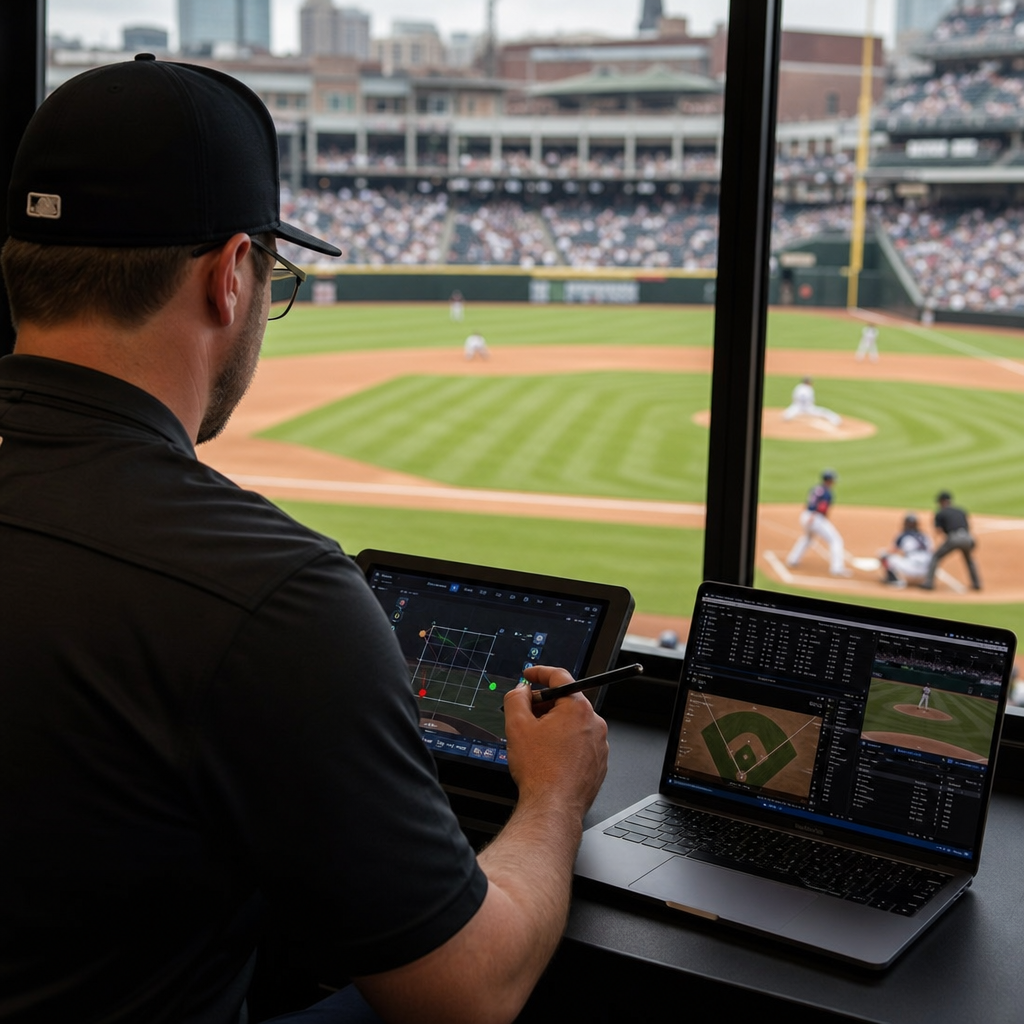
Baseball has always changed, but the ethical implications of technological advances in baseball have become impossible to treat as a side issue. In clubhouses, front offices, training labs, replay rooms, and broadcast booths, technology now shapes how the game is taught, played, judged, monetized, and remembered. The central question is no longer whether innovation belongs in baseball. It does. The real question is which innovations improve fairness, safety, and understanding without damaging the sport’s competitive integrity, human element, or accessibility.
When people discuss technology in baseball, they often mean different things. Some are talking about performance tools such as high-speed cameras, bat sensors, force plates, biomechanics software, and wearable trackers. Others mean officiating systems like instant replay, automated ball-strike technology, and optical tracking. Still others mean fan-facing changes: pitch clocks on broadcasts, enhanced data visualizations, sports betting integrations, and personalized streaming. Each category raises a different ethical problem. A biomechanical sensor may help prevent injury, but it may also create privacy concerns. Automated strike zones may improve consistency, but they may also alter catcher framing, pitcher strategy, and the authority of umpires.
I have worked with baseball organizations and digital publishers long enough to see how quickly a useful tool becomes an expectation. Once one team gains an edge through better data capture or player development systems, everyone else feels pressure to follow. That pressure drives progress, but it also widens gaps between wealthy clubs, lower-budget teams, college programs, youth organizations, and international development systems. Technology is not neutral in practice. It tends to reward whoever can buy infrastructure, hire specialists, and translate raw data into decisions faster than competitors.
This matters because baseball presents itself as a meritocratic sport built on rules, records, and earned advantage. If innovation changes who can compete, how skills are evaluated, or what counts as legitimate preparation, then ethics moves to the center of the conversation. A complete view of innovation and change in baseball has to examine competitive balance, athlete welfare, data ownership, labor relations, fan trust, and the preservation of what makes the game recognizable across generations.
How Technology Changed Baseball’s Competitive Landscape
The modern game runs on information. Statcast, Hawkeye, TrackMan, Rapsodo, Blast Motion, K-Vest, Edgertronic cameras, and force plate systems have transformed player evaluation and development. Teams can measure spin efficiency, vertical approach angle, seam-shifted wake effects, bat speed, attack angle, hip-shoulder separation, reaction time, and defensive route efficiency with extraordinary precision. Those measurements can improve coaching dramatically. A pitcher who once heard “get on top of the ball” can now see release height, induced vertical break, and extension in objective terms. A hitter struggling with ground-ball contact can analyze bat path and point of contact within minutes.
These gains are real, but so is the ethical tension. Clubs with larger budgets can integrate multiple systems into one development model, hire data engineers and biomechanics specialists, and build individualized plans at scale. Less wealthy organizations may still use advanced tools, but often not with the same depth or staffing. That inequality affects player outcomes. A marginal prospect may become a major leaguer in one organization and plateau in another because the surrounding technological ecosystem differs so much.
The issue extends beyond Major League Baseball. At the college, high school, and travel-ball levels, expensive tracking devices and private hitting or pitching labs can create a pay-to-develop pipeline. Families with resources can expose players to elite analysis early, while equally talented athletes without that access may be overlooked. In ethical terms, baseball risks confusing measurable refinement with innate potential. The sport becomes better at identifying polished skill, but not always fairer at discovering raw ability.
There is also a strategic arms race problem. When every team chases the same measurable advantages, the game can narrow around optimized behavior. Pitch design helped create sharper breaking balls and high fastballs. Hitting optimization emphasized launch angle and damage on contact. Defensive positioning once pushed fielders precisely where models expected batted balls. Optimization is rational, but fans and league officials have seen that rational strategies can still produce undesirable outcomes, including more strikeouts, fewer balls in play, and less stylistic variety.
Fairness, Rules, and the Limits of Gamesmanship
Baseball has always tolerated a degree of gamesmanship. Sign decoding from second base, pitch tipping recognition, catcher framing, and spray-chart positioning all live within the accepted struggle for information. Ethical trouble begins when technology changes the speed, scale, or secrecy of that information gathering. The Houston Astros sign-stealing scandal remains the clearest recent example. The core violation was not merely creativity. It was the use of prohibited technology to capture and relay signals in real time, undermining the shared assumptions that make competition legitimate.
That case matters because it showed how thin the line can be between smart preparation and unfair manipulation. Video review itself is not unethical. Teams are expected to study film. The problem arises when a legal tool is repurposed into covert in-game surveillance. Similar concerns appear whenever clubs use clubhouse feeds, wearable communications, or data-sharing systems in ways rules did not intend.
Leagues therefore need ethical standards that do more than list banned devices. They must define principles. A useful test asks three questions: Does the tool create hidden asymmetric information during live competition? Does it bypass a skill the sport traditionally asks humans to perform? Does it pressure others to adopt questionable practices simply to avoid disadvantage? If the answer is yes, regulation is justified.
Automated ball-strike systems illustrate the nuance. Many people frame the issue as accuracy versus tradition, but the ethics are broader. A fully automated zone may reduce umpire inconsistency, which supports fairness. Yet baseball’s strike zone is a rulebook construct applied to moving bodies in a dynamic environment. The placement of the zone, the calibration of the system, and the appeal process all matter. If players, catchers, and umpires cannot understand or trust those inputs, “automation” may merely replace one kind of discretion with another hidden layer of authority.
| Technology | Primary Benefit | Main Ethical Risk | Best Governance Response |
|---|---|---|---|
| Biomechanics sensors | Injury prevention and skill development | Player privacy and coercive monitoring | Clear consent and data use limits |
| Instant replay | More accurate calls | Game delays and overreliance on technical margins | Defined review scope and time limits |
| Automated strike zone | Zone consistency | Opaque calibration and reduced human authority | Public standards and challenge-based use |
| Optical tracking | Better evaluation and fan insight | Unequal access and surveillance creep | Shared baseline access across clubs |
| Betting integrations | New revenue and engagement | Integrity risks and fan distrust | Strict firewalls and transparency |
Player Health, Consent, and Data Ownership
The strongest ethical case for baseball technology is player health. Workload monitoring, motion capture, markerless biomechanics, sleep tracking, and force plate testing can identify fatigue patterns or mechanical changes before they become injuries. I have seen player development staffs use this information responsibly, not as a surveillance tool, but as a way to tailor throwing programs, recovery windows, and strength plans. In a sport defined by repetition and overuse risk, that is a substantial benefit.
But health technology becomes ethically fragile when consent is vague or employment pressure is high. A minor leaguer asked to wear a tracker may not feel free to decline, even if the data could later influence promotion decisions, contract evaluations, or release risk. That is why data governance matters as much as data collection. Players should know what is being gathered, who can access it, how long it is stored, and whether it can be used in arbitration, salary discussions, or medical determinations.
Data ownership is the unresolved issue likely to define the next era. If a pitcher’s arm slot, stress signature, and fatigue markers are collected every day, does that information belong to the club, the player, or both? If a player changes teams, can he take his historical training data with him? Collective bargaining will increasingly shape these answers. In professional sports, personal performance data is not just information. It is labor-related information, and that gives it economic power.
There is also a risk of overconfidence. Models can identify probabilities, but they cannot eliminate uncertainty. A team that treats biometric indicators as definitive may overrule athlete self-reporting or reduce a player to a dashboard profile. Good ethics requires preserving human judgment. Trainers, physicians, coaches, and players need systems that inform decisions rather than dictate them.
The Human Element, Fan Trust, and the Meaning of the Game
Every sport has to decide what it is willing to mechanize. Baseball’s appeal has always included a tension between precision and imperfection: the strike zone interpreted by a human umpire, the stolen base judged in real time, the manager deciding whether to trust his eyes or the scouting report. Technology can improve those moments, but if it replaces too many of them, the game risks becoming less human in a way fans can feel even if they cannot name it.
Instant replay demonstrates both the value and the cost. It corrects important mistakes, especially on boundary calls and tag plays that happen too fast for any crew to judge perfectly. At the same time, replay can encourage forensic review of negligible details that were never visible in real time. When a slide is ruled out because a fingertip lost contact with the bag for a fraction of a second during an otherwise successful steal, fans often feel the process delivered technical accuracy without preserving competitive truth.
Broadcast technology raises another set of concerns. Richer visuals, pitch metrics, and defensive overlays have made baseball easier to understand for many viewers. That is a genuine improvement. Yet the presentation of probability can mislead if context is missing. Win probability swings, catcher framing values, and expected batting average all depend on model assumptions. Used carefully, they educate. Used carelessly, they flatten the game into a series of automated verdicts and encourage audiences to treat models as reality itself.
Fan trust also intersects with gambling. Sportsbooks integrated into broadcasts and apps create new revenue streams, but they introduce conflict around integrity and attention. Baseball cannot credibly market every pitch as a betting opportunity without also strengthening player education, league monitoring, and public transparency about suspicious activity. The sport learned long ago that integrity is not a branding slogan. It is an operational requirement.
What Responsible Innovation Looks Like in Baseball
Responsible innovation in baseball starts with a simple rule: technology should solve a clearly defined problem without creating a larger hidden one. That means leagues and teams should evaluate new tools against five standards: fairness, transparency, proportionality, consent, and competitive integrity. If a system improves injury prevention, for example, the next questions should be whether players can understand it, whether participation is meaningfully voluntary, and whether the resulting data can be misused.
Shared access is another important principle. Not every club will spend equally, but leagues can reduce ethical imbalance by setting baseline standards for data availability, officiating systems, and player protections. Baseball has done versions of this before through centralized replay rules, league-wide tracking infrastructure, and standardized testing programs. A hub approach to innovation works best when core information is broadly available and proprietary advantages come from coaching quality, implementation, and decision-making rather than exclusive surveillance capacity.
Governance must also be iterative. Technology evolves faster than rulebooks, so static regulation is rarely enough. Pilot programs in the minor leagues, independent audits, public explanation of rule changes, and consultation with players and umpires are essential. Challenge-based automated ball-strike systems are a good example of measured adoption because they test accuracy while preserving game flow and some human authority.
Closing thoughts on innovation and change in baseball should therefore resist two lazy conclusions. The first is that tradition should block progress. The second is that innovation is automatically good because it is newer and more precise. Baseball is healthiest when it adopts tools that protect players, clarify competition, and deepen understanding while rejecting systems that erode fairness, exploit labor, or turn every uncertainty into a data extraction opportunity. If you are building coverage for this broader topic, use this page as the hub: examine each technology not only by what it can do, but by what it changes about responsibility, trust, and the game itself.
Frequently Asked Questions
1. Why are the ethical implications of technological advances in baseball such a major issue now?
The ethical stakes are higher now because technology no longer sits at the margins of baseball; it influences almost every layer of the sport. Advanced tracking systems measure pitch movement, spin rate, bat speed, sprint efficiency, and defensive positioning in extraordinary detail. Replay systems affect officiating. Wearables and biomechanical tools shape training and injury prevention. Analytics platforms influence contracts, roster construction, player development, and even how fans interpret value. When technology affects who gets paid, who stays healthy, who wins, and how the game is judged, ethics stops being an abstract concern and becomes part of baseball’s daily operating system.
What makes the issue especially urgent is that innovation can improve the game while also creating new forms of imbalance. A tool that helps prevent arm injuries may be a clear good, but if only wealthy organizations can access it, competitive inequality grows. A system designed to make umpiring more accurate may improve fairness, yet it can also reduce the human character many people believe is part of baseball’s identity. In other words, technology often solves one problem while introducing another. That is why the conversation has shifted from “Should baseball use technology?” to “How should baseball govern it?”
There is also a trust issue. Fans, players, and coaches are more likely to accept technological change when the purposes are clear and the rules are consistent. But when tools are used secretly, unevenly, or opportunistically, the game’s legitimacy suffers. Baseball depends on the belief that outcomes are earned within a shared framework of rules and expectations. Once people start to suspect that hidden systems, proprietary advantages, or data asymmetries are deciding too much, the integrity of competition comes into question. That is why the ethical implications of technological advances in baseball are now impossible to dismiss as a side topic.
2. Which baseball technologies raise the biggest ethical concerns?
Several categories of technology generate the most serious ethical debate, and they do so for different reasons. Sign-decoding systems and electronic communication tools are among the most obvious because they touch directly on competitive integrity. If technology is used to steal signs in ways that go beyond what baseball considers fair gamesmanship, it crosses from clever strategy into cheating. The same concern applies to any hidden or unauthorized system that gives one team information its opponent cannot reasonably anticipate or counter within the rules of play.
Player-tracking and biometric technologies raise a different but equally important set of concerns. These tools can help coaches refine mechanics, monitor fatigue, and reduce injury risk, but they also collect deeply personal data about a player’s body and performance. That creates ethical questions about consent, ownership, privacy, and future use. Can a team use biometric data in contract negotiations? Can it share that data across departments without clear permission? Could a player’s health markers be used to label him as risky, even if the information was originally collected for wellness purposes? Those questions are not theoretical; they affect careers, bargaining power, and workplace rights.
Automated strike zone systems and replay technology also raise ethical issues because they reshape the relationship between accuracy and tradition. Many people favor these tools because they reduce obvious officiating errors, and fairness matters. At the same time, some worry that baseball could become over-engineered, with too much authority transferred from on-field judgment to technological systems that may appear neutral but still rely on calibration, interpretation, and human oversight. Add in bat and ball design innovations, performance-enhancing recovery technologies, and unequal access to elite development labs, and the ethical landscape becomes broad. The central concern across all of these technologies is whether they enhance fair competition and player welfare or instead create hidden advantages, pressure athletes, and alter the nature of the sport in ways baseball has not fully reckoned with.
3. Does technology make baseball fairer, or does it create new inequalities?
The honest answer is that it does both. Technology can absolutely make baseball fairer in important ways. Replay review can correct obvious mistakes that once changed games and seasons. Advanced medical and training tools can help players avoid injuries, extending careers and improving quality of life. High-speed cameras and pitch-tracking systems can give coaches more accurate teaching information than guesswork ever could. From that perspective, technology promotes fairness by reducing error, improving transparency, and replacing anecdote with evidence.
But fairness is not just about precision; it is also about access. If one organization has world-class analysts, proprietary models, elite biomechanics staff, and cutting-edge recovery systems while another lags behind, the game can become stratified by technological capital. Wealthier teams may be better positioned not only to identify talent but to manufacture improvement, preserve health, and exploit market inefficiencies. That can widen the gap between clubs in ways that are difficult for traditional baseball operations to overcome. In that sense, technology may improve internal decision-making while undermining competitive balance across the league.
There is another form of inequality as well: informational inequality between teams and players. Organizations often know more about a player’s projected value, injury profile, or mechanical risk than the player himself, especially when analysis is proprietary. If teams hold superior data and interpretive power, they can use technology to strengthen their position in negotiations. That does not mean data is unethical by itself, but it does mean fairness requires standards around transparency, consent, and reasonable limits on how information is used. So while technology can make baseball more accurate and more sophisticated, it does not automatically make the sport more just. Fairness depends on governance, access, and the willingness to ensure that innovation does not simply reward whoever has the most money, secrecy, or leverage.
4. How do technological advances affect player privacy, autonomy, and consent?
This is one of the most important ethical dimensions in modern baseball because players are not just athletes; they are workers whose bodies generate valuable data. Wearables, motion-capture systems, sleep monitors, force plates, heart-rate trackers, and biomechanical assessments can provide tremendous benefits. They can detect fatigue, support safer training loads, identify injury risks, and personalize development. Used well, these technologies can extend careers and improve performance in genuinely responsible ways. The ethical problem begins when data collection expands faster than player protections.
Privacy matters because biometric and performance data can reveal intimate information about a player’s physical condition, limitations, stress levels, and future durability. Once collected, that information can affect playing time, roster decisions, salaries, free agency, and public reputation. If players feel pressured to surrender data in order to keep their jobs or compete for opportunities, then “consent” may not be fully voluntary. Ethical use requires more than a signed form. It requires clear understanding of what is being collected, why it is being collected, who can access it, how long it is stored, and whether it can be used in employment decisions.
Autonomy is equally important. Players should have meaningful input into how technology shapes their development, workload, and career management. If a system flags a player as a risk, does he get to challenge that interpretation? If a team changes a pitcher’s mechanics based on lab analysis, who bears responsibility if that intervention fails or leads to injury? Ethical technology policy in baseball should include informed consent, data security, limited use, and shared governance involving players and their representatives. Without those safeguards, tools meant to support athletes can become instruments of surveillance and control. The best approach is one that treats players not as data sources to be optimized but as human beings with rights, agency, and legitimate interests in how their information is used.
5. What would an ethical approach to technology in baseball actually look like?
An ethical approach would start with a simple principle: technology should serve the game, not overpower it. In practice, that means evaluating every major innovation against a few core standards. Does it improve fairness? Does it protect player health and dignity? Is it transparent in its use and limits? Is it reasonably accessible across the sport? Does it preserve meaningful aspects of baseball’s competitive and cultural identity? Those questions create a better framework than simply asking whether a tool works. Many technologies work. The harder issue is whether they work in ways the sport should endorse.
At the policy level, ethical governance would require clear rules from leagues and governing bodies rather than ad hoc reactions after controversies emerge. That includes explicit boundaries around in-game communication, data collection, sign protection, replay procedures, and automated officiating. It also means strong privacy standards for player data, including informed consent requirements, restrictions on secondary uses, and accountability for misuse. If a team gains an unfair edge through prohibited technology or covert systems, enforcement needs to be credible. Ethics without enforcement is just branding.
Just as importantly, baseball should resist the false choice between tradition and innovation. An ethical path does not demand rejecting modern tools, nor does it require embracing every available advancement simply because it exists. The healthiest model is selective adoption: use technology where it clearly improves safety, accuracy, and understanding, but slow down when it threatens competitive integrity, human agency, or the texture of the game itself. Baseball has always evolved, but not every change deserves equal acceptance. An ethical approach asks the sport to be intentional, transparent, and accountable so that technological progress strengthens baseball’s legitimacy instead of weakening it.