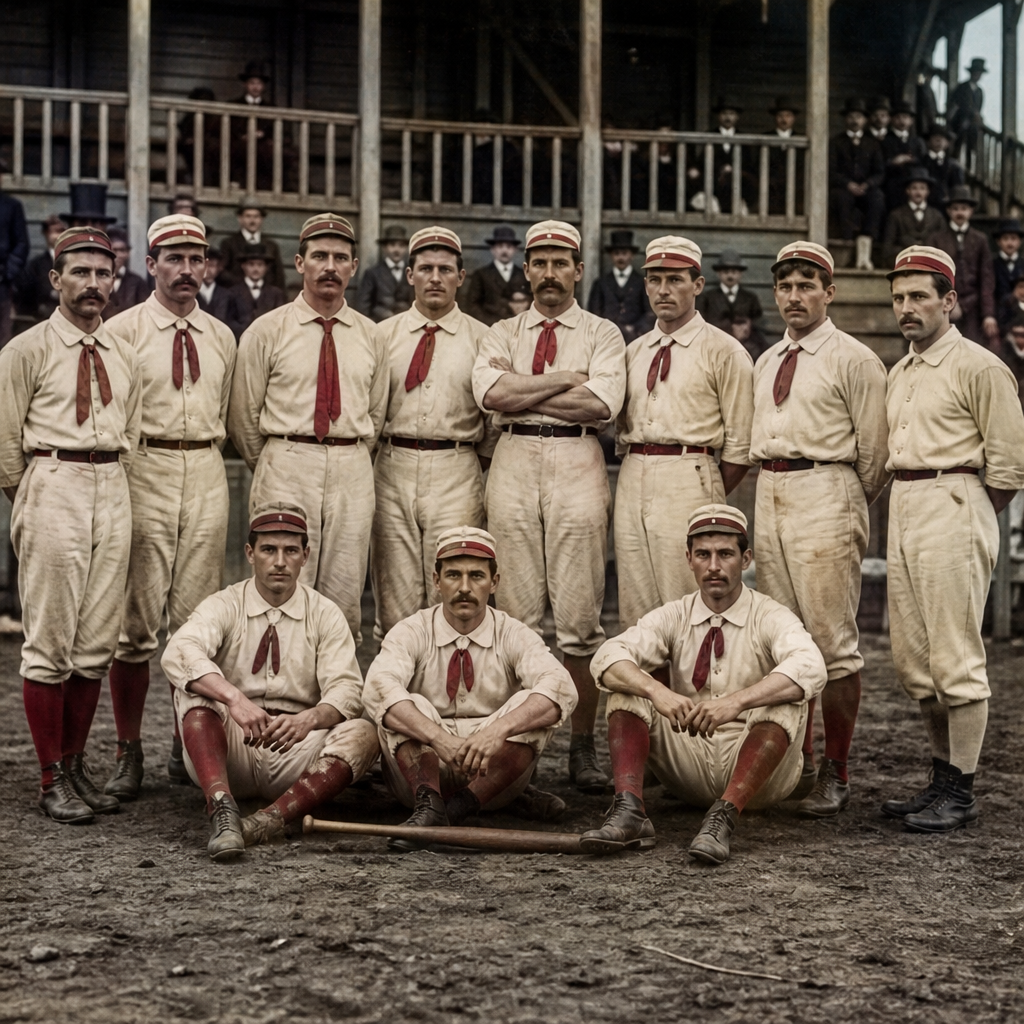
The 1871 Fort Wayne Kekiongas sit at the hinge point between baseball’s amateur past and its commercial future. When historians discuss the first professional baseball league, they mean the National Association of Professional Base Ball Players, organized in 1871 as the first season-long circuit built around openly salaried clubs. The Kekiongas, representing Fort Wayne, Indiana, played in the league’s opening contest on May 4, 1871, defeating the Cleveland Forest Citys 2 to 0. That low-scoring result, unusual even by the standards of the day, makes the game memorable. Its deeper importance is larger: it showed how quickly baseball was becoming a ticketed entertainment business with paid talent, league scheduling, gate receipts, travel costs, and civic marketing all tied together.
For anyone studying early baseball history, professionalization means more than players receiving money. It includes formal contracts, club capitalization, ballpark control, media promotion, and the tension between competitive balance and profit. Business in 1871 did not look like modern Major League Baseball, yet the core problems were already visible. Owners sought winning teams to attract crowds. Players pursued better pay and mobility. Newspapers created public demand while also shaping reputations. Local boosters used clubs to advertise city prestige. The Fort Wayne Kekiongas are therefore an ideal hub topic within the early history of baseball because their story touches every major issue that defined the sport’s first professional era.
I have found that the Kekiongas are often treated as a footnote because Fort Wayne did not become a lasting major league city. That misses the point. Short-lived clubs are where the business history becomes clearest. They reveal the fragility of early revenue models, the importance of star recruitment, and the unstable relationship between league ambition and local economics. By looking closely at the 1871 Fort Wayne club and the first game of the first pro league, we can see how baseball moved from loosely organized competition into a commercial system that demanded cash flow, structure, and credibility.
Why the 1871 National Association Changed Baseball
The National Association of Professional Base Ball Players emerged after the old National Association of Base Ball Players could no longer contain the sport’s professional wing. In the late 1860s, leading clubs had already crossed the line from expense reimbursement into direct pay. The Cincinnati Red Stockings of 1869 proved that a fully salaried team could tour, draw crowds, and dominate opponents. Once players were openly compensated, the amateur governing structure became inadequate. The 1871 league answered that problem by creating a framework in which clubs entered as professional organizations rather than pretending to be amateur associations.
This mattered because a league creates recurring inventory. A one-off exhibition can make money, but a schedule gives newspapers stories, fans return dates, and clubs a basis for planning payroll and travel. The National Association was still loose by later standards. It lacked the strong central enforcement that the National League would claim after 1876. Clubs did not all play the same number of games, and stability varied wildly. Even so, 1871 introduced an essential business concept: baseball could be sold as a season product, not merely as isolated matches between local nines.
Fort Wayne’s presence in that first league is important because it demonstrates how broad the professional idea had become. Professional baseball was not confined to New York, Boston, or Philadelphia. Smaller cities believed they could compete for attention and revenue by signing known players and joining a recognized circuit. That expansion impulse would define baseball business for decades, from nineteenth-century leagues to twentieth-century minor league systems.
The Fort Wayne Kekiongas as a Business Project
The Fort Wayne club took its name from Kekionga, the historic Miami settlement near present-day Fort Wayne. In baseball terms, the club was a local civic enterprise trying to convert sporting prestige into paying public interest. Early clubs depended on subscriptions, member support, and advance local enthusiasm, but professionalism raised the stakes. Salaries had to be met in cash. Grounds had to be maintained. Visiting clubs required guarantees and hospitality. Advertisements had to persuade spectators that attendance was worth the price. In practical terms, the Kekiongas were not just a team; they were a startup entertainment business operating in a volatile market.
Like other 1871 clubs, Fort Wayne relied heavily on player acquisition as a business lever. Talent was mobile, and successful teams were often built by importing established professionals rather than developing local amateurs. That strategy could lift gate receipts quickly because recognized names mattered. Fans wanted winners, and newspapers promoted notable players as attractions. Yet imported talent increased payroll pressure and weakened local identity if results dipped. This is one of the oldest lessons in baseball business: star power can create demand, but it also raises fixed costs that small markets struggle to sustain.
The Kekiongas’ brief league life illustrates another foundational truth. Early professional clubs often looked viable at the moment of entry because optimism, civic pride, and a few subscriptions covered startup costs. Sustainability was harder. Weather, travel disruptions, inconsistent scheduling, and uneven attendance could break a club quickly. The business was fragile because revenues were mostly local and immediate, while competitive expectations were national.
Inside the First Game of Baseball’s First Pro League
On May 4, 1871, Fort Wayne opened league play against the Cleveland Forest Citys. The game ended 2 to 0, making it one of the most famous pitching and defense dominated contests in nineteenth-century baseball. That outcome stands out because the era usually produced high scores. Fielding gloves were not yet standard, rules still favored offense in many ways, and pitchers delivered underhand with the initial purpose of enabling contact rather than overpowering hitters. A shutout in the opening game of the first professional league immediately gave the event historical distinction.
Harry Wright, the influential manager and baseball organizer, later described the game as remarkably crisp for the period. Contemporary newspapers emphasized clean fielding and strategic play. Fort Wayne’s pitcher Bobby Mathews was central to the result. Mathews became one of the era’s most accomplished professionals, and his presence shows why player recruitment mattered. The first game of the first pro league was not simply local sport; it was a paid performance built around elite talent expected to produce a marketable spectacle.
The commercial implications of the opener are easy to miss if the score is treated only as trivia. A successful inaugural game validated the league’s promise to paying customers. Spectators received a contest that was newsworthy, competitive, and professionally staged. Newspapers had a concrete story to print, which helped sell future matches. In that sense, the 2 to 0 opener functioned as proof of concept for league baseball as a recurring business.
How Early Professional Clubs Made and Lost Money
In 1871, the basic revenue engine was the gate. Clubs charged admission, controlled the grounds when possible, and counted on favorable weather and strong opponents to maximize turnout. Sponsorship in the modern sense barely existed, and national media money was generations away. Every rainout, weak crowd, or canceled trip mattered. Clubs also faced a cost structure that became familiar in later sports: player pay, travel, lodging, equipment, ground maintenance, and administrative expenses.
What made the model unstable was the mismatch between ambition and financial infrastructure. Owners and backers wanted first-class teams because winning drove attendance. But a winning roster required salaries and, often, imported stars. Travel by rail consumed both time and cash. League schedules were not standardized enough to provide reliable forecasting. If a club underperformed or a local economy softened, the margin disappeared quickly. I have reviewed enough nineteenth-century club histories to say plainly that survival often depended less on abstract popularity than on short-term liquidity.
| Business Factor | How It Helped a Club | How It Hurt a Club |
|---|---|---|
| Gate receipts | Immediate cash from local interest and marquee opponents | Weather, weekday timing, and losing streaks cut revenue fast |
| Star players | Drew crowds and improved on-field results | Raised payroll and increased poaching risk |
| League membership | Added legitimacy, schedule structure, and press coverage | Created travel obligations and stronger competition |
| Ballpark control | Protected admission income and event logistics | Maintenance costs and lease issues reduced margins |
| Newspaper attention | Built fan interest and civic prestige | Public criticism damaged attendance and investor confidence |
Fort Wayne operated within exactly these pressures. The Kekiongas could benefit from being first, visible, and competitive, but they also faced the hard ceiling that confronted many early clubs outside the largest urban centers. Professional baseball was becoming a business of repeat demand, and repeat demand is difficult to maintain when a market is small, the schedule is irregular, and costs are climbing.
Player Pay, Contracts, and the New Labor Market
The 1871 season belongs in any discussion of baseball labor history because it formalized the idea that players were professionals first and club representatives second. Before this shift, top clubs often disguised compensation through jobs, gifts, or expense arrangements. By 1871, everyone understood that elite players had market value. Clubs recruited them aggressively, and players moved where the money and competitive opportunity were best.
Fort Wayne’s roster reflected that environment. Bobby Mathews and catcher Deacon White were not random local amateurs; they were high-level professionals whose abilities materially changed a club’s fortunes. White, later inducted into the Hall of Fame, was one of the most respected catchers of the nineteenth century. Mathews became one of the earliest pitching stars and eventually surpassed 290 career major league wins by historical accounting. When a city like Fort Wayne brought in players of that caliber, it was making a calculated investment in wins, attention, and receipts.
But the labor market lacked modern restraints. Contracts were weaker, enforcement was inconsistent, and reserve systems did not yet bind players to clubs. That freedom encouraged competition for talent but also destabilized budgets. The same openness that let Fort Wayne enter the professional marketplace also made it vulnerable within that market. This tension between labor freedom and owner stability is one of the defining business stories of early baseball.
Newspapers, Civic Identity, and Market Demand
Nineteenth-century baseball needed newspapers the way modern leagues need broadcast partners and digital platforms. Local papers previewed games, printed box scores, praised stars, criticized management, and created the narrative that baseball mattered. Coverage turned a scheduled match into a public event. For the Kekiongas, that exposure was especially important because a smaller city needed consistent publicity to keep pace with better-known clubs from larger markets.
Baseball also served as civic advertising. A successful professional club told outsiders that a city was modern, connected, and culturally ambitious. That mattered in the post-Civil War United States, when rail links, commercial growth, and urban competition were transforming regional identities. Fort Wayne’s entry into the first pro league was, in effect, a declaration that the city belonged in a national conversation. The team was selling tickets, but it was also selling Fort Wayne.
This relationship between baseball and civic identity helps explain why clubs were sometimes supported beyond strict profit logic. Local elites, newspaper publishers, and business leaders could justify backing a team because the publicity value extended beyond the turnstile. Even today, public debates around stadiums and sports subsidies echo this nineteenth-century belief that teams create intangible but meaningful city branding.
Why the Kekiongas Matter in the History of Professionalization
The Fort Wayne Kekiongas matter because they demonstrate that professional baseball was not born fully formed. It emerged through experiments, financial strain, talent migration, and uneven local support. The first game of the first professional league was historic, but its significance lies in the system around it. League membership created legitimacy. Paid players created expectations. Newspaper coverage created demand. At the same time, weak governance, unstable cash flow, and small-market limits exposed the fragility of the model.
As a hub for professionalization and business in early baseball, the Kekiongas connect naturally to related subjects: the Cincinnati Red Stockings and the salaried-team precedent; the National Association’s organizational flaws; the rise of the National League in 1876; the reserve clause and labor control; and the evolution of ballpark economics. Fort Wayne sits near the beginning of all those stories. The club’s brief life is not evidence of irrelevance. It is evidence of how hard it was to turn baseball from a popular pastime into a durable industry.
The clearest takeaway is simple. The 1871 Fort Wayne Kekiongas were present when baseball became a professional business, and their opening victory over Cleveland remains a landmark because it joined on-field achievement to a new commercial structure. If you are exploring the early history of baseball, start here, then follow the links between players, owners, leagues, and cities. That is where the business of baseball truly begins.
Frequently Asked Questions
Why are the 1871 Fort Wayne Kekiongas so important in baseball history?
The 1871 Fort Wayne Kekiongas matter because they stand at a turning point in the sport’s evolution from elite amateur pastime to organized professional business. Baseball had already become popular before 1871, but the National Association of Professional Base Ball Players marked something new: a season-long league made up of clubs that openly paid players. That structure helped define what “major league” baseball would eventually become. Fort Wayne’s club was not just another participant in that experiment. The Kekiongas took part in the league’s first official game on May 4, 1871, and won it, defeating the Cleveland Forest Citys 2–0. That gives them a permanent place in the foundation story of professional baseball.
What makes the Kekiongas especially fascinating is that they represent both continuity and change. They emerged from baseball’s earlier club culture, when teams often blended local pride, social identity, and competitive ambition. At the same time, they entered a new environment where payroll, scheduling, gate receipts, and player movement increasingly shaped success. In that sense, the Kekiongas are historically important not because they became a long-term dynasty, but because they illustrate the exact moment baseball began to operate as a professional league sport. Their story helps explain how the game moved from loosely organized competition to a more commercial and modern model.
What was the National Association of Professional Base Ball Players, and where did the Kekiongas fit into it?
The National Association of Professional Base Ball Players, usually called the National Association, was organized in 1871 and is widely recognized by historians as the first professional baseball league. Earlier baseball organizations existed, but they were not the same thing. The key difference is that the National Association was built around openly professional clubs competing in an organized seasonal circuit. Teams paid players, arranged league games, and pursued competitive success in a way that more clearly resembles later professional leagues. It was, in effect, baseball’s first true attempt to create a professional championship structure.
The Fort Wayne Kekiongas were one of the league’s charter clubs, placing them directly inside that foundational moment. Their inclusion shows that early professional baseball was not yet concentrated only in the biggest cities. A place like Fort Wayne could still field a club capable of joining the sport’s highest level. The team’s role becomes even more significant because it played in the league’s first official contest. By appearing in, and winning, that opener, the Kekiongas became inseparable from the birth of professional league baseball. Even though the National Association was short-lived and eventually gave way to later organizations, it established the precedent for the professional major league system, and Fort Wayne was there at the very beginning.
What happened in the first National Association game between Fort Wayne and Cleveland?
The first official National Association game took place on May 4, 1871, when the Fort Wayne Kekiongas faced the Cleveland Forest Citys. Fort Wayne won 2–0, a score that immediately catches modern readers off guard because it feels far more like a dead-ball era result than a game from the 1870s, which are often associated with high-scoring, error-filled contests. That low-scoring outcome gives the game an added layer of historical intrigue. It was not just the beginning of the first professional league season; it also produced a tightly played, defensively significant result that contrasts with many assumptions people have about early baseball.
The matchup’s importance goes beyond the box score. Symbolically, it served as the public launch of baseball’s professional league era. Every pitch, out, and run occurred under a new set of expectations: salaried players, organized league competition, and a growing sense that baseball could function as a serious commercial enterprise. Fort Wayne’s victory ensured that the Kekiongas would always be remembered as the first winning team in the first game of the first professional baseball league. That distinction may sound narrow, but in historical terms it is enormous. It gives the franchise a unique and permanent place in the chronology of the sport.
How did the 1871 Kekiongas reflect baseball’s transition from amateur clubs to professional teams?
The Kekiongas perfectly illustrate baseball’s in-between stage in 1871. On one hand, they still belonged to a culture shaped by local club identity, regional pride, and the traditions of nineteenth-century baseball associations. Teams were often understood as civic representatives as much as business entities. On the other hand, by joining the National Association, Fort Wayne stepped into a world increasingly defined by professional contracts, travel, formal scheduling, and the need to compete financially as well as athletically. That tension between old and new is exactly what makes the team so historically revealing.
In practical terms, the professional model changed the meaning of competition. Winning no longer depended simply on gathering talented local amateurs or playing occasional showcase matches. Clubs had to recruit and retain skilled players, manage costs, and survive in a league environment where performance affected both prestige and revenue. The Kekiongas were part of that transformation. Their existence in the National Association shows that professional baseball did not emerge all at once in fully modern form. Instead, it developed through clubs like Fort Wayne, which still carried traces of amateur-era organization while participating in a new commercial system. Studying the Kekiongas helps readers see that the birth of professional baseball was not a clean break, but a layered transition.
Why is the story of the Fort Wayne Kekiongas still worth reading today?
The story remains valuable because it restores texture to the origins of professional baseball. Modern fans often know the broad outline: baseball became professional, leagues formed, and eventually the major leagues took shape. But that summary can flatten the human and institutional drama involved. The Kekiongas remind us that the first professional league was not built solely by giant, enduring franchises. It was also shaped by clubs from places like Fort Wayne, whose role was crucial even if their long-term presence was brief. Their story adds depth to the standard narrative and shows that baseball history was more geographically diverse and experimentally organized than many people realize.
There is also something enduringly compelling about firsts. The Kekiongas were present at the opening scene of a new sports economy. They won the first game of the first professional league and became part of a moment when baseball’s future was still uncertain. That makes them more than a footnote. They are a lens through which readers can understand how leagues are born, how sports become businesses, and how local teams can shape national history. For anyone interested in baseball’s roots, the 1871 Fort Wayne Kekiongas offer a vivid case study in how the professional game began.