Baseball’s history is often told through the careers of famous men, yet the sport has been shaped at every stage by women who played, managed, scouted, owned teams, challenged exclusion, and built new pathways into the game. In the context of women in baseball, “miscellaneous” should not mean minor. It is the category that captures the pioneers who do not fit neatly into one box but collectively changed rules, business practices, media coverage, player development, and public imagination. This hub article maps that wider landscape and shows why these women matter to anyone who wants a complete understanding of baseball history.
When I have worked on baseball heritage projects, the biggest pattern I have seen is not absence of evidence but fragmentation. One woman appears in Negro Leagues history, another in wartime professional ball, another in front-office innovation, another in youth coaching, and their stories are too often isolated from each other. That separation hides the real lesson: women have influenced baseball continuously, not occasionally. From the nineteenth century Bloomer Girls clubs to the All-American Girls Professional Baseball League, from Effa Manley in the Newark Eagles front office to Kim Ng in a modern general manager’s chair, women have repeatedly entered the sport where opportunity opened and pushed against it where barriers remained.
Key terms help clarify the discussion. A pioneer is a first mover who enters a role from which women were excluded. A trailblazer goes further by making that role easier for others to follow. Inclusion means more than visibility; it means access to competition, coaching, leadership, pay, and decision-making. Representation matters in baseball because the sport is developmental. Players, executives, and fans learn what is possible by seeing who belongs on the field, in the dugout, and in the boardroom. That is why the women in this article are game changers. They did not simply participate. They altered baseball’s structure, standards, and future.
Early pioneers proved women belonged on the diamond
Women were playing organized baseball long before most mainstream histories acknowledge it. In the late nineteenth century, traveling teams known as Bloomer Girls drew crowds across the United States. They mixed skilled women players with, at times, disguised male ringers, which reveals both the commercial pressures of the era and the public appetite for women on the field. Even with those complications, the core fact stands: women were marketed as baseball attractions because they could play and people wanted to watch. These teams toured relentlessly, often under difficult travel conditions, and normalized the sight of women throwing, hitting, and turning double plays in an age that questioned whether they should compete at all.
Among the earliest stars, Lizzie Arlington is frequently cited as the first woman to play for a men’s semi-professional team when she appeared with the Reading Coal Heavers in 1898. Alta Weiss, a pitcher from Ohio in the early twentieth century, built a substantial following and was promoted as a legitimate baseball draw, not merely a novelty act. Jackie Mitchell’s famous 1931 exhibition strikeouts of Babe Ruth and Lou Gehrig with the Chattanooga Lookouts remain debated because of the performance context, but the event still exposed a central truth: even symbolic moments can unsettle gatekeepers. These early players faced ridicule, restrictive clothing expectations, uneven pay, and limited league structure, yet they established the principle that baseball ability is not inherently male.
Wartime professional baseball changed public perception
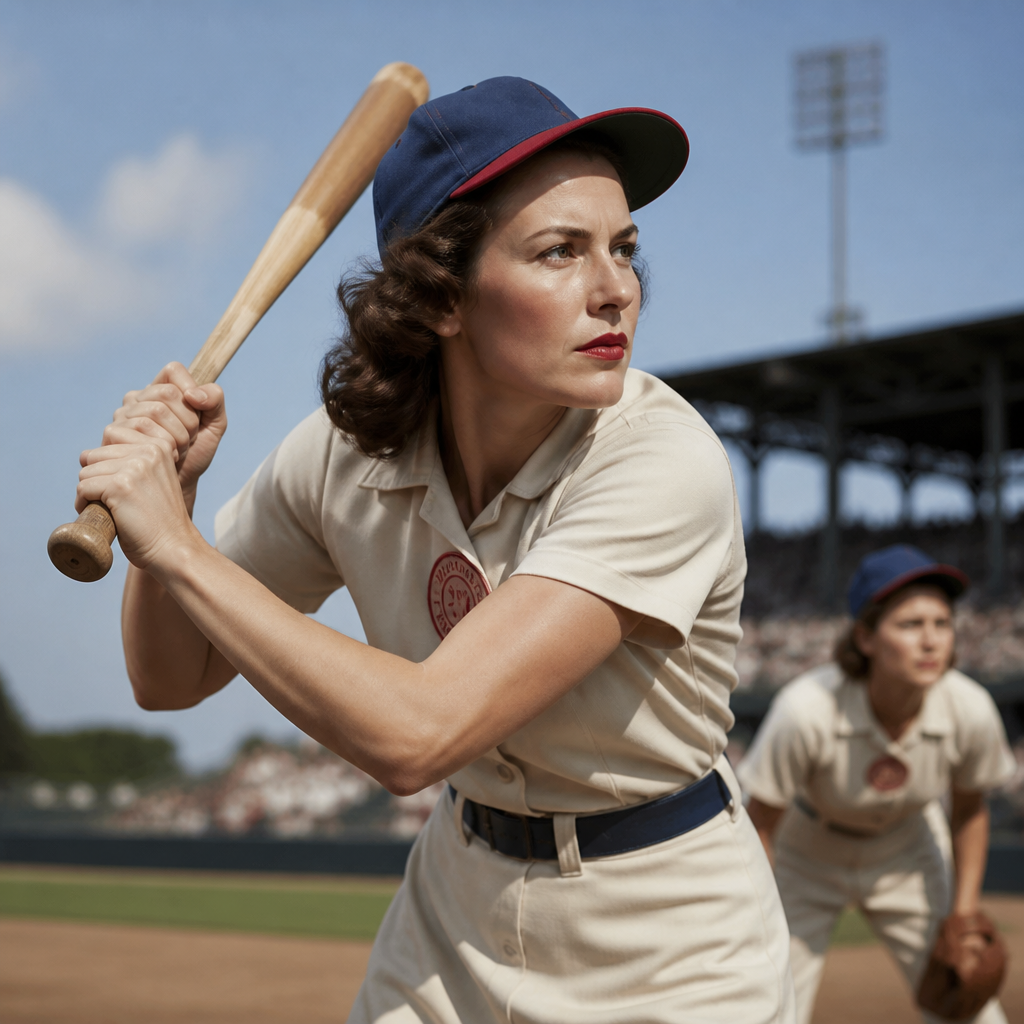
The most widely recognized chapter in women’s baseball history is the All-American Girls Professional Baseball League, founded in 1943 while World War II depleted male player availability. Too often, this league is reduced to nostalgia because of the film A League of Their Own. In reality, it was a serious professional enterprise that evolved from a hybrid of softball and baseball into a more fully baseball-based game. Players endured rigorous schedules, extensive travel, and highly controlled expectations around conduct and presentation. They had to attend charm school, wear skirted uniforms, and project femininity in ways male athletes never had to consider. None of that diminishes their baseball skill; it highlights the extra labor women were required to perform just to stay employed.
The league produced outstanding athletes such as Dottie Kamenshek, Sophie Kurys, Connie Wisniewski, and Toni Stone’s contemporaries in parallel circuits. Kamenshek was so highly regarded defensively at first base that some observers compared her favorably with top major leaguers. Kurys set records on the basepaths through elite speed and instincts. More importantly, the league proved that women’s team sports could be commercially viable in multiple Midwestern cities, with attendance reaching into the millions over its lifetime. It also created a pipeline of coaches, ambassadors, and baseball teachers whose influence lasted long after the league ended in 1954. For public perception, the AAGPBL was decisive: it moved women in baseball from curiosity to durable institution.
Black women and overlooked stars expanded the map of baseball history
No hub on women in baseball is complete without addressing who has been left out of the standard story. Toni Stone, Mamie “Peanut” Johnson, and Connie Morgan played in the Negro Leagues at a time when both race and gender narrowed opportunity. Stone replaced Hank Aaron on the Indianapolis Clowns roster in 1953 and faced open hostility from some teammates and opponents, yet she belonged there on merit. Johnson, a pitcher with the Clowns, reportedly compiled a remarkable record and used control, movement, and competitiveness to beat skepticism. Morgan also played second base for the Clowns and demonstrated that women could handle demanding infield roles against men in professional competition.
These players matter not only because they were firsts, but because they expose the weakness of a narrow integration narrative that centers only Major League Baseball. Women’s baseball history was never one single lane. It included Black baseball, barnstorming circuits, industrial leagues, military teams, and local semi-pro clubs. Recognition has improved through the Negro Leagues Baseball Museum, the National Baseball Hall of Fame’s growing interpretive work, and recent scholarship, but coverage is still uneven. When readers explore this subtopic further, they should treat race, region, class, and access as central categories. The women who made history did so under different conditions, and those differences explain both why some names became famous and why many equally important careers remained obscure.
Women changed baseball from the front office and ownership level
Some of the most consequential women in baseball never took a professional at-bat. Effa Manley, co-owner and business manager of the Newark Eagles, is the clearest example. She was the first woman inducted into the National Baseball Hall of Fame in 2006, and her case is overwhelming. Manley handled contracts, promotions, community engagement, and civil rights advocacy while helping build one of the Negro Leagues’ strongest franchises. She was an executive in the fullest sense of the word: strategic, financially active, operationally capable, and publicly influential. Her career proves that baseball leadership has never been exclusively male, even if formal recognition arrived far too late.
In the contemporary game, Kim Ng’s appointment as general manager of the Miami Marlins in 2020 marked a milestone because it placed a woman at the top of baseball operations in Major League Baseball. Ng had already built one of the strongest résumés in the sport through work with the Chicago White Sox, New York Yankees, MLB, and Los Angeles Dodgers. Her rise was not symbolic. It rested on collective bargaining knowledge, player personnel evaluation, international operations, and years of executive decision-making. Other leaders, including Janet Marie Smith in ballpark development and Alyssa Nakken in coaching, have similarly expanded what baseball leadership looks like. The practical effect is profound: once a role is visibly attainable, hiring conversations, mentorship, and candidate pools begin to change.
Coaches, scouts, and developers opened modern pathways
One of the clearest shifts of the last two decades is that women are now appearing in baseball jobs tied directly to player improvement. That matters because development is the engine room of the sport. If women can coach mechanics, analyze pitch design, supervise strength programs, or run advance scouting, they become part of the everyday competitive process rather than occasional public-relations milestones. Rachel Balkovec broke major barriers in player development and became the first woman to manage an affiliated minor league team when she took over the New York Yankees’ Class A Tampa Tarpons in 2022. Her background in strength and conditioning and hitting instruction showed that expertise, not novelty, drove her progression.
Similarly, Bianca Smith became the first Black woman to coach professional baseball when the Boston Red Sox hired her in 2021 for a minor league role. Veronica Alvarez has contributed as a coach, national team leader, and development advocate, while women such as Justine Siegal have created instructional opportunities that connect grassroots participation to professional aspiration. Scouts, analysts, athletic trainers, and performance specialists now form a broader ecosystem of influence. The pattern I have seen across organizations is simple: once women are trusted with real baseball responsibilities, resistance tends to shift from open doubt to ordinary professional evaluation. That is progress, because equality in baseball ultimately means being judged by standards of performance that apply to everyone.
| Figure | Primary role | Why she changed baseball |
|---|---|---|
| Effa Manley | Owner and executive | Built the Newark Eagles and set a lasting standard for baseball leadership |
| Toni Stone | Negro Leagues player | Proved a woman could compete in men’s professional Black baseball |
| Kim Ng | MLB general manager | Opened the top baseball operations role to women in the major leagues |
| Rachel Balkovec | Minor league manager | Normalized women in player development and on-field leadership |
Media, advocacy, and youth programs sustain the future
Baseball history changes when institutions choose to preserve it. Journalists, documentary producers, museum curators, and advocacy groups have all expanded the public record on women in baseball. The Society for American Baseball Research has supported more rigorous work in this area, while the Hall of Fame’s educational materials increasingly place women within the broader narrative of the game rather than in a side exhibit. That shift is important because visibility drives funding, research, and participation. If families, school programs, and local leagues can find credible examples of women in baseball, girls are more likely to stay in the sport longer.
Youth initiatives are especially important because softball and baseball often split girls’ pathways early. Softball has created valuable opportunities, but it should not function as a forced substitute for girls who want to play baseball. Programs like Baseball For All, girls’ tournaments, and national development events have helped create competitive environments where girls can keep refining baseball-specific skills. Women’s national team competition under the World Baseball Softball Confederation has also provided elite targets for players who might otherwise leave the sport. The next wave of history will depend less on exceptional one-off pioneers and more on durable systems. That is the real measure of change: not whether one woman breaks through, but whether many can advance without being treated as exceptions.
Why this miscellaneous hub matters within women in baseball
A hub page in a women in baseball content structure has a specific job: connect the scattered pieces into a coherent picture. The miscellaneous category matters because many essential figures cross boundaries. A woman may be a player, later a coach, then an advocate. Another may be remembered for a famous first, even though her deeper contribution was organizational reform or youth mentorship. If coverage focuses only on single biographies, readers miss how progress actually happens. It happens through networks: leagues, schools, museums, front offices, media ecosystems, and community programs that reinforce each other over time.
The key takeaway is clear. Women have always been part of baseball’s competitive and institutional history, and the sport is better when that reality is recognized and expanded. Early pioneers challenged the idea that women could not play. Professional stars during wartime proved women could draw crowds and sustain a league. Black women in the Negro Leagues shattered both racial and gender barriers. Executives, coaches, and developers changed how baseball is run. Advocates and historians made sure those gains were not forgotten. If you are building your understanding of women in baseball, use this article as the starting point, then explore the connected stories, teams, and eras that turn isolated milestones into a complete history.
Baseball’s game changers did more than make appearances. They built evidence, institutions, and momentum. Their legacy is visible every time a girl stays in baseball, every time a woman is hired for a baseball role on merit, and every time the sport tells its own story more honestly. To go deeper, continue through the women in baseball subtopic and trace each pathway from pioneer to present-day impact.
Frequently Asked Questions
Why is it important to look beyond the most famous names when telling the history of women in baseball?
It is important because the real story of women in baseball is much bigger than a short list of widely recognized figures. Popular history often highlights a few breakthrough players or headline-making moments, but the game was also changed by women who worked in less celebrated roles and spaces. They organized teams, financed clubs, trained players, promoted leagues, reported on games, scouted talent, and challenged assumptions about who belonged in baseball. Many of these women operated in periods when formal opportunities were limited or openly denied, which means their influence often appeared in indirect but lasting ways.
Looking beyond the most famous names also helps explain how change actually happens in sports. Baseball did not become more inclusive because of one single event. It changed through cumulative pressure from many women whose work reshaped culture, policy, and expectations over time. Some proved women could compete at high levels. Others demonstrated leadership in front offices, ownership groups, and community baseball programs. Still others changed public perception by writing about the game, preserving its history, or creating opportunities for the next generation. When these contributions are treated as “miscellaneous,” they can seem secondary, when in fact they are often the connective tissue of baseball history.
A fuller view also makes the sport itself easier to understand. Baseball is not only what happens between the foul lines. It is a network of institutions, ideas, labor, and storytelling. Women influenced all of those areas. By widening the historical lens, we get a truer account of who built the game and a more accurate sense of how baseball evolved into the sport people know today.
What kinds of roles have women played in shaping baseball history?
Women have shaped baseball in nearly every imaginable role, and that breadth is one of the most important parts of the story. On the field, women played in organized leagues, barnstorming teams, amateur clubs, and exhibition games, proving both skill and staying power in a sport that often tried to exclude them. Off the field, they served as owners, executives, scouts, journalists, broadcasters, photographers, historians, promoters, and advocates. Each of these roles affected how baseball functioned and how it was understood by the public.
As owners and business leaders, women influenced franchise survival, league stability, and the financial direction of clubs. In some cases, they inherited teams and then proved to be astute stewards of the game; in others, they actively built baseball institutions from the ground up. As scouts and player-development figures, women helped identify talent and refine how organizations thought about recruitment and evaluation. In media, women expanded the visibility of baseball and brought new perspectives to coverage, often navigating workplaces that doubted their authority or expertise. Their reporting and storytelling helped shape public memory, which is a powerful form of influence in any sport.
Women have also played a crucial role as barrier-breakers and organizers. Some challenged formal policies that prevented participation. Others created alternative systems when mainstream baseball shut them out, establishing leagues, clinics, youth programs, and local networks that kept the game accessible. These contributions matter because they show that baseball’s growth has always depended on more than star players. The women who managed operations, changed business practices, opened media doors, and built developmental pathways were not working on the margins of baseball history. They were actively redefining it.
How did women challenge exclusion and create new opportunities in baseball?
Women challenged exclusion in baseball through persistence, performance, organization, and public advocacy. In many eras, the barriers they faced were explicit. Women were told they could not play professionally, could not enter certain baseball spaces, could not report from clubhouses, or could not hold authority in decision-making roles. Some challenged these restrictions directly by trying out for teams, signing contracts, filing legal cases, or demanding equal access. Others worked around exclusion by creating new teams, leagues, publications, and support systems that allowed women to participate even when the traditional structures resisted change.
Performance was one of the most powerful tools. Every time a woman demonstrated clear baseball skill, strategic knowledge, or executive competence, she undercut the assumptions used to justify exclusion. But performance alone was not enough, because institutions often remained resistant even when women succeeded. That is why organization mattered so much. Women built programs for girls and young women, promoted women’s baseball internationally, developed coaching pipelines, and formed communities that kept pressure on the sport to expand. These efforts turned isolated breakthroughs into longer-term progress.
Public visibility also played a major role. When women wrote about baseball, appeared in news coverage, or became symbols of the game’s untapped possibilities, they influenced fans and future players as well as decision-makers. Cultural change often preceded policy change. Once the public could imagine women as players, experts, and leaders in baseball, the arguments for excluding them became harder to sustain. The result was not a straight line of progress, but a series of hard-won advances that opened doors for future generations.
Why does the “miscellaneous” category matter so much in the history of women in baseball?
The “miscellaneous” category matters because it often contains the people and stories that do not fit traditional baseball labels but had enormous impact on the sport. History tends to favor neat categories such as player, manager, owner, or executive. Yet many women influenced baseball in ways that crossed those boundaries or existed outside official recognition. They might have been organizers, educators, writers, patrons, local team builders, traveling promoters, or behind-the-scenes strategists whose work changed how baseball reached communities and how people thought about participation in the game.
Calling these contributions miscellaneous can be misleading if it suggests they were minor. In reality, this category often includes the innovators who changed the rules of possibility. A woman who founded a youth program, preserved a neglected baseball archive, financed a club during a fragile moment, or used media to legitimize women’s place in the sport may not fit a single famous title, but her impact can be far-reaching. Baseball depends on infrastructure as much as stars, and many women built exactly that infrastructure.
This category also reveals how incomplete conventional baseball history can be. When records are uneven or recognition was denied at the time, many achievements survive only in fragments unless historians deliberately seek them out. The “miscellaneous” label becomes a reminder to look harder, not dismiss faster. It points to a larger truth: the transformation of baseball did not happen only through official milestones. It also happened through overlooked labor, creative problem-solving, and persistent advocacy carried out by women whose contributions deserve to be seen as central, not supplemental.
What is the lasting legacy of the women who made history in baseball?
The lasting legacy of the women who made history in baseball is that they expanded the sport’s definition of who belongs in it and who can shape its future. Their influence can be seen in increased opportunities for girls and women to play, coach, scout, report, lead, and study the game. Just as important, they changed the conversation around baseball itself. They forced the sport to confront outdated assumptions, broaden its talent pool, and recognize forms of expertise that had long been ignored or undervalued.
Their legacy is also institutional. Today’s women in baseball benefit from pathways that earlier generations had to create from scratch. Youth development programs, greater media visibility, front-office opportunities, and broader public awareness did not emerge on their own. They are the result of decades of effort by women who pushed against exclusion and insisted that baseball should reflect ability and commitment rather than inherited tradition alone. Even where progress remains incomplete, the framework for further change exists because earlier pioneers built it.
Perhaps most significantly, these women changed baseball’s historical imagination. They made it harder to tell the story of the sport as if women were merely spectators or exceptions. Instead, they established that women have always been participants in baseball’s evolution, whether in prominent or underrecognized roles. Their legacy is not only in records, positions, or milestones, but in the broader understanding that baseball history is richer, more accurate, and more compelling when their contributions are fully included.