
Baseball, often referred to as America’s pastime, transcends the realm of mere sports. It is a spectacle interwoven with the fabric of American culture and history, a source of inspiration for artists and writers, and a metaphor for life’s broader narrative. This article delves into the history of baseball and its poetic and literary significance, highlighting how the game has mirrored and influenced American society.
Early Beginnings: A Game Takes Root
The origins of baseball are somewhat nebulous, with various forms of bat-and-ball games being played in different cultures for centuries. However, the version that evolved into modern baseball began taking shape in the 18th century in North America. It was a game played by amateurs for recreation, gradually becoming organized with the establishment of clubs like the New York Knickerbockers in 1845.
Early baseball, much like today, was more than just a game. It was a social event, bringing communities together, reflecting the societal norms and values of the time. This communal aspect laid the foundation for the deep emotional connection many would feel towards the game, a sentiment that would inspire countless literary works.
The National Pastime: Baseball’s Golden Age
Baseball’s Golden Age, from the late 19th century to the early 20th century, saw the game becoming America’s national pastime. It was during this era that some of the game’s most legendary figures, like Babe Ruth and Ty Cobb, graced the field. Their larger-than-life personas and extraordinary talents captured the public’s imagination, turning them into folk heroes and cultural icons.
This era also witnessed the deep-seated racial divides in America. The segregation in baseball, with the Negro Leagues running parallel to Major League Baseball, mirrored the societal segregation of the time. The struggles and triumphs of players in the Negro Leagues added a poignant chapter to baseball’s narrative, one that would later become a powerful subject in literature and poetry.
Baseball in Literature and Poetry
Baseball’s ascent as a cultural phenomenon naturally found its reflection in literature and poetry. Writers like Ernest Thayer, whose 1888 poem “Casey at the Bat,” captured the drama and emotion of the game, making it a metaphor for the highs and lows of life. This poem remains one of the most famous pieces of baseball literature, encapsulating the essence of the game’s suspense and unpredictability.
In the 20th century, the relationship between baseball and literature deepened. Authors like Bernard Malamud, with his novel “The Natural,” used baseball as a backdrop to explore themes of heroism, tragedy, and redemption. For Malamud and many others, baseball was a lens through which the complexities of human nature and society could be examined.
The Integration Era and Beyond
The integration of Major League Baseball, beginning with Jackie Robinson breaking the color barrier in 1947, marked a significant chapter in both baseball and American history. Robinson’s journey was not just a sports story but a narrative of courage and resilience in the face of deep-rooted prejudice and discrimination. His story and the stories of others who followed have been a rich source of inspiration for writers, symbolizing the broader struggle for civil rights and equality in America.
Contemporary Reflections: Baseball in the Modern Era
In the modern era, baseball continues to evolve, reflecting and influencing contemporary society. The game has become more global, with players from diverse backgrounds adding to the rich tapestry of Major League Baseball. This diversity has brought new stories and perspectives, continuing the tradition of baseball as a fertile ground for literary exploration.
The use of advanced statistics and technology in baseball, known as sabermetrics, has also influenced literature, with works exploring the intersection of data, strategy, and the human element of the game. This modern evolution of baseball mirrors broader societal shifts towards technology and data-driven decision making.
The Enduring Legacy
Baseball’s enduring appeal lies in its simplicity and its complexity, its capacity to be both a mirror and a metaphor for society. From its humble beginnings to its status as a global sport, baseball has inspired poets, writers, and artists, weaving its narrative into the cultural and historical tapestry of America. As America’s pastime, it continues to be a source of joy, reflection, and inspiration, truly embodying the poetic beauty of sport and life.
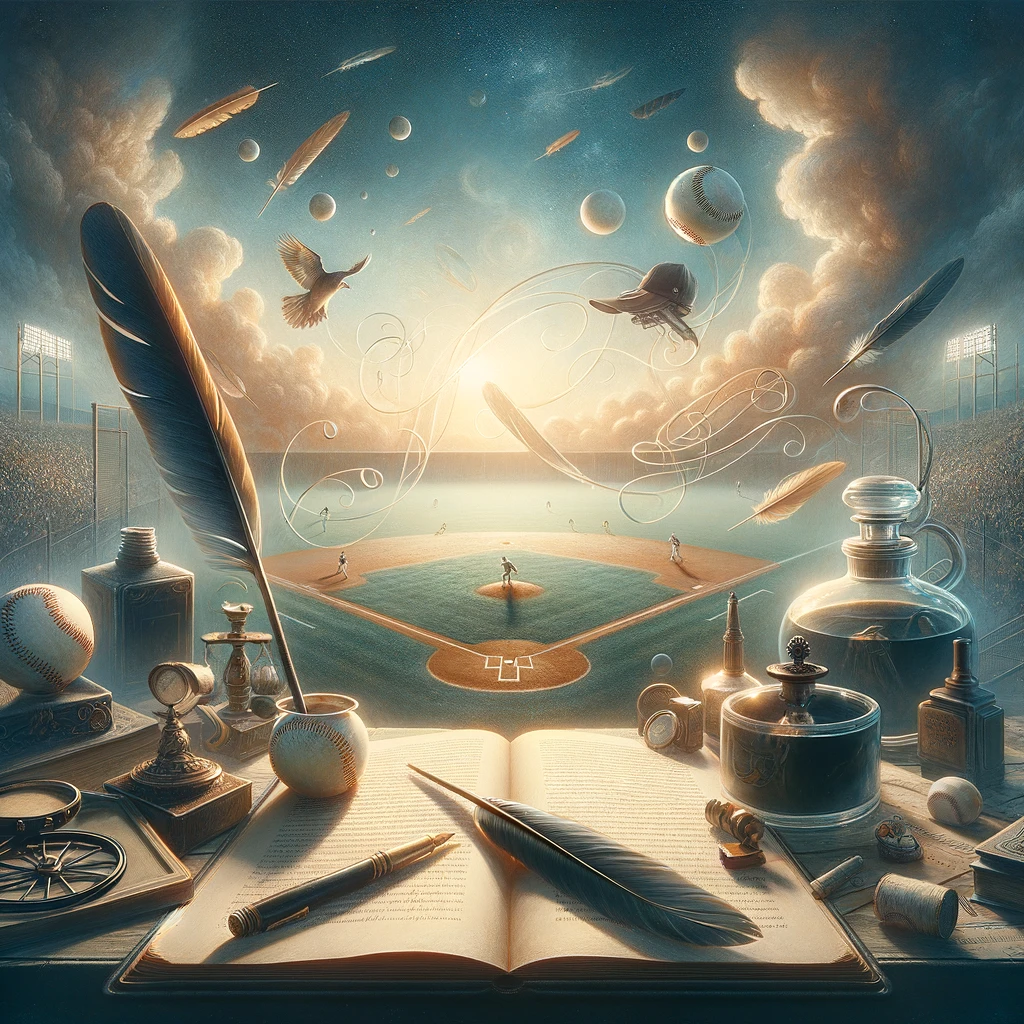
The Fabric of American Culture: Baseball’s Literary Impact
The impact of baseball on American literature and culture is profound and multifaceted. It has served as a canvas for writers to explore themes of hope, failure, triumph, and the human spirit. The game, with its leisurely pace and strategic nuances, offers a unique narrative structure, akin to the unfolding of a well-crafted story.
The Poetry of the Game
Baseball’s rhythm and structure lend themselves to poetic expression. It’s a game of moments – the suspense of a pitch, the crack of a bat, the graceful arc of a ball flying into the stands – each a stanza in an unfolding poem. Poets like Walt Whitman and Donald Hall have written eloquently about baseball, capturing its essence and its reflection of the human experience.
The Integration Narrative
The story of integration in baseball is a compelling narrative of progress and struggle, reflecting broader societal changes. The courage of players like Jackie Robinson and Larry Doby is a testament to the human spirit’s resilience in the face of adversity. Their stories have been the subject of numerous books and films, resonating far beyond the world of sports.
Baseball’s Reflection of Social and Cultural Change
Baseball has often mirrored social and cultural shifts in America. The game’s evolution from the dead-ball era to the live-ball era, the rise and fall of dynasties, the advent of free agency, and the impact of performance-enhancing drugs – all these aspects have parallels in American history and have been explored in literature.
The Globalization of the Game
In recent decades, baseball’s expanding international reach has brought new perspectives and narratives into the fold. The influx of players from Latin America, Asia, and other parts of the world has added a rich layer of cultural diversity, influencing both the game and the literary works it inspires.
The Future of Baseball and Literature
As baseball continues to evolve, so too will its relationship with literature. The digital age has brought new forms of storytelling and new ways to experience and interpret the game. Blogs, podcasts, and social media have democratized baseball writing, allowing fans and writers to share their stories and perspectives with a global audience.
The Timelessness of Baseball’s Literary Connection
The connection between baseball and literature is timeless. The game, with its unique blend of individual and team play, its history of heroes and villains, triumphs and tragedies, continues to inspire and reflect the human condition. As long as there is baseball, there will be stories to tell, lessons to learn, and poetry to write.
In conclusion, baseball is more than a sport; it is a rich tapestry of stories and emotions, deeply intertwined with American culture and history. Its poetic and literary connections offer a window into the soul of America, making it a powerful symbol of the nation’s identity. Through literature, the beauty and complexity of baseball are immortalized, ensuring that its legacy continues to inspire and resonate with generations to come.
Frequently Asked Questions
1. What is the connection between baseball and poetry?
Baseball and poetry are both intricate forms of art that value rhythm, pace, emotion, and imagination. This connection can be traced back decades, as baseball provides a rich tapestry for poets to explore themes such as triumph, loss, nostalgia, and the passage of time. The gracefulness of a pitcher’s throw or the strategic dance between catcher and batter creates a narrative that is ripe for poetic exploration. Poets often use baseball as a canvas to project the complexities of human emotion, interpreting the game’s nuances as metaphors for larger life experiences. Moreover, the historical and cultural significance of baseball has made it a wellspring of inspiration for artists seeking to capture the soul of America through the stanzas of a poem. From famous poets like Marianne Moore and Donald Hall to contemporary voices, baseball continues to ignite the poetic imagination.
2. Why is baseball often referred to as America’s pastime?
Baseball earned the title of America’s pastime due to its historical roots and cultural significance within the United States. As early as the 19th century, baseball rose to prominence, capturing the collective heart of a nation emerging from the Civil War and entering an era of rapid industrialization and change. It evolved alongside America itself, reflecting the social, political, and economic shifts of the time. The game became a fixture of American summers, a constant in a changing world, bridging communities and generations. Its leisurely pace allowed spectators to savor each moment, making it a favorite pastime. The sport’s inclusivity, allowing people from all walks of life to either play or spectate, strengthened its reputation as a national unifier. The nostalgic and often romanticized view of summer nights at the ballpark or the legendary tales of players like Babe Ruth and Jackie Robinson continue to cement baseball’s indelible mark on the American collective consciousness.
3. How has baseball poetry reflected American society over the years?
Baseball poetry has mirrored the evolving landscape of American society, often serving as a reflection of its triumphs, challenges, and changes. The poetic form provides a unique lens through which to view pivotal moments in the nation’s history in tandem with the sport. Early baseball poetry captured the innocence and idealism of America’s growing identity. As the nation underwent profound transformation through the Civil Rights Movement and Vietnam War, baseball poetry highlighted the struggle for equality, the breaking of racial barriers, and the shifting societal norms. Poets used the lore of baseball to comment on the American Dream, grappling with its promises and failures. Even in contemporary times, baseball poetry continues to address issues such as globalization, diversity, and technological advancements, portraying a society that is ever-evolving yet grounded in tradition. Through the artful expression of verse, baseball poetry remains a profound commentary on the American experience.
4. Can you name some notable works of baseball poetry and their significance?
Several notable works of baseball poetry stand out for their artistic and cultural significance. “Casey at the Bat,” written by Ernest Lawrence Thayer in 1888, is perhaps the most famous baseball poem, capturing the drama and emotional rollercoaster of a baseball game. Its narrative and structure emphasize the unpredictable nature of the sport, resonating with themes of hope, failure, and disappointment. Marianne Moore’s “Baseball and Writing” blends literary critique with love for the game, illustrating how baseball informed her poetic voice. Donald Hall’s “The Baseball Players” offers a nostalgic yet instructive view of baseball’s impact on American life, drawing connections between the past and present. “Lineup for Yesterday” by Ogden Nash creatively uses an alphabetical format to homage past baseball legends, while capturing the essence of baseball’s storied history. These works, among many others, highlight the diversity and vibrancy of baseball poetry and its enduring legacy as part of the American literary canon.
5. How does baseball serve as a metaphor in literature and poetry?
Baseball serves as a powerful metaphor for numerous aspects of life and society. Its structure, defined by cycles of tension and release, mirrors the ups and downs inherent in the human experience. The sport’s long-standing traditions offer metaphors for perseverance, resilience, and hope. In literature and poetry, the diamond-shaped field is often seen as a stage for life’s journey, where each base represents significant milestones or challenges. The batter, standing alone against the pitch, symbolizes the individual quest against adversity, while the teamwork required on the field reflects societal interdependence. The season’s cyclicality parallels life’s repetitive and seasonal nature, suggesting both continuity and change. Themes such as redemption, nostalgia, and the relentless passage of time are effortlessly woven into the narrative fabric of baseball, making it a rich source of inspiration for writers and poets seeking to articulate the complexities of existence with both clarity and depth.