Women have long shaped baseball player development, even when their work sat outside the spotlight reserved for managers, scouts, and star athletes. In modern clubs, player development means the coordinated process of improving a player’s physical tools, technical skills, decision-making, health, and professional habits from amateur ball through the major leagues. It includes scouting handoff, onboarding, coaching, strength and conditioning, sports science, mental performance, nutrition, video analysis, medical care, analytics, and education. When people ask about the role of women in baseball player development, the honest answer is broad: women contribute across every one of those functions, and their impact is measurable in how players learn, recover, adjust, and perform.
This matters because player development is the competitive engine of baseball operations. A club that develops talent better can win with lower payroll, extend contention windows, and reduce the risk attached to free agency. I have seen front offices pour resources into biomechanics labs, data systems, and individualized coaching plans, then discover that the real separator is communication: can the staff turn information into better daily decisions for players? Women working in development roles have been central to that translation work, from building trust in the training room to designing reports that coaches can actually use on the field. Their presence has also widened the talent pool for clubs, bringing in expertise from medicine, data science, education, psychology, and high-performance environments outside baseball.
The topic also matters beyond wins and losses. Baseball has historically limited who gets access to authority, mentorship, and advancement. As more women enter player development, they change not only staffing demographics but also the culture players experience every day. Better development environments are usually clearer, more accountable, more collaborative, and more evidence-based. Those are not symbolic gains. They affect injury prevention, swing changes, pitch design adoption, language support for international players, and the confidence a teenager carries through his first professional season. A hub article on this miscellaneous area therefore needs to do two jobs at once: explain where women fit into player development, and map the many connected roles that make the system work.
At the professional level, player development usually sits under a farm director or vice president of player development, but the work is deeply cross-functional. Hitting coordinators, roving instructors, complex-league coaches, physical therapists, registered dietitians, athletic trainers, analysts, and mental skills coaches all feed one plan. In college and youth baseball, the titles vary, yet the needs are similar: skill acquisition, health, evaluation, and progression. Women are active in all of these layers. Some are on-field coaches. Some lead research or medical departments. Others handle education, operations, or performance support that keeps plans consistent across affiliates. Understanding their role requires looking at the full ecosystem rather than only the dugout.
Where women contribute across the player development pipeline
Women contribute at every stage of the baseball development pipeline, from first evaluation to major league readiness. In amateur settings, they work as scouts, data analysts, tournament operators, strength coaches, and instructors who identify movement patterns or skill gaps early. Once a player signs, development staff build baselines using performance testing, medical screens, bat and ball tracking data, and video. Women in these roles often own key parts of the process: collecting information, interpreting it, and converting it into simple action items the player can repeat under pressure. A well-run first-week orientation can determine whether a player understands his throwing program, sleep expectations, nutrition targets, and defensive priorities. Those details are player development, not background administration.
In the minor leagues, progression depends on consistency. A player may hear from a hitting coach, a strength coach, an athletic trainer, a coordinator, and an analyst in the same week. The best organizations align those messages. Women serving as coordinators, therapists, analysts, or coaches often become central connectors because they sit at the intersection of departments. I have watched successful staffs use shared dashboards, post-series reports, and individual development plans so everyone knows the player’s current objective: maybe improving chase rate, adding velocity safely, or reducing asymmetry after an oblique strain. The role is not abstract support. It is direct influence on the player’s daily workload, mechanics, and decision-making.
Women also play a major part in transition points, where prospects are most vulnerable to failure. The jump from college or Latin American academies into affiliated ball can overwhelm players who suddenly face denser schedules, higher velocity, more advanced scouting, and stricter routines. International players may also navigate a new language and country while trying to compete. Development staff members who combine technical expertise with communication skill can stabilize that transition. Many women in baseball operations and player support do exactly that, helping players absorb information without overload. Clubs that treat acclimation as a development skill, rather than a side issue, tend to protect performance better over a long season.
On-field coaching, instruction, and communication
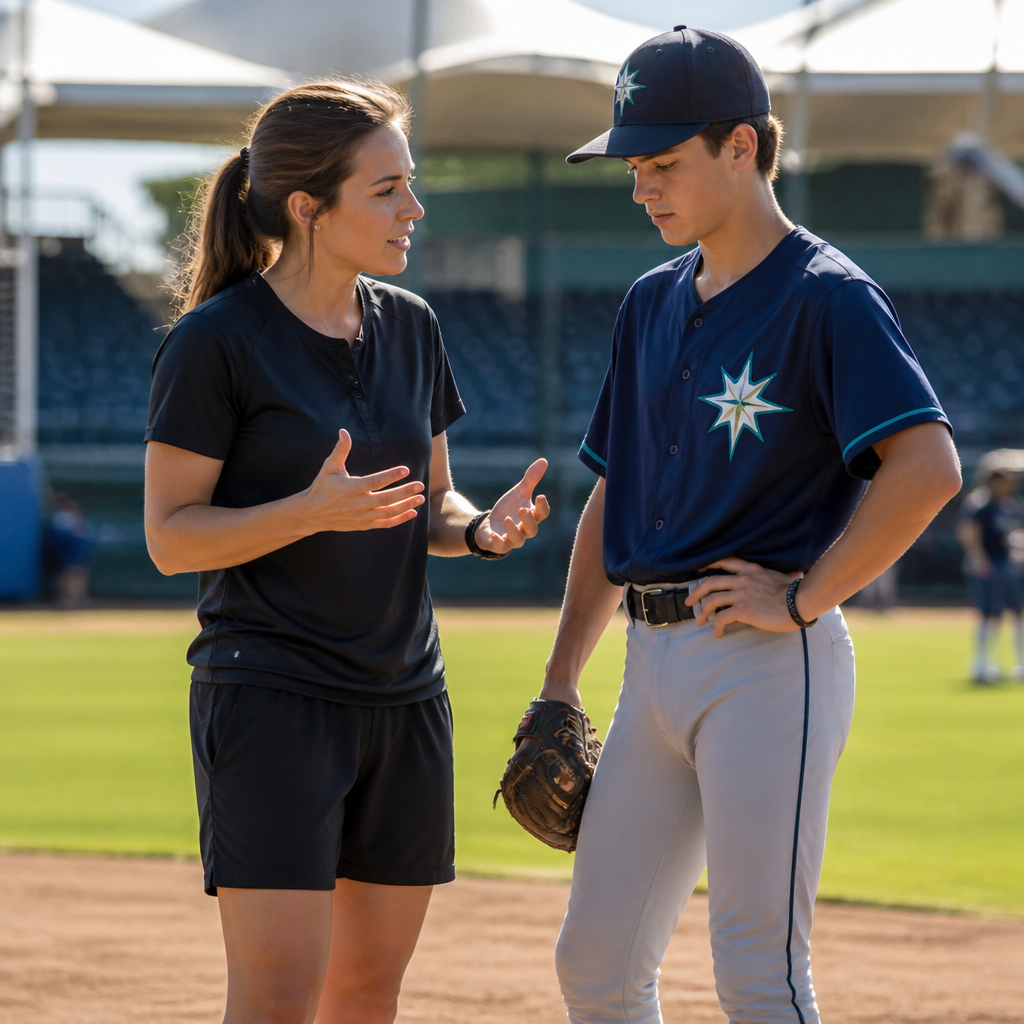
Women in on-field development roles are still fewer in number than men, but their impact is significant and growing. Instruction in baseball is not just giving drills. It means diagnosing the cause of a problem, choosing a cue that fits the player, setting constraints that produce the desired movement, and evaluating whether the change holds in game conditions. That work demands technical knowledge and strong communication. Alyssa Nakken’s move into a major league coaching role with the San Francisco Giants mattered because it showed that clubs were willing to place women in direct instructional environments, not only support functions. Rachel Balkovec’s path through strength and conditioning into coaching and then managing in the Yankees system highlighted the same point: development staff earn credibility through preparation, consistency, and measurable player improvement.
Good instruction is individualized. One hitter may respond to external cues such as “drive the ball through the big part of the field,” while another needs a biomechanical focus like posture through contact or bat path efficiency. One pitcher may need a plyo-ball progression and force-plate review; another needs a simpler tempo adjustment and better recovery routines. Women coaches and coordinators work within the same evidence-based methods used by leading organizations: high-speed video, bat sensors, Rapsodo, TrackMan, Hawkeye, K-Vest, and objective testing. Their role is to interpret those tools without letting the tools become the lesson. Players improve when the coach turns data into one clear next step, then monitors whether the adjustment transfers from cage to game.
Trust is the hidden currency of coaching. Players must believe that feedback is accurate, timely, and aimed at their success rather than at winning an argument. In development settings, trust often grows from small acts: a coach who remembers how a player learns best, a coordinator who explains why workload is being reduced, or an instructor who admits when a drill is not working and pivots quickly. Women who have built careers in baseball player development have repeatedly had to establish that trust in environments where they were initially underestimated. The result, in many cases, is especially intentional communication. That benefits players. Direct, organized, respectful communication reduces confusion and gives prospects a clearer path to adjustment.
Performance science, medical care, and holistic support
Some of the most influential roles women hold in player development sit in performance science, rehabilitation, nutrition, and mental skills. Baseball’s season is long enough that availability becomes a skill. Keeping players healthy, resilient, and mentally steady is therefore central to development. Women work as athletic trainers, physical therapists, sports dietitians, psychologists, and performance specialists who monitor readiness, guide return-to-play progressions, and help players build habits that support adaptation. In practical terms, that can mean using force plates to identify lower-body deficits, adjusting hydration plans during summer heat, or designing post-start recovery that lowers fatigue without compromising throwing volume.
Medical and performance departments are especially important because many development breakthroughs come after injury or underperformance, when players are most receptive to change. A pitcher rehabbing from elbow trouble might rebuild his lower-half mechanics, improve shoulder strength ratios, and refine pitch usage all at once. A hitter with recurring hamstring issues may alter sprint preparation, body composition targets, and base-running workload. Women leading or contributing to these programs shape more than health outcomes; they influence the player’s future skill ceiling. Progressive organizations now integrate medical notes, motion capture, workload data, and coach observations into one decision stream. That level of collaboration can shorten the gap between diagnosis and effective adjustment.
The same is true in mental performance and player support. Baseball punishes impatience. Prospects fail often, travel constantly, and live under public evaluation. Mental skills coaches teach routines for focus, emotional regulation, and process-based evaluation, helping players separate a bad week from a broken approach. Women in these roles often help clubs address areas that used to be neglected, including family support, cultural adjustment, sleep education, and life skills. Those topics may sound soft to outsiders, but they directly affect learning capacity and on-field output. A player who sleeps poorly, eats inconsistently, or feels isolated will not absorb complex feedback well, no matter how advanced the analytics department may be.
| Development area | Typical responsibilities | How women influence outcomes |
|---|---|---|
| On-field coaching | Swing work, pitch design, defense, game planning | Translate data into usable cues and individualized drills |
| Sports science | Testing, workload monitoring, biomechanics review | Connect objective metrics to safer, faster improvement |
| Medical and rehab | Injury care, return-to-play plans, movement restoration | Protect availability while preserving long-term development |
| Nutrition and recovery | Fueling, hydration, supplementation, sleep habits | Increase consistency across a long season and heavy travel |
| Mental performance | Routines, confidence, stress management, focus | Improve learning, resilience, and decision-making under pressure |
| Operations and education | Scheduling, reports, onboarding, language and life support | Reduce friction so players and coaches can execute plans |
Analytics, technology, and decision systems
Women have also become increasingly important in the analytical side of player development, where clubs convert large streams of information into training priorities. Modern organizations track pitch shapes, release characteristics, contact quality, swing decisions, defensive positioning, and workload trends at a granular level. Analysts do not merely produce reports for executives; they help coordinators and coaches decide what to teach next. A player with average raw power but excellent bat-to-ball skill may benefit more from attack-angle optimization and selective aggression than from a generic strength push. A pitcher with elite induced vertical break but poor command may need a different bullpen structure than one with weaker shape but excellent strike efficiency. Those are development decisions guided by analysis.
The women doing this work often come from statistics, engineering, computer science, biomechanics, or applied math backgrounds, and many have helped baseball move beyond descriptive stats toward better process metrics. Concepts such as expected outcomes, seam effects, swing decision quality, time to contact, and workload periodization are now common in development conversations. The key contribution is not only technical fluency. It is the ability to frame evidence in ways coaches trust and players can apply. The best development analysts know when to use a full model and when to offer one clean visual before batting practice. If the information does not change behavior, it has not done its job.
Technology has expanded these opportunities. Systems such as TrackMan, Hawkeye, Blast Motion, KinaTrax, Motus, and VALD generate detailed data, but they also create noise. Someone must validate samples, account for context, and prevent overreaction to small changes. I have seen staffs get into trouble by treating every red number as a crisis. Strong analysts, including many women now embedded with affiliates and coordinators, act as quality control. They ask whether the metric is stable, whether the player’s role has changed, and whether the intervention cost outweighs the likely benefit. That disciplined reasoning is essential in a field where too much information can derail a simple, effective plan.
Leadership, barriers, and the future of development pathways
Despite clear progress, women in baseball player development still face structural barriers. Hiring pipelines remain narrow, especially for former softball players or women from nontraditional baseball backgrounds who possess transferable expertise but lack the network effects men often inherit. Clubhouses and training environments can also lag behind the values organizations promote publicly. Advancement depends not just on entry-level opportunities but on being trusted with travel, affiliate assignments, budget authority, and direct player-facing responsibility. When women are confined to symbolic roles or siloed functions, clubs lose both talent and credibility. The organizations making real progress treat inclusion as a performance issue: if the best coach, therapist, analyst, or coordinator can help players improve, that person should have a pathway to lead.
The future is likely to bring more women into hybrid roles that blend coaching, technology, and performance support. As development systems become more integrated, the old divide between “baseball people” and specialists continues to weaken. A coordinator who understands bat tracking, learning theory, and interpersonal communication can be more valuable than a traditional instructor who relies only on experience. That shift should help more women advance because it rewards demonstrated skill and outcomes. It also aligns with how successful clubs already operate. Player development is no longer a collection of isolated opinions; it is an interdisciplinary system built around repeatable processes and constant feedback.
For readers exploring the wider women in baseball landscape, this hub should point you toward related subjects such as women coaches, women in front offices, scouts, broadcasters, medical staff, umpires, and executives. Player development connects to all of them because every part of a club eventually touches how athletes improve. The central takeaway is straightforward. Women are not peripheral to baseball player development. They are coaches, analysts, clinicians, coordinators, and leaders who shape skill growth, health, adaptation, and culture every day. If you are building coverage for a women in baseball resource center, use this page as the starting point, then branch into each role in detail and keep the focus where it belongs: on the work, the results, and the people making the game better.
Frequently Asked Questions
How have women historically contributed to baseball player development?
Women have influenced baseball player development for far longer than most public histories acknowledge. Even when they were excluded from official titles or front-facing leadership roles, they often shaped how players learned, matured, recovered, and prepared to compete. In earlier eras, that contribution could appear through teaching fundamentals, organizing amateur programs, supporting athletic training environments, managing logistical systems that allowed development programs to function, and advocating for more disciplined, professional approaches to player care. While those efforts were not always labeled as “player development,” they directly affected how athletes improved over time.
As baseball became more specialized, player development expanded beyond batting instruction and field drills into a full support system that includes strength and conditioning, sports medicine, nutrition, performance analysis, mental skills, and education around professional habits. Women became increasingly visible across those areas, bringing expertise that helped organizations understand development as a long-term, coordinated process rather than a series of isolated coaching moments. Their impact has been especially important in roles where trust, communication, observation, and consistency matter every day, such as athletic training, sports science, rehabilitation, performance support, and player services.
Today, the historical story is clearer: women have helped build the infrastructure of development, not just participate around its edges. Their contributions have ranged from individualized instruction to system design, from helping players recover from injury to shaping the culture that makes improvement possible. That history matters because it shows that player development has always depended on a wide network of expertise, and women have long been a meaningful part of that network.
What roles do women hold in modern baseball player development departments?
In the modern game, women work across nearly every part of the player development pipeline. That includes coaching, strength and conditioning, sports science, athletic training, physical therapy, mental performance, nutrition, video and data analysis, biomechanics, player operations, education, and front-office development leadership. Some work directly on the field with players during drills, game preparation, and skill instruction. Others work behind the scenes interpreting performance metrics, creating development plans, overseeing recovery, or coordinating communication between affiliates and the major league staff.
These roles matter because player development is no longer a narrow coaching function. A prospect’s growth depends on how well an organization integrates information and support from multiple disciplines. For example, a hitting coach may work with a biomechanist to improve swing efficiency, while a strength coach manages workload, a nutrition professional supports recovery, and a mental performance specialist helps the player apply adjustments under pressure. Women serving in these positions are not peripheral to the process; they are often central to how clubs identify problems, design interventions, and track progress.
Many women also contribute in leadership and strategic roles, helping set organizational philosophies for instruction, communication, and evaluation. Their work may influence how a club handles onboarding for drafted players, how prospects transition between levels, how injuries are managed, and how players are taught professional routines. In practical terms, that means women can affect everything from daily cage work to long-term career outcomes. The broadening of these roles reflects a modern understanding of baseball development as interdisciplinary, evidence-based, and highly collaborative.
Why is female representation important in baseball player development?
Female representation matters because better player development usually comes from broader expertise, stronger collaboration, and more complete perspectives. Baseball organizations are trying to solve complex problems: how to refine mechanics without creating injury risk, how to teach decision-making under game pressure, how to support players through setbacks, and how to build sustainable professional habits over many years. A development system benefits when it includes talented professionals from a wide range of backgrounds, including women whose experience and training may expand how the organization sees those challenges.
Representation also shapes culture. When women are present and respected in development settings, it reinforces the idea that credibility comes from knowledge, preparation, and results rather than outdated assumptions about who belongs in baseball. That can improve communication standards, professional accountability, and organizational openness to innovation. In environments where players are asked to trust coaches, trainers, analysts, and support staff, a healthy culture is not a side issue; it directly affects whether developmental plans are accepted and executed.
There is also a pipeline effect. Visible female professionals give younger coaches, analysts, trainers, and sports scientists a model for entering and advancing in the game. That helps clubs recruit from a deeper talent pool, which is good for the sport and good for player outcomes. Ultimately, representation is not important simply for optics. It matters because player development improves when organizations are able to identify, hire, and empower the best people, and that requires making room for qualified women to contribute fully and lead where their expertise has impact.
How do women influence a player’s development beyond on-field coaching?
Player development extends far beyond swing mechanics, pitch design, or defensive drills, and women often have major influence in those wider areas. A player’s progress depends on how well he manages recovery, nutrition, sleep, stress, injury prevention, mental routines, video review, travel demands, and the transition from amateur to professional baseball. Women working in athletic training, physical therapy, nutrition, mental performance, sports science, and player services can shape each of those dimensions in ways that directly affect performance and durability.
For example, an athletic trainer or physical therapist may help a pitcher move safely through a throwing progression after injury, preserving long-term development instead of rushing a short-term return. A sports scientist may use movement and workload data to flag fatigue before it becomes a bigger problem. A nutrition professional may improve body composition, hydration habits, and recovery quality over the course of a season. A mental performance coach may help a young prospect handle failure, maintain focus, and build routines that support consistency. Each of these interventions can change how quickly a player adapts, how available he remains, and how effectively he applies instruction.
Women also often contribute through relationship-building and communication systems that keep development plans coherent. In a successful organization, coaches, analysts, trainers, and coordinators must align around clear goals for each player. The people who facilitate that alignment are crucial, even if they are not always the most visible figures in the dugout. In that sense, influence beyond on-field coaching is not secondary; it is part of the foundation that allows technical instruction to stick and talent to turn into sustained performance.
What challenges remain for women in baseball player development, and what is changing?
Although progress is real, women in baseball player development still face challenges tied to access, perception, advancement, and visibility. Some continue to encounter skepticism rooted in outdated ideas about authority in male-dominated sports environments. Others face narrower hiring pipelines, fewer mentorship opportunities, or uneven access to the informal networks that often influence promotions. In some cases, women may be welcomed into support roles more readily than into highly visible coaching or decision-making positions, even when their qualifications are strong.
Another challenge is that player development is an around-the-clock environment with long seasons, frequent travel, and constant performance pressure. Those demands can be difficult for anyone, but they can become more complicated when organizational structures are not designed with inclusive career development in mind. If clubs want to retain top talent, they need more than symbolic hiring. They need clear advancement pathways, professional respect, equitable resources, and leadership that actively supports qualified women in technical and strategic roles.
What is changing is the growing recognition that modern baseball depends on specialized knowledge and collaboration. As organizations invest more heavily in data, health, performance, and individualized development plans, they increasingly value expertise wherever it is found. That shift has opened more doors for women to serve as coaches, coordinators, analysts, medical professionals, and development leaders. The trend is strongest in clubs that treat inclusion as a competitive advantage rather than a public relations issue. When organizations hire broadly, evaluate fairly, and empower skilled professionals to shape decision-making, women are better positioned to contribute at every stage of development, from first-day onboarding to major league readiness.