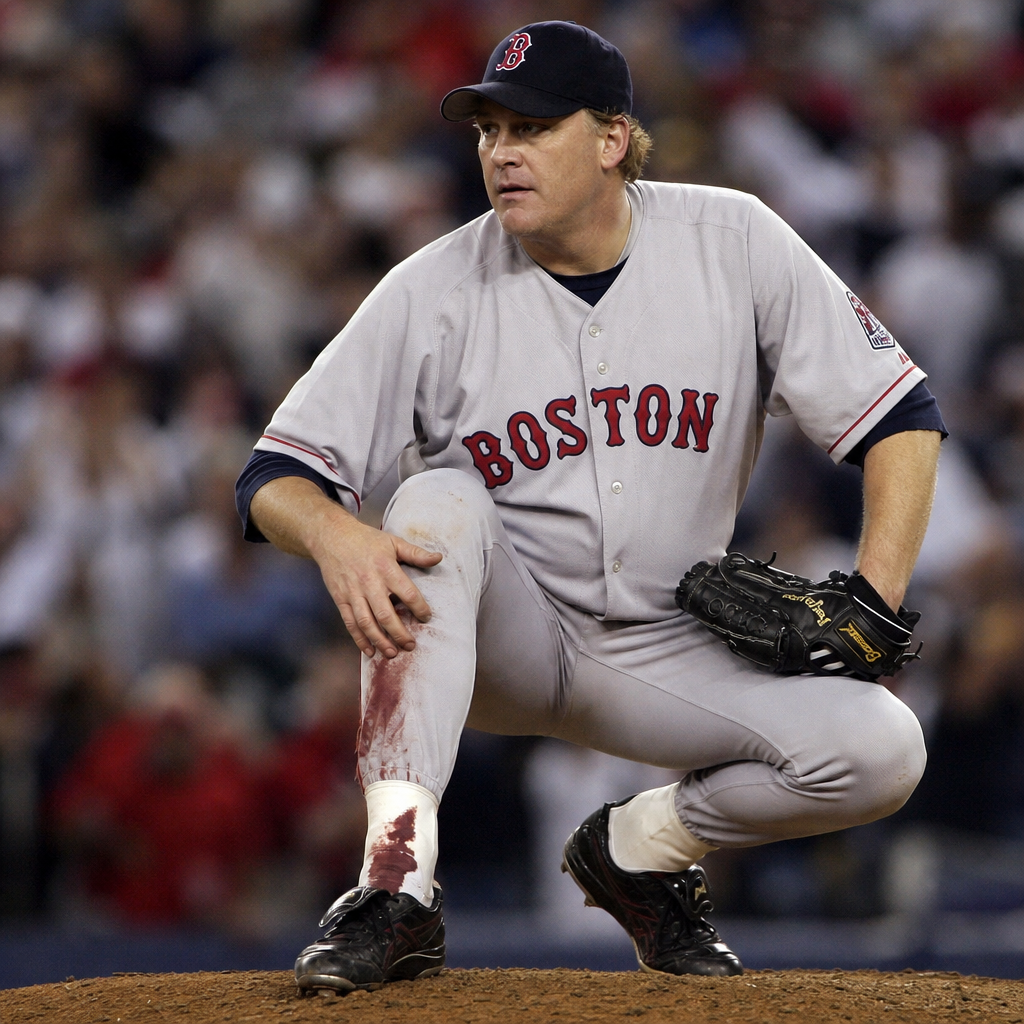
The Curt Schilling Bloody Sock Game remains one of baseball’s most replayed, debated, and mythologized postseason moments because it sits at the intersection of performance, medicine, media spectacle, and rivalry. For many fans, the image is simple: Schilling on the mound in October 2004, white sock soaked with red, gutting through pain to help the Boston Red Sox beat the New York Yankees and continue a comeback that would end an eighty-six-year championship drought. Yet the phrase “bloody sock game” now carries a second meaning. It refers not only to a specific playoff start, but also to the later controversy over how authentic, spontaneous, and medically necessary the scene actually was.
To evaluate whether the Curt Schilling Bloody Sock Game was myth or reality, it helps to define the terms clearly. The reality is straightforward. Schilling did pitch with an injured right ankle during the 2004 American League Championship Series and later in the World Series. His tendon sheath issue had been widely reported, and Red Sox medical staff used a stabilization procedure, often described as suturing or anchoring the area, to reduce movement and allow him to pitch. The blood visible on the sock was also real in the basic sense that it appeared on live television and in photographs while he competed. The myth question begins where facts meet storytelling: was the blood naturally seeping from a necessary procedure, was it exaggerated for effect, or was the visual manipulated to heighten drama?
This matters because the bloody sock became more than a sports image. It became a case study in how legends are built. In clubhouses, television trucks, newspaper columns, and now social feeds, a compelling visual can harden into accepted history faster than careful reporting can catch up. I have worked through enough sports controversy archives to know that once a postseason image becomes symbolic, every later claim gets filtered through tribal loyalty. Red Sox fans see toughness and sacrifice. Skeptics see theater and brand-building. Good analysis has to separate chronology, medical plausibility, media incentives, and what participants said at different times.
As a hub article for miscellaneous scandals and controversies, this piece also serves a broader purpose. Not every sports controversy centers on cheating, crime, or formal discipline. Some revolve around presentation, narrative control, and the blurry line between truth and embellishment. The Curt Schilling Bloody Sock Game belongs in that category. It is not merely about one athlete’s pain tolerance. It is about whether iconic moments remain authentic when later storytelling changes the audience’s understanding of what they watched.
What happened in the bloody sock game
The signature bloody sock appearance came during Game 6 of the 2004 ALCS on October 19, when Boston faced elimination against the Yankees. Schilling, already dealing with an ankle injury, started at Yankee Stadium and delivered seven innings in a 4-2 Red Sox win. Television cameras repeatedly showed blood spreading through his white sock near the ankle area. The image instantly framed the outing as a heroic endurance performance. Boston would win Game 7, complete the first comeback from a 3-0 deficit in Major League Baseball postseason history, then sweep the St. Louis Cardinals in the World Series.
There was a second bloody sock appearance in Game 2 of the World Series, reinforcing the original image. That matters because the legend was not built from one isolated camera cut. It was repeated in another high-leverage start on another national stage. Schilling’s postseason line in those two injured starts strengthened the story’s credibility. He was not simply walking around with a dramatic prop; he was effective against elite opponents under visible physical stress. In sports memory, performance validates imagery. If he had been shelled early, the sock might have become a curiosity instead of an emblem.
The basic injury explanation was also medically coherent. Schilling had a tear involving the tendon sheath around his right ankle. The Red Sox sought a way to stabilize the tendon so it would not slide and create debilitating pain during his delivery. Team physician Dr. Bill Morgan later became central to the story because he described using sutures to secure tissue, a detail that gave the public a concrete procedural explanation. That detail helped the event move from vague toughness tale to specific medical intervention, which made the moment feel even more real to fans and reporters.
Why the moment became baseball mythology
The bloody sock became legendary because it combined four powerful ingredients that sports history rewards. First, there was a hated rival. Yankees-Red Sox games already carried emotional weight beyond ordinary playoff baseball. Second, there were enormous stakes. Boston was trying to avoid elimination and reverse generations of disappointment. Third, there was an unmistakable image. A bloodstain on a white sock communicates pain instantly, even to casual viewers who know nothing about tendons or pitching mechanics. Fourth, there was payoff. The Red Sox did not merely survive; they completed an unprecedented comeback and won the World Series.
From a media standpoint, the moment was ideal. Television could keep returning to the sock between pitches, announcers could layer in Schilling’s medical context, and newspaper front pages had a single frame that told the whole story. In practical newsroom terms, editors love images that collapse complexity into one visual fact. The bloody sock did exactly that. It stood for courage, urgency, and curse-breaking destiny all at once. Those are the conditions under which myth forms quickly.
Schilling’s own public persona amplified the legend. He was articulate, combative, and fully aware of narrative. Athletes who can explain their suffering often shape how it is remembered. Schilling understood postseason theater and never shrank from high-visibility moments. That does not prove deception, but it does explain why later critics remained alert to the possibility that he leaned into the symbolism. In controversies like this, charisma is both evidence and distraction.
The controversy: was the blood natural, staged, or enhanced?
The central controversy emerged more forcefully years later, when questions surfaced about whether the blood on Schilling’s sock had been partly staged or at least strategically presented. The most widely cited spark came from a 2013 ESPN report connected to Tim Kurkjian and others, revisiting the possibility that Schilling had used fake blood or a paint-like substance to dramatize the effect. Former Orioles pitcher and then-analyst Gary Thorne claimed in a radio interview that Schilling had told him it was paint. That allegation reignited debate because it challenged the authenticity of one of baseball’s sacred images.
Schilling strongly denied those claims. Dr. Morgan also disputed the idea that the scene was fabricated, maintaining that the blood resulted from the medical stabilization and the stress of pitching. Other reporting indicated that while there may have been some uncertainty over exactly how much blood seeped naturally and how much attention was drawn to the sock, no conclusive evidence ever established a hoax. This is where the controversy differs from a classic scandal with a definitive investigative endpoint. There was accusation, denial, circumstantial interpretation, and lasting suspicion, but not a final documented reversal of the original event.
That ambiguity is precisely why the question persists. People often ask: if the ankle procedure was real, why would anyone think the bloody sock was fake? The answer is simple. Real injuries and embellished presentation can coexist. A player may truly be hurt and still benefit from how the injury is displayed. Sports culture is full of examples where an authentic condition becomes part of a consciously managed narrative. The debate around Schilling is less about whether he was injured than whether the visual was allowed, encouraged, or enhanced because everyone involved understood its emotional impact.
| Claim | Supporting Point | Main Limitation |
|---|---|---|
| The bloody sock was entirely authentic | Live game footage, confirmed ankle injury, medical procedure described by team doctor | Does not resolve whether presentation was emphasized for cameras |
| The blood was exaggerated but rooted in a real injury | Fits common sports PR behavior and explains why the image felt unusually vivid | No definitive proof of deliberate enhancement has surfaced |
| The blood was staged or fake | Later claims from broadcasters and persistent public skepticism | Contradicted by Schilling, disputed by medical accounts, unsupported by hard evidence |
What the medical details do and do not prove
Medical specifics matter because they set the boundaries of plausibility. The reported issue involved Schilling’s peroneal tendon and surrounding sheath in his right ankle, crucial for a pitcher’s landing and balance. The Red Sox medical team needed to limit tendon displacement so he could push through his motion. Accounts have described a temporary stabilization method using sutures to hold skin or tissue in a way that reduced tendon movement. While public retellings vary in precision, the larger point remains stable: there was a legitimate procedure intended to make pitching possible.
Does that procedure make visible bleeding likely? Yes, it can. Any intervention around a stressed area under repeated athletic load can produce bleeding or seepage. Pitching is violent on the lower half, particularly for a power pitcher like Schilling who planted forcefully. So the appearance of blood is medically believable. But believable does not automatically mean untouched by presentation choices. A sock can be left white rather than changed, a camera can be tipped off, and a player can recognize the symbolic value of what the audience is seeing. Medical legitimacy answers one question while leaving another open.
That distinction is crucial in evaluating sports controversies responsibly. The wrong way to analyze the bloody sock is to force a binary choice between complete fraud and pure spontaneous martyrdom. The more disciplined approach is to examine layers of reality. The injury was real. The medical intervention was real. The visible blood was almost certainly grounded in that reality. The unresolved issue is whether the iconic visual was also cultivated as part of postseason storytelling. That is a narrower and more plausible controversy than the broad claim that the whole thing was invented.
How media coverage shaped public memory
Public memory of the Curt Schilling Bloody Sock Game was shaped less by medical reports than by replay culture. Every retrospective on the 2004 Red Sox comeback used the same images: Dave Roberts stealing second, David Ortiz delivering late hits, and Schilling’s stained sock. Once a clip enters the standard montage package, it stops being merely evidence and becomes historical shorthand. That process tends to flatten nuance. Later disputes rarely dislodge an image already canonized in documentaries, anniversary specials, and Hall of Fame-era nostalgia.
The controversy also shows how later reporting can destabilize legend without fully replacing it. Investigative revisits and radio comments generated headlines, but they did not erase the original emotional truth many fans felt in the moment. In sports media, first impressions carry extraordinary power. Millions saw a wounded ace pitching effectively under pressure. Any later allegation had to overcome not just facts, but memory. That is a very high bar, especially when the newer claims are indirect or disputed.
For a hub page on miscellaneous controversies, this is the larger lesson. Some controversies are sustained not by new evidence but by the durability of unresolved tension. The Schilling case remains alive because two compelling stories continue to compete: heroic perseverance and carefully managed spectacle. Neither story fully defeats the other, which keeps the debate useful for broadcasters, writers, and fans whenever October baseball returns.
Verdict: myth, reality, or both?
The most accurate verdict is that the Curt Schilling Bloody Sock Game was both reality and myth. It was reality because Schilling was genuinely injured, underwent a real stabilization procedure, and delivered a significant postseason performance with visible blood on his sock. Those core facts are not seriously erased by later skepticism. It was myth because the moment was instantly elevated into a cultural symbol larger than the available evidence could fully explain. Myth in this sense does not mean false. It means dramatized, simplified, and repeated until it represents values as much as events.
If you ask the narrow question, “Did Curt Schilling really pitch with blood on his sock?” the answer is yes. If you ask the more skeptical question, “Was the image possibly accentuated, showcased, or narratively exploited?” the honest answer is also yes, that remains possible. What cannot be said with confidence is that the sock was proven fake. The record does not support a definitive hoax conclusion. It supports a more nuanced one: an authentic injury became an iconic image, and iconic images invite embellishment, suspicion, and legend.
That is why this story fits so well within the broader landscape of scandals and controversies. Not every disputed sports moment ends with a league report or confession. Some remain contested because they involve performance and perception in equal measure. The benefit of revisiting the bloody sock game is not merely settling an old argument. It is learning how to read famous moments carefully: check the timeline, separate confirmed facts from retrospective claims, and notice how television images shape what generations believe. If you are exploring other controversial sports moments in this category, use this same standard and follow the evidence before the mythology.
Frequently Asked Questions
What exactly was the Curt Schilling “Bloody Sock Game”?
The “Bloody Sock Game” refers to Curt Schilling’s start for the Boston Red Sox in Game 6 of the 2004 American League Championship Series against the New York Yankees. Pitching with an injured right ankle, Schilling took the mound in one of the most pressure-filled moments in baseball history, and television cameras repeatedly showed blood seeping through his white sock. The image quickly became one of the defining visuals of modern postseason baseball. Schilling delivered seven strong innings, helping Boston win 4-2 and force a Game 7.
What made the moment so memorable was not just the visible blood, but the context around it. The Red Sox had been down three games to none in the series, something no team in Major League Baseball had ever overcome in a best-of-seven postseason series. Boston had already won Games 4 and 5 to stay alive, and Schilling’s Game 6 outing turned the comeback from unlikely dream into genuine possibility. When people talk about the Bloody Sock Game, they are really talking about a blend of performance, pain tolerance, theater, and history all happening at once under enormous scrutiny.
Was the blood on Curt Schilling’s sock real, or was the whole thing exaggerated?
The blood on Curt Schilling’s sock was real. Schilling had a tendon injury in his right ankle, and the Red Sox medical staff performed a procedure before the game intended to stabilize the area well enough for him to pitch. During the outing, blood became visible through the sock, and that visual was captured over and over by the television broadcast. There is no serious factual dispute that he was bleeding and that the sock itself showed it.
Where the debate begins is not over whether the blood existed, but over how the moment was framed and remembered. Critics have argued that the image was amplified by television, replay culture, and the mythology that quickly built around Boston’s 2004 postseason run. Supporters counter that intense media focus does not make the event fake; it simply reflects how visually powerful and dramatically timed it was. In other words, the “myth” is not that the bloody sock was invented, but that the moment has sometimes been retold in simplified, almost legendary terms that can overshadow the more complicated medical, competitive, and media realities behind it.
What injury did Curt Schilling have, and how was he able to pitch through it?
Schilling was dealing with a tear in the sheath that held a tendon in place near his right ankle. Because he was a right-handed pitcher, that ankle was central to his delivery and balance, making the injury especially serious. If the tendon was not stabilized, the pain and mechanical instability could make pitching effectively nearly impossible. In a postseason setting, that kind of injury would normally cast major doubt on whether a starter could take the mound at all.
To give him a chance, Red Sox team physician Dr. Bill Morgan performed a procedure that involved suturing the tendon sheath to help limit movement and reduce the risk of the tendon shifting during Schilling’s delivery. It was not a magical fix, and Schilling still had to endure discomfort and physical risk while pitching. That is a major reason the performance resonated so deeply with fans. The bloody sock became the symbol, but the underlying story was really about a pitcher using a medical workaround, competitive will, and disciplined execution to perform on one of the sport’s biggest stages.
Why is the Bloody Sock Game considered so important in baseball history?
The game matters because it sits at the center of one of baseball’s most famous postseason turnarounds. The Red Sox were trying to do something unprecedented: come back from a 3-0 deficit against their fiercest rival, the Yankees, in the ALCS. Schilling’s performance in Game 6 gave Boston the kind of stabilizing, emotionally charged start teams often need in elimination scenarios. By winning that game, the Red Sox forced Game 7, won the pennant, and then swept the St. Louis Cardinals in the World Series to end the franchise’s eighty-six-year title drought.
Its significance also comes from how perfectly it fit the larger narrative of that Red Sox team. Boston’s 2004 run is remembered for resilience, dramatic reversals, and symbolic moments, and the bloody sock instantly became a shorthand for all three. Baseball history often preserves moments through images as much as through box scores, and Schilling’s stained sock became one of those rare visuals that communicates stakes, pain, rivalry, and triumph all at once. Even people who do not remember every pitch often remember that image, which is why the game continues to be discussed decades later.
Why do people still debate the Curt Schilling Bloody Sock Game today?
People still debate it because the game lives at the intersection of fact and folklore. On the factual side, Schilling was injured, he underwent treatment, he pitched effectively, and the blood was visible on his sock. On the folklore side, the moment has been elevated into a larger-than-life symbol of toughness and postseason greatness. Whenever a sports moment becomes that iconic, people naturally revisit it to separate what happened from how it was packaged, replayed, and remembered.
The continued discussion is also tied to broader questions about sports culture. Fans and historians ask whether the moment should be viewed primarily as a remarkable athletic effort, a triumph of medical improvisation, a television-made spectacle, or all three at once. There is also the unavoidable role of rivalry: because the game came against the Yankees and helped propel the Red Sox toward a historic championship, emotions and allegiances have always shaped how people interpret it. That is why the Bloody Sock Game endures. It was real, but it was also instantly mythologized, and that combination is exactly what keeps it alive in baseball conversation.