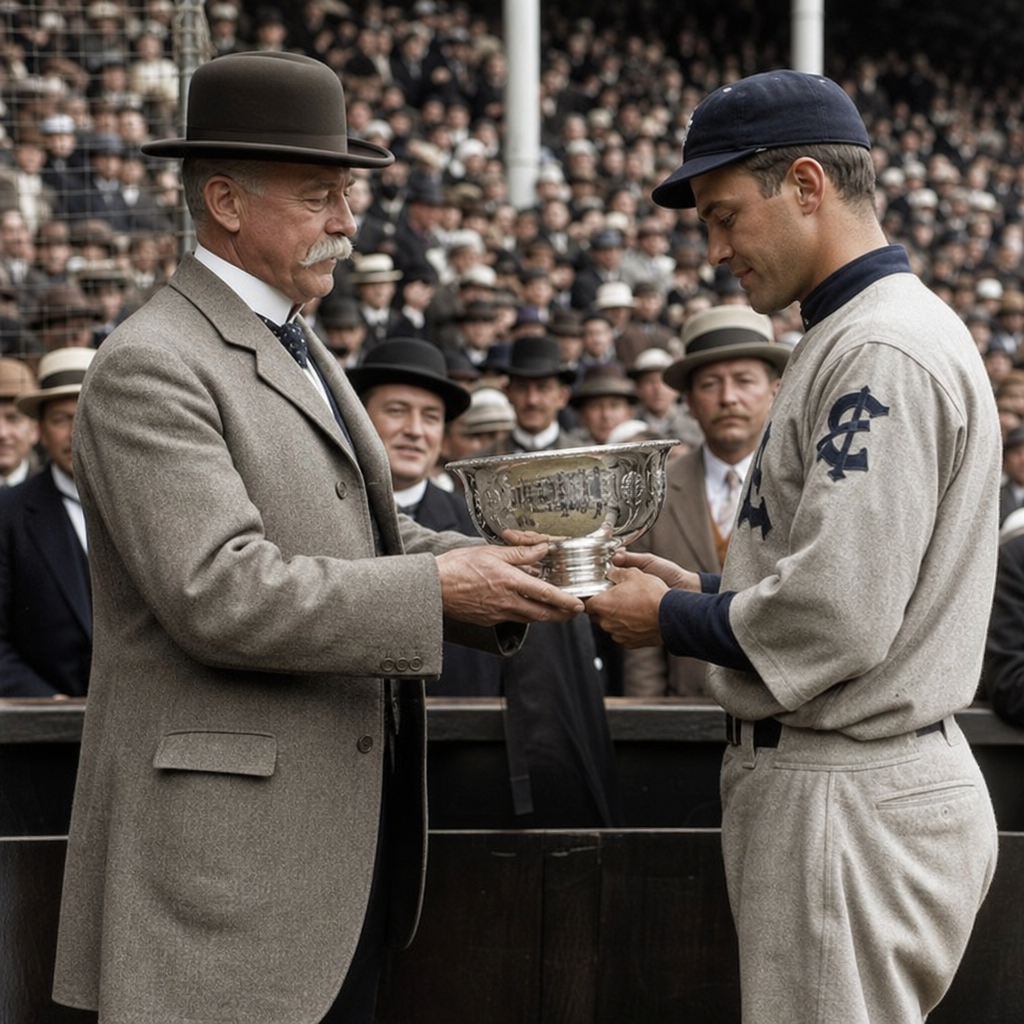
The 1911 Chalmers Award controversy sits at the intersection of baseball history, early sports marketing, and one of the game’s first public arguments about what “most valuable” really means. The dispute centered on Ty Cobb, the Detroit Tigers’ brilliant and abrasive star, and Napoleon “Nap” Lajoie, the Cleveland Naps’ respected veteran hitter. In modern terms, the Chalmers Award functioned as an early Most Valuable Player prize, created by the Chalmers Motor Company to promote automobiles through baseball’s growing national popularity. What should have been a simple celebration of excellence instead became a lasting scandal because the American League batting race appeared to be influenced by on-field manipulation in the season’s final days.
Understanding the 1911 Chalmers Award controversy requires defining three key pieces. First, the Chalmers Award was not yet a formal MVP as fans know it today, but it was treated as a major honor because it awarded a new automobile to the player judged most valuable. Second, batting average was then one of baseball’s most prestigious measures, carrying far more cultural weight than statistics such as on-base percentage or wins above replacement do now. Third, the charge of manipulation came from the belief that Cleveland and St. Louis players collaborated to help Lajoie pile up late hits and overtake Cobb, who had chosen not to play the final game of his season.
I have spent years working through old box scores, sporting papers, and league rulings, and this episode repeatedly stands out because it reveals how loosely governed baseball could be before modern replay, video archives, and standardized award voting. It matters well beyond one disputed batting title. The controversy shows how incentives can distort competition, how player reputations shape public judgment, and how league leadership often tries to protect legitimacy after trust has already been damaged. As a hub within baseball scandals and controversies, this story also points toward wider themes found across miscellaneous disputes: weak oversight, ambiguous rules, commercial pressure, and long historical afterlives.
What the Chalmers Award Was and Why the 1911 Race Mattered
The Chalmers Motor Company launched its baseball promotion in 1910, promising a Chalmers “30” automobile to the player in each major league judged most important to his club. In practice, the award immediately became linked to batting supremacy, star power, and press attention. For players, an automobile was not a trivial prize. In 1911, a new car represented wealth, status, and publicity at a time when most Americans did not own one. For the company, the promotion tied its brand to elite performance and newspaper coverage. For baseball, it added another layer of pressure to end-of-season statistics.
By late September 1911, the American League batting race was essentially a duel between Cobb and Lajoie. Cobb already had a fierce reputation: he was an exceptional base runner, a multiple-time batting champion, and one of the era’s most polarizing figures. Lajoie, older and broadly admired, was considered a cleaner sportsman by many contemporaries. According to the official accounting that framed the controversy, Cobb sat out the last game, apparently believing his lead was safe. Lajoie then entered a season-ending doubleheader against the St. Louis Browns needing a huge day at the plate to catch him. What happened next triggered one of baseball’s earliest credibility crises.
The Doubleheader That Sparked the Scandal
On September 24, 1911, Lajoie faced St. Louis in a doubleheader and went 8-for-8, at least according to the scoring conventions that ultimately shaped the official totals. Several of those hits came on bunt attempts or soft placements down the third-base line while Browns third baseman Red Corriden reportedly played unusually deep, effectively conceding the bunt single. Contemporary accounts, later histories, and statements from participants all fueled the suspicion that St. Louis manager Jack O’Connor wanted Lajoie to beat Cobb and instructed his defense accordingly. The motive was personal as much as competitive: O’Connor reportedly disliked Cobb intensely.
The details matter because baseball people immediately recognized the tactical abnormality. A third baseman stationed far back against a known bunter in a batting-title chase is not inherently illegal, but in context it looked coordinated. Lajoie was too skilled not to exploit the opening. He dragged balls toward third, reached safely, and watched his average surge. In one of the games, a scoring decision also became crucial when an apparent sacrifice bunt was ruled a hit. That distinction affected the denominator used in batting average calculations, and in a race this narrow, one official judgment could decide the title. The suspicion, then, was not based on one odd bounce. It was based on a pattern of favorable conditions.
How Official Scoring and League Governance Shaped the Outcome
Baseball in 1911 did not have the centralized statistical infrastructure fans now take for granted. League offices relied on telegraphed reports, local scorers, newspapers, and later review. That created room for error and influence. After Lajoie’s huge day, conflicting figures circulated about who had won the batting title. Some newspapers briefly reported Lajoie ahead. Others kept Cobb in front. American League president Ban Johnson then reviewed the numbers. The official ruling credited Cobb with the higher average, .4205 to Lajoie’s .4201, a microscopic gap by any era’s standard.
Even that ruling did not end the matter. Johnson concluded Cobb had won the batting championship, but Chalmers Motor Company gave automobiles to both Cobb and Lajoie, a practical decision aimed at easing public outrage and protecting its promotion. That dual award is one reason the episode remained memorable. A normal statistical dispute ends with one winner. Here, the official title and the commercial prize partly split apart. Decades later, researchers revisiting box scores and accounting methods found additional inconsistencies, including whether Cobb had been shorted or credited with extra at-bats in prior games. The fact that historians could still debate the arithmetic underscored how fragile official record-keeping was at the time.
Why Many Historians Call It Manipulation, Not Just Gamesmanship
The strongest case for calling the 1911 Chalmers Award episode manipulation rests on intent. Baseball has always included strategic positioning, selective pitching, and tactical tradeoffs. What pushed this case into scandal territory was the perception that St. Louis was not merely choosing a defensive alignment for competitive reasons but actively helping one player from another team alter a league statistic. That crossed an ethical line because the Browns had no sporting reason to invite easy hits in a batting race involving clubs already finishing their seasons.
Participants’ later statements deepened the suspicion. O’Connor and coach Harry Howell were widely linked to efforts to influence the result, and both men were subsequently pushed out of the American League. Johnson’s actions suggested the league considered the conduct serious, even if it stopped short of voiding Lajoie’s performance. From my review of the surviving accounts, that response is revealing: administrators often avoid severe sanctions when facts are messy, but they remove individuals when they believe intent was improper. In plain terms, the league may not have been able to rewrite every play, yet it clearly believed lines had been crossed.
| Issue | What Happened in 1911 | Why It Was Controversial |
|---|---|---|
| Defensive positioning | Red Corriden played deep at third against Lajoie | Created easy bunt singles during a batting race |
| Scoring decision | A bunt was ruled a hit instead of a sacrifice | Directly affected batting average calculations |
| League oversight | Ban Johnson reviewed conflicting totals | Showed weak standardization in official statistics |
| Commercial response | Chalmers awarded cars to both Cobb and Lajoie | Implied the official result did not settle public doubt |
Ty Cobb, Nap Lajoie, and the Role of Reputation
No analysis of this controversy is complete without acknowledging how personality shaped public reaction. Cobb was one of the greatest players in baseball history, but he was also widely disliked by opponents, writers, and even some teammates. His spikes-high style, confrontations with fans, and relentless competitiveness made him easy to cast as the villain. Lajoie, by contrast, carried the image of a dignified star from an earlier phase of the dead-ball era. When a close call arose between Cobb and Lajoie, many observers were predisposed to favor Lajoie morally even before the facts were settled.
That matters because scandals are rarely judged by evidence alone. They are filtered through reputation. If the same late-season help had benefited a player with Cobb’s personality, outrage might have been even stronger. If Cobb had received favorable positioning from an opposing club, critics would likely have called it proof of corruption without hesitation. Instead, because Lajoie was so respected, some framed the incident as harmless accommodation or anti-Cobb justice. From a historical standpoint, that is too generous. A player can be admirable and still benefit from manipulated circumstances. Character evidence may explain reactions, but it should not replace the competitive facts on the field.
What the 1911 Dispute Reveals About Early Baseball Scandals
As a hub article for miscellaneous scandals and controversies, the 1911 Chalmers Award affair is useful because it captures a recurring pattern in sports history. First comes an incentive: in this case, a valuable automobile and public prestige. Next comes a governance gap: inconsistent scoring, weak central review, and broad discretion for local officials. Then comes a human trigger: rivalries, grudges, or sympathies that turn a gray-area situation into active interference. Finally comes reputational repair, usually in the form of a compromise that soothes headlines without fully resolving the underlying problem.
That pattern appears in many later disputes, from sign-stealing controversies to manipulated voting, exhibition-level effort in meaningful games, and record-chasing arrangements between teams. The lesson is not that baseball in 1911 was uniquely corrupt. It is that any sport becomes vulnerable when prestige and prizes attach to statistics that can be influenced by people outside the immediate contest. Modern leagues use centralized data systems, video review, formal scorer manuals, and published award ballots partly because episodes like this exposed the need for stronger process. The scandal therefore belongs not only in batting-title history but in the broader evolution of sports integrity standards.
Was Cobb the Real MVP, and Does It Even Fit the Modern Definition?
If the question is whether Cobb deserved recognition for his 1911 season, the statistical answer is yes. He hit over .420, stole bases, scored runs in volume, and remained the offensive engine of a Detroit club that won the American League pennant. By modern measures, he was still an elite candidate because he combined batting production with constant pressure on defenses. Lajoie also had an outstanding year, but his overall value case was weaker than his batting-race drama made it appear. In that sense, the argument over the Chalmers Award can obscure the broader performance gap between a batting title and total player value.
Still, calling the prize an MVP equivalent requires caution. Early twentieth-century awards often mixed excellence, popularity, team success, and commercial storytelling. They were not governed by today’s standardized voter instructions. That ambiguity explains why the controversy lasted. Fans were not only asking who had the higher average; they were asking what the award was supposed to recognize. The clearest takeaway is that a prize tied loosely to “value” but publicly driven by one flashy statistic invites confusion. If you want a fair award, define the criteria before the race, enforce neutral conditions, and make the calculations transparent.
The 1911 Chalmers Award controversy endures because it was never just about two batting averages. It was about whether a league could guarantee honest competition when money, grudges, and imprecise rules all pulled in different directions. Cobb officially kept the batting title, Lajoie shared the automobile, and the sport moved on without a completely satisfying resolution. Yet the unresolved quality is exactly why historians still return to it. The case exposes the fragile machinery behind early baseball honors and shows how easily trust can erode when outcomes appear staged rather than earned.
For readers exploring baseball’s scandals and controversies, this episode is one of the best entry points into the miscellaneous category because it touches so many themes at once: statistical disputes, questionable sportsmanship, commercial influence, and uneven league discipline. It also offers a practical standard for judging similar controversies in any era. Ask who benefited, what rules were unclear, what incentives distorted behavior, and whether the governing body acted transparently. Those questions cut through myth and personality.
The simplest conclusion is this: Cobb likely deserved the season’s top recognition, but the path to confirming it was compromised by manipulation around Lajoie’s final games. If you are building a deeper understanding of baseball history, use the 1911 Chalmers Award controversy as a lens for the wider record. Follow the statistics, study the incentives, and keep reading across the scandals and controversies hub to see how often the same patterns return.
Frequently Asked Questions
What was the 1911 Chalmers Award, and why did it matter so much at the time?
The 1911 Chalmers Award was one of baseball’s earliest high-profile attempts to honor the game’s “most valuable” player, and it mattered because it combined prestige, publicity, and a very tangible prize: an automobile. Sponsored by the Chalmers Motor Company, the award was designed as both a baseball honor and a marketing vehicle, tying America’s rapidly growing love of the national pastime to the glamour of the automobile industry. In an era before the modern MVP award existed, this kind of promotion stood out. It suggested that individual excellence on the field could be celebrated in a public, commercial, and highly visible way.
What made the award especially significant was the way it reflected the changing culture of sports in the early twentieth century. Baseball was no longer just a game played and followed locally; it was becoming a national spectacle, covered intensely by newspapers and debated by fans across the country. An award like the Chalmers gave the press a ready-made storyline: Who was truly the most valuable player in the league? That question, now familiar to every sports fan, was still relatively new in organized form. The award therefore helped establish the pattern of annual player-value debates that still define modern baseball coverage.
It also mattered because “value” was never a simple statistic, especially in 1911. The award was tied to performance, but also to perception, sportsmanship, leadership, pennant-race impact, and reputation. That ambiguity is exactly why the 1911 controversy became so memorable. The dispute over whether Ty Cobb or Nap Lajoie deserved the honor showed that even at the dawn of baseball awards, fans and writers were already wrestling with a question that has never gone away: Is the best player always the most valuable, or does context change the answer?
Why was the 1911 Chalmers Award controversial?
The controversy stemmed from the fierce batting race between Ty Cobb of the Detroit Tigers and Nap Lajoie of the Cleveland Naps, and from the widespread belief that the final outcome may have been shaped by manipulation rather than pure competition. Cobb entered the final stretch of the season with a narrow lead in batting average, while Lajoie surged late. On the last day, Lajoie famously recorded a series of bunt hits against St. Louis, and accusations quickly spread that the Browns’ third baseman had played unusually deep or cooperatively, making it easier for him to reach base and inflate his average.
Those suspicions mattered because the Chalmers Award was linked directly to the batting title in the public imagination, even if “value” was broader than average alone. If Lajoie’s late push had been aided by friendly tactics, then many believed the integrity of both the batting race and the award had been compromised. But the controversy did not stop there. The official calculations themselves also became a source of dispute. At first, Cobb was declared the batting champion, but the margin was razor-thin, and debate over scoring decisions and statistical accuracy only deepened public distrust. In a period before modern record-keeping standards and instant replay, confusion could linger much longer and feel much more personal.
The personalities involved made everything even more combustible. Cobb was one of the greatest players in baseball history, but he was also notoriously aggressive and widely disliked by opponents and even some contemporaries. Lajoie, by contrast, was respected and popular. That difference shaped public opinion. Many people were willing to believe the worst about Cobb, or at least to view the result through a moral lens rather than a strictly statistical one. In the end, the controversy became larger than one award. It raised lasting questions about competitive fairness, scorer influence, league governance, and whether sports honors can ever be fully separated from reputation and narrative.
How did Ty Cobb and Nap Lajoie become the central figures in the dispute?
Ty Cobb and Nap Lajoie were not just statistically prominent players in 1911; they represented two different baseball identities, which made their rivalry especially compelling. Cobb was the explosive superstar of the Detroit Tigers, a brilliant all-around player whose intensity and confrontational style made him both feared and polarizing. He was the kind of player who forced attention, whether through his hitting, baserunning, or sheer force of personality. Lajoie, on the other hand, was an established veteran and one of the most admired hitters of his era. He carried a reputation for professionalism and steadiness, making him an easy figure for fans and writers to embrace.
The immediate reason they became central to the controversy was the American League batting race. In 1911, batting average was one of the most prestigious and visible measures of offensive excellence, and the race between Cobb and Lajoie unfolded in dramatic fashion. As the season neared its end, every hit mattered. Lajoie’s late-season push, combined with the unusual circumstances surrounding his final games, turned what might have been a routine statistical race into a public scandal. Cobb, meanwhile, chose not to play in the final games of the season, a decision that became part of the story because it left his average vulnerable and gave critics room to question both strategy and legitimacy.
More broadly, Cobb and Lajoie became symbols in a deeper argument over merit and character. To Cobb’s supporters, he was the rightful winner because his season-long production justified the result. To Lajoie’s supporters, he was the more deserving figure, both because of his popularity and because many saw his late surge as evidence of grit under pressure. The dispute therefore was never only about arithmetic. It was about which kind of player the public wanted to celebrate, and whether awards should reflect dominance alone or also reward the player who embodied the sport’s ideals. That tension is a big reason the 1911 Chalmers Award controversy remains historically fascinating.
Was the 1911 Chalmers Award outcome actually manipulated?
The most honest answer is that there was enough suspicious behavior to create a lasting cloud, but not enough definitive proof to settle the matter beyond argument. The strongest claim of manipulation centers on Lajoie’s final doubleheader against St. Louis, when he reportedly dropped multiple bunts down the third-base line and reached safely as the third baseman played back, allowing easy infield hits. To critics, this looked like deliberate cooperation designed to help Lajoie overtake Cobb in the batting race. Because the race was so close, even a small number of questionable plays could have changed the final numbers and, by extension, the Chalmers Award discussion.
At the same time, baseball in 1911 did not operate under the same standards of scrutiny, centralized oversight, or data verification that fans expect today. Official scoring decisions could be contentious, record-keeping was more vulnerable to inconsistency, and league processes were less transparent. That means some of the controversy reflects the structural looseness of the era as much as any proven conspiracy. What looked improper may in some cases have been strategic gamesmanship, informal sportsmanship, poor governance, or simply the kind of loosely managed competition that was more common in early professional baseball.
There is also an important distinction between “manipulation” and “perception of manipulation.” Even if one cannot prove a coordinated scheme in a modern evidentiary sense, the appearance of impropriety was powerful enough to shape the award’s legacy. Fans, writers, and later historians have continued to revisit the episode precisely because the circumstances undermined confidence in the result. In that respect, the controversy was real regardless of whether every allegation was true. The lasting lesson is that awards depend not only on rules and outcomes, but also on public trust. Once people believe a competition may have been tilted, the honor itself becomes part of the argument.
What is the long-term legacy of the 1911 Chalmers Award controversy?
The long-term legacy of the 1911 Chalmers Award controversy is that it foreshadowed many of the debates that still define sports awards today. It showed early on that deciding a “most valuable” player is never purely mechanical. Statistics matter, but so do narrative, timing, sportsmanship, media framing, and fan sentiment. The Cobb-Lajoie dispute made clear that an award can become controversial not simply because two players are excellent, but because the criteria for judging value are inherently open to interpretation. That is a lesson that still resonates in every MVP debate across baseball and beyond.
The episode also stands as an important example of the relationship between sports and commercial promotion. The Chalmers Motor Company created the award to sell cars, not just to celebrate baseball. That does not make the prize trivial; if anything, it highlights how quickly professional sports became a platform for branding, sponsorship, and public spectacle. In modern terms, the Chalmers Award was an early demonstration of how corporate interests and athletic achievement could reinforce each other. The controversy surrounding it also revealed a risk that remains familiar today: when a sponsored award becomes tangled in public distrust, the sponsor, the league, and the players all become part of the story.
Historically, the 1911 controversy endures because it sits at the crossroads of baseball myth, statistical history, and questions of legitimacy. It invites modern readers to look back at an era when the sport was still formalizing how it measured greatness, and to see that many supposedly modern problems are actually very old. Deb