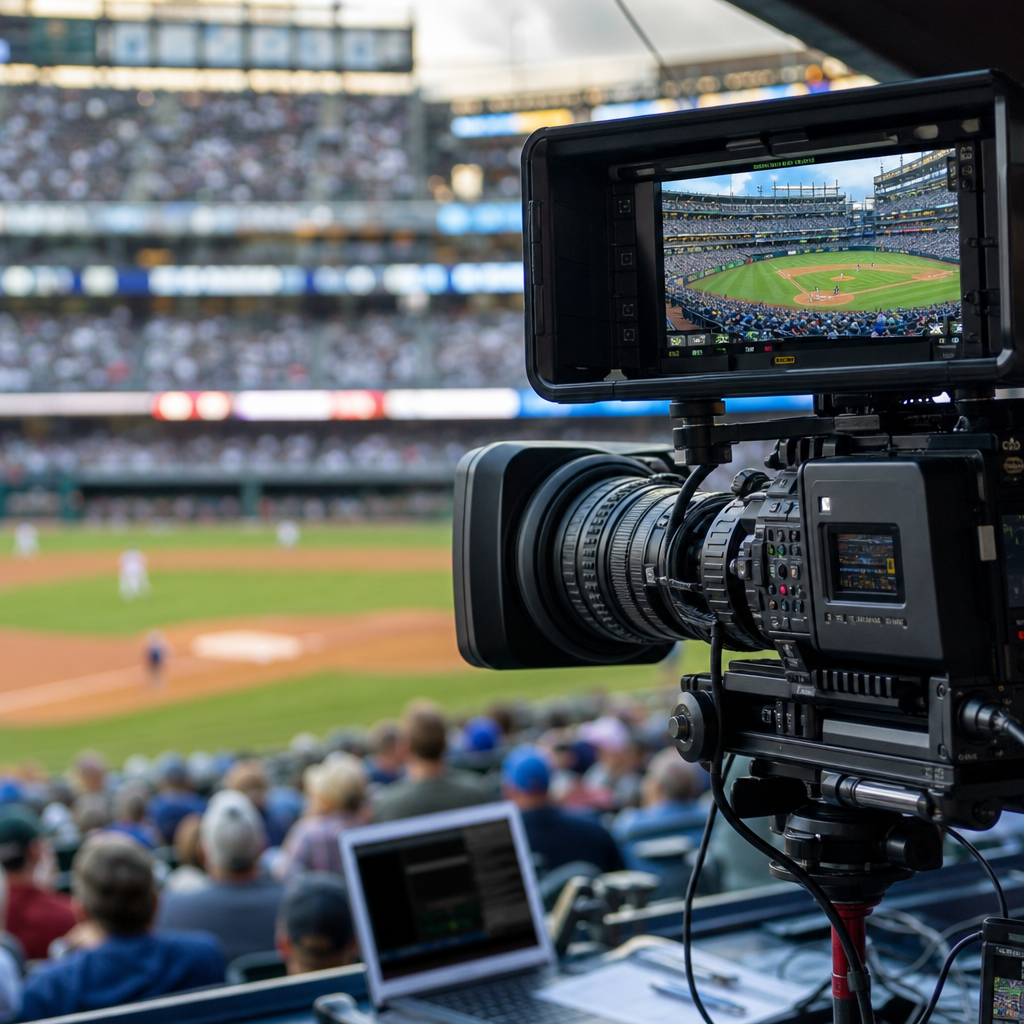
Baseball broadcasts look effortless on screen, but every pitch, replay, and on-screen graphic depends on a tightly coordinated system of cameras, networks, software, and production crews working in real time. In the context of broadcasting evolution, the technology powering baseball broadcasts includes image capture, audio acquisition, replay infrastructure, graphics engines, tracking data, remote production workflows, distribution pipelines, and the analytics tools that turn raw feeds into a compelling viewing experience.
This matters because baseball is uniquely demanding to televise. The game stretches across a large field, alternates between slow buildup and explosive action, and invites viewers to follow both strategy and statistics. A football broadcast can often focus on the ball and the line of scrimmage. Baseball must show pitch movement, base runner leads, defensive shifts, swing mechanics, and managerial decisions, sometimes all within a few seconds. That challenge has driven decades of innovation, from center-field cameras and super slow motion to strike-zone overlays and real-time bat-speed metrics.
I have worked around live sports production systems long enough to know that the audience usually notices only when something fails: a missed cut, a silent interview, a frozen replay, or a delayed graphic. When everything works, technology disappears behind the story of the game. That invisibility is the result of meticulous engineering. Modern baseball broadcasting is no longer just about placing cameras in a stadium. It is an integrated technical operation linking venue infrastructure, mobile production units, cloud systems, data providers, announcer workflows, and streaming platforms.
As a hub for broadcasting evolution within innovations and changes in baseball, this article explains the core technologies, how they fit together, and why each matters. It also points naturally toward deeper topics such as camera innovation, audio design, statistical graphics, streaming delivery, remote production, and the growing role of data-driven presentation. Understanding the full stack behind a baseball telecast reveals why the modern broadcast feels richer, faster, and more informative than ever before.
Camera Systems and Field Coverage
The foundation of any baseball broadcast is the camera plan. A standard major league production typically uses a primary high-home camera for the game cut, a center-field camera aimed at the pitcher and hitter, low first- and third-base cameras, outfield isolations, beauty shots, robotic cameras near foul poles, and super slow-motion units for key moments. National broadcasts often add specialty systems such as shallow-depth cinematic cameras, RF handhelds for player arrivals, and aerial coverage where permitted. The goal is not simply to show the field; it is to build a visual language that helps viewers understand action and emotion instantly.
Baseball requires precise lens choices and sightline planning. The center-field camera, for example, is essential because it gives viewers the pitcher-to-plate perspective used to judge pitch location and movement. Long box lenses allow operators to stay tight on the mound or batter from considerable distance while preserving image stability. Super slow-motion cameras, commonly running at high frame rates, reveal seam orientation, bat flex, tag plays, and foot placement at the bag. Those details are not decorative. They support rules analysis, player development storytelling, and officiating discussions that shape how fans interpret the game.
In recent years, HDR workflows and higher-resolution acquisition have improved baseball coverage significantly. Bright afternoon games, deep shadows, white uniforms, and green grass create difficult contrast conditions. High dynamic range preserves more highlight and shadow detail, making the image more natural and easier to follow. Robotic cameras have also expanded options in tight stadium positions where a full operator setup is impractical. Because these cameras can be shaded, framed, and recalled remotely, they add angles without increasing on-site footprint dramatically, an important gain for regional networks and streaming productions managing costs.
Audio Capture, Crowd Sound, and On-Field Atmosphere
Audio is often undervalued by viewers, yet it is the technology that makes a baseball telecast feel alive. The sharp pop of a catcher’s mitt, the crack of the bat, infield chatter, crowd swells, and public-address announcements all combine to create spatial realism. A typical broadcast mixes parabolic microphones, effects microphones near home plate and dugouts, crowd mics around the bowl, booth microphones for announcers, and wireless systems for reporters and interviews. The A1, or lead audio mixer, balances these sources constantly so the sound matches the pace and tension of the game.
Baseball’s rhythm makes audio mixing especially important. Long pauses between pitches mean silence can feel awkward unless the ambient bed is shaped carefully. At the same time, overly aggressive crowd mix can bury commentary and distort the natural stadium environment. During the pandemic-era empty stadium broadcasts, networks learned how much of baseball’s emotional impact depends on authentic crowd response. Artificial sound could fill dead air, but it could not fully replace the information fans derive from spontaneous reaction. That period accelerated more intentional microphone placement and improved ambient mixing strategies once crowds returned.
Wireless RF technology has also made pregame and in-game elements more flexible. Reporters can move along the warning track, interview players during batting practice, or deliver live hits from crowded concourses without fixed cable runs. Intercom systems tie everyone together: producers, directors, tape operators, graphics staff, utility crew, stage managers, and announce talent. If viewers hear a clean booth segment transition into a dugout report and then into nat sound from the field, that seamlessness reflects both strong audio engineering and disciplined communication architecture behind the scenes.
Replay, Switching, and Real-Time Production Control
The moment a close play happens, the replay room becomes the nerve center of the baseball broadcast. Replay operators ingest every camera feed into servers from vendors such as EVS, then mark, clip, and roll angles within seconds. The director calls for the best look, the technical director executes the switch, and the producer determines editorial priority: Was the runner safe, did the ball scrape the wall, did the shortstop deke the baserunner, or did the pitcher tip a breaking ball? Baseball rewards replay because so many decisive events hinge on tiny movements invisible at full speed.
Production switchers and multiviewers support this speed by giving the control room immediate access to all active sources. The director watches camera composition, anticipates pitch timing, and chooses cuts that maintain continuity. Unlike some sports, baseball often uses a highly disciplined cut pattern: pitch, reaction, runner, fielding angle, replay, then reset. That structure is familiar to audiences, but it is powered by sophisticated routing and timing systems that keep video synchronized across dozens of sources. Frame accuracy matters when comparing a foot on the bag with the glove arriving a split second later.
Challenge reviews by officiating crews have further increased the value of replay infrastructure. Broadcast teams do not control official review, but they must present contested plays clearly and quickly. I have seen the best crews prepare likely angles before the on-air discussion even starts. That readiness depends on replay operators understanding game situations, not just machinery. Good baseball replay is editorial judgment plus technical execution. The machines make rapid retrieval possible; experienced operators turn that capability into insight that helps viewers understand what really happened.
Graphics, Data Integration, and the Modern Baseball Interface
On-screen graphics have evolved from simple score bugs into a sophisticated information layer that shapes how fans learn the game. Today’s baseball graphics systems pull live data from league feeds, scoring systems, tracking platforms, and research databases to display count, pitch type, velocity, defensive alignment, probability models, hitter tendencies, and milestone context. Systems from companies such as Chyron, Ross Video, and Vizrt let graphics operators trigger lower thirds, matchup cards, sponsor elements, and statistical inserts with precise timing. The best graphics support the story without overwhelming the viewer.
The strike-zone box is one of the clearest examples of broadcasting evolution. It appears simple, but it depends on calibrated camera geometry, accurate pitch tracking, and software that aligns the visual overlay to the broadcast perspective. Even small calibration errors are noticeable, which is why high-quality implementations are maintained carefully throughout the game. As newer metrics like bat speed, attack angle, and catch probability enter broadcasts, producers must choose which numbers genuinely inform and which merely clutter. More data is not automatically better television.
Baseball broadcasts now function as a bridge between advanced analytics and casual fans. A well-designed graphic can explain why a pitcher’s sweeper is effective against left-handed hitters or why an outfielder started three steps deeper than usual. Poorly designed graphics, by contrast, interrupt flow and confuse the audience. The craft lies in translating technical baseball information into plain language without losing accuracy.
| Broadcast element | Core technology | Viewer benefit |
|---|---|---|
| Score bug | Real-time scoring data feed | Instant game state awareness |
| Strike-zone overlay | Camera calibration and pitch tracking | Clear pitch location context |
| Statcast-based metrics | Optical and radar tracking systems | Deeper understanding of performance |
| Replay telestration | Touchscreen analysis and graphics engine | Better explanation of mechanics and strategy |
Tracking Technology, Analytics, and Storytelling
Tracking technology has changed baseball broadcasting as profoundly as instant replay once did. Systems such as Hawk-Eye combine multiple high-speed cameras to track player and ball movement across the field, while radar-based approaches have measured pitch velocity and trajectory for years. These systems generate the data behind pitch movement charts, exit velocity readings, launch angle graphics, route efficiency, jump metrics, and defensive positioning analysis. What began as back-office performance data is now a central part of the viewer experience.
The key shift is not the existence of data but the way broadcasts use it to tell stories. A pitcher is no longer described only as “throwing hard.” Broadcasters can show that his four-seam fastball averages 97 miles per hour with above-average induced vertical break, setting up a splitter that falls beneath the barrel. A slugger is not just “locked in.” The broadcast can note a recent jump in average exit velocity and a tighter spray pattern to the pull side. These details make commentary more concrete and more credible.
Still, baseball analytics on television work only when they remain anchored to visible action. Viewers can see late movement, poor swing decisions, or excellent first steps; the data should confirm and sharpen that observation, not replace it. The best producers pair an analyst’s explanation with replay, freeze frames, and one or two relevant metrics. That approach respects both advanced fans and newcomers. It also creates natural pathways to deeper subtopics across a broadcasting evolution hub, including Statcast presentation, telestration methods, and metric literacy for general audiences.
Remote Production, Connectivity, and Distribution
One of the biggest operational changes in baseball broadcasting is the rise of remote production, sometimes called REMI workflows. Instead of sending every technical role to the ballpark, networks may keep parts of the production team at a central facility while cameras, audio capture, and essential engineering remain on site. High-bandwidth fiber links, low-latency encoding, IP transport, and synchronized return feeds make this possible. For regional coverage, college baseball, and digital-first productions, remote workflows can reduce travel costs and increase scheduling flexibility without sacrificing core production quality.
These systems require robust network design. Video feeds must move with minimal delay, comms must remain stable, and timing references must stay aligned across locations. Standards such as SMPTE ST 2110 have influenced how broadcasters think about moving video, audio, and metadata as separate IP streams rather than traditional baseband signals. Not every baseball production runs fully on an IP backbone, but the industry direction is clear. Flexibility, scalability, and centralized resource sharing are now major competitive advantages.
Distribution has evolved just as dramatically. A baseball game may air simultaneously on a regional sports network, a national network, a league app, a connected TV platform, and clipped highlights across social channels. Each destination has different technical requirements for encoding, captions, ad insertion, aspect-safe graphics, and latency management. Streaming adds another layer: viewers expect near-broadcast quality on phones, tablets, and smart TVs, even though internet delivery introduces buffering risks and delay variations. Delivering a clean baseball stream consistently is not simple. It depends on adaptive bitrate ladders, resilient CDNs, observability tools, and careful monitoring from first pitch through postgame.
What Comes Next for Baseball Broadcast Technology
The next phase of broadcasting evolution will be defined by personalization, automation, and richer viewer control. Alternate broadcasts already tailor commentary and graphics to different audiences, from traditional telecasts to data-heavy streams. Automated camera systems are improving at lower levels of the sport, though top-tier baseball still benefits from experienced operators who understand anticipation and storytelling. AI-assisted clipping, metadata tagging, and highlight generation are reducing turnaround time for digital publishing and archive search, making every game more reusable across platforms.
At the same time, restraint will matter. Not every innovation improves the viewer experience. Ultra-shallow cinematic shots can be dramatic in pregame but distracting during live action. Too many betting, probability, or novelty graphics can crowd the screen. The most successful baseball broadcasts will continue to combine strong fundamentals with selective innovation: clear camera coverage, excellent audio, fast replay, disciplined graphics, accurate data, and dependable delivery.
Behind the scenes, baseball broadcasts are powered by an interconnected technology stack built to capture detail, preserve timing, and explain the game with clarity. Cameras show the action, audio supplies atmosphere, replay reveals truth, graphics organize information, tracking systems add evidence, and modern networks move everything where it needs to go. For fans, the benefit is simple: a smarter, clearer, more immersive way to watch baseball. If you are exploring innovations and changes in baseball, use this hub as your starting point, then dive deeper into the specific tools and workflows shaping the future of the sport on screen.
Frequently Asked Questions
What core technologies make a modern baseball broadcast possible?
A modern baseball broadcast is built on a layered production system that combines capture, processing, coordination, and distribution technologies. It starts with image acquisition: multiple broadcast-grade cameras are positioned around the stadium to cover the main game action, tight player shots, crowd reactions, dugouts, bullpen activity, and specialty angles. These can include hard cameras, handheld units, robotic cameras, super slow-motion systems, and increasingly, high-frame-rate and ultra-high-definition setups designed to give directors more flexibility in live production and replay.
Audio is just as important. Microphones are placed throughout the ballpark to capture bat cracks, glove pops, crowd noise, umpire ambience, and on-field atmosphere. Announcer audio comes through dedicated commentary systems, while audio consoles mix all of these sources in real time so the final broadcast sounds natural, exciting, and balanced. Behind the scenes, intercom systems allow producers, directors, camera operators, replay teams, graphics coordinators, and audio engineers to stay synchronized pitch by pitch.
From there, everything flows into the production infrastructure, often centered in a mobile production truck or a remote production hub. Video routers, switchers, multiviewers, replay servers, graphics engines, timing systems, and monitoring tools all work together so the crew can select live shots, insert replays, trigger lower-thirds, display scorebugs, and move seamlessly between game action and analysis. Data systems also play a major role, pulling in pitch tracking, player statistics, defensive positioning, and situational analytics that help broadcasters explain what viewers are seeing in more depth. Finally, distribution technology encodes and sends the finished program to cable providers, satellite systems, streaming platforms, and regional or national network partners. What looks smooth and simple on screen is really a highly coordinated, low-latency technical operation running continuously from first pitch to postgame.
How do broadcasters capture so many camera angles and instant replays during a baseball game?
Baseball broadcasts rely on a carefully planned camera map that assigns each camera a specific role. A center-field camera typically provides the primary pitch view, while high-home and low-home cameras handle wide and tight shots from behind the plate. Additional cameras cover first base, third base, the outfield, dugouts, and crowd reactions. Robotic and specialty cameras may be mounted near foul poles, on backstops, or in hard-to-reach positions to create dramatic perspectives. Because baseball unfolds across a large field and includes both fast reaction plays and slower strategic moments, directors need a broad range of angles available at all times.
Instant replay is powered by dedicated replay servers that continuously record all active camera feeds. Operators can mark important moments as they happen, such as a stolen base attempt, a diving catch, a checked swing, or a close play at the plate. These systems let replay teams scrub through footage frame by frame, isolate the clearest angle, and return a replay package to air within seconds. Slow-motion technology is especially important in baseball because so many decisive moments happen in fractions of a second, from bat-ball contact to tag timing to pitch release mechanics.
What makes this impressive is not just the hardware, but the workflow. Replay operators work closely with the director and producer, who decide whether a moment should be replayed immediately, saved for analysis, or combined with telestration and commentary later in the inning. In high-level productions, several replay channels can run at once, allowing one team to prepare a super slow-motion sequence while another assembles a multi-angle package. The result is a broadcast that can explain the game visually in near real time, giving fans a clearer understanding of how a play developed and why it mattered.
What role do graphics, statistics, and player-tracking data play in baseball broadcasts?
Graphics and data systems are now central to how baseball is presented on television and streaming platforms. The most visible element is the scorebug, which displays the inning, count, outs, baserunners, and score continuously. Beyond that, graphics engines are used to generate player identification banners, lineup cards, defensive alignments, pitching matchups, milestone alerts, sponsor-integrated elements, and post-play statistical breakdowns. These visual tools help viewers follow the game quickly, especially during moments when multiple layers of information matter at once.
Player-tracking and ball-tracking technologies have expanded what broadcasters can show and explain. Systems that measure pitch velocity, spin, movement, release point, launch angle, exit velocity, route efficiency, and fielder positioning provide analysts with far more than traditional box score numbers. During a broadcast, this data can be turned into strike zone overlays, pitch location maps, hit probability visualizations, spray charts, defensive positioning graphics, and side-by-side comparisons that reveal strategy and performance trends. These tools make the broadcast more informative without requiring viewers to already understand advanced analytics in depth.
The real challenge is integration. Data has to be accurate, timely, and visually understandable. Broadcast teams depend on reliable feeds from official scoring systems, tracking providers, league data platforms, and internal production databases. Graphics operators and statisticians then decide which numbers are most relevant for the moment. A good baseball broadcast does not overwhelm viewers with data; it translates raw information into context. Instead of simply showing that a pitch had a certain spin rate, the production may use that number to explain why a hitter swung under a fastball or why a breaking ball looked especially sharp that night. In that sense, analytics tools are not just technical add-ons; they are storytelling instruments.
How are baseball broadcasts produced remotely, and why has remote production become more important?
Remote production, sometimes called REMI production, allows parts of the broadcast workflow to happen away from the stadium. Instead of sending a full production crew and every piece of control-room infrastructure on site, broadcasters can capture camera and audio feeds at the ballpark and transmit them back to a centralized production facility. There, directors, producers, replay operators, graphics staff, audio mixers, and technical directors can manage the show from a hub that may handle multiple games across different markets. This model has grown in importance because it improves efficiency, reduces travel and setup costs, and makes it easier for networks to allocate specialized talent and equipment where it is needed most.
For remote production to work, connectivity is critical. Broadcasters use high-bandwidth fiber circuits, IP-based transport systems, redundant paths, and low-latency encoding technology to move high-quality signals reliably between the venue and the production center. Timing and synchronization must be tightly maintained so that commentary, crowd sound, graphics, and replay stay aligned. Communication systems also need to function as if everyone were in the same truck, even when the crew is spread across multiple locations. If a director calls for a replay, a graphics insertion, and a camera iso at once, those commands must move instantly across the network.
This approach does not eliminate the need for on-site personnel. Camera operators, audio technicians, utility crew, engineers, and certain production staff still work in the stadium to handle acquisition and local coordination. But remote workflows let broadcasters scale more intelligently, especially for regional sports networks, secondary game feeds, shoulder programming, and digital simulcasts. They also create flexibility during scheduling surges and allow organizations to centralize technology upgrades rather than duplicating every capability in every truck. As baseball media continues to evolve across linear TV and streaming, remote production has become one of the most important technologies shaping how games get to audiences.
How does the final baseball broadcast get from the stadium to viewers at home or on streaming apps?
Once the live program is produced, it enters a distribution chain designed to preserve quality while delivering the feed quickly and reliably to many different platforms. The finished broadcast is typically sent from the venue or production hub to a master control operation, where it can be monitored, branded, quality-checked, and routed to the appropriate destinations. From there, it may go to regional sports networks, national television partners, cable and satellite distributors, over-the-top streaming services, league-operated platforms, and mobile app ecosystems. Each destination may require specific technical formats, ad insertion workflows, captioning support, and compliance checks.
Encoding and compression are major parts of this process. A live baseball game contains fast motion, fine visual detail, score graphics, and constant changes in scene composition, all of which need to be preserved as efficiently as possible. Broadcasters use professional encoders to convert the production feed into transport formats suitable for contribution and distribution. Streaming workflows add another layer, often using adaptive bitrate packaging so viewers on different devices and connection speeds can still receive a stable stream. That is why the same game may appear slightly differently on a big-screen television, a tablet, or a phone, even though the source production is the same.
Reliability is the overriding priority. Redundant transmission paths, backup encoders, alternate network routes, disaster recovery systems, and continuous signal monitoring are standard because live sports leave no room for failure. If a transmission path drops during a key at-bat, the audience notices immediately. Broadcasters therefore build resilience into every stage of the pipeline, from venue connectivity to cloud-based distribution layers. Increasingly, they also gather performance analytics on stream quality, latency, buffering, and device behavior to improve delivery over time. In practical terms, the final step of a baseball broadcast is not just sending out a signal; it is managing a complex, multi-platform media supply chain that ensures the game arrives clearly, consistently,