
The early history of baseball is a tapestry woven with threads of myth, regional pastime variations, and burgeoning national pride. As America was navigating its journey towards modernity in the 19th century, baseball began to emerge from the shadows of its European ancestors like cricket and rounders, adapting and evolving into something distinctly American. Understanding baseball’s rise to prominence offers a window into the social, cultural, and economic fabric of the United States during that time. The sport’s journey from informal local games to a national pastime reflects broader American themes of innovation, community, and competition.
It’s fascinating to trace the contours of baseball’s early development. America’s agrarian landscape gave way to urbanization, creating opportunities and spaces for communal recreation, including sports like baseball. With roots traced back to the early 1800s, the game we now recognize as baseball started to take shape with the establishment of formal rules and the founding of amateur clubs. The proliferation of baseball mirrors the growth of other American institutions, tied closely to the societal trends and transformations of the era. Even in its infancy, baseball captivated the hearts and minds of young Americans, offering not only entertainment but a unique form of civic engagement and identity.
The journey of baseball from casual field game to professional, organized sport encompasses a myriad of factors, including technological advancements, population shifts, and a growing thirst for a collective American identity. From its New York-centric introduction to its embrace by cities and towns across the nascent nation, baseball quickly became more than just a pastime—it evolved into a defining element of American culture. This tale covers the nascent stages of baseball’s birth and early development through to its establishment as a cherished national pastime.
The Origins and Early Influences
Baseball’s origins are a mix of folklore and historical record, shrouded in mystery and debate. One of the most enduring myths is that baseball was invented in Cooperstown, New York, by Abner Doubleday in 1839. While this story has been widely debunked by historians, it persists as a charming chapter in the game’s lore. Instead, baseball likely evolved from older bat-and-ball games that immigrated with Europeans, incorporating elements from English games like rounders and cricket.
In the early 19th century, various forms of bat-and-ball games were played in schoolyards and vacant lots throughout the United States. These early iterations differed widely in rules and style, largely determined by regional preferences. However, it’s widely accepted that by the mid-1800s, a formalized version of the game began to emerge, predominantly in the northeastern states. Alexander Cartwright, a member of the Knickerbocker Base Ball Club in New York, is often credited with formalizing some of the foundational rules of baseball in 1845, which paved the way for the sport’s standardization and growth.
The Knickerbocker Rules, as they came to be known, laid out the dimensions of the diamond, the designation of foul lines, and the three-out structure for an innings, among other guidelines. These rules helped clarify the gameplay and made it easier for different communities to play the same game, promoting a sense of unity and shared experience. This standardization was crucial to transitioning baseball from a casual pastime to an organized sport.
The Formation of Baseball Clubs
With the establishment of standardized rules, the mid-19th century saw the formation of numerous amateur baseball clubs, particularly in urban centers. Clubs like the Knickerbockers played a pivotal role in promoting the game and staging formal competitions. By the 1850s, baseball clubs were sprouting up across New York and New Jersey, reflecting the sport’s growing popularity. These clubs were typically formed by young men, often from the middle or upper classes, who had the leisure time and societal support to engage in recreational activities.
One of the crucial developments in this era was the formation of the National Association of Base Ball Players (NABBP) in 1857, the first governing body of baseball. This organization played a crucial role in further standardizing rules, organizing competitions, and promoting the sport at a national level. The NABBP’s annual conventions served as a forum to discuss rule changes and to ensure uniformity in how the game was played across different regions.
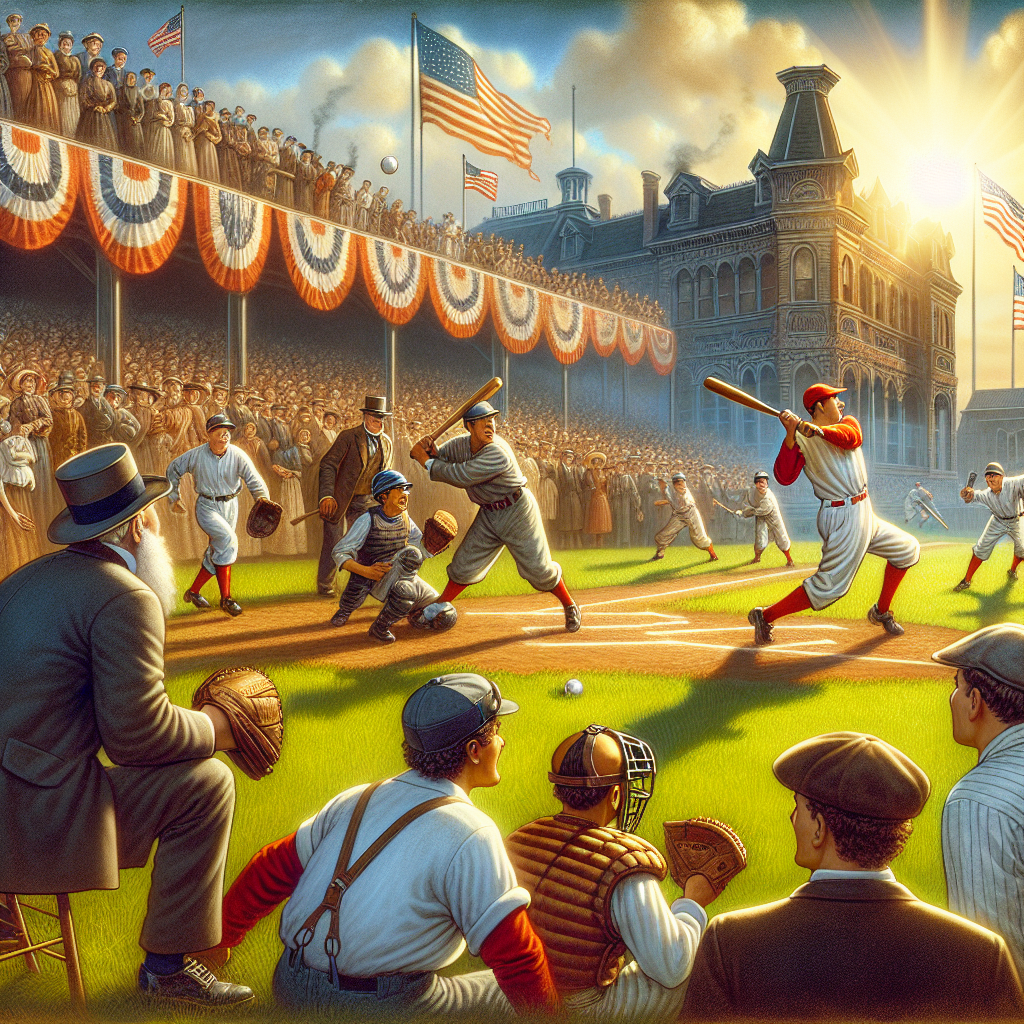
The Civil War (1861-1865) had a profound impact on the spread of baseball. Soldiers from different parts of the country introduced the game to each other, and post-war, it became a unifying activity in a nation seeking to rebuild its bonds. Veterans who had played baseball during the war continued their enthusiasm for the sport upon returning home, further fueling its spread and popularity. By the end of the 1860s, baseball was not just a northeastern phenomenon but was being played in every region of the United States.
Professionalization and the Birth of Leagues
The transitioning of baseball from an amateur pastime to a professional sport began in earnest in the late 1860s and early 1870s. Until then, baseball was seen mainly as a hobby, and players were not typically paid for their participation. However, the growing interest in the sport and the draw of large crowds opened up new economic opportunities. In 1869, the Cincinnati Red Stockings became the first openly professional baseball team, with all players receiving salaries. This was a turning point, marking the beginning of professional baseball.
The success of the Cincinnati Red Stockings led to the formation of more professional teams and eventually, organized leagues. In 1871, the National Association of Professional Base Ball Players (NA), the first professional baseball league, was established. The NA, however, struggled with issues such as inconsistent rules and governance, leading to its dissolution in 1875. It was succeeded by the National League of Professional Base Ball Clubs in 1876, which brought a more structured and sustainable approach to professional baseball.
The establishment of the National League marked the start of baseball as we know it today, with standardized schedules, formalized team structures, and professional management. Teams began to represent cities and regions, creating local rivalries and fostering community pride. This era also saw the emergence of baseball’s first stars, whose on-field exploits captivated fans and added to the sport’s growing allure.
The Cultural Impact of Baseball
The rise of baseball as America’s national pastime in the late 19th and early 20th centuries paralleled significant societal changes. Urbanization, technological advancements, and the rise of the mass media all played a role in baseball’s dominance in American culture. The sport became a lens through which Americans viewed themselves and their society, reflecting both their aspirations and their struggles.
Playing baseball offered a sense of community and belonging in rapidly growing urban environments. It provided an outlet for physical activity and social interaction that was increasingly necessary in an industrializing society. Baseball parks became communal spaces where people from different backgrounds could come together, united in their support for their home team. This communal aspect of baseball helped to forge a shared identity and sense of national pride.
The media played a critical role in popularizing baseball. Newspapers began to cover games extensively, and baseball’s first radio broadcasts in the 1920s broadened its reach. Iconic players like Babe Ruth, Ty Cobb, and Lou Gehrig became household names, their exploits followed eagerly by fans across the nation. The sport’s integration into the fabric of American life was given further institutional support through events like the construction of iconic ballparks and the establishment of the World Series in 1903, which became a symbol of competitive excellence and a highlight of the sporting calendar.
Baseball’s Challenges and Triumphs
Despite its growing popularity, baseball faced significant challenges in its early years. Issues such as gambling scandals, labor disputes, and integration remained hot-button topics. The notorious Black Sox Scandal of 1919, where members of the Chicago White Sox were accused of intentionally losing the World Series in exchange for money from gamblers, shook the sport to its core. This scandal led to major reforms, including the establishment of the Commissioner of Baseball, a role created to restore integrity and public confidence in the sport.
Labor disputes also emerged as players sought fair compensation and rights. The formation of the first players’ union in the early 20th century marked the beginning of a long journey towards players’ rights and free agency. The battle for worker rights within baseball mirrored broader labor movements across the United States, representing a struggle for fairness and respect in the workplace.
Integration was another monumental challenge. For decades, baseball was segregated, with African American players relegated to the Negro Leagues despite their immense talent. The breaking of the color barrier by Jackie Robinson in 1947, when he joined the Brooklyn Dodgers, marked a significant turning point not only for baseball but for American society. Robinson’s courage and exceptional performance on the field paved the way for future generations of players from diverse backgrounds, embodying the broader civil rights movement and pushing America toward a more inclusive and equitable society.
Conclusion
The early history of baseball is a microcosm of America’s own evolution, embodying the nation’s values, conflicts, and transformations. From its murky origins and foundational years to its ascent as a professional sport and its cultural integration, baseball’s journey reflects greater societal trends and shifts. It rose from a collection of loosely played local games to become America’s beloved national pastime, drawing people together from all walks of life to celebrate competition, skill, and community.
Modern baseball remains deeply rooted in its history, with traditions and legends that continue to captivate new generations of fans. Understanding its early development offers not just insights into the sport itself, but also a deeper appreciation of the broader historical context of 19th and early 20th century America. Baseball’s growth and transformation, its challenges and triumphs, mirror the resilient and innovative spirit of the American people through times of change and adversity.
In many ways, baseball is more than a game; it’s a narrative—a series of stories that, together, form a rich tapestry of American life. As the sport continues to evolve, it carries forward more than a century of history, connecting past, present, and future in a way that few other cultural institutions can. And as baseball’s early history shows, its rise to becoming America’s national pastime was not just about bats and balls, but about community, identity, and the relentless pursuit of excellence.
Frequently Asked Questions
1. How did baseball begin to rise as America’s national pastime?
The rise of baseball as America’s national pastime can be attributed to several key factors that conspired during the 19th century to make the sport an indelible part of the American identity. Unlike other sports from its European ancestors like cricket and rounders, baseball quickly found its footing in a nation that was embracing change and modernization. In an America transitioning through industrialization and urbanization, cities needed recreational outlets, and baseball perfectly filled that void as a leisure activity that could be easily learned and played. Additionally, baseball’s organized structure and rules were codified relatively swiftly, lending the sport a sense of order and professionalism. The sport’s unique ability to transcend class and regional differences also played a crucial role. People from varied backgrounds could gather around the diamond, not just to watch, but to participate. This communal experience fostered a sense of shared identity at a time when the nation was seeking it most. With the advent of the Civil War, soldiers often played baseball during their downtime, further spreading its popularity across the country as these soldiers returned home with a newfound love for the game.
2. What influence did early baseball clubs and professional leagues have on the sport’s rise?
Early baseball clubs and the formation of professional leagues were pivotal in the sport’s rise to prominence, helping to cement rules, professionalize players, and build fan bases that would sustain the game into the future. In the 1840s and 1850s, amateur baseball clubs began emerging in larger American cities. These clubs laid the groundwork by not only organizing games but fostering a competitive spirit and camaraderie that attracted audiences. Crucially, the formation of the National Association of Base Ball Players in 1857 marked a significant step toward standardizing rules and gameplay. The transformation from amateur to professional baseball was further accelerated with the Cincinnati Red Stockings, established in 1869 as the first openly professional baseball team. The success of the Red Stockings demonstrated the viability of professional baseball as not just an athletic pursuit but an enterprising spectacle capable of drawing large crowds and generating revenue. When the National League was founded in 1876, it provided a structured, reliable platform that promoted a higher level of financial and organizational stability. The league was able to enforce standardization of play and scheduling, enhancing public interest and cementing baseball’s place as a mainstay of American culture.
3. What role did media and broadcasting play in the growth of baseball’s popularity?
The impact of media and broadcasting on the growth of baseball’s popularity is undeniable and multifaceted, affording the sport national visibility and innumerable opportunities for cultural integration. As newspapers became widely circulated in the late 19th century, sports pages and dedicated baseball coverage became a staple, providing fans with not only scores and recaps but also player profiles, team news, and even game strategy discussions. By the dawn of the 20th century, baseball was being brought to every corner of the country via telegraph updates and enthusiastic journalism, inspiring young athletes and imbibing regional pride. The introduction of radio broadcasting in the 1920s signified another leap in baseball’s national outreach. The ability to hear the crack of the bat and the roar of the crowd from living rooms across the nation democratized access to the game and intensified the connection fans felt with their teams and heroes. Later, the advent of television broadcasting only magnified this effect, allowing fans to visually experience games even if they couldn’t be there in person. The media’s narrative capabilities were just as vital, often romanticizing the game and its players, turning them into American folklore and heroes that transcended time.
4. How did baseball influence American culture and society?
Baseball’s influence on American culture and society is profound, penetrating facets of national life ranging from literature and language to advocacy and identity formation. More than just a sport, baseball became a mirror reflecting societal changes and occasionally, a catalyst for such change. It has long been a common theme in American literature and cinema, with its universal appeal providing powerful metaphors and narrative devices. Famous works like “The Natural” and films such as “Field of Dreams” and “A League of Their Own” illustrate baseball’s symbolic hold on the American imagination. Language too, has been influenced with baseball jargon infiltrating everyday speech, creating phrases and idioms used far beyond the ballparks. Additionally, baseball has served as a potent platform for social progress. The integration of Major League Baseball through figures like Jackie Robinson challenged racial segregation and provided momentum for the Civil Rights Movement. Those moments of breaking barriers reflect baseball’s larger role as a place where social issues are openly contested and resolved. Community spirit often coalesces around local teams, uniting diverse fan bases and fostering a sense of belonging—a testament to America’s deep-rooted connection with baseball.
5. Why is baseball still considered America’s pastime despite changes in popular sports trends?
Despite the fluctuation in popular sports trends, baseball continues to hold the title of America’s pastime due to its historical significance, cultural traditions, and storytelling universality. Baseball’s timeless and intergenerational appeal stems from its rich history in shaping and reflecting the American experience. It’s a sport passed down through generations, with its leisurely pace allowing fans to bond over shared experiences and collective memories. Little League imparts sportsmanship and dreams of greatness to countless children, while the traditions surrounding baseball—like the singing of “Take Me Out to the Ball Game” or enjoying a ballpark hot dog—continue to be cherished rituals. Baseball presents a storybook season, culminating in the World Series, that aligns with the rhythm of American life, punctuating summer with anticipation and offering resolution in fall. Furthermore, baseball’s idiosyncratic balance of individual performance and team strategy provides endless narratives that satisfy both statistical enthusiasts and casual fans alike. Protagonists, dramas, triumphs, and failures are played out in real-time, each season adding depth to the sports’ ongoing dialogue with the nation. This encapsulates why baseball endures as not only a sport but a cultural institution—an embodiment of America’s ideals and dreams.