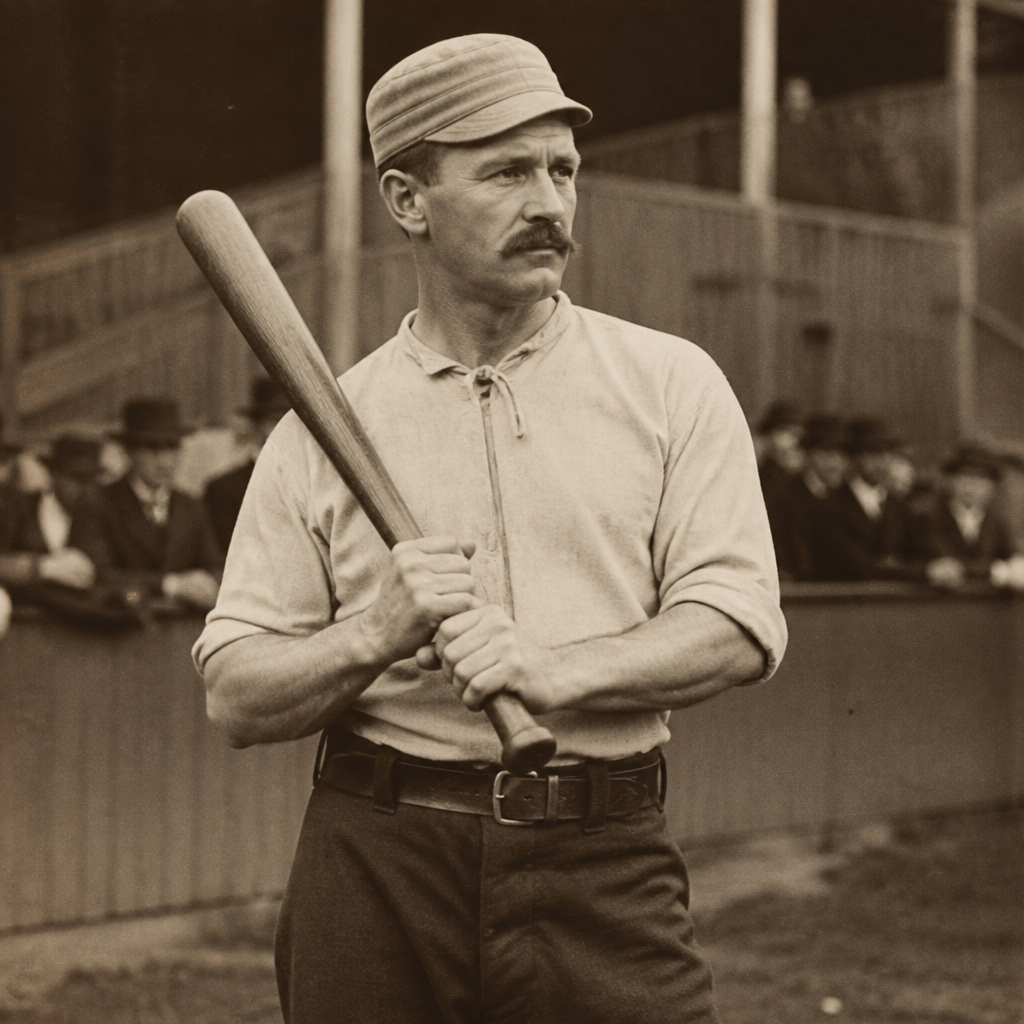
King Kelly was baseball’s first true celebrity, a player whose fame reached beyond the diamond and helped define what a star athlete could be in the 19th century. In the growing world of professional baseball, Michael Joseph “King” Kelly stood at the intersection of sport, theater, business, and urban entertainment. He was not simply a great catcher and outfielder for the Chicago White Stockings and Boston Beaneaters; he was a national attraction, a master self-promoter, and one of the earliest player profiles to show how personality could sell tickets as effectively as performance. For readers exploring legendary players, Kelly is an ideal hub subject because his career connects nearly every major theme in baseball biography: skill, controversy, innovation, media attention, fan culture, and legacy.
To understand King Kelly, it helps to define three key ideas. First, a player profile is more than a list of statistics. It is a complete view of a player’s background, style, achievements, reputation, and influence on the game. Second, celebrity in the 1880s meant public visibility created through newspapers, live appearances, songs, endorsements, and storytelling rather than radio or television. Third, showmanship in baseball meant turning ordinary play into spectacle through daring baserunning, argument with umpires, emotional flair, and a keen awareness of what crowds wanted to see. I have worked through many 19th-century box scores, newspaper archives, and early sporting guides, and Kelly appears repeatedly as the player writers could not stop describing. Even when another star had better numbers, Kelly often owned the headline.
That is why he matters. Long before Babe Ruth, Joe DiMaggio, or Jackie Robinson became national symbols, Kelly demonstrated that a ballplayer could shape public identity as deliberately as an actor on stage. He helped normalize autograph culture, player branding, ghostwritten memoirs, exhibition appearances, and off-field storytelling. His life also reveals the rough edges of early professional baseball: weak labor rights, uneven rules, heavy travel, rowdy crowds, and a sport still deciding what counted as acceptable gamesmanship. As the hub for player profiles under legendary players, this article uses Kelly to show how to evaluate historic stars in full context, balancing statistics with role, environment, and cultural reach.
Early life, rise to stardom, and why his profile spread nationally
Mike Kelly was born in Troy, New York, in 1857 to Irish immigrant parents and grew up in Paterson, New Jersey, a working-class environment that shaped both his ambition and his style. He entered professional baseball in the late 1870s, when the sport was consolidating after the chaotic early years of the National Association and the emerging authority of the National League. By 1880 he joined the Chicago White Stockings, one of the era’s model franchises under Cap Anson. That team gave Kelly visibility, but visibility alone did not create fame. He earned attention because he played multiple demanding positions, excelled as a runner, and added theatrical instincts that translated perfectly to newspapers hungry for colorful copy.
Writers portrayed him as clever, daring, funny, and occasionally impossible to control. That combination sold papers. In Chicago, then one of the country’s great media centers, Kelly’s exploits circulated quickly through syndication. His transfer to Boston in 1887 for a reported $10,000 purchase price, a stunning sum at the time, became a national story and inspired the popular song “Slide, Kelly, Slide.” In practical terms, that transaction made him baseball’s first marketable superstar. Fans discussed his salary and sale price the way modern audiences debate free-agent contracts. If you are building player profiles, this moment is essential because it shows that biography must include economics and public reaction, not just on-field totals.
Kelly’s reputation also spread because he embraced public performance beyond baseball. He toured in vaudeville, appeared on stage, and lent his name to products and promotional events. His autobiography, “Play Ball,” published in 1888, is often cited as baseball’s first autobiography, though like many 19th-century memoirs it likely involved significant editorial help. Even so, it mattered. It taught fans to consume a player’s voice as part of the entertainment package. In that sense, Kelly pioneered a model later used by nearly every legendary player: the athlete as storyteller, brand, and character.
How King Kelly played: skills, positions, and baseball intelligence
King Kelly’s statistical record is strong, but numbers alone undersell him because 19th-century baseball was strategically and structurally different from the modern game. He played catcher, outfield, first base, and occasionally other spots, an unusual level of versatility for a star. Catching then was especially punishing; protective gear was primitive, foul tips were dangerous, and the physical toll was severe. Kelly nevertheless built a reputation as one of the game’s smartest players, known for anticipating throws, reading defenses, and taking extra bases with aggression that bordered on improvisation.
Over his major league career, Kelly hit above .300, scored heavily, stole hundreds of bases under scoring rules very different from today’s, and starred for pennant-winning clubs. Baseball-Reference credits him with over 1,300 runs and nearly 600 stolen bases, though stolen-base accounting from that era requires context because official definitions changed. The point is not that every number translates cleanly to current metrics; the point is that contemporaries consistently viewed him as an offensive engine and tactical menace. He excelled in an environment with lower-quality fields, variable equipment, and inconsistent officiating, all of which rewarded quick thinking.
What I find most revealing in old game accounts is the frequency of phrases such as “heady play,” “sharp practice,” and “baseball instinct.” Kelly manipulated tags, feints, and timing in ways that made him difficult to defend. He cut bases tightly, distracted fielders, and turned hesitation into advantage. Today we might describe that as elite baseball IQ paired with theatrical timing. He was not merely fast; he understood when to appear reckless and when to be precise. That distinction matters when writing player profiles, because great players are often remembered for tools, while truly legendary players are remembered for how they used them.
| Player profile element | What King Kelly shows | Why it matters for legendary players |
|---|---|---|
| Background | Irish American, working-class roots, Northeast urban upbringing | Explains his connection to immigrant fan bases and city audiences |
| Primary value | Versatility, baserunning, adaptability, baseball intelligence | Shows how stars succeeded before modern specialization |
| Public image | Flamboyant, witty, controversial, highly marketable | Demonstrates that fame can amplify athletic impact |
| Career milestone | Record-setting sale from Chicago to Boston in 1887 | Marks an early turning point in player economics and publicity |
| Legacy | Prototype for athlete celebrity and baseball self-branding | Connects 19th-century baseball to modern sports culture |
Showmanship, controversy, and the blurred line between innovation and gamesmanship
Kelly’s fame rested partly on a trait that made some contemporaries admire him and others distrust him: he tested baseball’s boundaries constantly. The famous phrase “Kelly’s strategy” came to mean opportunistic, crafty, and sometimes barely within the rules. Stories about him include hiding the ball, deceiving runners, exploiting dead-ball situations, and using confusion to create outs or extra bases. Some tales grew in the retelling, but the fact that so many circulated tells us something important. Kelly represented baseball’s tension between formal rules and practical advantage at a time when many conventions were still unsettled.
One often-repeated anecdote involves Kelly supposedly entering a game from the bench to catch a foul pop and record an out without having been formally announced, leading to the expression “Kelly now catching for Boston.” Historians debate the exact details, but the story endured because it fit his public persona perfectly. He was the player audiences expected to try something audacious. In modern terms, he was both highlight creator and rules stress-tester. That combination made him ideal newspaper material and made his profile larger than his box score.
His showmanship also worked in direct relationship with spectators. Kelly played to crowds, argued visibly, reacted dramatically, and understood pacing in a way many athletes do not. I would compare him less to a silent statistical machine and more to a live performer who understood that suspense, indignation, and daring could all become part of the ticket value. In the 1880s, when ballparks were social spaces and newspaper storytelling magnified personality, this skill had economic weight. Owners wanted stars who filled grandstands, and Kelly did that repeatedly.
There were costs. His nightlife, drinking, and irregular discipline were regular subjects of criticism. Cap Anson and other authority figures often found him difficult to manage. This is an important reminder for player profiles: legendary status does not require sanitizing the subject. Kelly’s flaws were central to his story, affecting his conditioning, reliability, and eventually his longevity. Balanced baseball biography should preserve both the magnetism and the instability.
Why King Kelly is a model hub for player profiles under legendary players
If this page serves as a hub for player profiles, Kelly offers the ideal framework for evaluating other legendary players across eras. Start with origin and social context: where a player came from, which communities embraced him, and what the sport looked like when he arrived. Move next to role and skill set: primary positions, signature abilities, and how those abilities fit league conditions. Then examine achievements using era-aware statistics rather than raw comparison across centuries. After that, assess personality, reputation, media treatment, labor conditions, controversies, and long-term influence.
Kelly checks every box. His origin story links baseball to immigration and city growth. His multi-position career shows why flexibility mattered in early rosters. His offensive production and baserunning demonstrate star value before modern power metrics dominated discussion. His transfer to Boston highlights player valuation before free agency. His stage career and autobiography reveal the commercial expansion of athlete identity. His controversies show how charisma and disorder often coexist. His death in 1894, likely from pneumonia during a period of public health vulnerability, underscores how fragile life and careers could be in that era.
He was elected to the National Baseball Hall of Fame in 1945 by the Old Timers Committee, a significant but delayed recognition that reflects how 19th-century stars were sometimes overshadowed by the fully documented heroes of the 20th century. Yet Hall of Fame status is only one part of his value. For anyone building or reading player profiles, Kelly teaches the most useful lesson in sports history: a player’s importance comes from the intersection of performance, context, and cultural effect. Remove any one of those and the picture is incomplete.
That framework also helps when linking outward to profiles of other icons. Cap Anson invites questions about authority and exclusion. John Montgomery Ward opens labor and legal history. Buck Ewing sharpens discussions about catching excellence. Babe Ruth expands the celebrity model Kelly helped prototype. Rickey Henderson offers a modern parallel in baserunning disruption and swagger, though expressed in a very different media age. A strong legendary players hub should encourage those comparisons because they help readers understand continuity and change across baseball history.
Legacy in modern baseball culture and what readers should remember
King Kelly’s legacy is larger than his stat line and more durable than many stars who once outperformed him. He showed that baseball could produce a public personality as compelling as any actor or politician of the day. He helped teach owners that charisma had monetary value, taught reporters that athletes could anchor serialized narratives, and taught fans that following a player meant following a life, not just a season. That template remains visible in every modern player profile, documentary, magazine cover, and social media brand strategy built around a star athlete.
At the same time, Kelly should not be romanticized without limits. Nineteenth-century baseball was unevenly organized, some stories about him were embellished, and the celebrity system he helped create could hide poor habits as easily as it celebrated brilliance. The best reading of Kelly is therefore neither myth nor dismissal. It is recognition that he changed what baseball fame looked like while also embodying the sport’s early volatility.
For readers exploring legendary players, the key takeaway is simple: King Kelly matters because he was both exceptional ballplayer and cultural inventor. He excelled on winning teams, expanded the possibilities of player identity, and made showmanship a permanent part of baseball history. Use this page as a starting point for deeper player profiles, compare his career with stars from other eras, and read the game’s history with a wider lens. When you do, Kelly stops being just an old nickname and becomes what he truly was: baseball’s first celebrity and one of its most revealing legends.
Frequently Asked Questions
Who was King Kelly, and why is he considered baseball’s first celebrity?
Michael Joseph “King” Kelly was one of the most famous players of the 19th century and is widely regarded as baseball’s first true celebrity because his appeal extended far beyond his on-field accomplishments. A star for the Chicago White Stockings and later the Boston Beaneaters, Kelly was admired for his athletic versatility, daring base running, strong catching, and flair in the outfield. Yet what truly set him apart was the way he turned fame into a public identity. In an era when professional baseball was still defining itself, Kelly understood that fans were drawn not only to skill but also to personality, drama, and spectacle.
He became a household name because he performed celebrity in a way that felt modern: he cultivated an image, engaged with audiences, inspired songs and promotional tie-ins, and made himself part of the broader entertainment culture of booming American cities. His popularity was amplified by newspapers, which increasingly covered athletes as public characters rather than anonymous competitors. Kelly fit that new model perfectly. He was witty, theatrical, unpredictable, and commercially valuable, helping establish the idea that a ballplayer could be both an athlete and a marketable star. That combination of sporting excellence and carefully amplified public persona is why he remains such a central figure in the history of American celebrity.
What made King Kelly such an important figure in 19th-century baseball?
King Kelly mattered because he embodied several major changes happening in baseball at once. He was an elite player at a time when the sport was evolving from a loosely organized pastime into a major professional enterprise with growing national attention. His career reflected the increasing competitiveness, commercial ambition, and urban popularity of late 19th-century baseball. On the field, he was known for intelligence, improvisation, speed, and a willingness to push the boundaries of accepted play. He helped define the energetic, opportunistic style of the era, when aggressive base running and gamesmanship could be as important as raw power.
Off the field, Kelly represented the business possibilities of the sport. Owners, promoters, journalists, and advertisers recognized that his fame could sell tickets and attract publicity. He became one of the earliest examples of a player whose drawing power affected the economics of the game. His transfer from Chicago to Boston, for example, was itself a major story and demonstrated just how valuable a star athlete could become. This was not simply a baseball matter; it was part of a larger shift in American culture, where mass entertainment increasingly revolved around recognizable personalities. In that sense, Kelly was important not only as a player but also as a symbol of baseball’s transformation into a spectator business built around stars, stories, and public excitement.
How did King Kelly use showmanship to build his reputation?
Kelly’s showmanship was central to his fame. He did not treat baseball as a silent, purely technical competition; he treated it as a live performance. He understood crowd psychology, the value of memorable moments, and the importance of being talked about after the game ended. Whether through daring slides, quick-thinking plays, animated behavior, or colorful public appearances, he created the sense that watching him was an event. Fans did not just come to see baseball; they came to see King Kelly. That distinction is crucial in understanding his place in sports history.
His reputation also benefited from a broader theatrical instinct that fit the entertainment culture of the 19th century. Urban audiences were already accustomed to vaudeville, music halls, public lectures, and stage personalities, and Kelly moved naturally in that world. He published autobiographical material, appeared in promotional ventures, and embraced publicity rather than shrinking from it. This helped him become more than a player with statistics; he became a character in the national imagination. That kind of self-presentation was groundbreaking for an athlete of his time. Kelly anticipated later stars who would use charisma, media attention, and personal branding to increase their fame. His genius was recognizing that the audience wanted both competition and personality, and he delivered both with uncommon skill.
Why did King Kelly’s fame extend beyond baseball fans?
Kelly’s fame spread beyond baseball because he emerged at a moment when American mass culture was expanding rapidly. Newspapers were reaching larger audiences, cities were growing, and entertainment industries were becoming more interconnected. A charismatic athlete could now become a public figure known even to people who never attended a game. Kelly’s nickname, style, and headline-generating personality made him especially suited to that environment. He was discussed not just as a ballplayer but as a celebrity performer, a colorful urban personality, and a symbol of modern popular culture.
His reach was strengthened by the fact that he appealed to multiple audiences at once. Sports fans admired his talent, casual readers enjoyed the stories written about him, and entertainment seekers responded to his theatrical image. He existed in a space where athletics overlapped with performance and publicity, which was still a relatively new concept. In many ways, Kelly helped normalize the idea that an athlete could become a mainstream cultural figure. His fame showed that sports stars could influence fashion, conversation, ticket sales, and public imagination in the same way actors and entertainers did. That broader resonance is one reason he remains so significant: he helped define the cultural possibilities of athletic stardom long before radio, television, or social media made such fame commonplace.
What is King Kelly’s lasting legacy in sports and celebrity culture?
King Kelly’s lasting legacy is that he helped create the blueprint for the modern sports celebrity. Long before the rise of endorsement empires, broadcast deals, and social media followings, Kelly demonstrated that athletic fame could be expanded through personality, media savvy, and public performance. He showed that fans formed attachments not only to winning and skill but also to style, narrative, and individuality. That insight remains fundamental to modern sports culture, where the biggest stars are often those who combine elite performance with a compelling public image.
His importance also lies in how clearly he reflects the cultural world of 19th-century America. Kelly stood at the intersection of professional sport, newspaper publicity, urban entertainment, and commercial ambition. He was one of the first athletes to inhabit all of those spaces at once. As a result, historians see him as more than a colorful early ballplayer; they see him as a key figure in the emergence of celebrity itself within American sports. His life and career remind us that the spectacle surrounding athletes did not begin in the 20th or 21st century. The roots were already there in Kelly’s era, and few figures embodied them more vividly. For that reason, his legacy endures both in baseball history and in the larger story of how fame came to shape modern sports.