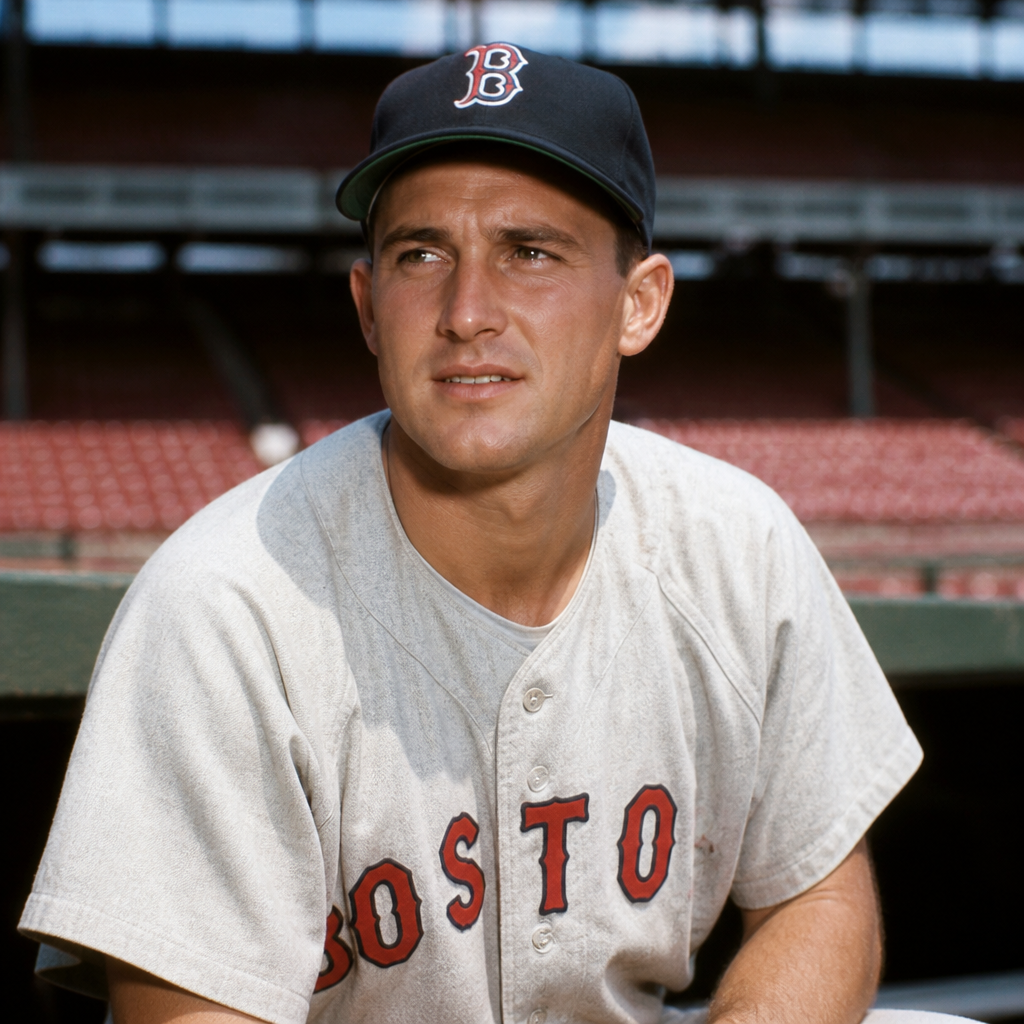
Bobby Doerr remains one of the most complete player profiles in Boston Red Sox history, a second baseman whose quiet style often hid the scale of his achievement. For readers exploring legendary players, his career offers a model of durability, power, defense, and leadership without the self-promotion that usually drives fame. Born in Los Angeles in 1918, Doerr reached the major leagues in 1937 and spent his entire career with the Red Sox, becoming a central figure on some of the franchise’s strongest pre-integration clubs. He retired after the 1951 season, later entered the National Baseball Hall of Fame in 1986 through the Veterans Committee, and remains a touchstone for how greatness can develop steadily rather than theatrically.
Any serious player profiles hub should include Doerr because he connects performance, team history, and baseball evolution. He played in an era shaped by rail travel, wartime roster disruption, changing equipment, and a heavier offensive environment, yet his skills still translate clearly to modern analysis. Traditional measures such as batting average, home runs, runs batted in, and All-Star selections all support his case. Advanced metrics strengthen it further. His blend of offensive production and middle-infield defense made him far more valuable than casual summaries suggest. In practical terms, Bobby Doerr matters because he shows that a Hall of Fame résumé does not require flash. It requires sustained excellence, adaptability, and impact in games that matter.
From my experience building player profiles, Doerr is the kind of figure who rewards close reading. The broad outline is simple: nine-time All-Star, seven seasons with at least 100 runs batted in, and one of the best offensive second basemen of his generation. The deeper story is richer. He hit for power unusual at his position, handled Fenway Park intelligently rather than accidentally, and formed part of a lineup core that included Ted Williams, Dom DiMaggio, and Vern Stephens. He also lost a prime season to military service in 1945, a common but important factor when evaluating players from the World War II era. If that missing year is restored even conservatively, his counting totals become even more persuasive.
This article serves as a comprehensive hub for Bobby Doerr within the broader Legendary Players topic. It covers who he was, what made him effective, how his statistics should be read, where he fits in Red Sox history, and why his Hall of Fame case has aged well. If you want one page that answers the essential questions about Bobby Doerr and points the way to deeper Red Sox player study, this is the right starting point.
Who Bobby Doerr Was and Why His Background Matters
Robert Pershing Doerr grew up in California and developed into a star with the Hollywood Stars of the Pacific Coast League system before reaching Boston at nineteen. That path matters because West Coast baseball in the 1930s was highly competitive, and the Pacific Coast League produced players who were often polished before they ever saw the American League. Doerr was not rushed as a novelty. He arrived with strong hands, quick reactions, and an offensive approach built on hard contact. Boston quickly recognized that he was more than a prospect filling a roster spot. He was a long-term answer at second base.
His era also shaped his reputation. The Red Sox of the late 1930s and 1940s featured larger personalities, especially Ted Williams, whose brilliance naturally captured more national attention. Doerr, by contrast, was famously reserved. Reporters and fans sometimes equate quietness with lesser importance, but club value works differently. Managers trusted him because his game held up every day. Teammates respected him because he prepared, hit in big spots, and avoided avoidable mistakes. In old baseball language, he was steady. In modern language, he combined consistency with high-value production at a premium defensive position.
Doerr’s career totals reflect that steadiness: 2,042 hits, 223 home runs, 1,247 runs batted in, and a .288 batting average. For a second baseman who debuted before offensive specialization and before modern conditioning programs, those are substantial numbers. They become more impressive when you remember that he played only 14 seasons, missed 1945 in the Navy, and retired at thirty-three because of back problems. This is one reason his profile belongs near the center of any Legendary Players player profiles collection: the totals are strong, the peak is stronger, and the context elevates both.
How Bobby Doerr Played Second Base at a Hall of Fame Level
The easiest way to understand Bobby Doerr is to start with role difficulty. Second base requires range to both sides, smooth exchanges on the double play, awareness of hitter tendencies, and the nerve to work around runners sliding hard into the bag. In Doerr’s era, infields were rougher than modern surfaces, gloves were smaller, and game footage review did not exist. Reliability had to come from repetition and instincts. By every contemporary account, Doerr had both. He led American League second basemen in fielding percentage multiple times and was repeatedly praised for his hands and pivot.
Defense alone would have made him a valuable regular, but Doerr paired it with middle-of-the-order offense. That combination is the real separator. He was not a slap hitter collecting singles. He drove the ball with authority to left and left-center, pulled pitches he could handle, and consistently produced extra-base hits. For a second baseman in the 1940s, 20 or more home runs represented impact power. Doerr reached that mark several times and led all major league second basemen in career home runs when he retired. That kind of offensive edge changes a lineup because it turns a position usually associated with table-setting into a run-production spot.
One practical example is his 1950 season, when he hit .294 with 27 home runs and 103 runs batted in. Those are standout totals for any infielder, and they came when Doerr was already in his early thirties. Earlier, in 1948, he drove in 120 runs, a remarkable figure for a second baseman and evidence that Boston trusted him in major run-producing situations. The famous left-field wall at Fenway certainly helped right-handed hitters, but Fenway only rewards players who can drive the ball with precision. Many visitors could not. Doerr did because he understood his park and shaped his contact around it.
Reading the Statistics Behind Bobby Doerr’s Reputation
Traditional numbers tell an important story, but they should be organized carefully. Doerr was selected to nine All-Star teams, finished in the top ten of American League Most Valuable Player voting several times, and produced seven 100-RBI seasons. Those marks indicate sustained league-wide respect, not a single short peak. He also scored more than 90 runs in multiple seasons and regularly played well over 140 games when healthy. Availability is part of value, especially in pre-expansion baseball, when talent concentration was higher and roster depth thinner.
Advanced analysis supports the same conclusion. Doerr’s career Wins Above Replacement, depending on source, sits comfortably within Hall of Fame territory for second basemen. His JAWS-style Hall comparison also places him in credible company, especially once the missed 1945 season is considered. He was not merely compiling. His best seasons delivered star-level impact, and his total value reflects contributions with both bat and glove. Modern analysts also note his adjusted offensive production was well above league average for his position, which is exactly the standard that matters when comparing second basemen across eras.
| Category | Bobby Doerr | Why It Matters |
|---|---|---|
| Career Hits | 2,042 | Shows long-term offensive consistency |
| Home Runs | 223 | Rare power for a second baseman of his era |
| Runs Batted In | 1,247 | Evidence of middle-order run production |
| All-Star Selections | 9 | Reflects sustained league recognition |
| Missed Season | 1945 | Military service reduced counting totals during his prime |
Statistics always require context, and Doerr’s context cuts in his favor. He played in a high-offense period, yes, but he also played a demanding defensive position and faced segregated baseball’s incomplete competition structure, a limitation that affects all pre-1947 evaluations. A balanced profile should acknowledge both realities. Even after making those adjustments, Doerr remains a Hall-caliber player. His numbers are not inflated decoration. They represent real separation from most of his positional peers.
Bobby Doerr’s Place in Red Sox History and the Legendary Players Hub
Within Red Sox history, Doerr belongs in the inner circle just below the franchise’s most universally celebrated names. Ted Williams is the obvious headline figure of the era, but strong teams require multiple stars, and Boston’s late-1930s to late-1940s competitiveness leaned heavily on Doerr. In 1946, when the Red Sox won the pennant, he was one of the roster’s anchors. That club is still remembered for Williams, Johnny Pesky, Dom DiMaggio, and manager Joe Cronin, yet Doerr’s bat and defense were equally central to its balance. He hit .291 that season with 116 runs batted in and helped stabilize the infield every day.
For a player profiles hub under Legendary Players, this matters because the best profiles do not isolate biography from team function. Doerr was not simply a good individual on a famous franchise. He was one of the reasons the franchise was formidable. His friendship with Ted Williams after their playing careers also adds human depth to his legacy. Williams trusted Doerr’s baseball judgment enough to seek his opinion, and their long relationship became one of the most documented friendships in Red Sox history. That kind of peer respect is valuable evidence when assessing players whose style was understated.
Doerr also bridges eras of baseball memory. Older fans remembered him as a dependable star before television saturation changed celebrity culture. Later generations encountered him through Hall of Fame discussions, team histories, and his work as a coach and instructor. After his playing days, he served as a coach for Boston and worked with young infielders, extending his impact beyond his own box scores. When a player remains relevant to instruction decades later, it usually means his fundamentals were real, repeatable, and respected by professionals who understood the game deeply.
Why the Hall of Fame Eventually Said Yes
Doerr was elected to the Hall of Fame in 1986, long after his final game, and that timeline reveals something important about baseball recognition. Players without gaudy publicity often wait while flashier narratives dominate annual voting. The Veterans Committee eventually corrected that by looking at the full record: positional value, offensive impact, durability, war interruption, and reputation among informed baseball people. Once those factors are weighed together, Doerr’s case becomes straightforward. He was one of the best second basemen of his generation and one of the most accomplished at his position in American League history to that point.
Some readers ask whether a delayed election weakens a Hall case. It does not. Voting processes are imperfect, and many worthy players have gained support slowly as historical methods improve. In Doerr’s case, later analysis only strengthened the original testimony from scouts, managers, and opponents who had seen him firsthand. He was not a sentimental pick. He was a deserving one whose value became clearer when baseball conversation broadened beyond headline statistics and personality.
The simplest answer to why Bobby Doerr became a Hall of Famer is this: he did nearly everything a second baseman can do at a high level for a long time. He hit for average, he hit for power, he drove in runs, he fielded his position, and he contributed to winning teams. Few player profiles can present such a balanced case without stretching for narrative drama. Doerr does not need embellishment. The record stands on its own.
Bobby Doerr’s legacy is powerful precisely because it is so unforced. He was a homegrown star before that phrase became marketing language, a lifelong Red Sox player before one-franchise careers became rare, and a Hall of Fame second baseman whose game was built on skill rather than spectacle. For anyone studying legendary players, his profile answers a useful question: what does sustained baseball excellence actually look like? In Doerr’s case, it looks like strong defense, consistent hard contact, run production from an up-the-middle position, and the respect of teammates who knew exactly how hard that combination is to find.
As a hub page for player profiles, this article should leave you with a clear framework for evaluating him. Start with the facts: nine All-Star selections, more than 2,000 hits, 223 home runs, 1,247 runs batted in, a lost wartime season, and a Hall of Fame plaque. Then add the context: Fenway fit his swing, but only because his bat speed and approach were good enough to exploit it; his quiet personality limited publicity, but not value; his era complicates comparison, yet his positional excellence still stands out. The result is a player who deserves more attention than he usually receives in broad baseball conversations.
If you are building a deeper understanding of Red Sox history or assembling your own Legendary Players reading list, keep Bobby Doerr near the top. Use this page as your starting point, then continue into related player profiles, season studies, and Hall of Fame comparisons to see how his career fits into the larger story of baseball greatness.
Frequently Asked Questions
Who was Bobby Doerr, and why is he so important in Boston Red Sox history?
Bobby Doerr was one of the defining players in Boston Red Sox history and one of the finest second basemen of his era. Born in Los Angeles in 1918, he reached the major leagues in 1937 and went on to spend his entire career with the Red Sox, a rarity that only strengthens his standing in the franchise’s story. He played during a period filled with larger-than-life personalities, yet Doerr built his reputation in a very different way. He was not known for self-promotion or dramatic public attention. Instead, he earned respect through consistency, toughness, and complete all-around performance.
What makes Doerr so important is how much he contributed in every phase of the game. He was a productive hitter with real power for a middle infielder, a dependable and often outstanding defender at second base, and a durable everyday presence on strong Boston clubs. In an era when second basemen were not always expected to be major offensive contributors, Doerr stood out by driving in runs, hitting for extra bases, and offering stability in the lineup year after year. He helped define what a complete second baseman could look like long before modern analysts began celebrating well-rounded value in the way they do today.
His historical importance also comes from the way he represented the Red Sox. Doerr became a central figure on some of the franchise’s best teams before Ted Williams missed seasons due to military service and before the long championship drought became the central narrative attached to Boston baseball. He was admired by teammates, respected by opponents, and later recognized by historians as one of the greatest players the organization ever developed. For many fans and baseball scholars, Bobby Doerr matters because he combined elite production with humility, making him one of the clearest examples of greatness that did not depend on constant publicity.
What made Bobby Doerr such a complete second baseman?
Bobby Doerr is often described as a complete second baseman because he excelled in every major part of the job. Offensively, he was far more than a contact hitter or table-setter. He brought legitimate run-producing ability to the position, hitting for power in a way that was unusual for a middle infielder in his time. He could drive the ball into the gaps, hit home runs, and contribute consistently in the middle of the batting order. That kind of offensive impact gave the Red Sox an advantage because they were getting production from second base that many teams simply did not expect from that position.
Defensively, Doerr was equally valuable. He had excellent hands, strong instincts, and the kind of quick reaction time that separated reliable fielders from truly high-level infielders. He was known for his range and his ability to make difficult plays look routine. At second base, where split-second decisions matter and double plays can change a game, Doerr brought calm and precision. His defense was not flashy for the sake of attention, but it was deeply respected because it was efficient, dependable, and technically sound.
Durability was another major part of his completeness. Doerr was an everyday player who could be counted on season after season. In an era with demanding travel, fewer medical resources, and rougher playing conditions than modern players experience, that kind of dependability had enormous value. Add in leadership and baseball intelligence, and the full picture becomes clear. Doerr was not simply good at several things; he was a player who consistently helped his team win with his bat, glove, presence, and professionalism. That is why he remains a model of the classic all-around second baseman.
How good was Bobby Doerr as a hitter compared to other second basemen of his era?
Bobby Doerr was one of the most productive offensive second basemen of his generation. While he may not always receive the same immediate attention as some of the era’s biggest stars, his numbers and reputation show that he was an exceptional hitter for his position. Second basemen in that period were often valued primarily for defense, contact ability, and basic infield reliability. Doerr offered all of that, but he also brought unusual power and run production, making him especially valuable in the Red Sox lineup.
He was capable of hitting home runs, collecting doubles, and driving in large numbers of runs, which gave Boston a major edge from a spot on the field that was not traditionally associated with middle-of-the-order offense. His right-handed power was particularly notable at a time when offensive expectations for second basemen were generally much lower than they are for modern infielders. He was not a one-dimensional slugger, either. He was a disciplined and intelligent hitter who understood situations, adapted to pitchers, and produced over a long period rather than in one brief peak.
Context matters greatly when evaluating Doerr. He played in a competitive era and shared the stage with legendary names, which can sometimes make his individual excellence easier to overlook. But when compared directly to other second basemen of his time, he ranks near the top as an offensive force. That is one of the key reasons historians and Hall of Fame voters eventually viewed him as more than just a very good player. He was one of the rare middle infielders whose bat could meaningfully shape an entire lineup, and that distinction helped separate him from many of his contemporaries.
Why did Bobby Doerr’s Hall of Fame recognition take time, and what ultimately made him a Hall of Famer?
Bobby Doerr’s path to Hall of Fame recognition was slower than many fans now believe it should have been, largely because his greatness was understated. He did not build his reputation through headlines, controversy, or a larger-than-life public persona. He played with quiet excellence, and players like that are sometimes easier to appreciate fully in hindsight than in the moment. He also spent much of his career in the orbit of more famous stars, most notably Ted Williams, which meant his contributions could be overshadowed despite their real importance.
Another factor is that Hall of Fame discussions have changed over time. Earlier generations of voting did not always place the same emphasis on complete positional value, long-term consistency, and two-way excellence that later historians and analysts highlighted more clearly. Doerr’s case became stronger as people took a broader and more careful look at what he accomplished: sustained offensive production from second base, strong defense, durability, leadership, and a career spent entirely with one franchise. When all of those elements are viewed together, the Hall of Fame argument becomes persuasive and quite clear.
What ultimately made him a Hall of Famer was the totality of his career. He was not just very good in one category or memorable for one short stretch. He built a complete body of work that reflected excellence over time. He represented the best qualities of the game: skill, toughness, reliability, and team-first professionalism. As baseball history matured and voters looked beyond flash to substance, Bobby Doerr’s place among the sport’s greats became impossible to ignore. His induction was, in many ways, a long-overdue acknowledgment of a player whose value had always been real, even if it was sometimes quietly expressed.
What is Bobby Doerr’s legacy today, and why does his story still resonate with baseball fans?
Bobby Doerr’s legacy today is that of a player whose greatness was built on substance rather than spectacle. He stands as one of the best examples of a Hall of Famer who earned his place through sustained excellence, complete skill, and personal humility. For Red Sox fans, he remains one of the franchise’s foundational figures, a player who embodied professionalism and consistency during an important era in team history. For baseball fans more broadly, he represents a reminder that some of the game’s most valuable stars are not always the loudest or the most publicly celebrated.
His story continues to resonate because it feels timeless. Every generation of fans can recognize the appeal of a player who shows up every day, performs at a high level, helps teammates, and lets his game speak for itself. In a sports culture that often rewards visibility as much as achievement, Doerr’s career offers a different kind of blueprint. He proved that leadership can be quiet, that excellence can be steady rather than theatrical, and that respect can be earned through reliability and performance as much as through charisma.
There is also something enduring about the fact that he spent his entire major league career with the Red Sox. That lifelong connection to one team deepens his bond with Boston history and gives his career a sense of continuity that modern fans often find especially meaningful. Ultimately, Bobby Doerr’s legacy is about more than statistics or awards. It is about the enduring value of doing everything well, carrying yourself with dignity, and leaving the game better than you found it. That combination is why his story still matters and why his reputation has only grown stronger with time.