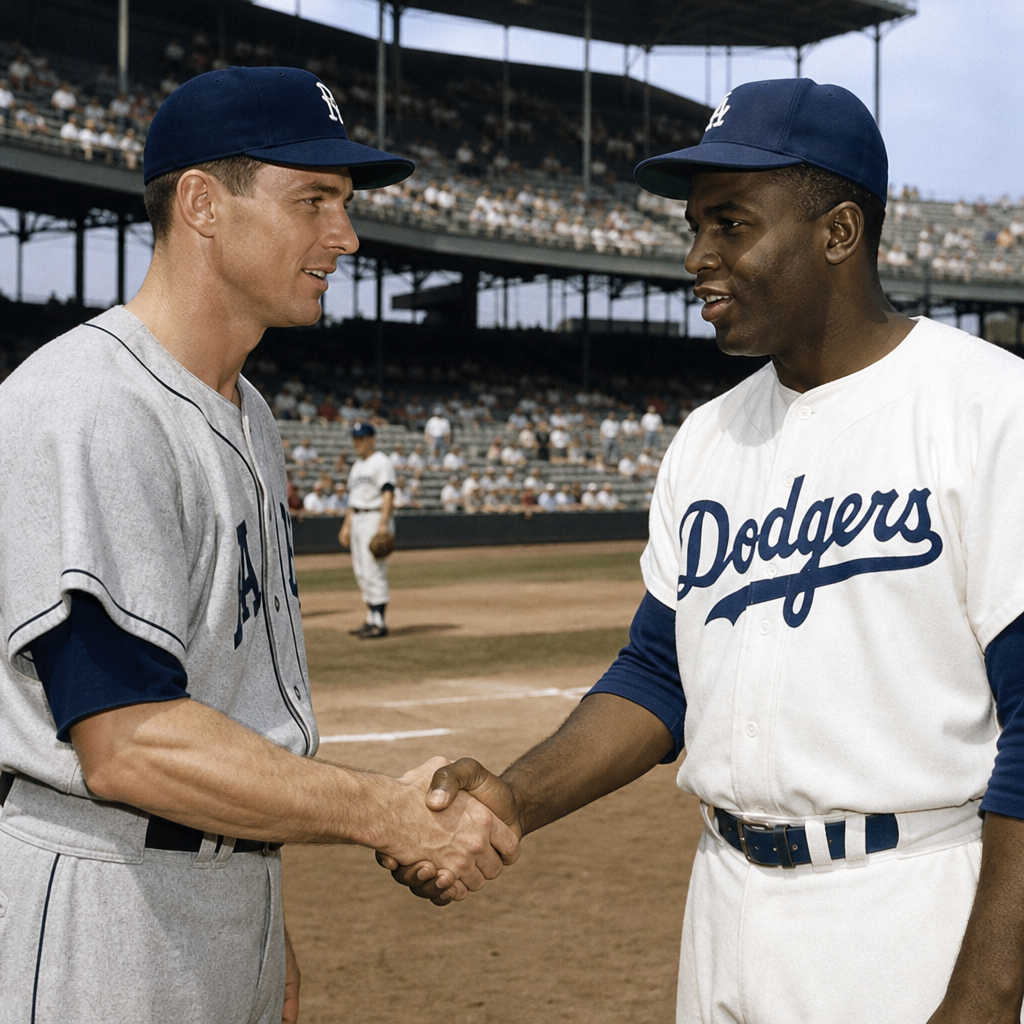
From 1947 to 1956, Major League Baseball changed more dramatically than at any point since the dead-ball era, as integration, postwar economics, and the first modern franchise relocations reshaped rosters, front offices, fan bases, and the competitive map of the sport. In practical terms, this was the decade when the color line began to fall team by team, when clubs adjusted to players returning from military service and to a new peacetime economy, and when owners started to accept that geography, television, and population shifts could matter as much as tradition. For anyone studying baseball eras, “War, Integration, and Relocation” is not a loose collection of themes. It is a connected story about how baseball moved from an insular, segregated, rail-bound league into a national business with a broader talent pool and a very different idea of where teams belonged.
Integration in this context means the admission and regular use of Black players in the American and National Leagues after decades of exclusion. War refers both to the lingering effects of World War II on rosters and to the Korean War, which still pulled players into military service in the early 1950s. Relocation refers to the early moves that signaled the end of the assumption that long-established franchises would remain fixed forever. I have worked through box scores, transaction logs, and team-building patterns from this period, and the central lesson is consistent: winning clubs were usually the ones that adapted faster. The most successful organizations expanded their scouting reach, signed talent ignored by rivals, and rebuilt depth charts around ability rather than custom.
This hub article covers that transformation comprehensively. It explains why Jackie Robinson’s debut in 1947 was the beginning rather than the conclusion of integration, how each club’s pace of change affected its roster construction, how returning veterans and wartime disruptions influenced lineup decisions, and why relocation pressures grew by the middle of the decade. It also provides a framework for exploring related articles under the broader Baseball Eras topic, including team-by-team integration timelines, the decline of the Negro Leagues, postwar attendance trends, and the road to westward expansion. The key point is simple: from 1947 through 1956, no major league roster existed in isolation. Every club was reacting, whether quickly or reluctantly, to the same historic forces.
1947 as the turning point: Jackie Robinson and the end of the fixed talent pool
When Jackie Robinson debuted for the Brooklyn Dodgers on April 15, 1947, he did more than integrate one roster. He broke the assumption that the major league talent pool had fixed boundaries. Branch Rickey’s strategy was not symbolic alone; it was competitive. By signing Robinson from the Kansas City Monarchs organization through the Dodgers’ system, Rickey accessed elite ability that other clubs had deliberately left outside the market. Robinson immediately proved the point, winning the inaugural Rookie of the Year award and helping Brooklyn to the National League pennant. The practical baseball lesson was unmistakable: a team willing to integrate could get faster, deeper, and more dynamic before its rivals did.
Robinson’s arrival also changed what a major league roster could look like tactically. He brought elite baserunning, infield versatility, and pressure offense at a time when many clubs still played conservatively. Soon the Dodgers added Roy Campanella and Don Newcombe, creating a core that improved run production, defense, and pitching at once. That concentration of talent mattered because integration was not a public-relations overlay on existing rosters. It altered batting orders, bench roles, rotation plans, and farm-system priorities. Teams that had previously searched only among white amateurs and minor leaguers were suddenly confronted with the fact that an entire parallel baseball world had been producing major league-caliber stars for years.
How integration unfolded one team at a time
Integration did not sweep through baseball evenly. The Dodgers integrated first in 1947, the Cleveland Indians followed with Larry Doby in the American League later that same year, and the St. Louis Browns added Hank Thompson and Willard Brown. But several clubs moved slowly, inconsistently, or only under competitive pressure. The Indians became one of the clearest examples of a club gaining from decisive action. Doby developed into a power-hitting center fielder, and Satchel Paige joined Cleveland’s 1948 club, which won the World Series. In contrast, teams that delayed integration reduced their own access to impact players during a period when pennant races were often decided by thin margins.
What mattered was not merely signing one player but building a sustainable pipeline. The New York Giants became stronger when they integrated with Monte Irvin and later Willie Mays. The Braves added Sam Jethroe, then a 1950 Rookie of the Year, and integrated more meaningfully as they pursued contention. The White Sox signed Minnie Miñoso, whose all-around game transformed their lineup and outfield. Yet other organizations, notably the Yankees, Red Sox, and Phillies, remained resistant for too long. The Yankees could survive that delay because of unusual organizational depth, but even they left value on the table. Boston’s resistance was especially costly given the club’s need for athleticism and pitching support around Ted Williams.
| Team | First Black player era entry | Immediate roster impact |
|---|---|---|
| Brooklyn Dodgers | 1947, Jackie Robinson | Added top-of-order speed, infield value, and opened path for Campanella and Newcombe |
| Cleveland Indians | 1947, Larry Doby | Strengthened lineup depth; later paired with Satchel Paige on 1948 title club |
| New York Giants | 1949, Monte Irvin | Improved run production and helped form a stronger early-1950s core |
| Boston Braves | 1950, Sam Jethroe | Added speed, center-field range, and immediate table-setting offense |
| Chicago White Sox | 1951, Minnie Miñoso | Brought power, on-base skill, and athletic outfield defense |
| Boston Red Sox | 1959, Pumpsie Green | Delayed integration beyond this era, illustrating lost competitive opportunity |
This staggered timeline explains much of the decade’s roster inequality. Clubs willing to scout the Negro Leagues aggressively found everyday players, frontline pitchers, and premium athletes. Clubs that hesitated had to rely on narrower farm systems and aging veterans. In my review of pennant contenders from these years, the pattern is direct: integration was not the sole reason teams won, but it consistently widened the margin for smart organizations and narrowed the options for stubborn ones.
War’s lingering effects on roster construction
Although 1947 usually stands as the symbolic starting point of this era, teams were still dealing with the aftershocks of World War II. During the war, many stars missed seasons or parts of seasons because of military service, and clubs filled rosters with older players, very young players, or limited replacements. When veterans returned, teams had to sort through age, lost development time, and changed physical condition. Ted Williams lost prime years. Bob Feller served in the Navy and returned to Cleveland as an ace, but not every player resumed his prewar trajectory. The war distorted career arcs and left front offices with a difficult blend of established names and uncertain depth.
The Korean War created another, smaller interruption in the early 1950s. Williams again lost time to service. Willie Mays served in 1952 and 1953, missing substantial playing time just as he was becoming a superstar. Clubs therefore had to manage two overlapping realities: the sport was integrating, and it was still vulnerable to military absences. That combination increased the importance of flexible rosters and broad scouting networks. Organizations could no longer assume that a stable core of veterans would carry them unchanged from year to year. They needed replacements ready, and integrated scouting supplied more of them.
This is one reason the best clubs of the period looked unusually deep. Brooklyn’s bench and farm system kept producing options. Cleveland could absorb disruption because it had strong pitching and a wider view of talent. The Yankees, even while integrating late, remained formidable because their player-development machine was so strong. Still, the larger truth remains that war accelerated the need for adaptable roster planning, while integration expanded the pool from which that planning could work.
Negro League talent, scouting, and the remaking of team-building
The decline of the Negro Leagues is an unavoidable part of this story. As major league teams signed Black stars, Negro League clubs lost gate attractions and financial stability. That loss was painful for Black baseball institutions that had sustained elite play under segregation. At the same time, major league rosters were undeniably improved by players who had long proved themselves in high-level competition. Scouts who had once ignored or dismissed Negro League performance had to reevaluate what constituted reliable evidence. Game speed, arm strength, bat control, durability, and travel demands in the Negro Leagues had prepared many players exceptionally well for the majors.
From a roster-building standpoint, this changed evaluation methods. Executives now had to compare segregated-league statistics, eyewitness scouting, and character assessments across different baseball environments. The best organizations were specific and disciplined. They looked beyond stereotypes about age, polish, or temperament. Rickey, Bill Veeck, and other aggressive operators focused on whether a player could help win games immediately. Campanella’s receiving and power translated. Newcombe’s fastball and workload translated. Miñoso’s all-around pressure translated. The clubs that asked the right baseball questions beat the clubs that hid behind excuses.
This section serves as a bridge to deeper subtopic coverage because the integration story is also a scouting story. Any full study of this era should branch into how teams built relationships with Black baseball networks, why some owners feared clubhouse backlash, and how minor league affiliates sometimes resisted directives from the parent club. Those tensions shaped who got signed, where they were assigned, and how quickly they reached the majors.
Competitive balance, pennants, and the clubs that changed fastest
If you want the clearest proof that integration reshaped major league rosters, look at who reached October. The Dodgers won National League pennants in 1947, 1949, 1952, 1953, 1955, and 1956, with integrated talent central to that run. The Giants won in 1951 and 1954 with key contributions from Monte Irvin and Willie Mays. Cleveland won the 1948 World Series and the 1954 American League pennant with Doby as a franchise cornerstone. Integration did not guarantee a championship, but it consistently improved top-end talent and lineup depth, especially for teams already strong in scouting and player development.
Just as important, delayed integration often aligned with competitive stagnation. The Phillies won the 1950 pennant with an all-white roster, but they struggled to sustain that level. The Red Sox remained dangerous when Williams was healthy, yet their refusal to integrate during this decade narrowed their margin for error in a league with rising athleticism. The Browns, despite early steps, lacked the organizational strength to turn isolated signings into a durable plan. This distinction matters. Progress was not measured by one headline debut; it was measured by whether a team truly incorporated new talent into the everyday structure of the roster.
Relocation pressures and the first cracks in baseball’s old map
By the early and middle 1950s, another force was reshaping front-office decisions: relocation pressure. Franchise moves had happened earlier in baseball history, but this period created the template for the modern relocation era. The most visible move within 1947 to 1956 was the St. Louis Browns becoming the Baltimore Orioles in 1954. That change reflected weak attendance, competition for the local market, and the growing belief that another city might offer better long-term revenue. Owners increasingly understood that population shifts, stadium conditions, and broadcasting opportunities could redefine a franchise’s future.
Relocation mattered for rosters because it changed payroll assumptions, farm-system investment, and the urgency of contention. A club trying to stabilize in a new market had reason to market star players, improve competitiveness quickly, and rebuild fan interest. Even teams that did not move were forced to think regionally rather than only locally. Milwaukee’s success after the Braves moved there in 1953, though outside the American League and different from the Browns’ case, showed how a new city could energize attendance and alter competitive ambitions. Those examples prepared the ground for the Dodgers and Giants leaving New York after 1956, making this decade the hinge between traditional geography and national expansion.
Why this era anchors the wider Baseball Eras conversation
As a sub-pillar hub under Baseball Eras, this period matters because it connects social history with roster mechanics in a way few other baseball decades do. Integration changed who could play. War changed who was available and when. Relocation changed where clubs could thrive. Together, those forces explain why late-1940s and 1950s baseball cannot be understood through standings alone. To study this era well, readers should move from this overview into team-by-team integration histories, profiles of Robinson, Doby, Mays, Miñoso, Campanella, and Paige, examinations of Negro League decline, and analyses of postwar attendance and franchise strategy. Each of those topics deepens the same core lesson: baseball evolved when institutions were forced to widen their assumptions.
Between 1947 and 1956, major league rosters were remade not by one event but by a chain reaction. The color line began to break, and clubs that adapted earliest gained a genuine competitive edge. War had already taught front offices that depth and flexibility were essential. Relocation pressures then pushed ownership groups to think beyond tradition and toward markets, media, and mobility. When viewed together, these developments explain why the decade feels both transitional and foundational. It was transitional because old habits still lingered. It was foundational because the modern major leagues, integrated, commercially ambitious, and geographically fluid, clearly begin here.
The lasting benefit of studying this era is clarity. You can see how roster decisions reflect larger social and economic systems, and you can track exactly why some organizations moved ahead while others fell behind. Use this hub as the starting point for the full “War, Integration, and Relocation” cluster, then follow the linked team studies, player biographies, and franchise histories to understand how each piece fits. Baseball did not simply change in these years. It reorganized itself, one roster spot and one city at a time.
Frequently Asked Questions
Why was 1947 such a pivotal starting point for understanding how integration changed Major League Baseball rosters?
1947 matters because it marks the moment when integration moved from theory to day-to-day roster reality in Major League Baseball. Jackie Robinson’s debut with the Brooklyn Dodgers did not just break a long-standing color barrier; it forced every club, every front office, and every manager to confront a new competitive landscape. Before Robinson, teams had effectively ignored a vast pool of elite Black talent because of segregation. Once the Dodgers proved that a Black player could excel under intense pressure and help a club win, the old excuses began to collapse. Integration was no longer an abstract social issue on the margins of baseball. It became a baseball operations issue at the center of roster building.
What made 1947 especially important is that the effects were immediate but uneven. Not every team integrated at once, and that uneven pace is the key to understanding the period from 1947 to 1956. Some organizations moved aggressively to scout and sign Black players from the Negro Leagues and other segregated circuits. Others hesitated, delayed, or resisted outright. That meant roster strength was increasingly tied to a club’s willingness to adapt. Teams that embraced integration gained access to impact players who could transform lineups, pitching staffs, and benches. Teams that clung to the old system voluntarily limited their own talent base at the exact moment rivals were expanding theirs.
Just as important, 1947 came in the broader context of postwar adjustment. Veterans had returned from military service, ownership groups were navigating a peacetime economy, and baseball was trying to define its future in a changing America. Integration became one of the clearest ways those broader changes showed up on the field. The result was a decade in which roster construction was reshaped one club at a time, and 1947 was the opening turning point that made everything that followed possible.
How did integration reshape team rosters one franchise at a time rather than all at once?
Integration unfolded unevenly because Major League Baseball had no uniform timetable for change. There was no instant, league-wide transformation in which every front office suddenly operated by the same principles. Instead, each organization made its own decisions based on ownership attitudes, local politics, scouting networks, competitive urgency, and clubhouse culture. That is why the period is best understood team by team. The Dodgers moved early and decisively. The Cleveland Indians and New York Giants also integrated relatively early and benefited from doing so. Other clubs moved slowly, cautiously, or reluctantly, and some remained entirely segregated well into the 1950s.
This staggered process had major consequences for roster quality. Early adopters could sign players who had already been proving themselves at high levels outside organized white baseball. They were not simply adding symbolic figures; they were adding legitimate stars, everyday contributors, and depth pieces who could improve multiple parts of the roster. A club willing to scout broadly could strengthen its infield defense, add speed to the bases, deepen its outfield, or find valuable pitching. By contrast, a club that refused to integrate was effectively choosing from a smaller labor pool while competitors drew from a larger and often underpriced one.
The team-by-team pace of integration also shaped player development and front-office strategy. Organizations that adapted early had to build relationships with Black baseball institutions, rethink scouting territories, and prepare managers and players for integrated clubhouses and travel. Those practical choices mattered. Successful integration was not just about signing one headline player; it involved creating pathways for multiple players to enter the organization and remain there. In that sense, rosters changed one franchise at a time because baseball’s institutions changed one franchise at a time. The clubs that understood this earliest gained one of the biggest competitive advantages of the era.
Which teams benefited the most from integrating early, and why did that matter in the standings?
The clearest examples are the Brooklyn Dodgers, Cleveland Indians, and New York Giants, all of whom gained meaningful on-field value by moving earlier than many rivals. The Dodgers are the most famous case because Branch Rickey’s front office paired moral courage with a sharp competitive vision. Signing Jackie Robinson was not just a social breakthrough; it was also a baseball decision that made the Dodgers faster, deeper, and more dynamic. As Brooklyn continued to add Black talent, it widened the gap between itself and clubs that were still refusing to evaluate a full talent market.
Cleveland also saw the competitive upside of moving ahead of the pack. By integrating and drawing from previously excluded players, the Indians gave themselves a stronger chance to contend in an era when pennant races were often decided by thin margins. The Giants likewise benefited by recognizing talent that other organizations were still bypassing. In all three cases, integration improved more than image. It improved roster efficiency. A team could acquire outstanding players without facing the same level of competition for their signatures that existed in the traditional white talent pipeline. That made integration not just ethically significant but strategically brilliant.
In the standings, this mattered because the margin between first and second place could be small, while the effect of one great player or several strong contributors could be enormous. Early integrators had access to elite athleticism, power, speed, and defensive ability that many competitors had ignored for decades. Meanwhile, slower-moving franchises were handicapping themselves. They were trying to win pennants while refusing to consider a substantial part of the best available talent. Over time, that imbalance helped reshape the competitive map of baseball. Integration was not the only reason teams won or lost, but during this period it became one of the clearest dividing lines between adaptable contenders and increasingly outdated organizations.
What role did postwar economics and returning veterans play alongside integration in reshaping rosters from 1947 to 1956?
Integration was the most historically significant change of the period, but it unfolded alongside major economic and demographic shifts that also transformed roster decisions. After World War II, clubs had to absorb players coming back from military service, reassess veterans whose careers had been interrupted, and determine which younger players were ready for larger roles. That alone would have made the late 1940s a transitional period. Add integration to the mix, and front offices suddenly faced a much more complicated and fluid labor market than they had known before the war.
Economics mattered because owners were operating in a peacetime environment that did not always resemble the baseball economy of the 1930s or wartime 1940s. Teams had to think harder about attendance, broadcasting, payroll efficiency, farm systems, and the long-term value of roster spots. In that environment, integrating could be both a moral and business decision. Clubs that recognized elite talent in the Negro Leagues and elsewhere often found players who could help them win and draw fan interest. At the same time, racial prejudice and institutional inertia kept many owners from moving quickly, even when doing so might have improved the product on the field.
Returning veterans also affected how quickly clubs changed. Managers had loyalties to established players, and organizations often had to decide whether to stick with familiar names or make room for newcomers who clearly raised the team’s ceiling. That tension played out across the league. Some clubs used the moment to modernize aggressively, while others leaned on older patterns for too long. So when we look at rosters from 1947 to 1956, we are seeing the combined effects of integration, military return, economic adjustment, and changing front-office priorities. The period was transformative precisely because all of these pressures hit baseball at once.
How did the first modern franchise relocations connect to integration and the broader reshaping of Major League Baseball?
The early franchise relocations of the 1950s reflected the same underlying truth that integration exposed: baseball could no longer rely on old assumptions and expect to remain stable. Owners were beginning to accept that population shifts, media markets, travel patterns, and local revenue potential mattered more than tradition alone. In practical terms, that meant some clubs started to see geography not as fixed destiny but as a strategic choice. The sport’s competitive map was changing, and roster construction was part of that story because where a team played affected whom it could attract, how it could market itself, and what kind of future ownership imagined for the franchise.
Integration and relocation were connected less because they were identical issues and more because they emerged from the same era of institutional adaptation. Teams that had long relied on inherited habits suddenly had to rethink them. If a club was willing to reconsider where it played, it also had to reconsider how it scouted, whom it signed, and which fan bases it hoped to serve. Conversely, a club that resisted integration often reflected a broader reluctance to modernize. During this decade, baseball’s center of gravity was starting to shift socially, economically, and geographically, and those shifts reinforced one another.
Relocation also changed competitive balance by altering market opportunities. A franchise in a growing region could imagine larger attendance, broader radio reach, and stronger long-term revenues, all of which fed back into roster planning. More money and more ambition could support better scouting, stronger farm systems, and a greater willingness to pursue talent aggressively. So while integration is rightly the headline development of 1947 to 1956, it should be understood within a wider transformation. The same decade that broke down the color line team by team also began to break down the idea that teams had to remain in the same cities, use the same assumptions, and build rosters in