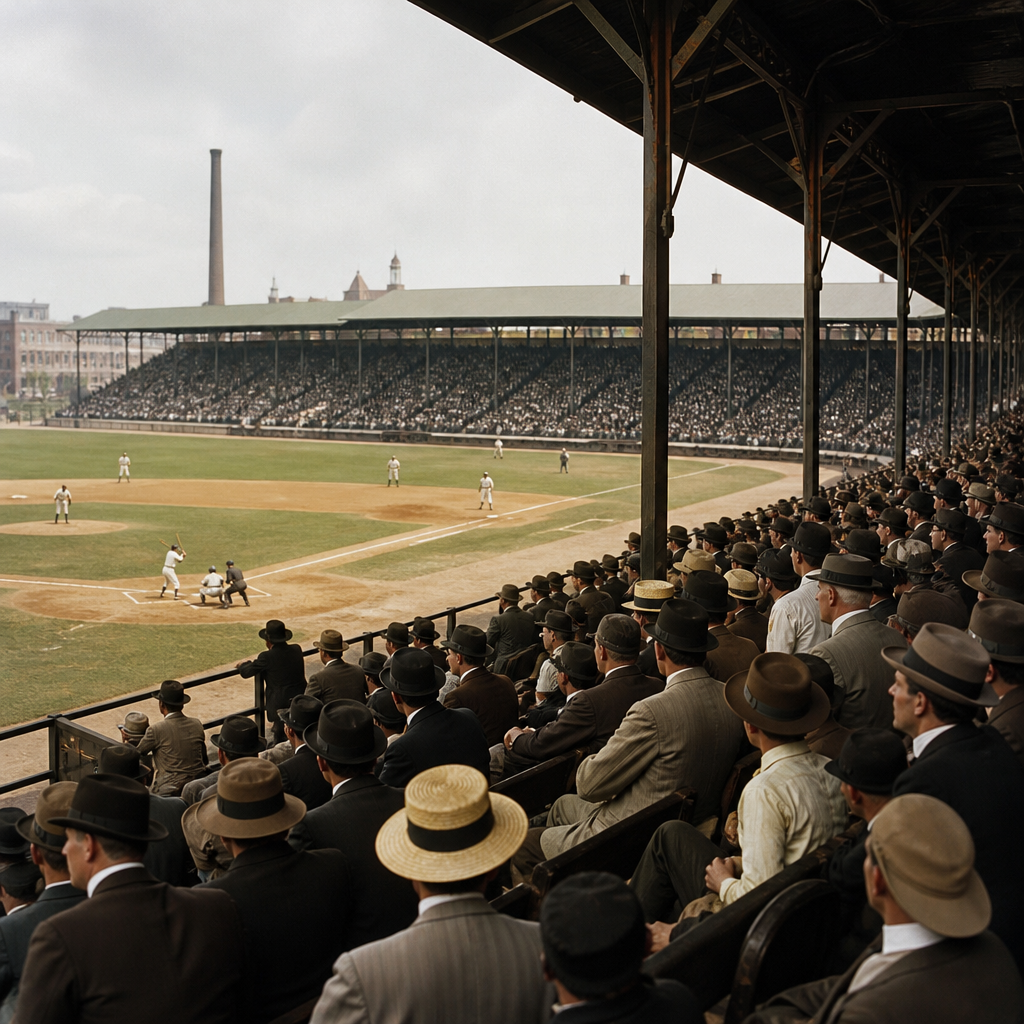
Baseball did not become a business the moment players signed contracts; it became a business when people paid to watch. The first paid admission baseball games transformed spectators into customers, forced clubs to think like enterprises, and created the revenue model that made professionalization possible. In the early history of baseball, that shift marks the true beginning of baseball’s commercial age.
Paid admission means a club charged entry at the grounds rather than relying only on dues, private patronage, or voluntary contributions. Professionalization means moving from amateur competition, where clubs were social organizations, toward a system in which players, owners, groundskeepers, and schedulers were compensated through dependable revenue. Business, in this context, includes ticket pricing, venue control, gate receipts, payroll, marketing, and league governance. Those concepts are now basic to every major sport, but in baseball they had to be invented through trial, conflict, and public demand.
I have worked through nineteenth-century box scores, club reports, and league constitutions often enough to know that the story is messier than the tidy legend suggests. There was no single switch flipped overnight. Instead, clubs gradually learned that enclosed grounds, scheduled marquee matches, and predictable admission fees could turn local enthusiasm into operating income. Once that happened, everything else followed: better players, stronger teams, more travel, larger crowds, and eventually formal leagues designed to protect investment. To understand the professionalization and business of early baseball, you have to start at the gate.
This hub article explains how paid admission emerged, why clubs embraced it, how it changed competition, and what institutions grew from it. It also serves as a guide to the larger professionalization and business subtopic, linking questions about player pay, club ownership, league structure, scheduling, media, and fan culture back to the earliest moment when baseball proved spectators would pay for access.
From Open Common to Enclosed Grounds
In the 1840s and 1850s, many baseball clubs played on public or semi-public grounds where charging admission was difficult or impossible. Early clubs such as the Knickerbockers were as much social associations as competitive teams. Members paid dues, arranged matches, and played before curious onlookers, but the economic relationship with spectators was weak. If anyone could walk up to the field, a club could not reliably monetize the crowd. That limitation mattered. Without controlled access, there was no stable way to cover travel, maintain grounds, or pay talent.
The practical answer was enclosure. Once a club rented or controlled a field with fences and entry points, it could sell access. The Union Grounds in Brooklyn, opened in 1862, became the decisive model. Built by William Cammeyer, the enclosed ballpark allowed admission charges for baseball on a regular basis and demonstrated that improved facilities increased demand. Better sightlines, designated seating, and a managed environment gave customers something tangible for their money. In business terms, enclosure turned an informal gathering into a ticketed event.
This was not merely a change in scenery. It altered incentives. Clubs now had a reason to schedule prominent opponents, advertise in newspapers, and keep matches on time. They had a reason to maintain the field and present an orderly spectacle. Most importantly, they could estimate receipts in advance and budget against expected attendance. Those are the basic habits of commercial sport, and they arrived because someone controlled the gate.
Why the First Paid Admission Games Mattered
The earliest paid admission baseball games mattered because they solved baseball’s central financial problem: enthusiasm alone does not fund high-level competition. Once clubs discovered that a strong matchup could draw paying crowds, they were no longer dependent on dues from a limited membership base. Revenue could scale with popularity. A club that attracted two thousand paying spectators operated under entirely different possibilities than a club supported by a few dozen members.
That new revenue stream changed the audience itself. Spectators became customers with expectations. Customers wanted reliable scheduling, recognizable stars, clearer rules, and grounds worth visiting. Clubs responded by improving the product. This is one reason baseball’s codification accelerated alongside its commercialization. Rule stability makes a sport easier to sell. A customer paying at the gate expects a coherent contest, not a loosely organized pastime vulnerable to confusion or cancellation.
Paid admission also changed status inside the game. Clubs that drew large gates gained influence because money could be converted into competitive advantage. They could travel farther, arrange return matches, recruit stronger players, and secure superior grounds. Financial success therefore became inseparable from sporting success. That relationship remains fundamental in baseball history, from early independent clubs to modern franchises with premium seating and media rights.
There is also a wider economic lesson here. The first paid admission baseball games helped establish spectator sport as a repeatable urban business. Growing cities in the Northeast supplied population density, transportation links, newspaper coverage, and leisure demand. Baseball fit that environment perfectly: the game was understandable, seasonal, and socially acceptable for mixed audiences. Charging admission did not create interest from nothing; it organized existing interest into a business model.
The Road from Amateur Ideals to Professional Clubs
For a time, baseball culture publicly defended amateurism even as clubs quietly moved toward commercial practice. This tension defined the 1860s. Officially, many club leaders still praised gentlemanly play for honor rather than profit. Unofficially, leading clubs offered jobs, expense money, or indirect compensation to attract talent. Once gate receipts became meaningful, the pressure to win intensified, and so did the temptation to secure the best players by any means available.
The Cincinnati Red Stockings of 1869 are the famous milestone because they openly fielded a fully salaried team. Yet their breakthrough only makes sense in the context of paid admission. Salaries require revenue. The Red Stockings’ barnstorming schedule and national draw were sustainable because crowds would pay to see elite baseball. In other words, professionalism in labor rested on professionalism in ticketing. Customers funded payroll.
The transition was uneven. Some clubs embraced direct professionalism early; others resisted, fearing corruption, gambling, or the loss of club identity. Those fears were not imaginary. Money changes incentives, and nineteenth-century baseball regularly struggled with disputed eligibility, contract jumping, and financial instability. Still, paid admission made retreat impossible. Once clubs understood the earning power of a major match, the amateur ideal no longer matched economic reality.
| Development | What Changed | Business Effect |
|---|---|---|
| Enclosed grounds | Controlled entrances and seating | Reliable ticket revenue |
| Marquee scheduling | Top clubs arranged headline matches | Higher attendance and publicity |
| Player compensation | Stars received salaries or indirect pay | Talent became an investment |
| League formation | Clubs adopted common rules and obligations | Protected schedules and revenues |
| Regularized pricing | Admission fees became standard practice | Fans became a predictable market |
How Ticket Revenue Reshaped the Game
Once gate receipts mattered, nearly every operational choice in baseball changed. Scheduling became strategic. Clubs sought holidays, Saturdays, and favorable opponents because demand was not constant across dates. Rivalries became assets. Return matches, championship claims, and regional tours were promoted because they filled seats. Newspapers increasingly served as marketing channels, publishing challenge notices, expected lineups, and postgame accounts that sustained public interest between games.
Ballpark design also evolved under commercial pressure. Enclosure remained the foundation, but clubs learned that comfort and visibility affected attendance. Grandstands, reserved sections, and carriage access all reflected market thinking. A baseball ground was no longer just a patch of play; it was a venue. The same principle later drove the development of urban ballparks near transit lines, but its roots lie in the first admission-charging grounds that treated spectator experience as part of the product.
Ticket revenue reshaped labor relations too. If winning increased attendance, then good players were worth paying, retaining, and sometimes poaching. Clubs began to think in terms of roster value rather than simply membership. This logic later produced contracts, reserve mechanisms, and league discipline, much of it restrictive by modern standards. The core idea, however, emerged early: player skill could be monetized because it attracted paying customers.
Even rules and pace of play were influenced by commercial considerations. Promoters wanted a game that began roughly on time, finished before darkness, and rewarded spectators with recognizable drama. Disputes over local rules gradually yielded to standardized codes because consistency reduced friction. A stable product is easier to sell, easier to report, and easier to repeat.
Entrepreneurs, Owners, and the Rise of Organized Baseball
The first paid admission baseball games also elevated a new type of figure in the sport: the entrepreneur. Men such as William Cammeyer recognized that baseball crowds could support dedicated facilities and recurring events. Club executives who might once have focused mainly on social standing now had to negotiate rents, receipts, travel costs, and contracts. Ownership became less honorary and more managerial.
This development fed directly into organized baseball. The National Association of Professional Base Ball Players, formed in 1871, was baseball’s first fully professional league structure, though it remained loose and often unstable. Its weaknesses are instructive. Clubs entered and exited, schedules were inconsistent, and governance was uneven because the sport had not yet fully solved how to balance competition with business discipline. Nevertheless, the association represented an effort to organize the commercial game around regular opponents and shared expectations.
The National League, founded in 1876 under William Hulbert, pushed that logic further. Hulbert believed baseball needed centralized authority, dependable schedules, stronger financial standards, and clubs located in substantial markets. That was not abstract reform. It was a response to the economics of paid attendance. If customers were buying a product, clubs needed reliability. If owners were investing in grounds and payroll, they wanted protection against chaos. League structure became a business tool designed to defend the gate.
Seen this way, professionalization and business are not side topics in early baseball history. They are the mechanism by which baseball scaled from local pastime to national institution. The paid crowd made the club, and the club made the league.
Press Coverage, Public Demand, and the Invention of the Sports Market
Newspapers were essential to the success of paid admission baseball. A match could not generate gate revenue if potential spectators did not know when, where, and why it mattered. Urban papers supplied previews, standings, controversies, and colorful game reports that turned baseball into an ongoing public conversation. Editors discovered that baseball copy sold papers; clubs discovered that newspapers sold tickets. The relationship was mutually reinforcing and foundational to sports business.
This media environment also helped create the sports consumer. Fans learned player names, followed championship races, and compared clubs across cities. Knowledge increased attachment, and attachment increased willingness to pay. Baseball was becoming not just an activity to witness accidentally, but a product to seek out intentionally. That distinction is crucial. Paid admission succeeds when demand is planned, not merely incidental.
Public demand, however, was not unlimited. Weather, transportation, economic downturns, and local competition could cut attendance sharply. I always caution against reading early gate success as smooth upward progress. Clubs failed regularly. Some overestimated their market, paid players more than receipts justified, or lacked the capital to survive weak dates. Business maturity in baseball emerged through these hard lessons. Sustainable clubs learned cost control, selective scheduling, and the value of league stability.
Still, the broader pattern is clear. By the 1870s, baseball had proven that spectator demand could be converted into recurring commercial value. That proof changed American sport permanently.
Why This Moment Anchors the Entire Professionalization Story
If you are studying the early history of baseball, the first paid admission baseball games are the hub for every major question about professionalization and business. Player salaries trace back to gate receipts. Franchise stability traces back to enclosed grounds and controlled revenue. League governance traces back to the need to protect schedules and investment. Ballpark design, media strategy, rivalry promotion, and even competitive integrity all connect to the moment baseball became something customers purchased.
This subtopic is best understood as a chain. First came controlled access to spectators. Then came dependable income. Then came paid players, stronger clubs, broader travel, formal leagues, and stricter administration. Each link depended on the one before it. Remove paid admission from the story and professional baseball develops far more slowly, if at all. The commercial habit of charging for entry was not a side effect of professionalism; it was its engine.
The key takeaway is simple: baseball became truly modern when the crowd passed through a gate and paid for the privilege. That act converted civic curiosity into revenue, revenue into organization, and organization into the professional game. Use this article as your starting point for the wider professionalization and business history of early baseball, then follow the connected topics of player pay, club finance, league formation, and ballpark economics to see how the entire system grew from that first transaction.
Frequently Asked Questions
What made the first paid admission baseball games such a turning point in baseball history?
The first paid admission baseball games mattered because they changed baseball from a social pastime into a commercial entertainment product. Before clubs regularly charged at the gate, many teams depended on membership dues, private support, or loosely organized event income. That model could sustain amateur play, but it could not easily support growth, regular competition, improved grounds, or the rising costs that came with drawing larger crowds. Once clubs began charging spectators to enter the grounds, the financial logic of the sport changed. A game was no longer just something participants arranged for themselves and their peers; it became something organized for paying customers.
That shift had major consequences. If fans were paying, clubs had to deliver a worthwhile experience. Grounds needed to be enclosed, admissions had to be collected, match scheduling became more important, and clubs gained a reason to promote contests that would attract attention. Gate receipts also created a direct link between public interest and club income. The better the matchup, the larger the crowd; the larger the crowd, the stronger the finances. In practical terms, this was the beginning of baseball’s commercial age because it established a repeatable revenue model. Players signing contracts would later symbolize professionalism, but paid admission is what made professionalism economically possible in the first place.
Why did charging admission matter more than simply collecting club dues or donations?
Charging admission mattered more because it created scalable income tied directly to public demand. Club dues and donations could help support uniforms, equipment, and basic club activities, but they were limited by the number and generosity of insiders. Paid admission opened baseball to a much larger financial base: the general public. That meant a successful club no longer depended solely on its own members to survive. Instead, it could earn revenue every time it staged an appealing event.
This distinction is crucial in understanding how baseball became a business. Dues are internal support; ticket sales are market income. Once spectators paid at the gate, clubs had to think about attendance, pricing, convenience, competitive quality, and the overall attractiveness of the event. Those are business concerns, not merely sporting ones. Paid admission also made budgeting more predictable. A club that could draw crowds could begin planning improvements, arranging stronger opponents, maintaining grounds, and eventually compensating talent. In other words, gate receipts transformed baseball from a member-supported activity into a spectator-driven enterprise. That transition is one of the clearest signs that the sport was entering a commercial phase.
How did paid admission change the relationship between spectators and baseball clubs?
Paid admission changed spectators from passive onlookers into customers with expectations. When people watched a game informally or as invited guests, clubs did not necessarily have to think much about customer experience. But once those same people paid for entry, the relationship became transactional. Fans were no longer just members of a community gathering around a sport; they were purchasers of an entertainment experience. That subtle shift had enormous implications.
Clubs now had to consider what paying attendees valued. They needed grounds that were easier to control and access, contests worth seeing, and a setting that justified the cost of admission. This encouraged more structured event management, from admission procedures to match promotion. It also helped turn baseball into a public attraction rather than a private club exercise. The audience’s importance grew because its willingness to pay directly affected club finances.
Just as important, paid spectators helped shape the sport’s future. Their attendance rewarded exciting teams, competitive games, and well-run events. In effect, the market began influencing baseball’s development. Clubs that satisfied public demand had stronger financial prospects, while clubs that failed to attract interest had fewer resources. That customer dynamic is one of the clearest reasons the first paid admission games deserve attention: they redefined not only how baseball was funded, but also whom it was being staged for.
Did the first paid admission games immediately create professional baseball?
No, not immediately, but they created the economic foundation that made professional baseball possible. Professionalism in baseball did not appear all at once. It developed gradually, through a series of changes in how clubs operated, competed, and financed themselves. Paid admission was one of the most important of those changes because it introduced a sustainable way to earn money from the public. Without reliable gate revenue, paying players consistently would have been difficult for most clubs.
In that sense, the first paid admission games should be understood as the beginning of the business structure behind professionalism rather than professionalism itself in its final form. Clubs still had to evolve in other ways. They needed stronger organization, regular schedules, more ambitious competition, and a willingness to use revenue for competitive advantage. But once gate receipts became part of the sport, the financial logic for paying talent became much stronger. If a star player could help attract larger crowds, then compensating that player could be justified as an investment rather than a violation of amateur ideals.
So while contracts and openly paid players often receive the most attention in discussions of professional baseball, the earlier shift to paid attendance is arguably even more foundational. It created the business environment in which professionalism could emerge and endure. Without customers at the gate, there would have been far less money to support the transition from amateur club culture to organized professional sport.
Why are the first paid admission baseball games so important to the broader history of sports business?
They are important because they illustrate one of the central transformations in modern sports history: the moment a game becomes a marketable spectacle. Baseball’s first paid admission contests show how a sport moves from participant-centered recreation to audience-centered enterprise. That pattern would later define not only baseball, but much of the sports industry. Once spectators were willing to pay for access, a revenue stream existed that could support better facilities, more regular scheduling, stronger competition, and eventually professional labor.
These early games also reveal that commercialization in sports does not begin only when athletes are salaried. It begins when organizers recognize that public attention has monetary value. Charging admission is the clearest expression of that realization. It means the sport is being packaged, presented, and managed as something people will purchase. That requires business decisions about pricing, access, promotion, and competitive quality. In baseball, that shift was especially significant because it helped establish the basic financial model that would power the sport’s expansion for generations.
Seen from that broader perspective, the first paid admission baseball games were not a minor administrative detail. They marked the emergence of a commercial system in which fan demand could be converted into operating income. That development helped lay the groundwork for professional clubs, league organization, and the long-term growth of baseball as both a cultural institution and a business. In short, they matter because they show the exact point at which spectators ceased to be just an audience and became the economic engine of the sport.