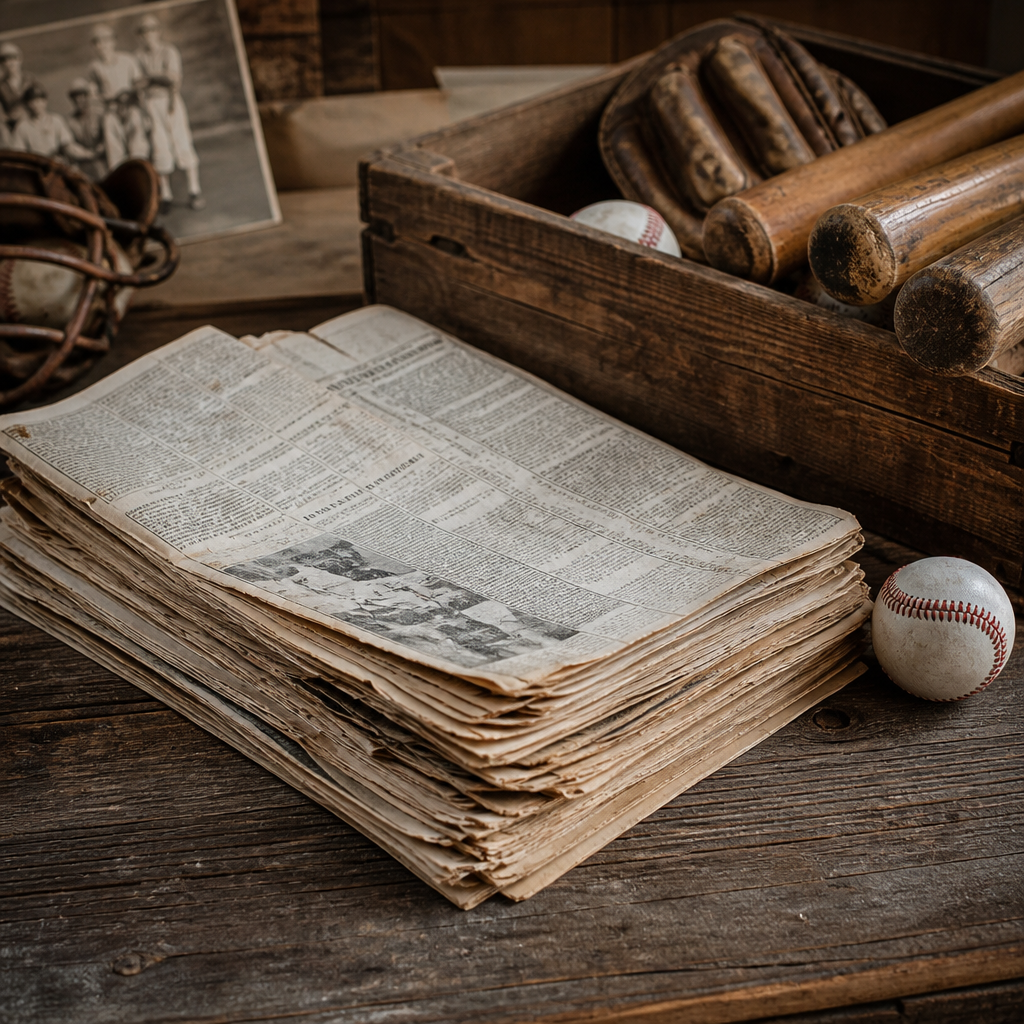
Baseball became a true national business only when news about games, players, owners, and money could move faster than the trains that carried clubs from city to city. The first baseball newspapers did more than print box scores. They standardized language, taught readers how to follow standings, publicized schedules, argued over rules, promoted star players, and turned scattered local loyalties into a shared national baseball audience. In the early history of baseball, this publishing boom sits at the center of professionalization and business because media coverage created demand, shaped league authority, and gave entrepreneurs a reliable way to sell tickets, subscriptions, advertising, and eventually the sport itself.
When historians discuss baseball newspapers, they usually mean three overlapping forms of print culture: general metropolitan dailies with dedicated baseball pages, weekly sporting papers such as the New York Clipper, and specialized baseball publications that treated the game as a commercial industry. The most influential title was Sporting Life, founded in Philadelphia in 1883, followed by The Sporting News, launched in St. Louis in 1886. Together with earlier sporting weeklies, these papers connected fans in Boston, Chicago, St. Louis, Cincinnati, Philadelphia, New York, and smaller league cities to one continuing conversation. They also gave club executives and league officers a way to speak to the public without waiting for local rumor to settle into fact.
This mattered because professional baseball was not inevitable. In the 1850s and 1860s, clubs were often civic associations, and information moved through letters, scorebooks, and occasional newspaper reports. Even after the National Association of Professional Base Ball Players began play in 1871, the sport struggled with unstable franchises, uneven scheduling, gambling concerns, and weak central control. A national audience requires consistency: regular competition, trusted records, recognizable stars, and media outlets that can explain why one game in one city matters to readers hundreds of miles away. Baseball newspapers supplied that consistency. They transformed attendance from a local habit into sustained interest in pennant races, league disputes, player contracts, and business strategy.
Understanding the first baseball newspapers also clarifies the wider business history of the sport. Media did not simply report professionalization; it accelerated it. Editors rewarded orderly leagues, criticized financial chaos, elevated statistics as evidence, and gave legitimacy to tools like the reserve system and formal scheduling by framing them as necessary for stability, even when players bore much of the cost. If you want to understand how baseball became a coordinated national enterprise, the rise of baseball newspapers is the essential hub topic.
From Local Match Reports to a National Baseball Press
Early baseball coverage emerged from the broader nineteenth century sports press, especially in New York, where urban readers already followed horse racing, boxing, and rowing. Papers such as the New York Clipper, founded in 1853, gradually expanded baseball reporting as the game spread. At first, reports were inconsistent. One city might print a narrative of a match, another only a short note, and many editors still treated baseball as a seasonal amusement rather than a structured industry. Yet by the late 1860s and 1870s, rising literacy, cheaper newsprint, railroad distribution, and telegraph service changed the economics of publishing. A baseball result no longer had to remain local for days. It could become part of a larger national record.
That shift coincided with the sport’s move from amateur ideals toward openly professional competition. Once clubs paid players, coverage naturally expanded beyond who won. Readers wanted to know who signed whom, how much clubs spent on travel, why a series had been rescheduled, whether an owner was solvent, and which league could enforce its rules. In my work reviewing nineteenth century sports pages, the striking pattern is how quickly editors learned to write baseball as business news. A club folding in Louisville or Troy was not merely a sporting disappointment; it affected gate receipts, schedules, betting markets, and competitive balance across the league.
The National League, founded in 1876, benefited enormously from this emerging press environment. League presidents and club secretaries understood that public credibility was a commercial asset. Newspapers carried official standings, notices of disciplinary action, and discussions of admission prices. They also amplified league claims of respectability. That mattered after the disorder of the National Association years, when clubs sometimes ignored road trips or dissolved midseason. A reader in Providence or Cleveland needed to believe the championship race was legitimate. Print created that belief by making the season visible as one coherent contest.
Sporting Life, The Sporting News, and the Business of Baseball Information
The two most important baseball-centered publications of the 1880s were Sporting Life and The Sporting News. Sporting Life, founded by Francis C. Richter in Philadelphia, quickly built a national readership through correspondence networks, league summaries, editorials, and statistical tables. The Sporting News, established in St. Louis by Alfred H. Spink, did similar work from the Midwest and Mississippi Valley, helping nationalize coverage beyond the Atlantic seaboard. Both papers understood a crucial commercial truth: baseball fans would pay not only for entertainment but for organized information.
These publications were hubs in every sense. They gathered dispatches from local correspondents, printed letters from players and executives, summarized league meetings, published transaction news, and turned recurring features into habits of readership. Box scores became routine, not occasional. Standings were updated in forms readers could compare week to week. Statistical leaders gave fans a way to evaluate distant players they would never see in person. Because telegraphy allowed faster reporting, editors could synchronize public attention across regions. A pennant race in the American Association or National League was no longer meaningful only in its home city. It became serial national content.
Publishers also monetized this attention through subscriptions and advertising. Sporting goods manufacturers, uniform suppliers, billiard halls, tobacco brands, railroad lines, and patent medicines all appeared in baseball papers. The audience was attractive because it was habitual. Someone who followed standings every week also saw advertisements every week. That recurring engagement is a core principle of sports media economics even now. In the nineteenth century, it helped prove that baseball attention itself was saleable.
| Publication | Founded | Primary Role | Business Impact |
|---|---|---|---|
| New York Clipper | 1853 | Early national sporting weekly with broad coverage | Created a template for regular baseball reporting and correspondence networks |
| Sporting Life | 1883 | Baseball-focused weekly with statistics, editorials, and league coverage | Expanded subscription demand and standardized baseball as a national information product |
| The Sporting News | 1886 | Midwestern sporting paper with strong professional baseball emphasis | Deepened regional integration and broadened the commercial baseball audience |
These papers were not neutral in the modern sense. Editors often backed leagues, favored certain executives, or criticized player behavior through a moral and commercial lens. Still, that partiality was itself part of professionalization. Industries develop trade papers, and baseball newspapers often functioned as quasi-trade journals for owners, managers, agents of the period, suppliers, and informed fans. They connected the front office to the grandstand.
How Newspapers Built Leagues, Schedules, and Trust
Professional baseball needed institutions that could survive beyond one season, and newspapers helped build them by rewarding standardization. The publication of official schedules taught fans to think in terms of a season-long calendar rather than isolated matches. Printed standings made comparative success legible. Reports from league meetings explained constitutional changes, franchise admissions, expulsions, and territorial disputes. In practical terms, this coverage reduced uncertainty, and lower uncertainty made the sport easier to buy into for spectators, advertisers, and investors.
Consider scheduling. Before stable league administration, clubs often arranged games opportunistically, and canceled or altered contests could damage public confidence. Newspapers gave advance notice, then held clubs accountable when they failed to appear or manipulated dates. The same dynamic applied to rules. Changes to pitching distance, umpiring practice, or roster limits had to be explained repeatedly if the public was to accept them. Baseball newspapers did that explanatory work in plain language. They translated governance into fan knowledge.
Trust also depended on records. Henry Chadwick, though associated more with daily and weekly general sports journalism than with one paper alone, was pivotal in promoting the box score and statistical reasoning. His scoring methods and advocacy gave baseball a numerical grammar. Once fans could compare earned runs, batting figures, and win-loss records across papers, they gained confidence that they were following the same sport as readers elsewhere. Standardized information is one of the foundations of a national market.
There were limits. Telegraph errors, partisan correspondents, and inconsistent definitions sometimes distorted reports. Editors also had incentives to protect relationships with powerful owners. Yet compared with the fragmented reporting of earlier decades, the late nineteenth century baseball press markedly improved transparency. It did not eliminate controversy; it made controversy legible and discussable at scale.
Stars, Scandals, and the Commercial Value of Attention
Baseball newspapers did not just describe the business of the game. They manufactured audience attention around personalities and conflict, which in turn raised the value of clubs and leagues. Coverage of stars such as Cap Anson, King Kelly, Buck Ewing, John Montgomery Ward, and later Cy Young turned players into recognizable assets. A star’s reputation could lift road attendance, increase interest in exhibition tours, and influence contract negotiations. Newspapers gave these reputations national reach.
Scandals mattered for the same reason. Gambling allegations, contract jumping, drinking, player-manager feuds, and league wars sold papers, but they also forced baseball to develop stronger governance. The conflict between the National League and the American Association in the 1880s, and later the challenge posed by the Players’ League in 1890, became national dramas through print. Readers learned not only who was winning games but who controlled labor, who honored contracts, and which business model might prevail.
This publicity had a double edge. It increased fan engagement, yet it could damage confidence if disorder appeared chronic. Editors therefore often balanced exposure with reassurance. They condemned corruption while endorsing reforms. They criticized rowdy conduct while defending the sport’s long-term respectability. That balance was commercially rational. Baseball needed excitement, but investors and middle-class ticket buyers also wanted credibility.
From a business perspective, this is where the first baseball newspapers became indispensable. They converted ephemeral games into continuing stories. A Tuesday box score mattered, but so did a Wednesday editorial about reserve clause enforcement and a Saturday note on gate receipts in Brooklyn. The audience returned because baseball had become serialized content, with each issue advancing the plot of the season and the industry.
Labor, Ownership, and the Economics Behind the Coverage
No hub on professionalization and business is complete without the labor question. Baseball newspapers were central arenas for debates over salaries, contracts, blacklisting, and the reserve system. Owners argued that reserve rules protected investment and prevented bidding wars that could bankrupt clubs. Players and their allies countered that perpetual control suppressed wages and restricted mobility. Newspapers printed both claims, but many editors favored management because stable leagues supported stable readership and advertising.
The Brotherhood of Professional Base Ball Players, organized in 1885 under John Montgomery Ward, understood the importance of public opinion. Ward wrote forcefully and intelligently, and newspapers gave his arguments circulation. When the Players’ League formed in 1890, its backers tried to persuade readers that better labor conditions could coexist with profitable baseball. The experiment failed after one season, largely because of capitalization pressures and competitive overexpansion, but the coverage revealed an industry wrestling openly with modern employer-employee relations.
Financial reporting also matured. Papers discussed gate receipts, ballpark leases, travel costs, Sunday baseball disputes, and the value of urban markets. They recognized that city size, transit access, and neighborhood demographics influenced revenue. They covered exhibition games as cash generators and highlighted winter meetings as decision-making centers. In effect, readers were learning how a sports enterprise worked. That education helped normalize the idea that baseball was not merely recreation. It was a managed entertainment business with payrolls, assets, liabilities, and media strategy.
The Lasting Legacy for the Early History of Baseball
The first baseball newspapers left a legacy far beyond their circulation numbers. They trained fans to expect regular standings, verified statistics, transaction news, league context, and commentary that connected local events to national consequences. They also created the information architecture that later radio, news services, magazines, and digital platforms would inherit. Features we now take for granted, including beat reporting, power of editorial endorsement, controversy cycles, and player market speculation, all have clear nineteenth century roots.
For the broader early history of baseball, this subtopic works as a hub because nearly every business development connects back to print. League formation needed publicity. Professional contracts needed explanation. Ballpark investment needed reliable demand. Rule changes needed public education. Labor disputes needed a forum. Even baseball’s claim to national status required evidence, and newspapers supplied it every week in standings, columns, and correspondence.
The main takeaway is simple: the rise of a national baseball audience was not produced by talent on the field alone. It was built by information systems that made the sport coherent, repeatable, and commercially valuable across distance. The first baseball newspapers helped turn clubs into brands, leagues into institutions, and fans into a paying public that followed baseball as an ongoing national enterprise. If you are exploring the early history of baseball, start here, then follow the linked subjects of league organization, labor relations, ballpark economics, and sports media growth to see how the business of baseball was assembled piece by piece.
Frequently Asked Questions
What made the first baseball newspapers so important to the growth of the game?
The first baseball newspapers were crucial because they transformed baseball from a collection of local contests into a recognizable national pastime. Before specialized coverage, most fans knew only what happened in their own city or region, and even that information often arrived late or in incomplete form. Baseball newspapers changed that by gathering reports from multiple cities, publishing scores, summarizing games, tracking pennant races, and introducing readers to clubs and players they would never see in person. In practical terms, they created a reliable information network for a sport that was spreading faster than ordinary communication could easily support.
Just as important, these papers helped define how baseball was understood. They did not simply report events; they explained them. They standardized terminology, described strategy, clarified rules, and taught readers how to interpret standings and statistics. That made it easier for someone in one city to follow a club in another and to discuss the sport using the same language as fans elsewhere. This shared vocabulary was essential in building a broad, connected audience.
They also made baseball feel continuous rather than occasional. Instead of the game existing only on the day it was played, newspapers extended its life through previews, recaps, opinion columns, league updates, and off-field reporting about owners, contracts, and disputes. Readers could follow baseball as an unfolding story. That ongoing narrative turned interest into habit, habit into fandom, and fandom into a national market.
How did baseball newspapers help create a national baseball audience instead of just serving local fans?
Baseball newspapers helped create a national audience by teaching readers to care about games and people far beyond their own ballpark. Local newspapers had long covered hometown clubs, but specialized baseball publications connected those local stories into one larger system. A fan in Chicago could read about developments in New York, Boston, Philadelphia, or St. Louis and begin to understand that all of those contests mattered within the same competitive world. That wider perspective is what made baseball feel national.
One of the most effective tools in that process was the regular publication of league standings, schedules, and comparative reports. When readers saw where clubs ranked, which series were upcoming, and how one team’s victory affected another team’s chances, they learned to follow baseball as a season-long race rather than as isolated exhibitions. Newspapers also highlighted major rivalries, pennant implications, and notable players across the country, giving readers emotional reasons to invest in teams and stars outside their immediate area.
These publications also encouraged a shared culture of debate. Fans in different cities could read the same arguments about rule changes, umpiring standards, player behavior, club finances, and league leadership. That common conversation mattered. It meant baseball was no longer just many separate local enthusiasms; it was becoming one national discussion. In that sense, baseball newspapers did not merely discover a national audience. They actively built it.
Beyond box scores, what kinds of information did early baseball newspapers provide?
Early baseball newspapers offered far more than final scores, and that broader coverage is a major reason they mattered so much. They published game summaries that explained how contests unfolded, not just who won. They included standings that showed each club’s position in the league, schedules that helped fans anticipate future matchups, and player profiles that introduced personalities behind the uniforms. For readers trying to understand a rapidly growing sport, this material added context and made baseball easier to follow over time.
They also covered the business and politics of the game. Reports on owners, league officials, contracts, gate receipts, player movement, and financial disputes revealed that baseball was becoming a serious commercial enterprise. Readers could see that the sport was not just entertainment on the field but also an organized business shaped by money, management, and competition between clubs and leagues. That kind of reporting helped the public understand baseball’s larger structure.
Editorials and opinion pieces were another important feature. Baseball newspapers often argued over rules, strategy, discipline, league governance, and the proper way the game should be played. In doing so, they acted as interpreters and advocates, not neutral record keepers. They shaped public opinion, influenced how controversies were perceived, and sometimes pressured baseball authorities to respond. This blend of reporting, explanation, promotion, and debate gave readers a much fuller experience than a simple sports column ever could.
How did these publications shape the way fans understood players, teams, and baseball itself?
The first baseball newspapers played a powerful role in teaching fans what to notice, admire, and argue about. They helped turn players into recognizable public figures by describing their performances, personalities, habits, and reputations. A talented shortstop or dominant pitcher could become known well beyond his home city because newspapers repeatedly mentioned his achievements and framed him as a figure worth following. In effect, these publications were among the earliest engines of baseball celebrity.
They also shaped perceptions of teams by giving clubs identities. Through recurring coverage, teams became more than names in a standings table. They were portrayed as disciplined or reckless, scientific or aggressive, rising or declining. Newspapers built narratives around winning streaks, managerial decisions, clubhouse tensions, and key series. Those narratives gave readers a way to emotionally connect with teams and to remember seasons as stories rather than just records.
On an even deeper level, baseball newspapers influenced how the game itself was understood. By standardizing terms and explaining rules and tactics, they created a more coherent public language for baseball. Fans learned what certain plays meant, why strategy mattered, and how officials interpreted the rules. That educational role was especially important in a period when the sport was still developing and regional differences in understanding could be significant. The papers helped make baseball legible, discussable, and shareable across distance, which is exactly what a national audience required.
Why does the rise of baseball newspapers matter in the larger history of American media and sports?
The rise of baseball newspapers matters because it marks an early and influential moment when media and sports began to fuel each other’s expansion on a national scale. Baseball needed regular publicity, explanation, and storytelling to grow beyond local attendance. Newspapers needed compelling, repeatable content that could attract loyal readers week after week. Baseball was ideal for that purpose because it produced constant events, statistics, controversies, and personalities. The relationship was mutually beneficial and helped establish patterns that would later define modern sports media.
In media history, these publications show how specialized journalism could create markets, not just serve them. By consistently packaging baseball as newsworthy, dramatic, and interconnected, newspapers trained readers to consume sports as an ongoing narrative product. They made schedules, standings, and player movement part of ordinary public conversation. This was an important step toward the media environment that later supported sports pages, national syndication, radio broadcasts, and eventually television coverage.
In sports history, their importance is just as large. They helped baseball become organized in the public mind as a national institution with common standards, common heroes, and common stakes. That process strengthened fan loyalty, expanded commercial opportunity, and supported the professionalization of the game. When historians look at how baseball became more than a local pastime, the first baseball newspapers stand out as one of the key forces that connected scattered communities of interest into a truly national baseball audience.