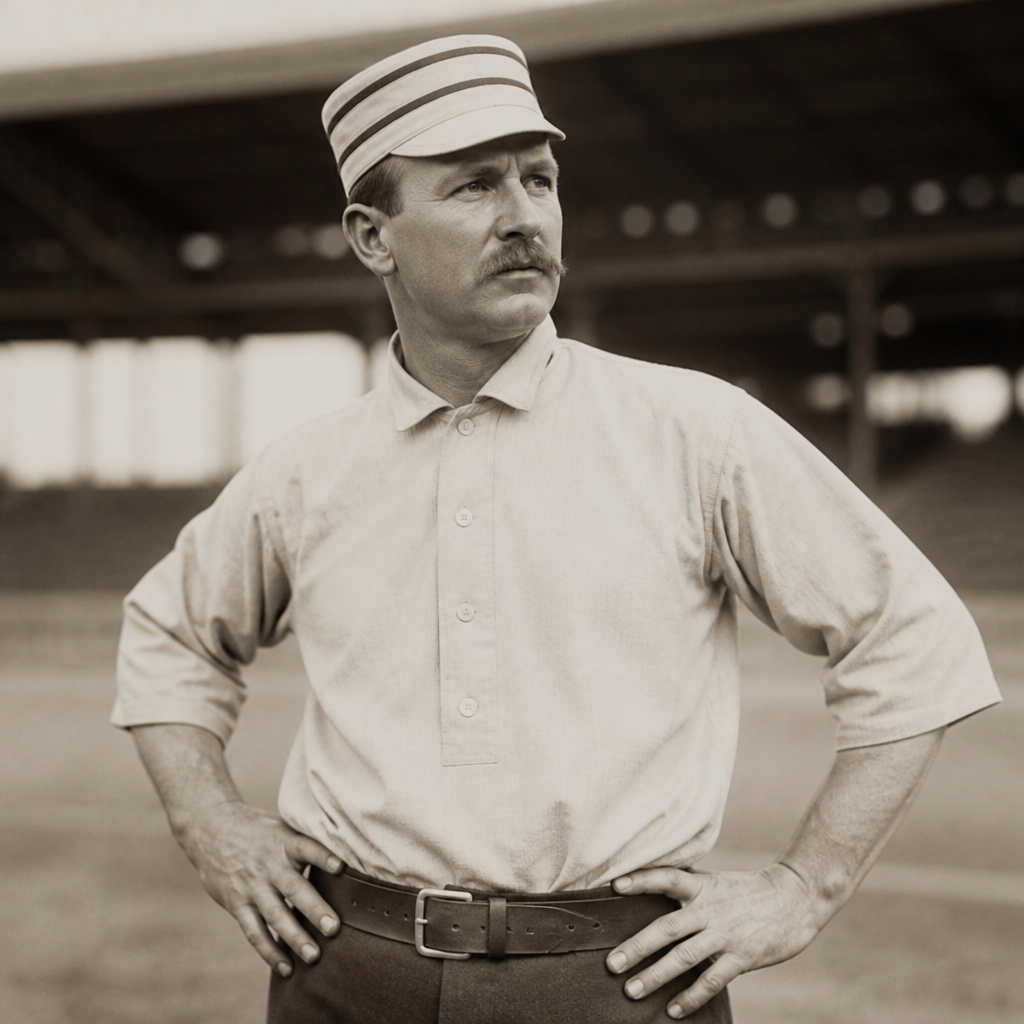
Jim Creighton stands at the center of early baseball history because he transformed pitching from a simple act of putting the ball in play into a skilled, strategic craft that shaped how the sport would evolve. In the 1850s and early 1860s, baseball was still defining its rules, style, and public identity, and players who introduced repeatable advantages could alter the game permanently. Creighton did exactly that. He became the most famous player of his era by combining athleticism, innovation, and competitive intensity in ways that opponents struggled to answer. For anyone studying early players and innovators, his career is the clearest example of how one athlete could accelerate the development of baseball before the professional leagues even existed.
To understand his importance, it helps to define the landscape he entered. Early baseball was largely organized through amateur clubs, especially in and around New York, and governed by the Knickerbocker or New York game rather than the Massachusetts game or town ball variants. Pitching under those rules was originally intended to begin action, not dominate it. The ball had to be delivered underhand, and the accepted spirit of play favored fair offering over deception. A pitcher was, in theory, a facilitator. Creighton changed that understanding by using speed, movement, and location to make batters uncomfortable while still working within the letter, or near the edges, of the rules.
His story matters beyond biography. Creighton offers a hub into the broader subject of early baseball innovators: pitchers who expanded technique, position players who specialized defensively, club organizers who standardized competition, and stars whose drawing power turned local matches into major public events. When I work through nineteenth-century box scores, club reports, and sporting papers, Creighton consistently appears as the figure who connected innovation on the field with growth off it. He was not simply talented; he became a model for how elite play could attract crowds, sharpen rivalries, and pressure rule makers to respond.
This article examines Jim Creighton as the pitching pioneer who changed early baseball while also placing him within the larger network of early players and innovators. It covers his rise, the mechanics of his pitching, the clubs and contests that made him famous, the controversy over legality and exertion, and the lasting influence of his brief career. It also points readers toward the wider subtopic of early baseball history by showing how Creighton’s legacy intersects with future stars, evolving rules, and the sport’s path from amateur pastime to organized business.
Who Jim Creighton Was and Why He Became Baseball’s First Superstar
James Creighton Jr. was born in 1841 and emerged as a baseball sensation while still a young man in Brooklyn, the most active center of competitive baseball before the Civil War. He first gained notice with the Star Club of Brooklyn and reached his greatest fame with the Excelsior Club, one of the era’s powerhouse organizations. Contemporary accounts describe him as a complete athlete, not only a pitcher. He fielded his position well, hit effectively, and was praised for agility and control. That all-around excellence mattered in a period when players were expected to contribute in every phase of the game, but it was his pitching that set him apart from every contemporary.
Creighton became baseball’s first true star because his performances were visible, repeatable, and decisive. Newspapers of the day did not treat every player as a celebrity, yet they regularly singled him out. Crowds came to see Excelsior partly because they wanted to witness whether any club could solve Creighton’s delivery. In practical terms, he gave spectators a reason to follow individual performance within a team game. That shift sounds ordinary now, but in the late 1850s it was significant. Star culture in baseball was still forming, and Creighton helped create it by making personal excellence a public attraction.
His fame also grew because he played at a moment when interclub competition was becoming more structured. The National Association of Base Ball Players formed in 1857 as the first governing body for the sport, and leading clubs increasingly scheduled prestige matches across city and state lines. Excelsior toured, traveled, and represented Brooklyn against major rivals. In those settings, Creighton was not just a local standout; he was a measuring stick for the best baseball available. When writers called him nearly unhittable, they were comparing him against top clubs, not weak opposition.
How Creighton Changed Pitching Technique
Jim Creighton changed pitching by proving that an underhand delivery could be used aggressively rather than passively. Under the rules of his day, pitchers could not throw overhand, and they were expected to deliver the ball with a relatively straight arm motion. Even within those constraints, Creighton generated unusual pace and apparent late movement. Accounts from opponents and reporters suggest that he imparted spin and varied trajectory in ways batters had not previously faced with consistency. The result was weak contact, missed swings, and a level of pitcher control over an at-bat that earlier norms did not anticipate.
When historians describe him as the first dominant pitcher, they do not mean he invented pitching from nothing. Earlier players delivered the ball skillfully, and some likely experimented with speed variation. Creighton’s breakthrough was systematizing those tactics and using them as the foundation of a winning strategy. He treated each batter as a problem to solve. He changed pace, targeted different parts of the hitting area, and forced opponents to react instead of simply swing freely. In modern terms, he turned pitching into an offensive weapon for the defense.
There was also a biomechanical element to his reputation. Many observers believed he snapped his wrist or forearm in a way that added life to the ball, and some critics argued that he bent existing rules too far. That debate is important because it shows how innovation usually enters sport: first through competitive advantage, then through controversy, and finally through adaptation by others or regulation by authorities. I have found that when early baseball writers discussed whether Creighton’s motion was fair, they were really acknowledging that the role of pitcher had changed. Once one player showed how much influence the position could exert, the old ideal of a neutral feeder became hard to preserve.
His success altered training habits too. Clubs realized that pitching was a specialized skill requiring repetition, stamina, and tactical thought. A casually assigned thrower was no longer enough against strong opposition. In that sense, Creighton accelerated specialization years before fully professional baseball normalized defined roles.
Key Teams, Games, and Rivalries in the Creighton Era
Creighton’s career cannot be separated from the elite Brooklyn clubs that dominated early baseball culture. The Star Club first showcased his talent, but the Excelsior Club turned him into a national figure. Excelsior was ambitious, well organized, and eager to challenge strong opponents, including leading New York and regional clubs. Their matches against organizations such as Atlantic of Brooklyn drew intense interest because they represented more than neighborhood bragging rights. They helped determine unofficial supremacy in a sport that lacked a modern league structure.
One of the clearest signs of Creighton’s impact was the way opponents framed strategy around him. Clubs entered games knowing that scoring opportunities would be limited, so defense, baserunning judgment, and error avoidance became more important. That strategic compression made top-level matches feel sharper and more consequential. In an era when field conditions were rough and gloves were not yet standard, reducing offensive output was difficult. Creighton managed it often enough that his appearances changed the expected shape of the contest.
Excelsior’s successful tours also mattered. Traveling teams spread standards of play and connected distant baseball communities. When a club led by a celebrated pitcher visited another city, the event functioned as both competition and demonstration. Local players could see advanced tactics firsthand, then carry those lessons back into their own clubs. This is one reason Creighton belongs in any hub covering early players and innovators: his influence moved through performance, imitation, and publicity, not just through statistics.
| Area | Before Creighton’s influence | After Creighton’s influence became visible |
|---|---|---|
| Pitcher’s role | Initiate play fairly | Control tempo and challenge hitters |
| Club preparation | General practice | Focused work on pitching and defense |
| Spectator interest | Team centered | Star pitcher became major attraction |
| Rule pressure | Loose expectations | Closer scrutiny of delivery legality |
| Baseball spread | Local styles persisted | Elite methods spread through tours and reports |
Innovation, Controversy, and the Physical Cost of Early Greatness
Creighton’s dominance brought admiration, but it also sparked suspicion. If a pitcher was too effective in a rule set designed to encourage batting action, many contemporaries assumed he must be exploiting a gray area. Some claimed he used an illegal jerk or twist. Others defended him by noting that umpires and club officials allowed his delivery. This disagreement reveals a recurring pattern in baseball history. Whenever technique advances faster than rule interpretation, controversy follows. Creighton’s case anticipated later debates over spitballs, mound height, doctoring the baseball, and high-effort mechanics.
The most enduring story attached to him concerns his death in 1862 at only twenty-one. Popular legend long held that he suffered a fatal internal injury while making a powerful throw or swing during a game. Modern historians are more cautious. The immediate cause may have involved a ruptured appendix or another serious abdominal condition rather than a single dramatic baseball moment. Still, the legend persisted because it fit the public image of Creighton as a player whose intensity exceeded ordinary limits. Even if the exact medical explanation remains uncertain, his early death froze him in baseball memory as a brilliant figure consumed by exertion.
That tragedy had cultural effects. It deepened his mystique and encouraged later writers to portray him as a martyr of competitive ambition. It also highlighted how little structured sports medicine existed in the nineteenth century. Players trained hard, traveled under uneven conditions, and played through pain with minimal medical understanding. Looking back from a modern perspective, it is easier to see the risks built into that environment. Creighton’s story therefore belongs not only to pitching history but also to the history of athletic labor and physical sacrifice.
Creighton’s Place Among Early Players and Innovators
As a hub topic, early players and innovators includes far more than one man, yet Creighton is the essential starting point because his career clarifies what innovation looked like before professional leagues stabilized the sport. Around him were influential figures such as Alexander Cartwright, often linked to early rule codification; Harry Wright, who later led fully professional club organization; Candy Cummings, associated with the curveball tradition; Doc Adams, important in rule development and equipment design; and stars like Lip Pike, Cap Anson, and Al Reach, who connected talent, commerce, and expansion. Each helped shape baseball, but Creighton showed earliest and most vividly how advanced play on the field could force the sport to evolve.
His example also illuminates the relationship between individual genius and institutional change. One outstanding player can expose limits in the current rules, reveal the value of specialization, and increase public appetite for higher standards. But lasting transformation requires clubs, governing bodies, and media networks to absorb that example. In Creighton’s era, sporting newspapers, scorekeeping practices, club secretaries, and the National Association of Base Ball Players all helped circulate and legitimize what audiences were seeing. That is why his influence outlived his short career.
For readers exploring this subtopic further, Creighton connects naturally to several related article paths: the origins of pitching rules; Brooklyn as baseball’s first great hotbed; amateurism and hidden compensation; the rise of touring clubs; early baseball equipment; and the emergence of national stars before the major leagues. Studying those themes together gives a fuller picture of why the 1850s and 1860s were not a primitive prelude but a formative period rich in innovation. Creighton remains the anchor because he personifies that transformation in a single, memorable career.
Jim Creighton changed early baseball by redefining what a pitcher could do, elevating the sport’s first star culture, and accelerating the move toward specialized, high-level competition. His underhand delivery introduced speed, variation, and tactical intent to a position once viewed mainly as a service role. His success with Brooklyn clubs, especially Excelsior, showed that exceptional individual performance could draw crowds, shape strategy, and spread new standards across regions. Even the controversy surrounding his motion proved his influence, because it forced players and officials to confront the widening gap between old expectations and emerging reality.
As the central figure in any discussion of early players and innovators, Creighton offers more than a dramatic biography. He provides a framework for understanding how baseball develops: creative athletes push boundaries, clubs adopt successful methods, audiences reward excellence, and rules eventually adjust. That pattern would repeat throughout baseball history, from pitching mechanics to equipment changes to professional organization. His brief life also reminds us that early baseball was physically demanding, loosely regulated, and built by young men whose contributions could be both spectacular and fragile.
If you are exploring the early history of baseball, start with Jim Creighton, then follow the connections outward to the rule makers, rival stars, pioneering clubs, and evolving tactics that surrounded him. Doing that reveals not only why he was the pitching pioneer who changed early baseball, but also how the entire sport learned to modernize around innovation.
Frequently Asked Questions
Who was Jim Creighton, and why is he considered so important in early baseball history?
Jim Creighton was one of the first true stars of organized baseball and a central figure in the sport’s formative years during the late 1850s and early 1860s. At a time when baseball was still developing its rules, style of play, and competitive culture, Creighton helped redefine what excellence on the field could look like. He played for the Brooklyn Excelsiors and quickly became known not just as a talented athlete, but as a player whose influence extended beyond box scores and game results. His fame spread because he dominated in a way that spectators, rivals, and fellow players immediately recognized as something new.
What makes Creighton especially important is that he changed expectations for pitching. Before players like him, pitching was largely seen as a way to start action by delivering a hittable ball to the batter. Creighton elevated the role into a specialized skill that could control tempo, disrupt hitters, and shape the entire contest. In that sense, he was not simply a great player of his era; he was a player who altered the direction of the sport itself. Historians often point to him as an early example of how one innovative athlete, arriving when a game is still young, can permanently influence its future.
How did Jim Creighton change the role of pitching in baseball?
Jim Creighton changed pitching by turning it from a basic mechanical duty into a strategic weapon. In early baseball, the pitcher’s primary job was to deliver the ball in a fair, underhand manner so the batter could put it into play. The emphasis was more on initiating action than on overpowering or fooling hitters. Creighton saw that this role had more potential. Through control, pace, movement, and variation, he demonstrated that a pitcher could influence outcomes directly rather than simply serving as a neutral starter of each play.
His style reportedly featured unusual speed for the era, deceptive delivery, and the ability to make the ball behave in ways that gave hitters trouble. Even within the constraints of early rules, that was revolutionary. He showed that a pitcher could create repeatable advantages through technique and intelligence. That shift mattered enormously because it encouraged the game to evolve toward a more competitive balance between pitcher and batter. In many ways, Creighton laid the groundwork for the modern idea that pitching is one of baseball’s most demanding and game-defining arts. His success made other teams take the position more seriously, pushed players to imitate or counter his methods, and helped drive baseball toward a more sophisticated and strategic future.
What made Jim Creighton such a dominant player compared with others of his time?
Creighton’s dominance came from a rare combination of physical ability, innovation, and competitive discipline. In an age when many players were still learning what high-level baseball could be, he approached the game with a seriousness that set him apart. He was not only effective; he was consistently effective in ways that seemed advanced for his era. His pitching gave opponents problems they were not accustomed to solving, and his overall athleticism helped build his reputation as one of the game’s premier performers.
Another key factor was timing. Because baseball was still relatively young, a player who discovered a reliable edge could have an outsized effect. Creighton found such an edge in pitching craft. He understood that small variations in delivery and control could produce major results. That insight allowed him to dominate games and build a mystique around his performances. Spectators and writers responded to that dominance, which helped make him one of the first baseball celebrities. His reputation was not based on hype alone; it grew because he repeatedly demonstrated that he could influence the game more directly and more dramatically than most of his contemporaries.
Why is Jim Creighton often called baseball’s first true star?
Jim Creighton is often called baseball’s first true star because his fame reached beyond local admiration and became part of the game’s wider public identity. In the period before professional leagues fully matured, baseball relied heavily on standout personalities to attract attention and shape public interest. Creighton became that kind of figure. His performances drew crowds, inspired discussion, and gave early fans a player whose name symbolized excellence, innovation, and competitive drama.
What made his stardom especially significant was that it reflected a changing relationship between the public and the sport. Baseball was becoming more organized and more visible, and Creighton’s rise showed how individual greatness could help fuel that growth. He was admired not only for winning, but for changing expectations. Fans saw in him a player who represented the future of the game. That combination of performance, influence, and public recognition is why he is remembered as baseball’s first genuine superstar. He stood at the intersection of athletic achievement and cultural impact, helping early baseball move closer to the spectator-driven national pastime it would eventually become.
What is Jim Creighton’s lasting legacy in the history of baseball?
Jim Creighton’s lasting legacy is that he helped define baseball at a moment when the sport was still flexible enough to be reshaped by individual innovation. His greatest contribution was proving that pitching could be a central, highly skilled component of winning baseball. That idea became foundational to the sport’s long-term development. Over time, rules changed, techniques improved, and generations of pitchers built on concepts that Creighton helped introduce in primitive form. While the game evolved far beyond his era, the basic principle that pitching can control and transform a contest remains one of baseball’s core truths.
His legacy also endures because he represents the power of early pioneers in sports history. Creighton was not merely participating in a developing game; he was actively influencing what that game would become. For historians and fans, he serves as a reminder that baseball’s familiar modern structure was not inevitable. It was created step by step by players who experimented, competed, and forced the sport to adapt. Jim Creighton stands out among those pioneers because his impact was both immediate and lasting. He helped make baseball more strategic, more competitive, and more compelling, and that is why his name still matters in any serious discussion of the game’s origins.