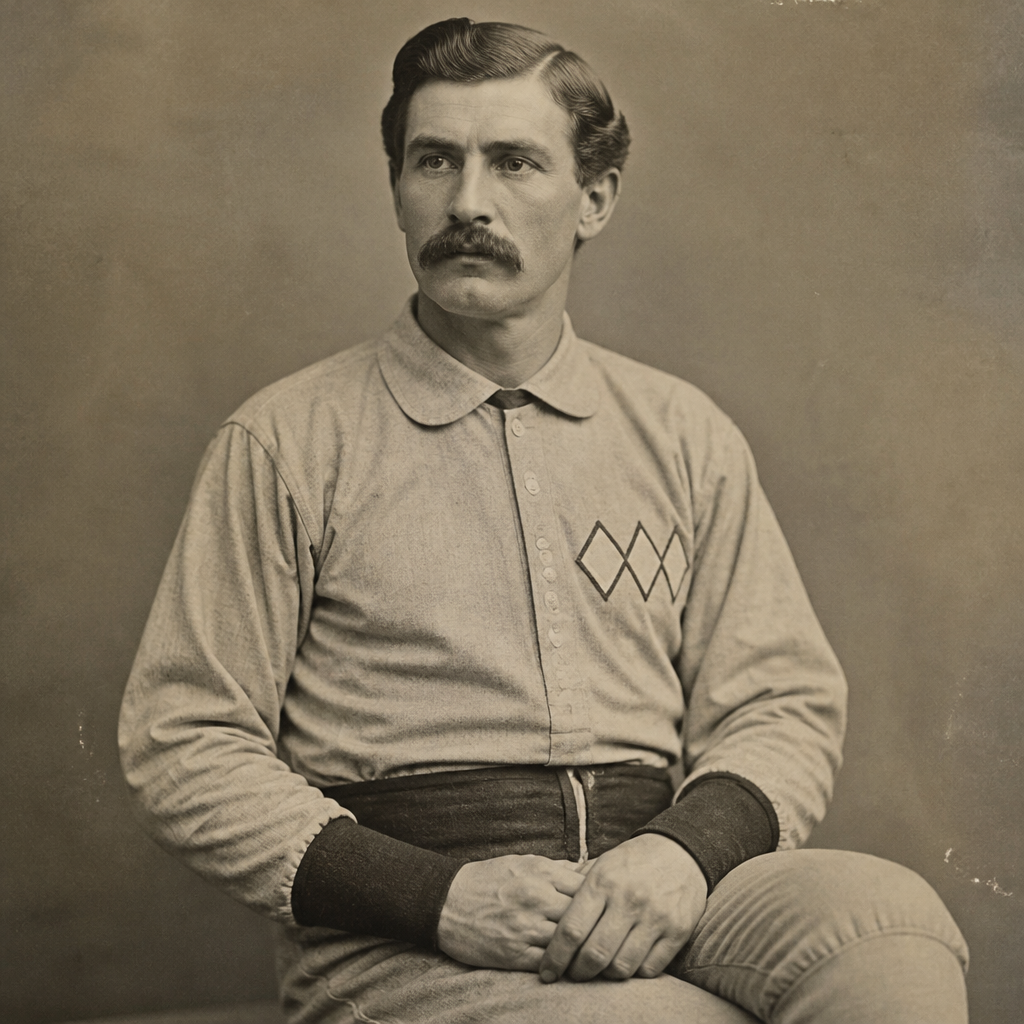
George Wright stands near the foundation of professional baseball, not simply as a famous nineteenth-century player, but as one of the figures who defined what an elite shortstop could be. As the star shortstop of the 1869 Cincinnati Red Stockings, baseball’s first openly all-professional team, Wright helped turn a regional pastime into a national spectacle. Any serious look at the early history of baseball, especially the branch focused on early players and innovators, has to begin with him because his career connects nearly every major development of the sport’s formative years.
To understand Wright’s importance, it helps to define the world he played in. Baseball in the 1860s was still standardizing its rules, its positions, and its business model. Clubs shifted between amateur ideals and paid competition, schedules were irregular, and equipment was primitive by modern standards. The shortstop position, now considered one of the game’s most demanding defensive roles, was still evolving. In that unsettled environment, Wright emerged as a complete player: quick, tactically advanced, durable, and popular enough to draw crowds across the country.
I have found that when readers ask who the first true baseball stars were, they often know Harry Wright, Cap Anson, or Albert Spalding before they know George Wright. That misses a central point. George Wright was not just one of the best players of his generation; many historians place him among the sport’s earliest all-around superstars. He excelled at defense when fielding standards were low, hit with authority during high-scoring years, and represented the new reality that baseball talent could be organized, marketed, and compensated at a national level.
This hub article covers George Wright’s career while also using his story to map the wider category of early players and innovators. That includes pioneering professionals, tactical thinkers, equipment makers, executives, and rule shapers who moved baseball from loosely organized club sport to major commercial institution. Wright belongs at the center of that discussion because he intersected with all of it: professionalization, positional development, touring teams, early leagues, sporting goods, and preservation of the game’s history.
George Wright’s early life and the baseball family that shaped him
George Wright was born in New York City in 1847 into a household already tied to bat-and-ball culture. His father, Samuel Wright, was a noted cricket professional and club organizer, and his older brother Harry Wright became one of baseball’s most influential captains and managers. That family background mattered. In the mid-nineteenth century, the path into organized baseball often ran through cricket clubs, gymnastic societies, and urban athletic associations. The Wright family moved comfortably through that sporting world, giving George early exposure to disciplined training, strategy, and public competition.
Before George became famous in baseball, he developed as a cricket player and multi-sport athlete. That broader athletic education is important because many early baseball innovators borrowed movement, conditioning, and club organization from cricket. Strong throwing, clean catching, and tactical positioning did not emerge in isolation. Wright’s later brilliance at shortstop reflected that inherited sporting education. He understood angles, anticipation, and team structure at a time when many players still relied mostly on raw instinct.
His early club career included time with prominent teams in the Northeast, where competition was intensifying rapidly after the Civil War. Baseball’s growth accelerated in cities linked by rail travel and newspapers, and talented players increasingly became known outside their home regions. Wright’s combination of range, arm strength, and batting ability made him one of the standout young players in that expanding network. By the late 1860s, he was exactly the kind of talent around which a professional team could be built.
The 1869 Cincinnati Red Stockings and the birth of professional baseball
The 1869 Cincinnati Red Stockings occupy a unique place in baseball history because they were the first team composed entirely of salaried professionals. Harry Wright managed the club, but George Wright was its greatest on-field attraction. The team’s undefeated season made headlines nationally, and their extended tours proved that baseball could succeed as a gate-driven professional entertainment business. Crowds came to see the Red Stockings as a team, but many came specifically to watch George Wright play shortstop with a style and consistency few had seen before.
On that club, Wright was more than a good infielder. He was a premium draw in the way later fans would pay to see Honus Wagner, Joe DiMaggio, Willie Mays, or Cal Ripken Jr. Contemporary accounts praised his fielding reach, powerful throwing arm, and offensive production. In an era when gloves were not yet standard and fields were often rough, making difficult plays cleanly had enormous impact on spectators. Wright transformed defense into performance. He made shortstop look glamorous, central, and indispensable.
The Red Stockings’ barnstorming schedule also matters for understanding his legacy. By traveling widely, the club spread tactical ideas and positional standards from city to city. Teams that faced Cincinnati saw firsthand how a well-drilled professional side defended, communicated, and approached match preparation. That is one reason George Wright’s influence extends beyond statistics. He helped establish a visible model of elite play at a moment when baseball culture was still learning what excellence looked like.
Why George Wright is called baseball’s first great shortstop
George Wright is often described as baseball’s first great shortstop because he elevated the position from a useful fielding spot to a premium defensive post. In the earliest forms of baseball, shortstop sometimes acted as a shallow outfielder or relay man because old balls did not travel as far and field conditions varied widely. As bats improved and hitters became more aggressive, the area between second and third base became increasingly important. Wright had the athleticism and instincts to dominate that territory.
What made him exceptional was not one flashy skill but a complete defensive package. He ranged far to both sides, charged slow rollers, made long throws accurately, and read batted balls earlier than most opponents. In practical terms, that meant he erased hits other fielders allowed. It also changed how teammates positioned themselves. A great shortstop stabilizes the infield, and Wright did exactly that decades before modern scouting metrics existed.
Historians should be careful with direct statistical comparisons because nineteenth-century recordkeeping was inconsistent and rules changed frequently. Still, the surviving evidence is overwhelming. Wright was praised repeatedly by journalists, opponents, and later historians as the premier shortstop of his era. He was not just good relative to his peers; he was a prototype for the position. If a reader asks who first defined elite shortstop play in professional baseball, the most defensible answer is George Wright.
Playing style, offense, and the realities of nineteenth-century baseball
Wright’s reputation can sometimes become so defense-centered that his offensive value gets overlooked. In truth, he was one of the era’s standout hitters as well. Nineteenth-century baseball was generally higher scoring than the dead-ball game that came later, but strong batting still mattered because offensive consistency separated top clubs from merely respectable ones. Wright hit for average, ran the bases well, and contributed across lineups built around constant pressure rather than home-run power.
It is also important to remember how physically demanding the sport was in his day. Players handled bare or lightly protected hands, irregular diamonds, variable umpiring, and grueling travel schedules by train. Rosters were smaller, substitution patterns were limited, and recovery methods were primitive. A star player needed toughness as much as talent. Wright’s durability and steadiness under those conditions reinforced his stature. He did not dominate in a carefully controlled modern environment; he excelled in a rough, unstable one.
When comparing early players and innovators, context matters more than raw numbers. A pioneer’s value lies partly in how much he advanced the standards around him. Wright’s batting, defense, and professionalism raised expectations for what clubs wanted from premium players. Younger athletes, managers, and sporting press observers copied what they saw. That is the signature of an innovator in sport: not novelty alone, but the creation of a model others adopt.
Early players and innovators: the broader cast around Wright
George Wright is the hub figure here, but the story of early baseball was collaborative. Harry Wright, his brother, shaped strategy, conditioning, scheduling, and professional team management. Albert Spalding emerged as a star pitcher and later one of the game’s most influential sporting goods executives. Cap Anson became the dominant player-manager of the 1870s and 1880s, helping define offensive excellence and club authority. Candy Cummings is often linked, controversially but persistently, with the development of the curveball. Henry Chadwick, though not a player, created key statistical and journalistic frameworks that still influence baseball language.
These figures belong together because they illustrate the many ways innovation entered baseball. Some changed how the game was played on the field. Others changed how it was explained, sold, governed, or equipped. Wright touched several of these lanes himself. He was an elite player, a public attraction, and later a businessman whose sporting goods work helped connect performance culture with baseball commerce.
| Figure | Primary role | Why the figure matters |
|---|---|---|
| George Wright | Shortstop, star player | Defined elite infield play and became a national attraction with the 1869 Red Stockings |
| Harry Wright | Manager, captain, organizer | Led the first all-professional team and established disciplined club management |
| Albert Spalding | Pitcher, executive | Starred on early clubs and built a major sporting goods empire tied to baseball growth |
| Henry Chadwick | Writer, statistician | Popularized box scores, reporting standards, and analytical language for the sport |
| Cap Anson | First baseman, player-manager | Helped define star power in the league era, though his segregationist role must be acknowledged |
One useful way to read Wright’s career is as a bridge among these innovators. He linked the amateur-club era to open professionalism, tactical experimentation to established positional value, and local celebrity to national baseball fame. That bridging role is why hub pages on early players should place him near the top.
From the Red Stockings to Boston: league baseball and sustained greatness
After the Cincinnati experiment ended, George Wright continued starring in top-level baseball, especially in Boston, where the Wright brothers remained central to the sport’s development. The formation of the National Association in 1871 and the National League in 1876 gave baseball more durable competitive structures, even if governance remained imperfect. Wright did not fade after the famous 1869 season. He remained one of the game’s most respected names as organized league baseball took shape.
That sustained excellence matters because it proves he was not merely the standout attraction of a single novelty team. He adapted as competition deepened and clubs became more systematically organized. Boston’s powerful teams of the 1870s benefited from his experience, leadership, and reputation for reliable play. In baseball history, longevity across transitional eras is one of the strongest markers of genuine greatness, and Wright had it.
He also contributed to the sport’s legitimacy. Early professional baseball faced constant skepticism from defenders of amateur ideals and from critics who associated paid play with gambling or disorder. Players such as Wright gave professionalism a more respectable public face. His conduct and consistency suggested that salaries could support serious athletic standards rather than undermine them.
Business, equipment, and historical memory
Wright’s influence did not end when his peak playing years passed. Like Spalding and other nineteenth-century baseball men, he moved into sporting goods and remained active in the game’s business culture. That was a common pattern among early baseball leaders because the sport’s institutions were still young enough that players often helped build the commercial infrastructure around them. Bats, balls, uniforms, scorebooks, and retail sporting culture all expanded alongside the game itself.
He also became part of baseball’s historical memory at a crucial time. The earliest generations of players were aware that the game was changing rapidly and that stories could easily be lost or distorted. Wright’s long life, stretching into the twentieth century, made him a living link to baseball’s foundational decades. When later historians, collectors, and journalists tried to reconstruct the professional game’s origins, his career offered a dependable anchor.
Recognition eventually followed. George Wright was elected to the Baseball Hall of Fame in 1937, an acknowledgment that his contributions were foundational rather than incidental. That honor remains justified. Even with uneven nineteenth-century documentation, the historical record clearly supports his place among the sport’s earliest inner-circle figures.
What George Wright’s career teaches about early baseball innovation
George Wright’s career shows that baseball innovation was never only about inventing a new pitch or writing a new rule. It also involved proving that a position could be mastered, that teams could be organized professionally, that defense could captivate spectators, and that athletic excellence could travel from city to city as a marketable product. Wright did all of those things. He helped set standards rather than merely participate in them.
For readers exploring the early history of baseball, this is the key takeaway: early players and innovators should be judged by both performance and influence. Wright ranks so highly because he excelled at both. He was a superior shortstop, a major offensive contributor, a national star of the 1869 Red Stockings, a durable presence in the emerging league structure, and a contributor to baseball’s commercial and historical development. That combination is rare in any era.
If you are building a deeper understanding of nineteenth-century baseball, use George Wright as your starting point and then branch outward to Harry Wright, Albert Spalding, Henry Chadwick, Cap Anson, and the many overlooked club pioneers around them. Following that path reveals how baseball became professional, positional, statistical, and national. George Wright did not merely witness that transformation. He helped lead it, and his legacy still explains what greatness looked like at the beginning of the game.
Frequently Asked Questions
Who was George Wright, and why is he so important to early baseball history?
George Wright was one of the most important figures in the earliest professional era of baseball and is widely regarded as baseball’s first great shortstop. Born into a family deeply connected to sport, he emerged in the 1860s as a player whose talent, athleticism, and baseball intelligence made him stand out at a time when the game itself was still taking shape. His importance comes from more than star power. Wright helped define what excellence looked like at a premium defensive position, and he did so just as baseball was transitioning from a loosely organized amateur pastime into a commercially viable professional sport.
His place in history is most closely tied to the 1869 Cincinnati Red Stockings, the first openly all-professional baseball team. That club became a sensation, touring widely, drawing enormous attention, and proving that elite players could be paid to perform before large audiences. Wright was the team’s biggest on-field star and one of its main attractions. In an age before modern media, his reputation spread through newspaper coverage, box scores, and the testimony of fans and opponents who saw him play. For many people of the period, George Wright embodied the highest level the sport could reach.
What makes him especially significant is that he represented baseball at a foundational moment. He was not just a great player in an existing system; he helped establish the standards by which future great players would be judged. His fielding range, arm strength, consistency, and all-around skill gave the shortstop position a level of prestige it had not previously enjoyed. In that sense, George Wright is not simply part of baseball history. He helped create the form that baseball history would take.
Why is George Wright called baseball’s first great shortstop?
George Wright is called baseball’s first great shortstop because he elevated the position into one of strategic and athletic importance long before modern defensive metrics, highlight reels, or formal coaching systems existed. In the 1860s and early 1870s, shortstop was still evolving, and many of the positional expectations familiar to modern fans had not fully developed. Wright brought unusual quickness, coordination, anticipation, and throwing ability to the infield, showing that a shortstop could be far more than a player standing between second and third base.
Contemporary accounts praised his exceptional range and his ability to make difficult plays look natural. On rough fields with primitive equipment, fielding was much harder than it would become later. Gloves were minimal or nonexistent, balls did not always behave predictably, and official scorekeeping standards were still developing. Under those conditions, Wright distinguished himself as a player who could handle the physical and mental demands of the game better than almost anyone else. He covered ground, completed plays with authority, and gave structure to the defense behind pitchers who relied heavily on their fielders.
He also stood out because he was not a specialist in the narrow sense. Early baseball stars were often expected to contribute in every phase of the game, and Wright excelled as a complete player. His reputation was built on defense, but he also hit, ran, and carried himself like a leader. That full package is a big reason historians still single him out. Calling him baseball’s first great shortstop is not just a ceremonial title. It reflects the fact that he established the blueprint for what an elite player at the position could be.
What made the 1869 Cincinnati Red Stockings so historic, and what role did George Wright play on that team?
The 1869 Cincinnati Red Stockings were historic because they were the first openly all-professional baseball team, marking a turning point in the development of the sport. Before that, baseball had largely been associated with amateur clubs, local pride, and a sporting culture that often treated payment to players as controversial or improper. The Red Stockings broke decisively from that model by openly paying every player on the roster. That move helped legitimize professionalism and demonstrated that baseball could support organized touring, gate receipts, and sustained public interest on a national scale.
The team became famous for its extraordinary success, including an undefeated season that turned it into a national sensation. Wherever the Red Stockings traveled, they attracted crowds eager to see the best club in the country. Their fame did not come only from winning, but from the novelty and excitement of seeing a polished professional team perform at a level that many spectators had never witnessed. In that environment, George Wright was central to the team’s identity. He was one of its biggest stars, one of its most admired athletes, and a major reason the club’s quality seemed so far beyond that of many rivals.
Wright’s role on the Red Stockings was both practical and symbolic. Practically, he was an elite performer whose defense and all-around play strengthened the club every time it took the field. Symbolically, he represented what the new professional game could offer: skill, consistency, athletic excellence, and entertainment value. Fans did not just come to see a team; they came to see players like George Wright, whose presence made the sport feel larger, sharper, and more modern. His stardom helped the Red Stockings become more than a successful club. It helped make them the team that announced professional baseball to the nation.
How did George Wright influence the growth and popularity of professional baseball?
George Wright influenced the growth and popularity of professional baseball by giving the young sport a recognizable superstar at exactly the right moment. Early professional baseball needed more than organization and scheduling; it needed personalities who could draw crowds, inspire press coverage, and convince the public that watching elite ballplayers was worth the price of admission. Wright was one of those players. His excellence gave credibility to the professional game, and his reputation helped transform baseball from a regional pastime into a broader national attraction.
As the Red Stockings toured, they did not simply win games; they advertised a new idea of baseball. Spectators saw coordinated team play, disciplined professionalism, and individual brilliance from athletes like Wright. Newspaper accounts spread those impressions far beyond the cities where the games were played. In an era without radio or television, a player’s fame depended heavily on word of mouth and print reporting, and Wright thrived under that system because his play was so consistently admired. He became one of the early figures through whom fans learned to think of baseball stars as public attractions in their own right.
His influence also extended into the long-term culture of the sport. By helping establish standards for fielding excellence, positional value, and professional conduct, Wright contributed to baseball’s identity as a game that rewarded skill, discipline, and tactical intelligence. He helped shape not only what fans enjoyed, but what clubs sought in their players. That matters historically because the rise of professional baseball was not inevitable. It had to be built through institutions, teams, tours, business models, and standout players. George Wright was one of the standout players who made that larger transformation possible.
What is George Wright’s legacy today, and why do historians still study him?
George Wright’s legacy today rests on his status as one of baseball’s foundational stars and as a player who helped define the professional game in its earliest form. Historians continue to study him because he sits at the intersection of several major developments: the emergence of paid players, the national rise of touring clubs, the increasing sophistication of defensive play, and the creation of baseball celebrity. Few figures from the nineteenth century connect so many of those themes as clearly as Wright does.
He is remembered not only for individual brilliance, but for the timing of his brilliance. Baseball in the late 1860s was still deciding what kind of sport it would become. Would it remain a mostly local, amateur recreation, or would it grow into a structured professional enterprise with stars, paying audiences, and competitive prestige? Wright was one of the players who answered that question on the field. His performances made the professional version of baseball look compelling, legitimate, and exciting. That alone would secure his place in history.
Modern historians also value George Wright because he offers a window into how baseball developed before the fully modern major league system took shape. Studying him helps explain how positions evolved, how teams marketed themselves, how early fans experienced the sport, and how the game’s first generation of elite players set enduring standards. In other words, George Wright matters today because he was there at the beginning, and because he was not merely present. He was one of the people driving the story forward. For anyone interested in early players and innovators, he remains an essential figure.