
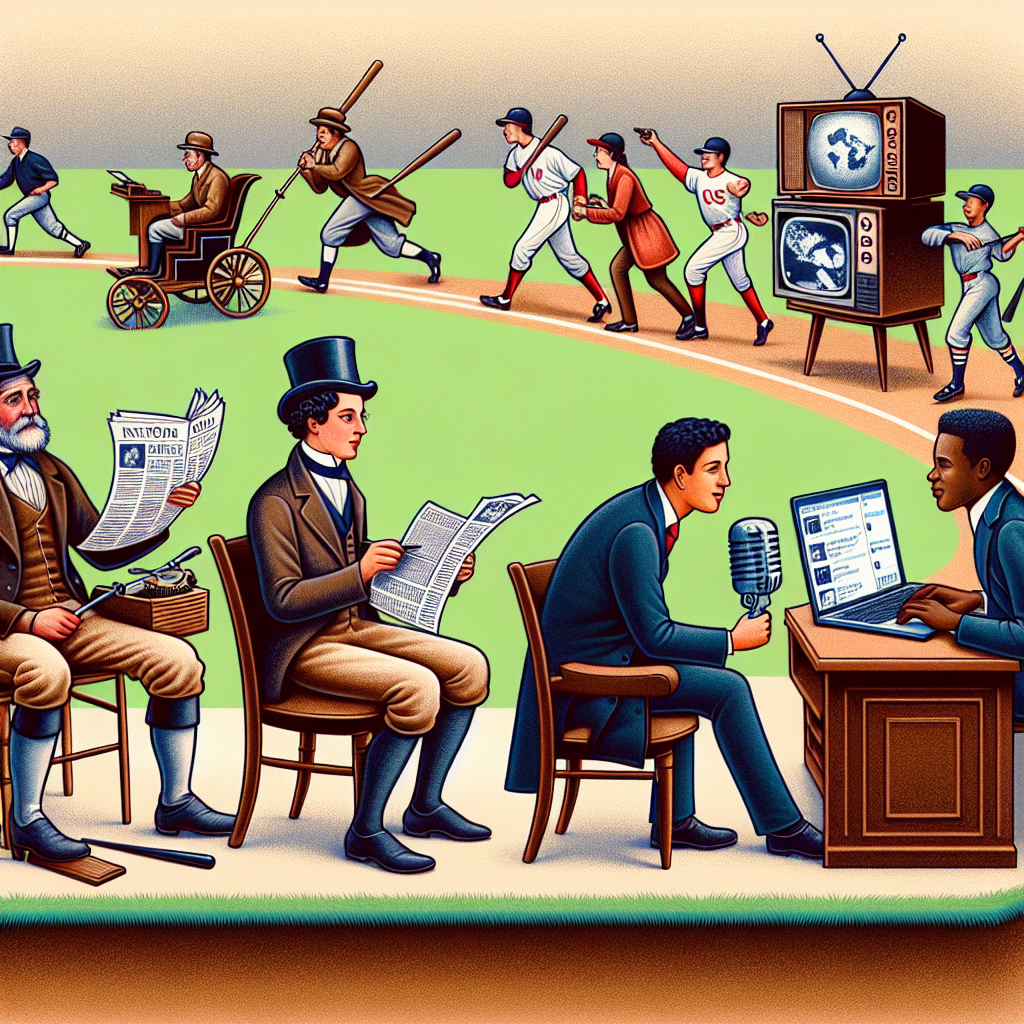
Baseball journalism, much like the sport it reports on, has endured an evolutionary journey that mirrors the changes and milestones of society itself. Beginning in the late 19th century, when baseball was establishing its place as America’s national pastime, the role of journalists in publicizing and shaping the narrative around the sport became crucial for its growth and acceptance among the masses. Early baseball journalism marked the sport’s emergence with rich anecdotes and detailed box scores in newspapers. Reporters rode trains alongside teams, capturing vivid accounts of games and players, thus bringing baseball directly into the living rooms of America.
Over the decades, the way baseball has been covered by the media has shifted in line with advances in technology and changes in consumer habits. From the purely text-driven print articles of the 19th century to the dynamic and immediate platforms like blogs, podcasts, and social media channels of today, the field has grown far beyond its roots. The ever-present curiosity and passion of fans have driven this evolution, constantly demanding more diverse and immediate access to their beloved sport.
This journey of adaptation showcases not only the resourcefulness of the journalism industry but also the transformative nature of baseball as a cultural and societal phenomenon. This article explores how the image and heart of baseball are consistently crafted, challenged, and revitalized by the journalists who have chronicled its story.
The Birth of Baseball Reporting
At the dawn of baseball’s popularity in the 1800s, newspapers provided the primary medium through which fans could keep up with their favorite teams and players. The sports pages of newspapers like The New York Times and The Chicago Tribune became the main sources of information. Coverage wasn’t only limited to game recaps and box scores; it often included vivid narratives and character-driven pieces that humanized players and elevated games to mythic status.
Baseball writers of this era laid the foundation for sports journalism by combining meticulous documentation with descriptive storytelling. Writers like Henry Chadwick, often referred to as the father of baseball, pioneered statistical measures that are still prevalent today, redefining how fans understood player performance. Chadwick’s box scores and player statistics began to shape strategies and decisions made in the game itself, thus altering perspectives on player performance and team tactics.
These pioneers recognized that their role wasn’t just to inform but to engage and excite. They crafted stories that would foster a personal connection between the teams and their fans, transforming local matches into national conversations and placing baseball at the heart of American culture.
The Golden Age and Radio Revolution
With the advent of the 20th century, baseball journalism experienced a golden age that coincided with the rise of radio. During the 1920s and 1930s, the proliferation of radio brought baseball to broader audiences. Figures such as Red Barber, Mel Allen, and Vin Scully became household names, bringing a new dimension to baseball coverage with their thrilling play-by-play commentary.
The immediacy of radio allowed fans to experience games almost as though they were in the stands, providing a vivid real-time connection to the action. This era saw journalism begin to blur the lines between reporting and entertainment. Commentary became an art form of its own, where inflection, timing, and storytelling enhanced the raw descriptions of gameplay, allowing listeners to visualize the unfolding drama vividly.
Radio also expanded baseball’s reach, connecting urban and rural fans alike, sparking the kind of passionate discourse that still fuels debates in bars and living rooms today. The ability of radio to bring fans “into the moment” was significant, keeping the sport vibrant even through trying times like the Great Depression and World War II when live attendance wasn’t feasible for many.
Television Takes Center Stage
The next seismic shift in baseball journalism came with the introduction of television in the mid-20th century. Iconic television broadcasts made legends out of announcers and turned ballplayers into superstars. Viewers could now see the action as it happened—every pitch, swing, and catch more vivid than ever before.
This new visual medium substantially increased Major League Baseball’s audience and revenue potential, transforming how fans consumed sports content. The television era required a different style of commentary and journalism, focusing more on visuals and instant replay analyses. Television announcers such as Joe Garagiola and Howard Cosell became synonymous with baseball, guiding viewers through games with engaging enthusiasm.
Television provided the platform for influencing cultural moments through baseball, such as Jackie Robinson’s historic breaking of the color barrier in Major League Baseball. Fans across America could finally see the integration of baseball on their screens, enhancing the societal and cultural impact of such pivotal events.
Baseball Goes Digital
As the 21st century dawned, the rise of the internet marked a new frontier for baseball journalism. Websites dedicated to stats and fan forums began to blossom, providing a mind-boggling array of information and opinions at fans’ fingertips. ESPN and MLB.com became digital giants, offering comprehensive coverage of the sport like never before, from news articles and video highlights to fantasy leagues and interactive stats.
Blogging and independent reporting also gained traction. Writers like Keith Law and Jonah Keri began to provide in-depth analytical takes, introducing concepts such as sabermetrics to the mainstream. This shift allowed fans not only to consume content but also to participate in the discourse, turning the fan into a co-creator of baseball journalism itself.
Fans could access live play-by-plays, insightful analysis, and opinion pieces from various perspectives, empowering them to develop a nuanced understanding of the game. Social media further enhanced this transformation by exponentially increasing the speed at which information and discussions were shared amongst fans.
The Rise of Social Media and New Platforms
In recent years, social media has revolutionized baseball journalism just as it has many other industries. Platforms like Twitter, Instagram, and YouTube have expanded the dialogue around baseball, providing real-time updates and a direct connection between players, journalists, and fans alike.
Social media has democratized baseball coverage, allowing anyone with a digital device to contribute to the conversation, be it through tweeting live game updates or sharing opinion pieces on player trades. This inclusivity has both diversified and intensified the discourse around baseball, amplifying fan voices while providing journalists with immediate feedback on their content.
Journalists like Jeff Passan and Ken Rosenthal have embraced these new tools, broadly expanding both their reach and their depth of engagement with fans. Furthermore, platforms like podcasts have allowed for deeper dives into baseball analysis, covering everything from historical retrospectives to minute tactical breakdowns.
Conclusion
The journey of baseball journalism reflects not only technological and societal changes but also the enduring human desire to connect with others through stories and shared experiences. From newspapers to podcasts, each phase of journalistic evolution in baseball has met the audience where they are, adapting to the tools and demands of the time to keep the spirit of the game alive and thriving.
As the sport continues to evolve, baseball journalism is sure to continue finding new methods to engage and captivate its audience. Whether through cutting-edge analytics, interactive virtual experiences, or yet-to-be-imagined platforms, the narrative of baseball remains as dynamic as ever. The histories and futures of journalism and baseball are bound together, eternally finding new ways to engage hearts and minds.
In understanding the evolution of baseball journalism, one sees a microcosm of cultural adaptation—an ongoing dialogue between the sport and its society, each influencing and reflecting the other. This constant evolution ensures that baseball retains its place in the heart of American culture, demonstrating that while the medium may change, the passion for the game endures continually.
Frequently Asked Questions
1. How did baseball journalism begin, and what role did it play in the sport’s early days?
Baseball journalism began in the late 19th century, precisely when baseball was solidifying its identity as America’s national pastime. This period was pivotal because it was a time of rapid urbanization and technological growth in America, which opened new avenues for mass communication. Early baseball journalism was not just reporting scores or recapping games; it intricately wove the narrative of baseball into the cultural fabric of the nation. Journalists became storytellers who crafted rich anecdotes, painted vivid pictures of games, and created larger-than-life personas of players and teams. Their words not only entertained but educated fans about the nuances of the game itself. The role of these early journalists was critical as they helped to romanticize baseball, framing it within the identity of American society. As a result, journalism helped foster a greater appreciation and understanding of the sport, ensuring its growth and acceptance among the public.
2. How has baseball journalism changed with the advent of new media?
The evolution of media technology has dramatically transformed baseball journalism. In its early days, coverage was essentially confined to print newspapers, where journalists made sure to include vivid play-by-play accounts and strong narrative stories. With the advent of radio in the 1920s and television in the 1950s, the way stories were told began to change, allowing fans to see and hear live broadcasts. Radio and TV brought immediacy to coverage, catalyzing a shift towards succinct and real-time reporting, and offered fans new levels of access to their favorite players and games. As time progressed into the digital age, the internet revolutionized baseball journalism once more by making information instantly available and interactive. Journalists now engage with fans on multiple platforms, including social media, blogs, and multimedia content. This dynamic has opened up the field to include more data analysis, personal narratives, and faster news cycles, reflecting how technological innovation has reinvented the way baseball stories are found, consumed, and engaged with by fans worldwide.
3. What impact have analytics and sabermetrics had on baseball journalism?
The rise of analytics and sabermetrics has had a profound impact on baseball journalism, ushering in an era that appreciates data-driven storytelling. Sabermetrics, the empirical analysis of baseball through statistics, initially popularized by Bill James and the Society for American Baseball Research (SABR), has completely changed how both the sport is played and reported. Journalists are no longer solely focused on traditional stats like RBIs or batting averages; they are delving into more complex metrics such as WAR (Wins Above Replacement), OBP (On-Base Percentage), and more nuanced statistics that better reflect a player’s performance or potential impact on the game. This analytics-driven approach allows journalists to provide deeper insights and explains strategies that were previously left to on-field speculation. It provides fans with a more comprehensive understanding of the sport and invites a richer discussion on performance evaluation, team building, and financial analyses of player contracts, fundamentally changing how the game’s stories are unfolded and understood.
4. How have digital platforms and social media transformed the relationship between baseball journalists and fans?
Digital platforms and social media have redefined the relationship between baseball journalists and the fan community. Historically, fans relied on newspapers and broadcasting for their source of news, which was largely one-sided communication. However, digital communication has opened up a dialogue, providing fans a voice and an avenue to engage directly with journalists. Social media platforms such as Twitter, Instagram, and Facebook allow journalists to share instant game updates, personal insights, live-tweet games, and directly interact with fans. Blogs and podcasts have also enhanced this relationship, offering journalists new ways to deliver content and connect with niche audiences who are seeking more analytical or behind-the-scenes coverage. This engagement has blurred the line between journalist and fan, creating a community that actively participates in the narrative rather than just consuming it. Digital tools have empowered fans to become part of the conversation, giving them unprecedented access to the stories that shape the game and enabling journalists to address a broader spectrum of topics, from speculations and rumors to player advocacy and fan perspectives.
5. What challenges do baseball journalists face today in maintaining credibility and engaging audiences?
Baseball journalists today face a myriad of challenges in maintaining credibility and engaging audiences. The digital age, while offering numerous distribution avenues, has also intensified competition and pressure for immediacy. With a flood of information available online, including from many non-professional sources, establishing and maintaining credibility has become paramount. Journalists must navigate the hazards of misinformation and the complexities of sourcing, ensuring they deliver accurate and reliable content in an environment where speed often takes precedence over accuracy. Moreover, the rise of user-generated content and the multiplicity of voices in the digital space make it challenging for traditional journalism to stand out. Journalists are redefining their roles by finding innovative ways to tell stories, integrating multimedia elements, and leveraging interactivity to engage audiences. The challenge lies in maintaining the essence and integrity of journalism while adapting to the evolving digital landscape—balancing the traditional craftsmanship of storytelling with the needs and expectations of a tech-savvy, always-connected audience.