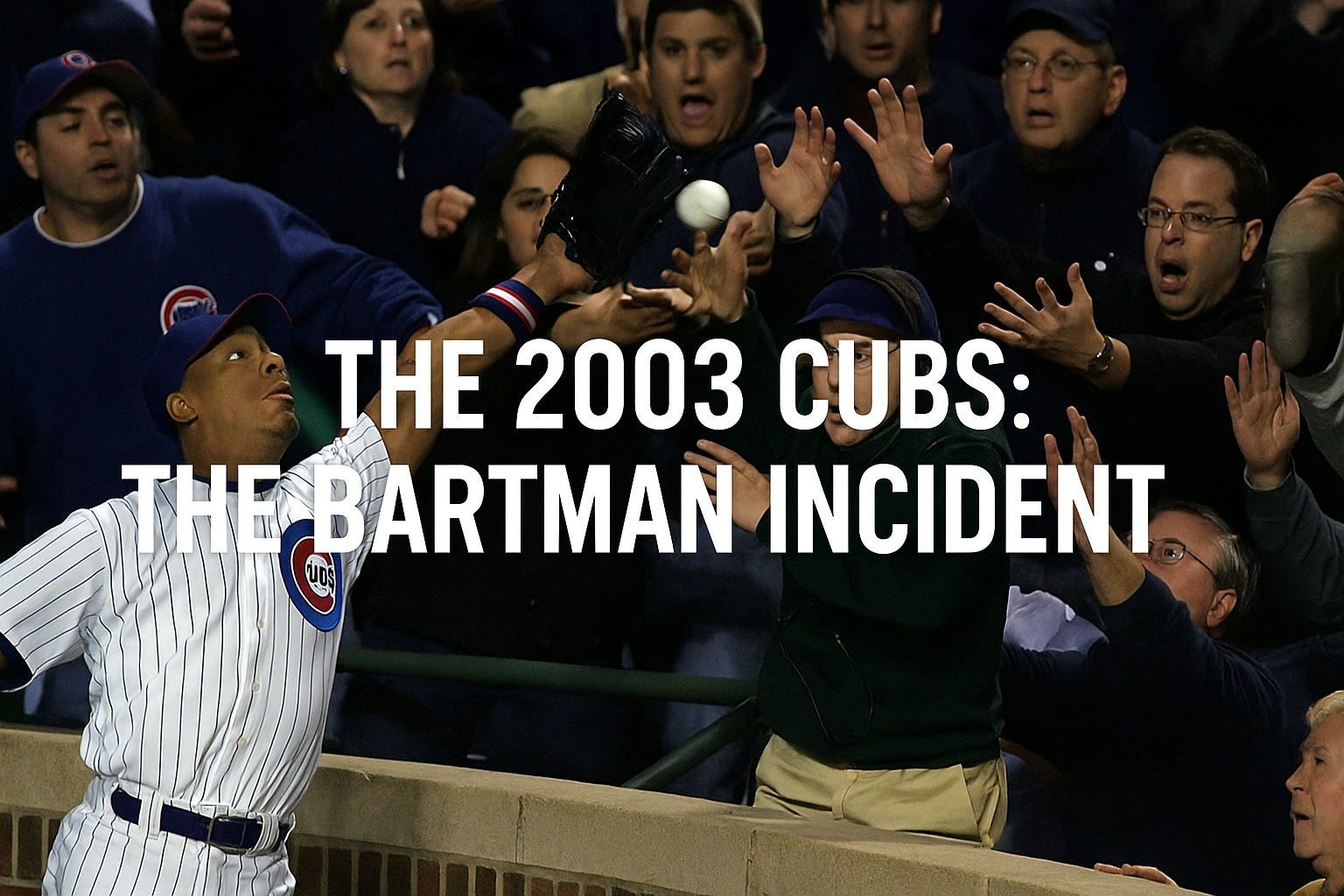
The 2003 Chicago Cubs were a team that invigorated a storied baseball franchise with renewed hope, as they approached what fans fervently believed could be their first World Series appearance since 1945. However, this optimism was severely tested during the National League Championship Series (NLCS) against the Florida Marlins. This pivotal series is primarily remembered not for extraordinary feats of athletic prowess, but for an event notorious enough to earn a moniker of infamy—the “Bartman Incident.” This story, centered around a fan named Steve Bartman, transpires during Game 6 of the NLCS, a game that could have propelled the Cubs to the World Series. The atmosphere at Wrigley Field was electric, as the Cubs held a 3-2 series lead and were five outs away from victory when the infamous incident occurred. To fully understand the breadth of the event, we must delve into the details of that season, that game, and the critical moment that became etched in Cubs lore.
The 2003 Cubs Season
As the 2003 season unfolded, the Chicago Cubs emerged as formidable contenders, buoyed by talent across the roster. Under the management of Dusty Baker, the Cubs thrived behind a stellar pitching rotation featuring aces Mark Prior and Kerry Wood. Both pitchers were critical to the team’s success, with Prior achieving a 2.43 ERA and Wood complementing with a 266-strikeout season. The offensive lineup was equally impressive, led by slugger Sammy Sosa who continued to put up formidable power numbers. The blend of pitching and hitting fostered a robust team dynamic, raising expectations as they clinched the National League Central Division title.
The playoffs began with the Division Series against the Atlanta Braves, where the Cubs demonstrated their mettle, winning the series 3-2 and securing a spot in the NLCS. Excitement filled Chicago as fans dared to dream of glory that had eluded them for nearly a century. As the Cubs squared off against the Miami Marlins, optimism soared. The team exhibited both grit and determination, surging to a 3-2 series lead as they headed back to Chicago for Game 6 at Wrigley Field. It was under these auspicious conditions that the Cubs prepared for a potential clinch that could rewrite the history books.
Game 6: The Build-Up
Game 6 of the NLCS was played on October 14, 2003, at Wrigley Field, a cathedral of baseball famed for its ivy-covered walls and devoted fanbase. The scene was rife with anticipation and palpable tension as fans on both sides of the rivalry understood the sheer stakes at play. The Cubs were within reach of the World Series, a feat that would have ended their long-standing championship drought. The pressure lay on Mark Prior, who had established himself as a pillar of the Cubs’ rotation. The game began auspiciously for the Cubs, with Prior maintaining control on the mound and the defense supporting his efforts. By the top of the eighth inning, the Cubs led the Marlins 3-0, with Prior cruising and only five outs away from securing the victory.
The Bartman Incident
The stage for the Bartman Incident was set at the top of the eighth inning. With one out, Marlins second baseman Luis Castillo approached the plate. On a 3-2 pitch from Prior, Castillo hit a foul ball into the left field stands. The ball approached the outer boundary of outfielder Moisés Alou’s territory and veered near the stands. It was at this precise moment that Steve Bartman, a lifelong Cubs fan seated along the left-field foul line, reached out in an attempt to catch the ball, potentially interfering with Alou’s opportunity to make the catch. The momentum of the game seemed to shift instantaneously, as Alou reacted visibly, expressing frustration and gesturing in disbelief that he had been hindered from making the play.
Bartman’s action, seemingly innocuous in nature, provoked an immediate uproar. Many fans, and eventually millions of viewers on television, saw this moment as an unwanted intervention that catalyzed a collapse. Following the incident, a sequence of misfortunes befell the Cubs, as Castillo walked, leading to an Alex Gonzalez error, and a cascade of Marlins runs followed. The inning eventually concluded with the Marlins scoring eight runs, turning a 3-0 deficit into an 8-3 lead. The Cubs’ World Series hopes were shattered, and the weight of the lost opportunity fell heavily on the shoulders of the players and the fans.
The Public and Media Reaction
The immediate aftermath of the Bartman Incident saw a polarizing response from fans and media alike. At the stadium, Bartman was quickly identified and became the target of verbal abuse from fellow spectators. Security escorted him out for his safety, as the vitriol he faced in person matched the outpouring of emotion across multiple platforms. Mainstream media outlets replayed the incident incessantly, magnifying Bartman’s role in the Cubs’ unraveling, while sports talk shows and columns dissected the event with unrelenting scrutiny.
Despite calls for understanding and calm from Cubs management and players, Bartman became an unwilling folk anti-hero of Cubs futility, thrust into a national spotlight that sought to ascribe blame to him for the team’s implosion. The outcry exemplified the passion and anguish embedded in Cubs fans, a microcosm of the heartbreak experienced throughout decades of unrealized potential.
Long-Lasting Impact and Legacy
The Bartman Incident remains a pivotal moment in Cubs history, molding the narrative of a team long entwined with misfortune and disappointment. The section of the public and sports media that perpetuated the blame on Bartman contributed to a scapegoating culture, overlooking the elements within the game itself where institutional factors, such as player execution and managerial decisions, played substantial roles. Over time, the story of Steve Bartman morphed into a cautionary tale of the power of fandom and the potential dangers of turning an individual’s ill-fated action into a symbol for an entire franchise’s misfortunes.
The broader impact of the event extended beyond baseball, generating discourse on the intersection between fan engagement and athlete performance, as well as examining the ethical dimensions of media coverage and public reaction. The incident sparked dialogue around the traditions and superstitions inherent in sports culture, adding to the lore and mystique associated with Cubs fandom.
The Road to Redemption
It took until 2016 for the Cubs to eventually shake the burden of the Bartman Incident, embarking on a remarkable journey that led to a World Series title and the end of the 108-year championship drought. With this victory, the shadow cast by that fateful night in 2003 began to dissipate, marking a significant turning point in the narrative surrounding the franchise.
In a notable moment of reconciliation, the Cubs organization reached out to Steve Bartman, extending an olive branch in the form of an official team World Series ring. This gesture, laden with symbolism, acknowledged the unwarranted burden Bartman had carried and served as an acknowledgment of shared responsibility for past grievances.
Conclusion
The Bartman Incident remains a defining episode in Chicago Cubs history, emblematic of the complexities of fan involvement and historical narratives within sports. It is a testament to the passion that characterizes both the game’s players and its supporters, as well as a poignant reminder of the depths of emotion that act as a compelling force in the world of professional athletics. Over the years, the incident has transcended its immediate associations, evolving into a broader understanding of perseverance, redemption, and the capacity for forgiveness. The event continues to invite reflection on the spirit of the game and society’s collective memory, cementing its place in sports history as both a cautionary and deeply human story. The Chicago Cubs, Steve Bartman, and their fans have long moved past the shadows of 2003, yet the lessons and emotions drawn from the Bartman Incident maintain resonant echoes, underscoring the multifaceted relationship between fans and the sport they hold dear. As baseball moves forward, the Bartman story endures, capturing the essence of both the inexplicable twists of fate and the pathways to healing within the triumphant narrative that is Cubs lore.
Frequently Asked Questions
What was the Bartman Incident and how did it impact the Chicago Cubs in 2003?
The Bartman Incident is one of the most infamous moments in Major League Baseball (MLB) history, particularly for fans of the Chicago Cubs. It occurred on October 14, 2003, during Game 6 of the National League Championship Series (NLCS) against the Florida Marlins at Wrigley Field. The Cubs were leading the series 3-2, and a win in this game would have secured their first trip to the World Series since 1945. In the eighth inning, with the Cubs holding a 3-0 lead, a foul ball was hit towards the left-field stands. Cubs outfielder Moisés Alou attempted to catch the ball, but a fan named Steve Bartman reached out and deflected it, preventing Alou from making the catch. This incident didn’t cause the Cubs to lose the game or the series on its own, but it marked the beginning of a disastrous turn of events. The Cubs went on to give up eight runs in that inning and eventually lost the game 8-3, and subsequently, the series in Game 7.
Who is Steve Bartman, and what happened to him after the incident?
Steve Bartman was a 26-year-old lifelong Cubs fan who found himself at the center of a firestorm after the incident. Seated in Aisle 4, Row 8, Seat 113, Bartman was one of several fans trying to catch the foul ball, but he became the scapegoat when the ball hit his hand, and Moisés Alou lost his chance at making a catch. Immediately after the incident, Bartman was heavily booed by the surrounding crowd and quickly identified by national television. Following the game, Bartman faced intense public ridicule, harassment, and even threats, which required security to escort him from the stadium. His personal information, including address and workplace, spread online rapidly, leading him to disappear from public life. Bartman chose to lay low, declining interviews and staying out of the public eye for years. In 2016, after the Cubs won the World Series, the team offered Bartman a World Series ring as a gesture of goodwill and extended an olive branch to close a dark chapter in Cubs history.
Was the Bartman Incident the sole reason for the Cubs losing the NLCS against the Marlins?
No, while the Bartman incident is often pinpointed as a turning point in Game 6, it was not the only reason the Cubs lost the NLCS. Following the incident, the Cubs’ own defensive errors and pitching struggles contributed significantly to their downfall. Shortstop Alex Gonzalez committed a crucial error just moments after the Bartman play, mishandling a routine ground ball that could have led to an inning-ending double play. Instead, it led to a flood of Marlins’ runs. Moreover, the Cubs’ pitchers were not able to stem the Marlins’ offensive surge. Ultimately, baseball games are a team effort, and singling out an external factor like a fan’s interference ignores the multitude of mistakes that can swing the momentum of a game.
How did the 2003 Cubs perform during the regular season before reaching the NLCS?
The 2003 Chicago Cubs had an impressive season, finishing with an 88-74 record and clinching the National League Central Division title. This success was largely thanks to their powerful pitching rotation, led by Mark Prior, Kerry Wood, and Carlos Zambrano. Prior and Wood, in particular, were dominant, forming a formidable one-two punch that opponents struggled to handle. The Cubs’ offense also had key contributors, with Sammy Sosa continuing his power-hitting ways and emerging players like Aramis Ramirez and Moisés Alou providing additional firepower. Under manager Dusty Baker, the Cubs showed resilience and a fighting spirit, which helped them overcome a competitive environment. Their playoff run included defeating the Atlanta Braves in the National League Division Series (NLDS), culminating in high hopes as they faced the Marlins in the NLCS. The Cubs were a well-rounded and determined team, ultimately raising expectations for their fans and establishing a renewed belief that their long-awaited World Series drought would end.
What was the reaction from the Cubs’ organization and fans toward the Bartman incident over the years?
Initially, the reaction from many Cubs fans was one of anger and frustration directed at Steve Bartman. He became a symbol of bad luck and desperation in the long-suffering narrative of the Cubs’ World Series drought, even though logically, the loss was a team effort. Over time, however, there was a shift in perspective. As the years passed and emotions cooled, many fans and observers began recognizing the unfairness of pinning the blame on Bartman. The organization’s position also evolved. In 2016, shortly after the Cubs finally won the World Series, they reached out to Bartman, offering sincere apologies and gifting him a World Series ring—a significant gesture of goodwill and reconciliation. This act was widely seen as a step toward healing and closure for a chapter in Cubs history marked by misfortune. The incident, once an example of collective heartbreak, has also become a teaching moment about the complexity of fandom, human emotion, and the unpredictable nature of sports.