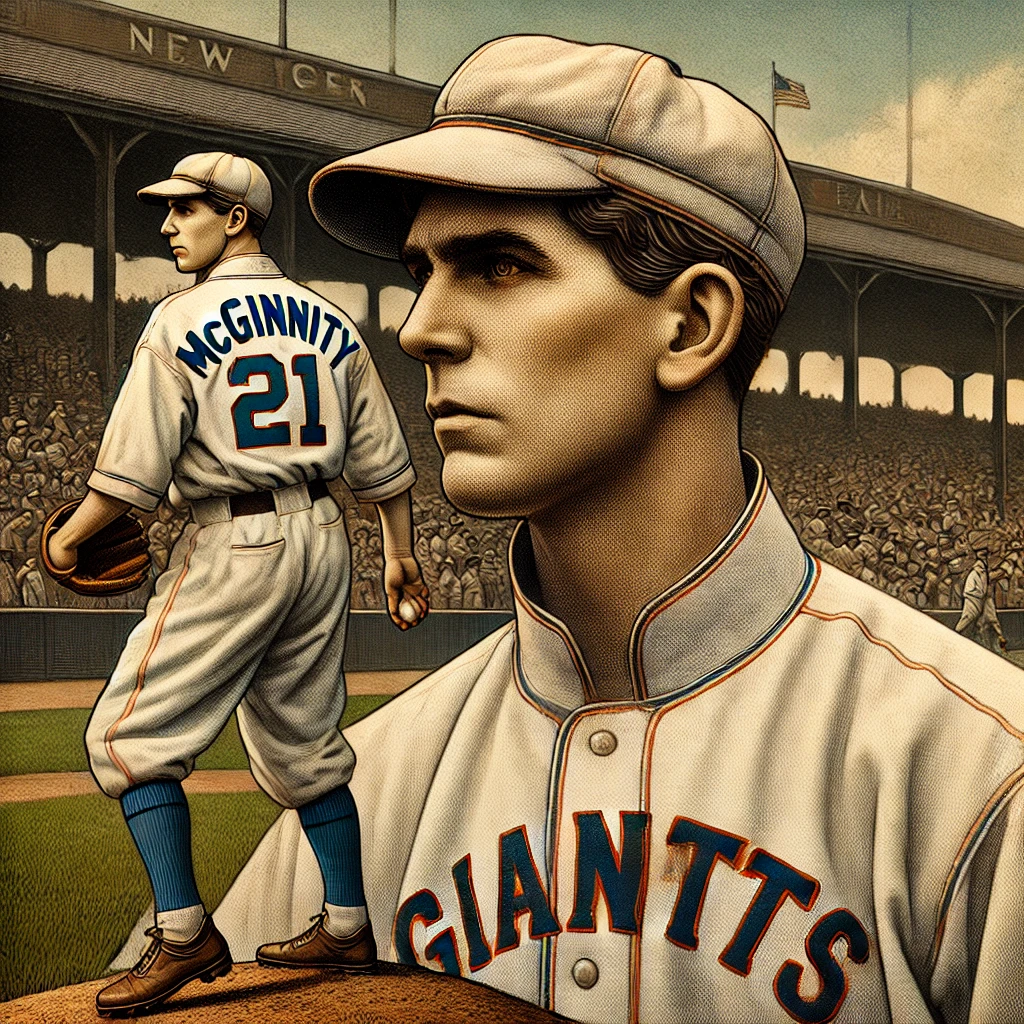
Joe McGinnity, often referred to as “Iron Man,” has left an indelible mark on the world of baseball with his unique durability and pitching prowess. Born on March 20, 1871, in Cornwall, Illinois, McGinnity’s journey from a humble beginning to becoming one of the most resilient and remarkable pitchers in Major League Baseball (MLB) history is a story worth revisiting. Growing up in a coal-mining town, Joe was introduced to the game of baseball at a young age, which would eventually lead him to sporting glory. McGinnity’s thick frame and exceptional stamina made him standout among his peers, leading to his initial successes in semi-professional baseball. He further honed his skills and quickly ascended to the professional ranks. His early career saw him pitching for minor league teams, where he caught the attention of larger clubs who saw the potential in his robust build and unyielding dedication to the sport. His break came in 1899 when he signed with the Brooklyn Superbas (now the Los Angeles Dodgers), a move that set the stage for his illustrious career. His uncanny ability to consistently pitch complete games quickly earned him the nickname “Iron Man.” This moniker wasn’t just for show; McGinnity’s career is replete with instances of pitching in doubleheaders, not just once or twice, but frequently, something unheard of in both past and present baseball eras. Through a career that spanned over two decades, McGinnity’s name became synonymous with durability and excellence. His journey, achievements, and the baseball records he either set or came close to breaking redefine the notions of athletic endurance and passion for the game.
The Pinnacle of His Career: Dominating the Major Leagues
Most remarkably known for his time with the New York Giants, Joe McGinnity’s career peaked during the early 1900s. He joined the Giants in 1902, and it was under legendary manager John McGraw that McGinnity’s prowess truly shone. McGraw’s rigorous approach meshed perfectly with McGinnity’s workhorse mentality, leading to an era defined by both strategic brilliance and physical endurance on Joe’s part. During his time with the Giants, McGinnity’s statistics were nothing short of extraordinary. In the 1903 season alone, he pitched an astonishing 434 innings, a testament to his unmatched stamina and resilience. Moreover, McGinnity regularly pitched more than 300 innings a season, a feat that remains impressive even by today’s standards. His stellar performance in the 1904 season, where he won 35 games, cemented him as one of the premier pitchers of his time. Joe’s signature pitching style included a variety of underhand pitches, which greatly contributed to his success. His unique delivery often left batters befuddled and his ability to mix pitches kept hitters on their toes. In 1904, he actually won both games of a doubleheader three times, an achievement that showcased his remarkable endurance and skill. In addition to his on-field accomplishments, McGinnity was known for his leadership and mentorship. His guidance not only uplifted his teammates but also left a lasting impact on the Giants’ pitching staff. He was a crucial part of their remarkable run in the 1905 season, where the Giants secured the National League pennant and went on to win the World Series, defeating the Philadelphia Athletics in five games. McGinnity’s contribution, both in terms of performance and team spirit, was crucial in this victory, further etching his name in the annals of baseball history.
Legacy and Influence in Modern Baseball
Joe McGinnity’s legacy transcends his incredible stats and the impressive innings he pitched. His influence on the game of baseball persists, with modern pitchers and coaches often drawing inspiration from his tenacity and work ethic. McGinnity’s career serves as a historical benchmark for durability and endurance, traits that continue to be revered in the sporting world. The phrase “workhorse pitcher” is almost synonymous with McGinnity’s name. His rigorous training regimen and strong mental toughness set him apart in an era where sports medicine and fitness were not as advanced as today. His remarkable ability to pitch doubleheaders voluntarily, more than any other pitcher of his time, speaks volumes about his physical and psychological resilience. Modern athletes across various sports respect McGinnity’s determination, and his journey from semi-professional leagues to the pinnacle of MLB serves as a motivating tale of perseverance. In fact, his life and career have been the subject of numerous articles, documentaries, and biographies that illustrate the depth of his impact. McGinnity’s influence even extends to player management and psychology, with many citing his approach to battling adversity and stress as groundbreaking for his era. Furthermore, Joe McGinnity’s career indirectly led to changes in how pitchers were managed. His unimaginable workload highlighted the need for strategic pitching rotations, culminating in the modern five-man rotations that aim to prevent injuries and prolong careers. While it’s unlikely today’s pitchers will replicate his exact feats, McGinnity’s spirit of resilience continues to inspire the strategic evolution in player management and game strategy.
The Iron Man’s Lasting Statistics and Records
Statistics often tell a substantial part of an athlete’s story, and Joe McGinnity’s career stats are a monument to his extraordinary abilities and consistency. Over his MLB career from 1899 to 1908, McGinnity compiled a win-loss record of 246-142, an ERA of 2.66, and 1,068 strikeouts. He completed 314 of his 381 starts – a figure that dwarfs the endurance of contemporary pitchers. One of the most startling statistics is McGinnity’s doubleheader achievements. In the 1903 season, he won both games of a doubleheader an astounding six times. Pitching two full games in one day is hard to fathom in modern baseball, where starters typically pitch every four to five days. This feat is a striking illustration of his incredible durability and ability to maintain performance under taxing conditions. McGinnity also led the National League in wins and innings pitched multiple times. For instance, in 1903 and 1904, he led the league in wins with 31 and 35 victories, respectively. These accomplishments were made all the more impressive considering the shorter season lengths compared to modern MLB schedules. Another testament to his greatness was his induction into the Baseball Hall of Fame in 1946. This posthumous accolade recognized his invaluable contributions to the sport, ensuring his legacy would be remembered by subsequent generations. The Hall of Fame plaque hails McGinnity’s exceptional work ethic, incredible endurance, and his role in shaping the ways pitchers were deployed in games. While his lifetime achievements were extraordinary, the statistical records Joe McGinnity set continue to be benchmarks for aspiring pitchers. His career serves as a reminder that physical endurance, mental fortitude, and the will to succeed are timeless traits that define true legends in sports.
Joe McGinnity’s Impact Beyond the Pitcher’s Mound
Joe McGinnity’s influence wasn’t confined solely to his on-field exploits. He was an individual who transcended the sport, becoming a significant figure in the baseball community long after his playing years. Following his retirement from Major League Baseball, McGinnity continued to contribute to the sport as a player in the minor leagues and as an influential coach. Post-retirement, Joe played in various minor leagues, demonstrating his undying love for the game. He continued to pitch well into his 50s, a testament to his enduring physical condition and unyielding passion. McGinnity’s tenure in the minor leagues also allowed him to mentor younger players, many of whom would go on to have prosperous careers of their own. Beyond the field, McGinnity was also a successful businessman. He co-owned a lucrative iron foundry – a nod to his “Iron Man” nickname – which added another dimension to his multifaceted life. This business endeavor not only helped secure his financial future but also highlighted his industrious nature and ability to excel beyond athletic endeavors. Moreover, Joe’s life story serves as an inspiration not just for athletes, but for anyone facing adversity. His early years working in coal mines before rising to baseball greatness underscore the potent combination of hard work, resilience, and opportunity. His enduring dedication to baseball, even after his prime years, paints a picture of a man wholly committed to his passion, a narrative that continues to resonate. In various interviews and memoirs from MLB players and historians, McGinnity’s name often surfaces as an archetype of perseverance and dedication. His story is a seminal chapter in baseball’s rich history, providing lessons that go far beyond the boundaries of sports.
Conclusion: The Enduring Legend of Joe McGinnity
Joe McGinnity’s contributions to baseball are etched in the annals of sports history. His journey from a small-town boy to one of the most durable pitchers in Major League Baseball epitomizes the essence of hard work, determination, and passion. The “Iron Man” didn’t just play baseball; he defined the spirit of the game with his relentless pitchwork, setting benchmarks that still awe baseball aficionados today. His exceptional career is marked not only by striking numbers but also by a legacy of inspiring tenacity. His doubleheader feats, astonishing innings pitched, and his influence on modern pitching protocols are foundational chapters in the book of baseball history. McGinnity was a player, coach, mentor, and businessman whose life transcended the sport, impacting all who knew his story. As fans and historians of baseball remember and celebrate icons of the past, Joe McGinnity stands tall as a beacon of what one can achieve with unyielding dedication and grit. His life and career provide an immersive lesson in the values that not only define great athletes but also remarkable human beings. In today’s fast-paced and often injury-prone sporting landscape, McGinnity’s story offers a fascinating contrast and a timeless lesson in enduring excellence. As we look back on the history of baseball, the legend of Joe McGinnity remains a testament to the enduring spirit of the “Iron Man,” a legacy that will continue to inspire future generations.
Frequently Asked Questions
1. Who was Joe McGinnity and why was he nicknamed “Iron Man”?
Joe McGinnity, born on March 20, 1871, in Cornwall, Illinois, was a Major League Baseball pitcher known for his extraordinary durability and endurance on the mound, earning him the nickname “Iron Man.” Unlike many of his contemporaries, McGinnity had an almost superhuman ability to pitch complete games on consecutive days and sometimes even twice on the same day. Growing up in a coal-mining town exposed him to the kind of hard work and perseverance that would later define his career. His workhorse mentality and remarkable toughness became legendary, propelling him to a career that included over 240 wins. His story is not just a testament to physical stamina but also a reflection of relentless work ethic and the ability to thrive amidst challenging conditions.
2. What were some of the notable achievements of Joe McGinnity’s baseball career?
Joe McGinnity’s career is filled with remarkable achievements that highlight his durability and skill as a pitcher. Over his MLB career, spanning from 1899 to 1908, he accumulated an impressive win-loss record of 246-142, with a superb earned run average (ERA) of 2.66. One of his most significant accomplishments was leading the National League in wins five times, and in innings pitched four times. During the 1903 season, McGinnity won both games of a doubleheader three times, a feat that underscored his resilience and earned him the moniker “Iron Man.” His contributions to his teams, including stints with the Baltimore Orioles and the New York Giants, showcased his ability to consistently perform at an elite level. His prowess on the mound was further recognized with his induction into the Baseball Hall of Fame in 1946, a testament to his lasting impact on the sport.
3. How did Joe McGinnity’s upbringing influence his baseball career?
Joe McGinnity’s upbringing in a coal-mining town in Illinois played a crucial role in shaping his character and ultimately, his baseball career. The demanding and tough environment of a mining town instilled in him a strong work ethic and resilience from a young age. These attributes were reflected in his approach to baseball, particularly his stamina and determination on the field. Learning baseball as a pastime amidst the industrial backdrop, McGinnity carried with him the lessons of grit and endurance as he rose through the ranks to Major League Baseball. His upbringing taught him the importance of perseverance and hard work, which became defining characteristics of his pitching style and contributed significantly to his reputation as one of the game’s most durable pitchers.
4. What challenges did Joe McGinnity face during his pitching career, and how did he overcome them?
Throughout his career, Joe McGinnity faced several challenges, both on and off the field, which he overcame with remarkable resolve and determination. Despite the physical demands of pitching almost every day, McGinnity displayed exceptional durability. He dealt with injuries that would have sidelined most players, yet he continued to pitch at a high level. Beyond physical challenges, he also encountered the pressures and expectations that came with being a top performer in the league. McGinnity’s ability to pitch complete games regularly, sometimes two in one day, showcased his exceptional resilience. His focus and mental toughness allowed him to maintain his performance level even under fatigue, solidifying his reputation as a pitcher who could be relied on no matter the circumstances. His perseverance through these challenges speaks to his enduring legacy as one of the true “Iron Men” of baseball.
5. What impact did Joe McGinnity’s pitching style have on the game of baseball and its players?
Joe McGinnity’s pitching style had a profound impact on the game of baseball, setting a standard for durability and effectiveness that influenced not only his contemporaries but also generations of pitchers to follow. Known for his underhanded delivery, McGinnity combined precision and endurance to outmatch hitters consistently. His ability to pitch and win both ends of a doubleheader set a benchmark for physical and mental toughness that few have matched. McGinnity’s approach taught pitchers the importance of maintaining their arm health and developing a strong work ethic to endure the rigors of long seasons. His influence is evident in the way pitchers are revered for their ability to log substantial innings and consistently provide their teams with chances to win games. By establishing a legacy built on tireless effort and resilience, McGinnity inspired a respect for durability in pitching that has endured through decades.