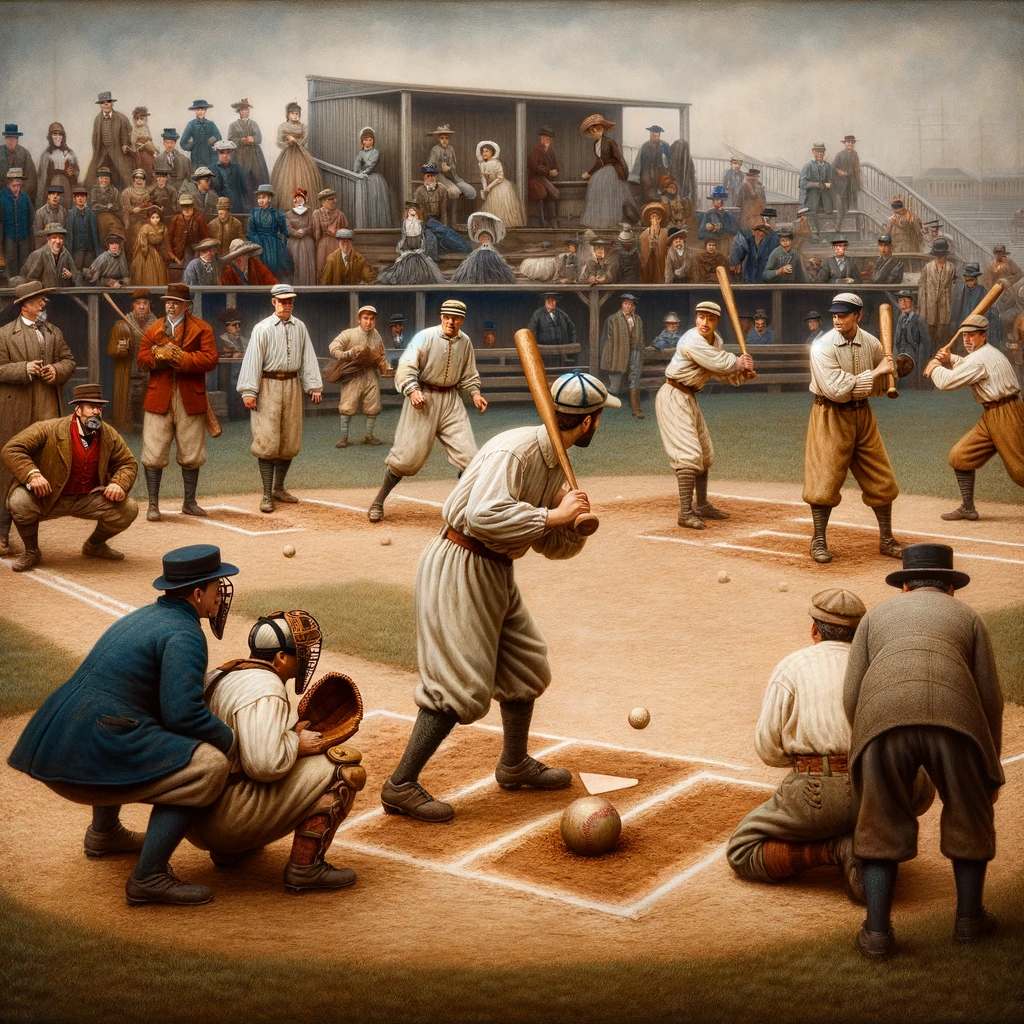
Baseball, often referred to as America’s pastime, has a rich and complex history that intertwines with the cultural and social fabric of the United States. While the exact origins of baseball are somewhat nebulous, the game’s development and evolution are well-documented, providing a captivating glimpse into a sport that has captured hearts and imaginations for over a century. This article explores the early rules and evolutionary milestones of baseball, tracing its journey from a rudimentary pastime to the sophisticated sport we know today.
Early Beginnings
The roots of baseball can be traced back to older bat-and-ball games such as cricket and rounders, which were popular in England and subsequently brought to North America by early settlers. However, the version of baseball that evolved in the United States took on its own distinct character. One of the earliest known instances of a game resembling baseball was played in 1838 in Beachville, Ontario. However, it was in the United States that the game truly began to take shape.
The Knickerbocker Rules
A pivotal moment in the history of baseball occurred in 1845 when the New York Knickerbocker Baseball Club, led by Alexander Joy Cartwright, developed a set of rules known as the Knickerbocker Rules. These rules represented a significant departure from the more rudimentary games played at the time. Among the notable features were:
- The establishment of a diamond-shaped infield.
- The specification of a three-strike rule.
- The elimination of the practice of throwing the ball at runners to put them out, replacing it with tagging the base or the runner.
This framework laid the groundwork for modern baseball, standardizing many aspects of the game that were previously left to local custom or personal preference.
The National Association of Base Ball Players
In 1857, the National Association of Base Ball Players (NABBP) was formed, marking the first organized baseball league. The NABBP began to formalize rules further and promote a unified way of playing the game. This period saw the introduction of nine innings as a standard game length, the establishment of a set distance between bases, and the formalization of positions like pitcher and catcher.
The Professional Era Begins
The year 1869 marked a significant turning point with the establishment of the first fully professional baseball team, the Cincinnati Red Stockings. This shift to professionalism brought about further changes in how the game was played and managed. Teams began to employ strategies and training methods that were more sophisticated, and the level of play improved dramatically.
The National League and American Association
The formation of the National League in 1876 and the American Association in 1882 brought about another major evolution in the rules and structure of baseball. The rivalry between these two leagues led to innovations in rules and gameplay, as each sought to attract more fans. Some of the significant changes included:
- The adoption of a standardized baseball.
- The introduction of chest protectors for catchers.
- The implementation of a system of fouls and fair balls.
These changes made the game safer and more competitive, contributing to its growing popularity.
The Merger and the Birth of Modern Baseball
The merger of the National League and the American Association in 1892 marked the beginning of modern baseball. This merger standardized the rules and established a uniform league that is recognizable as the precursor to today’s Major League Baseball. The following decades saw the introduction of key elements like the designated hitter rule in the American League and the integration of African American players, breaking the color barrier with Jackie Robinson’s debut in 1947.
Evolution of the Game
Throughout the 20th and into the 21st century, baseball continued to evolve. Technological advancements like television broadcasting and instant replay, along with changes in society and culture, influenced the game. Modern stadiums, advanced training and analytics, and a global player base have transformed baseball into a sport with a rich history and a dynamic present.
Baseball’s evolution is a testament to its ability to adapt and grow while maintaining a connection to its historical roots. From the Knickerocker Rules to the high-tech stadiums of today, baseball has continuously reinvented itself, reflecting the changing times while holding onto the essence of the game.
The history of baseball is not just a story of rules and regulations, but a narrative of cultural and societal change. The game’s ability to evolve while preserving its core principles is a key factor in its enduring popularity. As we look back at the early rules and their transformation, we gain a deeper appreciation for baseball’s unique place in history and its ongoing legacy.

The Integration Era and Expansion
Post-World War II America saw significant societal changes, and baseball was no exception. The integration of baseball, beginning with Jackie Robinson breaking the color barrier in 1947, marked a new era for the game. This period not only brought racial diversity to the sport but also led to an influx of exceptional talent that had previously been sidelined due to racial segregation.
The decades following integration saw baseball’s expansion both in terms of teams and geographic reach. New teams were added, and the sport spread across the United States and into Canada, broadening its fan base and influence. This expansion necessitated further adaptations and modifications to the rules and structure of the league to accommodate the growing number of teams and games.
Technological Advancements and Modernization
The latter half of the 20th century and the early 21st century witnessed the influence of technology on baseball. Television played a significant role in popularizing the sport, bringing games into homes across the country and later, around the world. This exposure not only increased the fan base but also significantly boosted revenue for the sport.
Advancements in technology also impacted how the game was played and managed. The use of video replay for umpire decisions, statistical analysis for player performance (sabermetrics), and improved training and medical care for players brought a new level of sophistication and strategy to the game.
The Steroid Era
One of the more controversial chapters in baseball’s history is the so-called “Steroid Era” of the late 1990s and early 2000s. This period saw numerous players achieve extraordinary levels of performance, which were later attributed to the use of performance-enhancing drugs. The revelation of widespread steroid use led to a significant backlash from fans and a reevaluation of records and achievements.
In response, Major League Baseball implemented stricter drug policies and more rigorous testing for performance-enhancing substances. This era highlighted the challenges of maintaining the integrity of the sport amidst the pressures of competition and the allure of enhanced performance.
Globalization of the Game
Baseball’s reach in the 21st century has truly become global. The World Baseball Classic, first held in 2006, is a testament to the game’s international appeal, featuring teams from around the world. The influx of players from Latin America, Asia, and other regions has added a rich diversity to the sport and has introduced new styles and strategies into the game.
The globalization of baseball has also had economic implications, with Major League Baseball seeking to tap into new markets and expand its global audience. This has led to regular season games being played in countries like Japan, Australia, and the United Kingdom.
The Future of Baseball
As we look towards the future, baseball continues to evolve. Issues like pace of play, player safety, and the use of technology are at the forefront of current discussions about the game. Efforts to make baseball more accessible and appealing to younger generations are ongoing, with changes to rules and formats being considered.
The enduring appeal of baseball lies in its rich history and its ability to adapt to changing times. From its humble beginnings to its current status as a major global sport, baseball’s journey is a reflection of the resilience and adaptability of the human spirit. As the game continues to evolve, it will undoubtedly retain its place as a beloved pastime for generations to come.
In conclusion, the history of baseball is a story of evolution and adaptation. From the Knickerbocker Rules to the high-tech, global sport it is today, baseball has mirrored societal changes and technological advancements. It’s a game that has not only survived but thrived through numerous challenges, adapting and evolving while maintaining its core essence. Baseball’s past and present offer a window into not just a sport, but a cultural phenomenon that continues to captivate and inspire.
Frequently Asked Questions
What are the origins of baseball, and how did the game start?
Baseball’s origins are a fascinating blend of myth and fact, with multiple stories about how it came into being. While many people grew up believing that Abner Doubleday invented baseball in Cooperstown, New York, in 1839, this is more of a legend than a historical fact. In reality, baseball evolved from older bat-and-ball games played in England, such as rounders and cricket. These games migrated across the Atlantic and morphed into a uniquely American version, gradually developing its own identity. The game we recognize today was heavily influenced by the Knickerbocker Rules, established in 1845 by the New York Knickerbocker Base Ball Club, led by Alexander Cartwright. These rules laid the groundwork for baseball as we know it, marking a significant evolutionary milestone by formalizing aspects such as the diamond-shaped infield and foul lines. It was this blend of informal play, club enthusiasm, and early codification that propelled baseball into the hearts of many Americans.
What were some of the earliest rules of baseball, and how have they changed over time?
The earliest known set of rules was the Knickerbocker Rules, created in 1845. These rules were pivotal in transitioning baseball from a casual pastime to a more structured and organized sport. For instance, the Knickerbocker Rules featured innovations like the diamond-shaped infield and the elimination of “soaking” or hitting runners with a thrown ball to record an out. Initially, pitches were delivered underhanded, and batters could request where they wanted the ball placed. The concept of innings also began with these rules. Over time, numerous changes evolved the game into its modern form. Pitching changed to an overhand style, and various pitches like curveballs and fastballs became part of the game. The dimensions of the field and equipment evolved, with the introduction of gloves and improved bats. Some guiding principles, such as three-strike rule and nine-player teams, however, have surprisingly remained constant, showcasing baseball’s balance between tradition and innovation.
Who was Alexander Cartwright, and why is he significant to baseball history?
Alexander Cartwright is a vital figure in baseball history, often lauded as one of the key figures in the development of modern baseball. Cartwright was a founding member of the New York Knickerbockers, a baseball club that played an instrumental role in transforming baseball from an informal recreational activity into an organized sport. He spearheaded the drafting of the first comprehensive set of rules for the sport, known as the Knickerbocker Rules, in 1845. These rules are seen as the cornerstone of baseball’s gradual transformation, providing essential frameworks for gameplay, including the diamond-shaped infield, foul lines, and the three-out format. Although often overshadowed by the Doubleday myth, Cartwright’s contributions are recognized by the Baseball Hall of Fame, and his influence is felt every time a game is played.
How did baseball come to be known as “America’s pastime”?
The title “America’s pastime” is both a testament to baseball’s deep historical roots within American society and recognition of its popularity and cultural significance. In the mid-to-late 19th century, baseball became a fixture in American life, growing from regional games to a nationwide phenomenon. Its rise paralleled the growth of American cities, often becoming a source of local pride and community bonding. Baseball was accessible and easy to play, with unifying rules that offered a sense of order sometimes lacking in the rapidly industrializing nation. It was a sport for everyone, embraced across class and regional lines, from rural fields to urban sandlots. By the early 20th century, major league baseball solidified its place in American culture, buttressed by legendary players like Babe Ruth whose exploits captured the imagination of millions. Baseball’s ability to adapt yet maintain a sense of nostalgia for tradition helped cement it as an emblematic part of the American experience.
How did the sport of baseball spread internationally if the origins were so deeply rooted in America?
While baseball’s heart beats strongest in America, its rhythm resonated beyond borders to captivate the world. The spread of baseball internationally began with cultural and economic influences from the United States. As America grew as a global power, it brought with it social and cultural exports, including baseball. U.S. expatriates, military personnel, and missionaries introduced the game in foreign lands, nurturing baseball in countries as disparate as Japan, Cuba, and the Dominican Republic. Each country’s unique twist on the game helped it flourish, emphasizing baseball’s universal appeal. In Japan, professional leagues grew from early industrial leagues, eventually birthing the Nippon Professional Baseball league. Cuban passion for baseball produced legendary talents who crossed cultural divides. The influence of Major League Baseball served as an aspirational beacon, further encouraging international growth. Its global reach today is a testament to baseball’s capacity to transcend its origin story, continually rewriting its narrative through the embrace of diverse cultures worldwide.