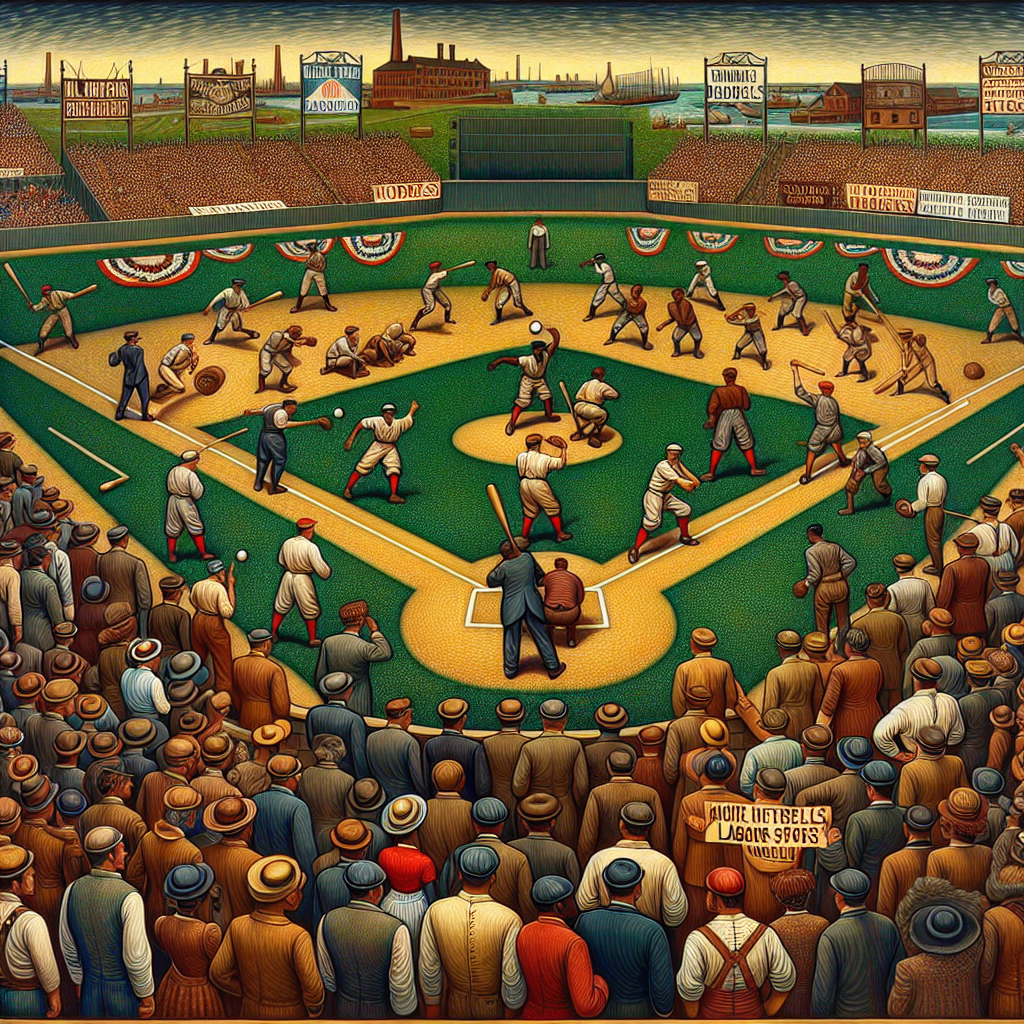
Baseball is often considered America’s pastime, an integral part of the country’s fabric that symbolizes many ideals the nation holds dear. However, beyond being a mere game that brought families and friends together, baseball has also played a significant role in other aspects of American society, particularly in the American labor movement. Over the decades, the narrative of baseball intertwines with the progression of workers’ rights and unionization, reflecting broader societal changes.
In the late 19th and early 20th centuries, America was navigating through industrialization, social upheaval, and significant economic changes. The workforce was organizing, demanding fair wages, stabilizing working conditions, and striving for a voice concerning their employment. During this time, baseball was emerging as a popular sport that could and did influence public opinion and the labor movement. The sport provided a unique mirror to societal shifts while embodying the workers’ struggle for better conditions.
From the foundation of the players’ league to stops, threats, strikes, and negotiations, baseball’s history is rife with significant labor relations milestones that speak volumes about the broader American labor movement. By examining these pivotal moments within baseball, we can better understand how this sport affected and profoundly mirrored societal changes in labor rights and organization.
This article delves into those connections, exploring the various stages and figures in baseball that were instrumental in shaping the American labor movement to what it is today. We’ll explore the birth of players’ associations, famous strikes, and how societal changes and the labor movement have influenced the players’ rights on and off the diamond.
The Origins of Baseball and Labor Tensions
Baseball’s prominence as a professional sport began in the latter half of the 19th century, alongside major significant changes in industrial America. As factories multiplied, so did the need for laborers, who began to recognize their power if organized. This realization led to the establishment and growth of labor unions within various industries, with remarkable figures such as Samuel Gompers spearheading efforts toward better working conditions and fair wages for American workers.
In 1885, John Montgomery Ward formed the first organized union in professional sports, “The Brotherhood of Professional Base Ball Players.” Ward was a star pitcher and shortstop who graduated from Columbia Law School and became a vocal advocate for players’ rights. His union was a response to the unfair treatment of baseball players as they were subjected to the reserve clause, which bound players to one team, giving owners immense control over their careers.
The Brotherhood laid the groundwork for future improvements in player conditions and contracts. Although marginalized to an extent, its mere existence challenged the established norms and set historical precedents. The Brotherhood of Baseball Players symbolized the growing unease and discontent among not just athletes but American workers dealing with similar injustices at their workplaces.
The pushback against monopolistic control in baseball dovetailed with broader societal movements towards greater worker autonomy and better labor legislation. The creation of the Players’ League in 1890, a direct rival to existing baseball leagues, epitomized this struggle. It was a league owned and operated by the players themselves that provided an alternative universe where ballplayers envisioned freedom similar to what unions pursued for laborers nationwide.
The Reserve Clause and Player Contract Disputes
One of the most contentious issues in baseball’s labor history was the reserve clause. This clause essentially chained players to the teams that signed them, as it granted the team perpetual control over the player’s career unless they decided to trade or release him. This practice was analogous to the restrictive long-term contracts faced by factory workers in other sectors, acting as an immense barrier for players seeking self-agency and improvement of their financial conditions.
For decades, players challenged the reserve clause, but it remained central to Major League Baseball’s control over their athletes. This monopoly over players’ careers was akin to the challenges many workers faced fighting against oppressive managerial tactics in their respective industries. The legal battles surrounding the reserve clause drew significant parallels with crusades by labor unions to break free from oppressive working conditions and gain the right to fair negotiations.
Curt Flood’s lawsuit against Major League Baseball in 1969 marked a pivotal moment in the career prospects for baseball players. Although ultimately unsuccessful, Flood’s courage in confronting the reserve system was monumental. His case brought widespread legal and public attention to the inherent inequities within baseball and its labor agreements. The circumstances reflected the broader labor movement’s struggles where individuals, often at great personal risk, fought against exploitation to secure justice and reform.
Flood’s stand foreshadowed eventual breakthroughs for players’ rights, matching similar successes labor activists began to achieve during that period. The landmark decision in the 1970s in which arbitrator Peter Seitz free-agency reflected broader economic changes and the evolving sentiment in America that workers had a right to control their work conditions and career paths.

The Rise of Players’ Unions
The establishment of the Major League Baseball Players Association (MLBPA) in 1966 marks a red-letter day in the history of baseball and its association with the labor movement. Formed amidst growing player dissatisfaction, the union’s creation signified players uniting collectively to champion their professional rights, echoing similar trends throughout the American labor landscape.
The players’ union, under the leadership of Marvin Miller, sought to transform not just the economic aspects of baseball but also the understanding of athletic labor. Miller, who was previously associated with the United Steelworkers of America, used his knowledge to revolutionize the ways players interacted with club owners. The introduction of collective bargaining transformed player contracts, setting new standards for compensation, working conditions, and retirement benefits.
This movement paralleled broader labor union successes across America, showing how athletic labor was no different from industrial labor when leveraged effectively. The rise of the MLBPA, negotiations it achieved, and subsequent strength served as a beacon of possibility, demonstrating that even in arenas dominated by money and media like professional sports, collective action held the power.
Key player strikes during the 1970s and ’80s further highlighted how the unionization model ported from traditional sectors into sports could yield essential benefits, aligning to the progress sought by corresponding labor movements. These actions portrayed athletes not just as entertainers but as workers subject to labor rights and fair workplace policies.
Baseball Strikes and Worker Solidarity
The history of baseball is fraught with numerous labor strikes that underscore the tumultuous relationship between the players and the management – each act of defiance stirring echoes across the entire workforce spectrum in America. The 1981 strike, one of the most significant, was primarily about free agency, signaling larger victories won by the MLBPA over owners dithering over player mobility and compensation.
The 1981 strike resonated deeply with American workers elsewhere. Professional sports, usually portrayed as free from worldly concerns, were revealed as a relevant part of the discussion on labor rights and injustices. The public witnessed firsthand how unjust treatment in sports paralleled unfair practices beyond fields and stadiums, reinforcing the notion of collective action as an invaluable tool in confronting and rectifying labor inequalities.
Players’ campaigns to protect their interests were marked not just by the compensation-related concerns but extended to youth expenses, service years, and fair organizational representation. One of the most notorious work stoppages happened during the 1994-1995 season. Costs were high for both players and owners, from broadcast revenues to public backlash. Nonetheless, it illustrated – much like labor strikes in other sectors – how solidarity among workers was critical in achieving equitable terms.
Not only did these strikes emphasize the common ground between athletes and traditional laborers, but they also showed how the organized principle could inspire cultural shifts, influencing both public opinions and legislative reforms. As fans watched from the sidelines, the underlying issues of equity on labor domains were becoming unavoidable, pushing societal expectations for players’ rights into the wider conversation on employment and workers’ rights.
Baseball, Globalization, and Evolving Labor Movements
In recent years, baseball has become a global sport, paralleling globalization’s effect on labor. As economies are interconnected, labor disputes, rights, and conditions have increasingly involved diverse and international consideration reflecting those trends within baseball. Players now hail from Latin America, Asia, and other regions, bringing aspects of global labor pool dynamics into the realm of American baseball.
This diversity among players isn’t just cultural; it represents socio-economic factors mirroring globalization’s reach into the workforce more broadly. Negotiations envelop international traits, adapting practices like fair pay, player transfers, and grievance handling within and outside America, similar to multinational corporations in varied industries. The MLBPA recognized these changes and adapted its role to include concerns of the increasingly global league.
The influence global players have had on both the game’s economics and labor negotiations is remarkable. It highlights baseball’s ability to reflect broader societal trends, including migration and labor norms, as workers around the world demand fair treatment and better regulation of international labor practices. The changing face of baseball symbolizes and challenges the status quo of traditional labor paradigms, creating an inclusive and diverse workplace advocacy.
The spread of baseball to countries with differing labor structures reflects back into the American domain while fostering a cross-pollination of labor strategies and worker empowerment globally. More than ever, baseball reflects a worldwide lens on labor rights, attracting international dialogue about ethical labor practices, advocacy, and the symbiosis of management and workers for mutual benefit.
Conclusion
Baseball’s relationship with the American labor movement illustrates the sport’s profound impact on societal change and reflects those changes back onto the field. Part of this cultural revelry surrounds its transformation lenses of labor’s struggles, triumphs, and evolutions, show the intrinsic connection between a sport and its broader socio-economic context.
From the Brotherhood of Professional Base Ball Players to modern associations like the MLBPA, players have remained at the forefront of advocating for workers’ rights, cementing a legacy that resonates far beyond the diamond. The battle for free agency, fair wages, contracts, and later international influences have shaped baseball into more than a competitive sport; it transformed into an arena that embraces labor equity and serves as a mirror to broader societal norms.
As these narratives continue evolving, contemporary conversations around workers’ rights thrive off baseball’s storied legacy involving labor negotiations and unionization. The sport remains a vital part of America’s labor conversation, influencing current and future labor landscapes. Baseball offers historical testimony of unity, collective action, and progression for improved workers’ rights—principles that the labor movement strives to actualize across various American industries.
Reflecting the ongoing dialogue between sports and the labor movement – where baseball remains a component of broader cultural and political landscapes – serves as a reminder that what happens on the playing field often resonates beyond entrances of stadiums right into factory floors, offices, and workers’ assemblies.
Frequently Asked Questions
1. How did baseball influence the American labor movement in its early years?
Baseball’s influence on the American labor movement dates back to the late 19th and early 20th centuries, a time of significant change and challenge in the American labor landscape. As the sport grew in popularity, it also became a microcosm of the broader labor struggles. Many baseball players faced same issues as industrial workers: low wages, long hours, and harsh working conditions. The reserve clause, which tethered players to their teams indefinitely, symbolized the lack of labor rights. This led to the formation of the first player unions, such as the Brotherhood of Professional Base Ball Players in 1885, which sought to combat these injustices. Although the Brotherhood disbanded, it set a precedent for subsequent labor movements. The challenges faced by early baseball labor organizers mirrored those of other American workers, catalyzing concerted efforts across various sectors to improve labor rights.
2. What was the significance of the Curt Flood case in baseball labor history?
In 1969, Curt Flood, an outfielder for the St. Louis Cardinals, stood up against the reserve clause after being traded against his will. His decision to sue Major League Baseball (MLB) for unrestricted free agency was monumental. Flood likened his situation to “being owned like a slave,” highlighting the lack of autonomy players had over their careers. Although Flood lost the Supreme Court case in 1972, his bold move ignited a revolution. It led to the eventual dismantling of the reserve clause, which was central to players’ inability to freely negotiate contracts. This case set the stage for the establishment of free agency in 1975, fundamentally altering player-team relations and empowering players with greater negotiating power and freedom. Flood’s stand resonated across various labor movements, marking a significant win for workers’ rights and setting a precedent for other industries.
3. How did baseball players’ strikes and lockouts relate to the broader labor movement?
Baseball players’ strikes and lockouts have been pivotal events that reflected and contributed to broader labor movements in America. Notable events include the players’ strike of 1981 and the lockout of 1994-95. These conflicts revolved around issues similar to those in other labor disputes, such as fair wages, working conditions, and profit sharing. The strikes drew attention to the plight of workers confined by strict contractual obligations and management dominance. They exemplified how organized labor could effectively campaigned for its rights, bringing issues like revenue sharing and pension plans into the spotlight. These actions paralleled industrial strikes happening across the country, where unions fought for better conditions and profit sharing. The baseball strikes thus served as a high-profile platform showcasing the power and potential success of collective bargaining in achieving significant labor reforms.
4. How have player unions changed the landscape of baseball and labor negotiations in general?
The formation and strengthening of player unions such as the Major League Baseball Players Association (MLBPA) have been transformative for the sport and labor negotiations at large. Since its foundation in 1953 and significant empowerment under the leadership of Marvin Miller in the late 1960s, the MLBPA negotiated landmark deals that ensured greater equality and fairness in player contracts. These negotiations affected not only salary structures but also benefits, working conditions, and grievance procedures. Player unions highlighted the effectiveness of organized labor advocating for workers, which resonated powerfully in other sectors striving for labor reforms. The establishment of free agency and arbitration as negotiating tools, similar to practices in industrial and service sectors, demonstrated a structured approach to collective bargaining, providing successful frameworks adopted across various industries.
5. What lasting impact did the successes of baseball’s labor struggles have on today’s labor movement?
Baseball’s labor struggles have left a lasting impact on today’s labor movement by highlighting the power of collective bargaining and unionization. The successes achieved in the realm of baseball – from challenging the reserve clause to securing free agency – illustrated the significance of organized preparation, solidarity, and negotiation strategies that remain influential in labor discussions today. The MLBPA has continually set high standards for labor negotiations in other sports and industries, proving that unified voices can challenge and change entrenched powers. Moreover, these achievements have inspired a broader societal recognition of workers’ rights as imperative, advocating for better compensation, working conditions, and contractual freedom. The principles echoed in baseball’s labor evolution continue to resonate with today’s workforce, serving as a testament to the enduring nature of fair labor advocacy.