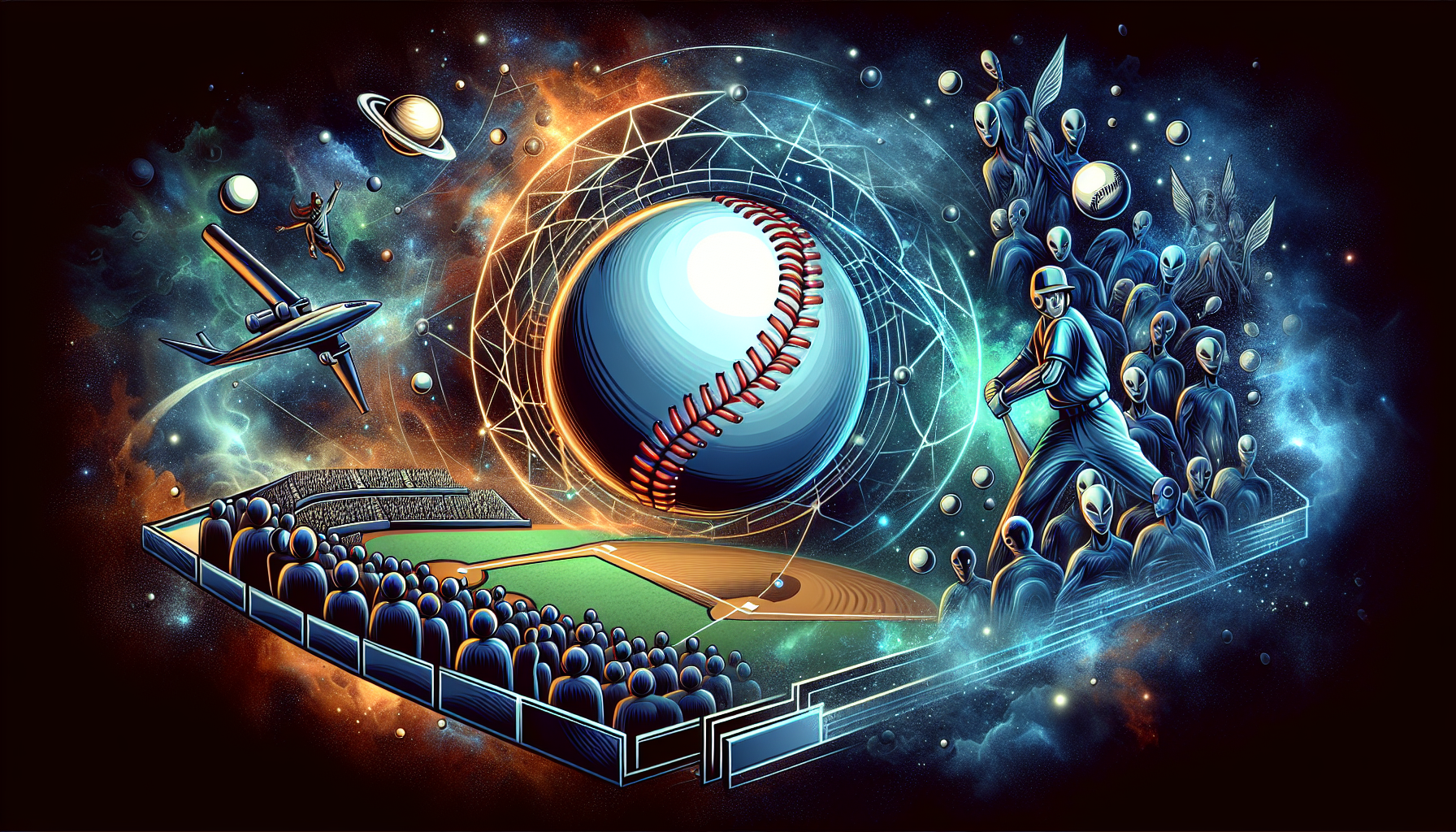
Baseball in science fiction sounds like a novelty, yet it has become one of the most revealing crossovers in modern storytelling. The sport carries a deep archive of symbols: ritual, patience, statistics, failure, community, nostalgia, and the long tension between individual action and team structure. Science fiction, by contrast, asks what changes when technology, biology, politics, or cosmic scale alter ordinary human life. Put them together and writers gain a flexible way to examine continuity and disruption at the same time. In my experience reviewing sports narratives across novels, film, television, comics, and speculative short fiction, few combinations generate such layered meaning with so little setup. A single scene with a glove, a diamond, or a box score can communicate home, memory, discipline, and identity even inside a starship or posthuman future.
Defining the territory helps. Baseball in science fiction includes stories where the game itself is central, stories where baseball imagery shapes character or setting, and stories where futuristic conditions transform how the sport is played, watched, or remembered. It overlaps with dystopian fiction, alternate history, cyberpunk, space opera, time travel, and literary speculative fiction. This hub article covers that full miscellaneous range because readers searching this topic usually want more than a list of titles. They want to know why creators keep returning to baseball, what themes the pairing serves, and which works deserve attention first. That matters for the broader “Baseball in Literature and Film” conversation because science fiction extends baseball beyond realism. It shows how the game survives social collapse, migration to other worlds, artificial intelligence, and even the end of the human body as we know it.
At its best, this mix works because baseball is structurally ideal for speculation. The game is episodic, data rich, rule bound, and full of pauses for reflection. Those qualities make it easy to project into future leagues, altered athletes, robotic umpires, virtual spectatorship, or interplanetary travel schedules. Just as important, baseball has centuries of cultural baggage, especially in American and Japanese contexts, so any speculative use immediately raises questions about heritage and power. Is the future preserving a treasured pastime, commercializing it beyond recognition, or using it as an anchor against chaos? That central tension gives the genre unusual depth.
Why Baseball Fits Science Fiction So Well
Baseball fits science fiction because both depend on systems. In baseball, outcomes emerge from codified rules, measurable performance, and strategic adaptation. In science fiction, worlds feel persuasive when rules, technologies, and institutions shape behavior consistently. When a writer imagines enhanced pitchers, lunar ballparks, or cloned lineups, the audience already understands that even small rule changes can create major consequences. A lower-gravity environment changes flight paths. Faster biomechanical recovery changes bullpen management. Machine learning scouting changes how prospects are valued. Baseball gives speculative fiction a precise sandbox for examining cause and effect.
The sport also solves a narrative problem that many futuristic stories face: how to make abstract change emotionally legible. Readers may not grasp orbital governance or neural implants instantly, but they understand a batter facing a pitcher with the game on the line. That confrontation translates large themes into a human moment. In several works, creators use baseball not because they care only about the sport, but because the sport provides a familiar grammar for discussing migration, militarization, labor, memory loss, or technological dependence. A league in decline can stand in for a civilization in decline. A reconstructed stadium can symbolize cultural recovery after catastrophe.
Another reason the pairing lasts is rhythm. Science fiction often alternates between wonder and explanation. Baseball naturally alternates between anticipation and action. That stop-start rhythm leaves room for exposition without killing momentum. A manager can discuss asteroid economics between pitches. A broadcast can explain android labor law during a mound visit. The structure supports worldbuilding elegantly, which is why baseball scenes in speculative fiction often feel denser than scenes built around faster sports.
Core Themes: Memory, Identity, and the Future of Tradition
The most common theme in baseball-centered science fiction is memory. Baseball already carries a strong association with recollection, archives, and generational continuity. Science fiction intensifies that by introducing time travel, artificial memory, digital preservation, or civilizational rupture. A future society keeping score by hand can signal resistance to total automation. A character preserving old broadcasts can reveal grief, exile, or a search for cultural inheritance. I have seen this pattern repeatedly: baseball becomes the object through which characters test whether the future still contains recognizable humanity.
Identity is equally central. Because baseball foregrounds repeated individual performance inside a collective framework, it works especially well for stories about clones, androids, augmented humans, and aliens passing as human. If a synthetic player can master technique, can they also embody sportsmanship, intuition, superstition, or loyalty? If genetic engineering produces perfect prospects, does competition still mean the same thing? These are not abstract questions. They mirror real debates around technology in sport, from biomechanical analysis to automated strike zones and wearable tracking devices. Science fiction simply pushes those trends to their logical endpoints.
Tradition versus reinvention gives the subgenre its emotional charge. Baseball is conservative in form; science fiction is transformative in impulse. The friction between them creates compelling drama. Some stories imagine the sport surviving almost unchanged across centuries, suggesting that ritual outlasts empire. Others depict baseball as radically redesigned for new bodies and environments, implying that tradition remains alive only through adaptation. The strongest works avoid easy nostalgia. They recognize that keeping baseball “pure” has often meant preserving exclusionary histories, while total modernization can erase the cultural memory that made the sport meaningful in the first place.
How Writers and Filmmakers Build Futuristic Baseball Worlds
Credible speculative baseball depends on operational detail. Serious creators think through ball physics, labor structures, travel logistics, media rights, and rule governance rather than stopping at a clever premise. If a league exists on Mars, the environment affects seams, spin rate, and stadium design. If players are cybernetically enhanced, there must be institutions deciding what counts as fair play. If fans consume games through immersive simulation, gate revenue and local fandom change. The best examples feel convincing because they treat baseball as an ecosystem, not a prop.
That ecosystem usually includes several recurring design questions:
| Speculative element | Baseball question it raises | Story value |
|---|---|---|
| Low gravity or space habitats | How do distance, pitching mechanics, and field dimensions change? | Shows how environment reshapes tradition without removing the game’s core duel |
| Android or cloned players | Who qualifies as a player, and what counts as unfair advantage? | Explores personhood, labor, and merit |
| Total data surveillance | Can intuition survive when every action is modeled? | Tests the limits of analytics and human judgment |
| Time travel or simulation archives | Can the past be preserved, replayed, or manipulated? | Connects baseball’s archival culture to memory and loss |
| Post-collapse societies | Why keep playing at all when resources are scarce? | Frames baseball as social glue and cultural recovery |
These questions matter because baseball fans notice inconsistency quickly. Even readers who do not know the infield fly rule can sense when a fictional league has no economic or cultural logic. That is why strong works often borrow from real frameworks: collective bargaining, player development pipelines, sabermetrics, biomechanics, and broadcast economics. The speculative layer succeeds when it extends known realities rather than ignoring them.
Notable Patterns Across Books, Film, Television, and Comics
One major pattern is the use of baseball as a shorthand for Earth memory in spacefaring stories. A ballgame on a distant colony instantly communicates what settlers brought with them and what they fear losing. In screen science fiction, this often appears in brief but memorable scenes because baseball iconography is visually efficient: a catch, a bat crack, chalk lines, or a scoreboard can carry emotional weight in seconds. Even when the plot is not about sports, baseball functions as a compact symbol of ordinary life worth protecting.
A second pattern is satirical exaggeration. Science fiction writers have long used future baseball to mock commercialization, media spectacle, and obsessive quantification. This approach works because the real sport already contains contract disputes, gambling history, technological controversy, and an immense statistical culture. Push those elements forward a century and the satire practically writes itself. Stories about algorithmic managers, corporate-owned athletes, or endless rules designed for attention metrics are effective not because they are impossible, but because they are uncomfortably plausible.
A third pattern involves alternate history and parallel timelines. Baseball’s documented past makes it ideal for “what if” storytelling. What if segregation ended earlier? What if a star disappeared into another timeline? What if geopolitical change shifted the global balance of the sport? In speculative treatments, those questions are not merely decorative. They let creators measure social change through something concrete and emotionally familiar. When a league’s demographics, geography, or style of play differ, readers can perceive the broader historical divergence immediately.
Comics and animation add a fourth pattern: stylized exaggeration of skill. Enhanced reflexes, impossible pitches, alien rivals, and weaponized training methods fit naturally in visual media. Yet even there, the most memorable stories ground spectacle in baseball logic. A ridiculous fastball still matters because of count leverage, coaching choices, or a batter’s mental adjustment. Spectacle alone fades; strategic context lasts.
What This Miscellaneous Hub Covers Within “Baseball in Literature and Film”
As a hub for the miscellaneous branch of this topic, this page maps the key directions readers usually pursue next. One cluster centers on futuristic gameplay: stories about robotics, bioengineering, simulation, and off-world baseball. Another focuses on symbolism: works where baseball appears briefly but meaningfully to express longing, national identity, parent-child memory, or resistance to dehumanization. A third cluster covers satire and critique, especially narratives examining ownership, media, gambling, surveillance, and the commodification of athletes. A fourth concerns alternate history and cross-genre hybrids, where baseball intersects with time travel, dystopia, or supernatural elements that border speculative fiction.
For readers building a research path, the useful approach is comparative rather than exhaustive. Start by asking what role baseball plays in a given work. Is it plot engine, background texture, ideological battleground, or emotional shorthand? Then identify what science-fiction device is being tested against it: AI, cloning, planetary settlement, memory engineering, or timeline divergence. This method makes connections clearer across very different media. It also supports internal exploration within the wider sub-pillar. A reader interested in futuristic leagues may next want baseball films about technology and labor, while someone interested in symbolic uses may move toward literary fiction or sports cinema with speculative edges.
This hub therefore serves two purposes. It introduces the unusual appeal of baseball in science fiction for general readers, and it creates a framework for deeper article-to-article navigation across the broader baseball-in-culture landscape. That matters because “miscellaneous” topics are often where the most inventive interpretations appear. They do not fit neatly into standard genre boxes, but they frequently reveal why baseball remains culturally durable.
Why the Combination Endures and Where It Is Going
Baseball in science fiction endures because it lets creators ask a durable question in a concentrated form: what should humanity carry forward when everything else changes? The game is useful precisely because it is not essential in a survival sense. If people preserve baseball in a difficult future, they are preserving values, habits, and shared stories along with it. That makes every speculative baseball scene a small referendum on civilization. Is the future still capable of leisure, fairness, apprenticeship, and communal memory? Or has the sport been hollowed out into content, extraction, and engineered performance?
Looking ahead, expect this crossover to grow more relevant, not less. Real baseball is already confronting issues that science fiction has explored for decades: automated officiating, biomechanical enhancement, immersive media, sports betting integration, data monopolies, and globalized talent pipelines. Climate change may alter scheduling, stadium design, and regional viability. Virtual production and interactive storytelling will likely create new baseball narratives that blur game, simulation, and audience participation. As those realities intensify, science fiction will remain a powerful testing ground for the sport’s ethics and identity.
The key takeaway is simple. Baseball in science fiction is not a gimmick; it is a rich interpretive lens for understanding tradition under pressure. It reveals how rules shape culture, how memory survives disruption, and how technology changes competition without erasing the need for meaning. Use this hub as your starting point within the wider “Baseball in Literature and Film” topic, then follow the related articles that match your interest in symbolism, future sport, satire, or alternate history. The deeper you read, the clearer this unusual mix becomes: one of the smartest ways artists imagine the future is by asking what happens to the game people refuse to forget.
Frequently Asked Questions
Why does baseball work so well in science fiction when the two seem so different at first?
Baseball and science fiction appear to come from opposite cultural worlds, but they actually complement each other remarkably well. Baseball is built on repetition, structure, and ritual. It is a game defined by measured time rather than a running clock, by long pauses that invite reflection, and by a constant interplay between data and feeling. Science fiction, meanwhile, is a genre concerned with systems, transformation, and the consequences of change. When these two forms meet, writers get a powerful framework for asking what remains recognizably human under altered conditions.
One reason the pairing works is that baseball already contains many of the themes science fiction likes to explore. It is obsessed with statistics, prediction, optimization, and performance, all of which connect naturally to artificial intelligence, cybernetics, surveillance, and genetic engineering. At the same time, baseball is deeply emotional. It carries memory, hometown identity, generational continuity, and the pain of failure. Science fiction can use the sport to test whether these emotional meanings survive in futures shaped by advanced technology, interplanetary migration, or social upheaval.
Just as importantly, baseball is a sport of patience and symbolism. A single pitch can feel like a tactical calculation, a psychological duel, and a mythic moment all at once. That gives science fiction authors a ready-made dramatic language for discussing larger ideas such as control versus improvisation, the value of tradition in a changing world, and the tension between the individual and the collective. In short, baseball is not an odd fit for science fiction at all. It is one of the genre’s most effective tools for making big speculative ideas personal, familiar, and emotionally legible.
What themes become especially powerful when baseball is placed in a futuristic or speculative setting?
Baseball in science fiction becomes especially compelling because it concentrates a wide range of major themes into a recognizable form. One of the strongest is continuity. In many speculative stories, the future can feel abstract or alien, but baseball introduces a sense of inheritance. A game played on a lunar colony, a generation ship, or a climate-altered Earth immediately raises the question of what people chose to preserve from the past and why. The sport becomes evidence that ritual still matters even when everything else has changed.
Another powerful theme is the relationship between human judgment and technological precision. Baseball has long been associated with numbers, probabilities, scouting, and performance analysis, so it becomes a natural stage for stories about algorithmic decision-making, augmented athletes, robotic umpires, or predictive systems that seem to eliminate uncertainty. Yet uncertainty is central to the sport’s drama. The speculative setting allows writers to ask whether a game remains meaningful if every motion can be modeled, or whether human error and unpredictability are exactly what give it value.
Identity is also a major theme. Science fiction often explores altered bodies, engineered abilities, alien life, and posthuman forms of existence. Baseball provides a practical and symbolic arena in which those questions can be tested. Who gets to compete? What counts as a fair advantage? How do communities react when the definition of “human athlete” starts to shift? These questions are not only about rules; they are about ethics, belonging, and the boundaries of personhood. The sport’s clear structure makes these debates vivid and accessible.
Finally, baseball in speculative fiction frequently highlights failure, endurance, and hope. Unlike many sports, baseball openly accommodates failure; even elite players fail often. That makes it a rich metaphor for survival in uncertain futures. Characters can strike out, regroup, adapt, and return. In this way, the sport becomes more than scenery. It becomes a language for resilience in worlds transformed by science, politics, or cosmic scale.
How does baseball help science fiction explore technology, data, and the future of the human body?
Baseball is uniquely suited to stories about technology because it already operates at the intersection of physical skill and analytical measurement. Every aspect of the game can be tracked, broken down, and evaluated, from pitch velocity and launch angle to reaction time and defensive range. That existing statistical culture makes baseball a natural platform for science fiction to imagine more advanced forms of quantification. Writers can extend current trends into futures where neural interfaces guide decisions, biomechanical implants enhance performance, or predictive systems know a hitter’s tendencies better than the hitter does.
What makes this especially interesting is that baseball is not just about measurable output. It is also about instinct, timing, nerve, deception, and emotional pressure. A speculative story can therefore ask whether technology truly improves the game or merely changes what counts as excellence. If a player uses memory augmentation or reflex enhancement, is that evolution, cheating, or simply a new stage in competition? If robotic systems reduce missed calls to zero, does fairness increase, or does something irreplaceable disappear from the culture of the sport?
The future of the human body becomes central in these stories because baseball depends on finely calibrated physical limits. It is a game where minute differences in eyesight, grip, balance, and coordination matter enormously. That gives science fiction writers an ideal testing ground for questions about genetic editing, synthetic tissue, prosthetics, anti-aging treatments, and nonhuman adaptation. The sport makes bodily transformation visible and consequential. A slightly stronger arm, faster processing speed, or altered skeletal structure can reshape not only outcomes on the field but also broader ideas about merit, labor, and equality.
In the best versions of this crossover, the technological speculation never remains purely mechanical. It opens into larger social questions: who can afford enhancement, who controls the data, who defines legitimacy, and how institutions preserve trust when the body itself becomes programmable. Baseball gives those questions immediate dramatic stakes, which is why it serves science fiction so effectively as both a setting and a philosophical instrument.
Why do nostalgia and community matter so much in stories that combine baseball with science fiction?
Nostalgia and community matter because they prevent speculative fiction from becoming emotionally weightless. Science fiction often deals in future systems, planetary scale, and sweeping transformation, but readers still need human anchors. Baseball supplies them. The sport carries deep associations with memory, ancestry, local belonging, and recurring ritual. A catch in the yard, a weathered stadium, a radio broadcast, or the inherited language of the game can instantly evoke continuity across generations. In a futuristic setting, those familiar elements become even more meaningful because they stand against disruption.
This nostalgia is not simply sentimental. In strong science fiction, it becomes a way of examining what societies preserve when confronted with radical change. If a colony on Mars still organizes around a baseball season, that choice says something important about cultural memory and social structure. It suggests that people do not move into the future as blank slates. They carry habits, symbols, and stories with them. Baseball becomes a vessel for those carried meanings, allowing writers to show how tradition can stabilize identity even in environments that are physically and politically unfamiliar.
Community is equally important because baseball is not only played by athletes. It is sustained by spectators, neighborhoods, institutions, families, and shared narratives. That broad social fabric makes the sport useful in science fiction concerned with collective life. A baseball game can reveal class division, civic pride, labor conflict, migration, nationalism, or interspecies coexistence without needing heavy exposition. Who sits in the stands, who owns the team, who is allowed on the roster, and what the game means to the surrounding population all become ways of mapping a future society.
Together, nostalgia and community give baseball in science fiction its distinctive emotional depth. They ensure that the speculative ideas are grounded in lived experience. The result is a body of storytelling that does more than imagine futuristic sports. It asks how people remember, gather, and remain connected when history itself is being rewritten.
What makes baseball in science fiction more than a gimmick or quirky genre mashup?
Baseball in science fiction becomes more than a gimmick when it is used as a lens rather than a decoration. A superficial version might include futuristic uniforms, space stadiums, or robot players simply for novelty. But the most compelling stories understand that baseball already functions as a miniature society. It contains rules, hierarchies, traditions, economic pressures, myths of fairness, and constant negotiation between individual brilliance and coordinated teamwork. Science fiction thrives on examining exactly those kinds of structures under pressure.
Because baseball is so culturally loaded, even small changes to it can carry large meaning. Alter the strike zone with machine precision, introduce nonhuman competitors, move the game into artificial gravity, or subject player development to total data surveillance, and the story immediately begins asking deeper questions. What is the role of chance? What counts as authentic performance? Can a tradition survive adaptation, or does preserving it require transformation? These are substantial philosophical and social questions, not gimmicks.
The sport also resists becoming a mere novelty because it has an unusually rich symbolic range. Baseball can represent national identity, childhood innocence, labor discipline, statistical modernity, mortality, and redemption all at once. Science fiction expands that range by placing those meanings into unfamiliar environments where they can be tested and reinterpreted. In that context, the game becomes a narrative instrument for examining continuity across time, the ethics of enhancement, the fragility of institutions, and the persistence of human longing.
Ultimately, the mix feels compelling because both baseball and science fiction are concerned with systems and possibility.