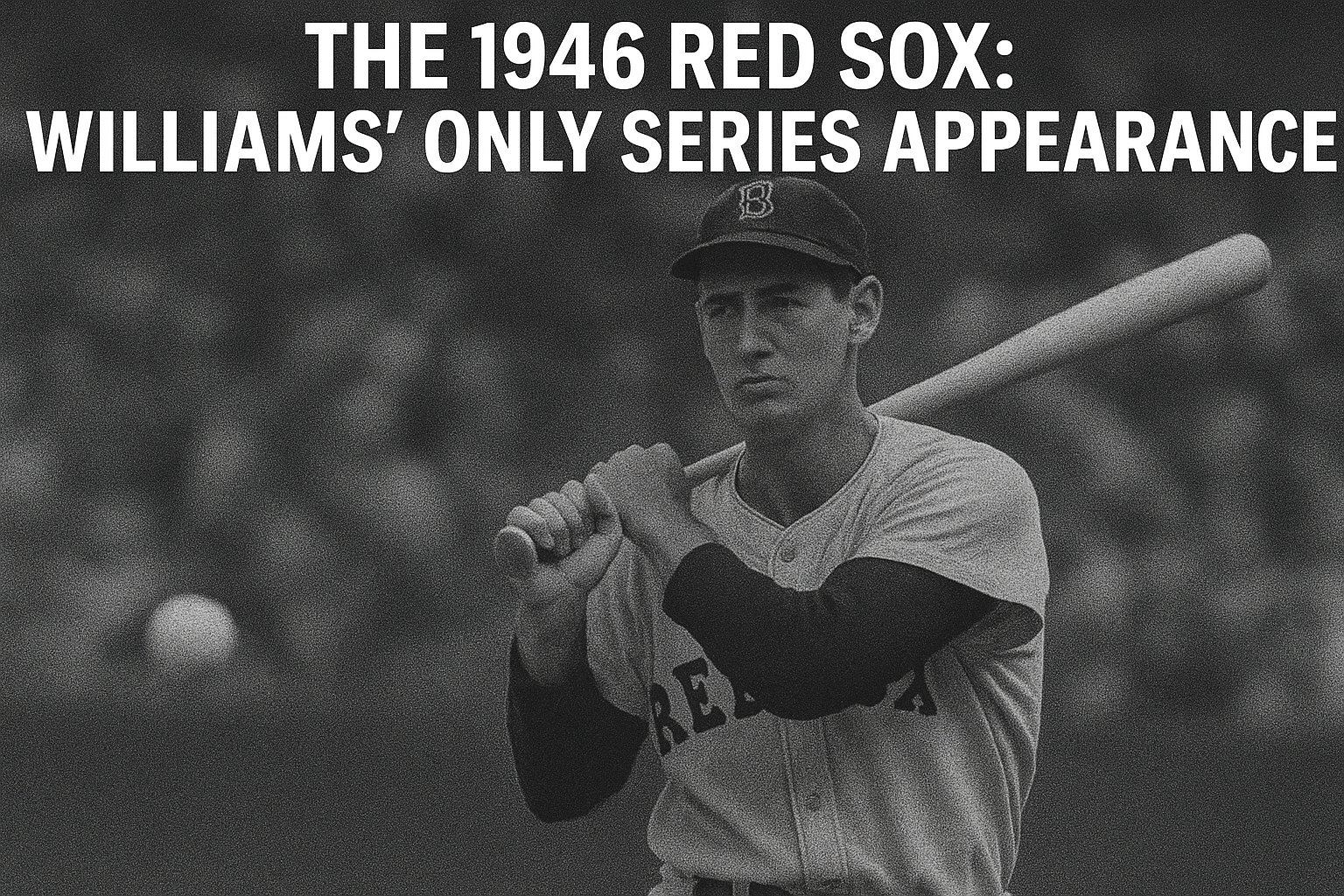
The 1946 Boston Red Sox baseball team is remembered for many reasons, but perhaps none more prominent than the fact it marked the only World Series appearance for Ted Williams. Known for his exceptional hitting skills and being one of the greatest baseball players, Williams played his entire 19-year MLB career with the Boston Red Sox. Despite his many achievements, the 1946 season stood out as the ultimate chance for Ted Williams to shine on the world stage during the fall classic. As we explore the journey of the 1946 Red Sox, we’ll examine not only the achievements of Ted Williams but also the efforts of his teammates who collectively made that season remarkable.
The year 1946 was significant for more than just baseball reasons. Post World War II, America was in a period of transition, with soldiers returning home, and society adjusting to peacetime life. Baseball, often considered America’s pastime, played an essential role in this cultural reintegration, offering a familiar escape and a renewed sense of normalcy. Ted Williams, himself a World War II veteran, returned to the Boston Red Sox to be part of a season that would be forever etched in the franchise’s storied history.
The Red Sox, at that time, were chasing a dream that had eluded them since 1918 – a World Series victory. Despite possessing talent in their roster over the years, post-season success had persistently slipped through their fingers. With players of high caliber, including the legendary Ted Williams, the 1946 season appeared to be the turning point for the Sox. It was a year full of promise and potential, culminating in their advance to the World Series. However, there was more to this journey than the final showdown, as intricate details weave the tapestry of one of baseball’s fascinating seasons.
The Road to the World Series
The 1946 season started off with optimism. The Red Sox had a strong lineup that included promising players like Bobby Doerr, Johnny Pesky, and Dom DiMaggio alongside Ted Williams. Managed by Joe Cronin, the team quickly demonstrated their prowess in the American League. By midseason, it was clear that the Red Sox were a force to be reckoned with, consistently toppling opponents and setting themselves apart as contenders.
Much of their success could be attributed to Ted Williams’ outstanding batting skills. Known as “The Splendid Splinter,” Williams was a formidable presence at the plate, intimidating pitchers with his keen eye and unrivaled swing. During the 1946 season, he achieved a batting average of .342 and a slugging percentage of .667, showcasing his offensive dominance. His prowess didn’t only uplift team morale but also drew fans in droves to Fenway Park to witness baseball brilliance.
However, it wasn’t just Williams who stood out. Bobby Doerr, playing second base, contributed significantly with consistent hitting and defensive skills. Doerr, like Williams, was an all-star and played a pivotal role throughout the season, being a dependable player both at the plate and in the field. Johnny Pesky, known for his high on-base percentage, offered stability in the infield at shortstop, making clutch plays when it mattered most.
As the Red Sox marched through the season, they clinched the American League pennant with ease, securing their berth in the World Series for the first time since 1918. Their opponent, the St. Louis Cardinals, boasted their own array of talents and experience, having won World Series titles in 1942 and 1944. The matchup was set, and it promised to be an exciting contest.
The 1946 World Series
The 1946 World Series began with much fanfare as baseball fans across America anticipated a memorable showdown. The series was a classic best-of-seven, played across both teams’ ballparks, starting at the famous Sportsman’s Park in St. Louis. Each game unfolded with tension, as neither team was willing to concede and expectedly so, given the stakes.
In Game 1, the Red Sox faced a tough challenge and ended up losing 3-2, but they rebounded strongly with a decisive 3-0 victory in Game 2 behind the excellent performance of pitcher Mickey Harris. The teams then moved to Boston where the Red Sox thrilled their home fans in Game 3, capturing a 4-0 victory with impressive pitching by Tex Hughson. However, St. Louis was not to be outdone, coming back in Game 4 with a hard-fought 12-3 win.
Game 5 saw both teams fight fiercely, but the Red Sox eked out a 6-3 win. With the series standing at 3-2, they needed just one more victory to clinch the championship. Yet, St. Louis, known for their resilience, pushed the series to a deciding Game 7 by winning Game 6 decisively.
Tension was palpable in Game 7, held once again in St. Louis. The Red Sox were on the cusp of finally capturing the title that had eluded them for nearly three decades. It was a tightly contested game, marked by strategic moves and high stakes. One of the series’ defining moments came in the eighth inning when Enos Slaughter of the Cardinals made his legendary “Mad Dash” from first base to home, scoring the go-ahead run due to a miscommunication between Red Sox center fielder Dom DiMaggio and Johnny Pesky. Despite their efforts, the Red Sox couldn’t recover, and the Cardinals secured the game 4-3, thus winning the World Series.
Ted Williams’ Underperformance
One of the more poignant aspects of the 1946 series was the underperformance of Ted Williams. Expected to be the difference maker, Williams struggled at the plate throughout the series. Hobbled by a lingering elbow injury, his batting average was a paltry .200, a significant dip from his regular-season performance.
Ted Williams, despite his confidence and preparation, found himself out of rhythm, an experience unfamiliar to the legendary hitter who was used to commanding respect from pitchers. This performance became a subject of much discussion among fans and analysts, especially given his standing as the team’s star. Although Williams’ contribution wasn’t up to his usual standards, it’s essential to acknowledge the exceptional pitching and tight defense of the Cardinals that constrained his usual batting exploits.
Legacy and Impact of 1946
The impact of the 1946 World Series, particularly following the underwhelming performance of Ted Williams, rippled through the baseball community. For Williams, it was a missed opportunity to showcase his excellence in the grandest stage of baseball, but it also pointed to the unpredictability and challenges of the postseason, where regular-season success doesn’t always translate the way players anticipate.
For the Boston Red Sox as a franchise, the 1946 season reinforced a tradition of heartbreak in their quest for the World Series glory. Several other near championship misses in subsequent years contributed to what would later be known as the “Curse of the Bambino,” a supposed jinx that emphasized their failures since trading Babe Ruth decades earlier.
The Red Sox wouldn’t win a World Series until 2004, making their 1946 appearance an early chapter of triumphs and trials that characterized much of their mid-century struggles. The team achieved much together with notable performances, marking an era of Red Sox baseball that flew close to the sun but fell short, leaving a hunger for fans that would turn into passionate dedication across the decades.
Despite the loss, the 1946 season remains a story of resilience, camaraderie, and sportsmanship that holds a special chapter in Red Sox lore. It underscores the impressiveness of the sport, where individual talent might dazzle during the regular campaigns, but team dynamics and timely precision ultimately decide fates in the postseason epics.
Conclusion
The 1946 Boston Red Sox, with Ted Williams at the helm, did not capture the coveted World Series title, but the season remains etched in baseball history as a tale woven with brilliance, heartbreak, and life lessons. Ted Williams, amidst his legendary career, only got one opportunity to play on baseball’s grandest stage, reminding us that even the most talented athletes do not always get multiple shots at greatness.
While his World Series performance in 1946 was less than stellar, Williams’ reputation as one of baseball’s greatest hitters remains untarnished, as his achievements across his career continue to inspire new generations of players and fans alike. The intricacies of the 1946 season encapsulate the beauty and unpredictability of baseball, a game where the outcome of a series can hinge on a single daring play or a mistimed moment.
For Red Sox fans, the 1946 World Series is a chapter remembered with bittersweet nostalgia, marking both the pinnacle of post-war baseball exuberance and the deep-seated yearning for a World Series victory that would take several more decades to fulfill. It’s a reminder of sports’ profound unpredictability, delivering both heartache and hope in equal measure.
The legacy of Ted Williams and the 1946 Red Sox transcends a single season, embodying the ebb and flow of baseball fortunes. It’s a narrative that highlights perseverance as an enduring theme, affirming why baseball, with all its nuances and history, captures our imaginations season after season.
Frequently Asked Questions
1. Why was the 1946 Red Sox season significant for Ted Williams?
The 1946 season was particularly significant for Ted Williams due to it being his one and only appearance in the World Series. Despite being renowned as one of baseball’s all-time greatest hitters, it’s surprising to many that Williams had just this single opportunity to showcase his talents on such a grand stage. The anticipation for the season was immense, given Williams’ track record as an exceptional hitter. Fans and teammates alike were eager to witness Williams shine during the fall classic, bringing his prowess at the plate to the world’s biggest baseball event. Unfortunately, the outcome wasn’t as legendary as many had hoped. While the Red Sox fought valiantly, they ultimately fell to the St. Louis Cardinals in seven games. This left a lingering ‘what if’ in the minds of Red Sox fans and baseball enthusiasts regarding Williams’ postseason potential.
2. How did Ted Williams perform in the 1946 World Series?
Ted Williams’ performance in the 1946 World Series is often regarded as one of disappointment, especially when measured against his usual high standards and expectations. Williams batted just .200 against the Cardinals, a sharp contrast to his regular season batting average of .342 where he showcased his dominance at the plate. Williams managed only five hits across seven games, with his struggles attributed to a combination of factors, including the standout pitching of the Cardinals. Additionally, it’s speculated that Williams was dealing with an injury during the series, which might have hampered his performance. Despite these challenges, the 1946 World Series remains a testament to the unpredictable nature of baseball, illustrating how even the greatest players can encounter difficulties on the biggest stages.
3. What is the historical impact of Ted Williams’ sole World Series run?
The historical impact of Ted Williams’ sole World Series appearance extends beyond his personal performance on the field. It encapsulates the might-have-beens of his storied career—a rare blemish on an otherwise brilliant legacy. While notable for its legendary star, the 1946 World Series underscores the unpredictable dynamics of baseball, reminding fans and players alike that individual greatness doesn’t guarantee team success or postseason triumphs. Despite the Red Sox’s loss, Williams’ participation in the series contributed significantly to his legendary status, as he carried the legacy of his remarkable talent and the enduring quest for the ultimate team victory. This appearance remains a poignant chapter in Red Sox lore, symbolizing the bittersweet realities of chasing baseball’s elusive crowning achievement.
4. How did Ted Williams’ performance affect his legacy?
Ted Williams’ somewhat underwhelming performance in the 1946 World Series is often seen as a footnote in his storied career rather than a defining moment. His legacy as one of the greatest hitters in baseball history remains firmly intact, fortified by his numerous individual accolades, such as his six batting titles and two MVP awards. While fans might speculate and discuss the implications of his sole Series outing, Williams is ultimately remembered for his exceptional prowess at the plate, his dedication to his team, and his unwavering competitive spirit. The 1946 World Series is viewed as a testament to his enduring commitment to the Red Sox, and although it didn’t end in victory, it cemented his status as a pivotal figure in baseball history. Williams’ legacy is a narrative of unmatched talent, passion, and the pursuit of excellence in America’s pastime.
5. How did the 1946 World Series impact the Boston Red Sox team as a whole?
The 1946 World Series had a profound impact on the Boston Red Sox, both positively and negatively. As the team returned to the Fall Classic after a lengthy absence—28 years since their last appearance in 1918—the excitement and hope were palpable among fans and players. Despite the ultimate loss, the season revitalized the franchise, putting them on the map as serious contenders and reinvigorating their fan base. On the flip side, losing in seven games left an enduring sense of frustration and heartbreak. The 1946 series highlighted both the team’s potential and their vulnerabilities, setting the stage for the storied “Curse of the Bambino” narrative that haunted the team for decades. Nevertheless, it propelled the Red Sox into a new era of competition and sparked a fervor for baseball in Boston that would carry on for generations, even if the ultimate triumph was elusive until 2004.