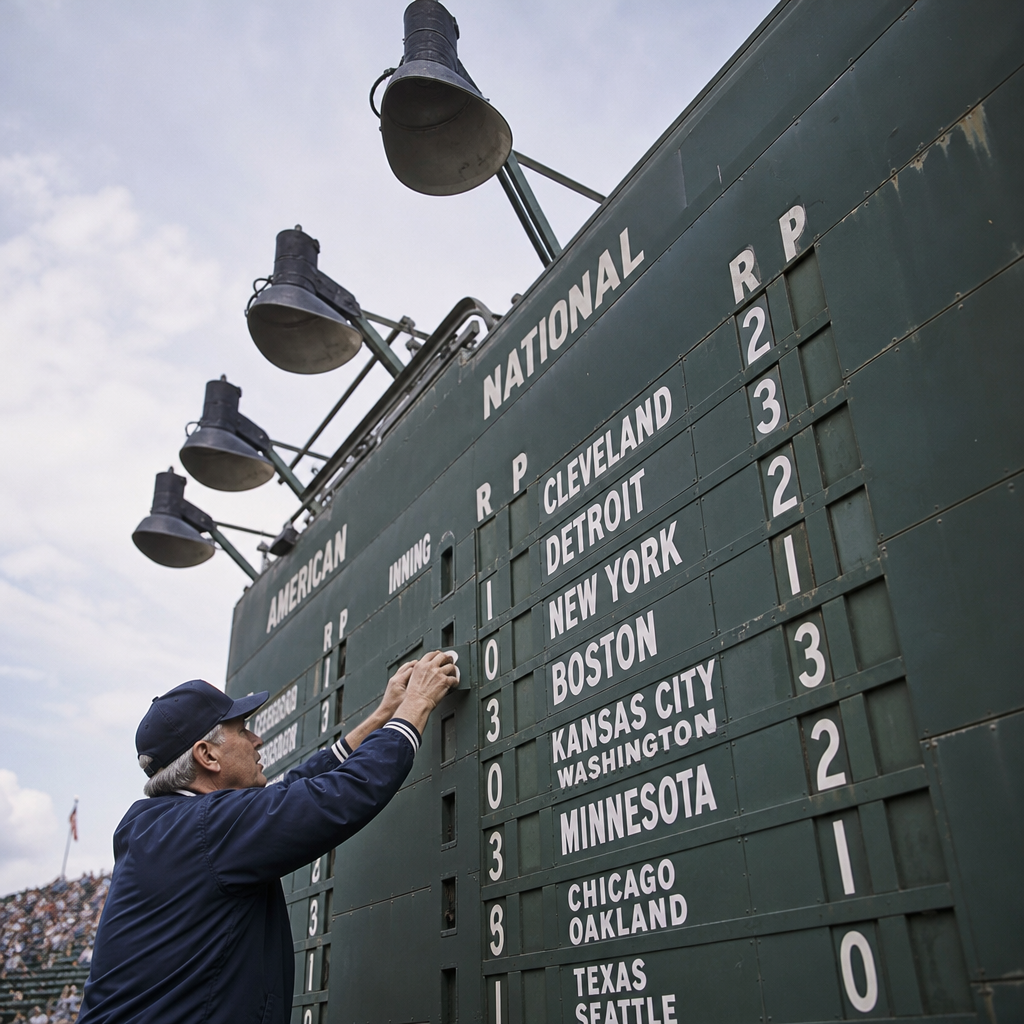
Manual scoreboards once served as the social media feed of the ballpark, quietly delivering out-of-town scores, pennant-race drama, and essential context long before smartphones put every update in a fan’s pocket. In baseball, a manual scoreboard is a hand-operated display, usually built into an outfield wall or grandstand, where attendants post inning-by-inning lines, final scores, and standings using painted numbers, metal plates, shutters, bulbs, or rotating panels. As part of broader ballpark design and features, these boards did much more than report information. They shaped architecture, staffing, fan behavior, and even the emotional rhythm of a game day. I have spent years studying classic parks and walking through the service corridors behind old scoreboards, and one lesson is consistent: the board was not a decorative relic. It was infrastructure. If you want to understand how iconic ballparks worked before digital networks, you have to understand how manual scoreboards connected one field to the entire baseball world. This hub article explains how they functioned, why teams invested in them, how attendants updated them in real time, what design choices distinguished famous parks, and why their influence still matters in modern stadium planning.
What Manual Scoreboards Did and Why They Mattered
Before televisions were common in concourses and before every fan carried a connected device, the manual scoreboard answered three basic questions that defined the live baseball experience: What is happening here, what is happening elsewhere, and what does it mean for the standings? That seems simple, but in practice it made the scoreboard one of the most important features in any park. A fan at Ebbets Field, Comiskey Park, Fenway Park, or Wrigley Field did not arrive expecting a sealed entertainment bubble. Baseball culture assumed that spectators cared about the whole league, especially during a pennant race. The board turned a local game into a league-wide event.
Out-of-town scores mattered because schedules overlapped. A Brooklyn fan in September might track the Giants and Cardinals while watching the Dodgers. An American League crowd might react to a Yankees loss posted in the middle innings almost as loudly as to a home run on the field. In practical terms, manual scoreboards compressed distance. Telegraph wires, press services, and later internal communication systems brought results into the park, and the scoreboard staff translated those data into visible public information. The result was shared awareness. Thousands of people learned the same news at the same moment, looked at the same wall, and responded together.
These boards also reflected a core principle of ballpark design and features: every structure should serve the game first. Outfield walls, scoreboard wells, catwalks, and service doors were laid out around visibility, durability, and workflow. A manual board was not an add-on. It affected dimensions, wall height, maintenance access, lighting plans, and the placement of advertisements. In older parks where space was constrained by city blocks, rail lines, or neighboring buildings, the scoreboard often became the defining visual landmark because it had to be large enough to communicate at long distance while fitting irregular architecture.
How Out-of-Town Scores Reached the Ballpark
The process behind those updates was more sophisticated than many fans realize. Teams typically relied on wire services such as the Associated Press or United Press, in-house telephone lines, ticker systems, and later dedicated press communications. Someone in the press box or operations area received score reports from other games, often inning by inning, and relayed them to scoreboard attendants. In the early twentieth century, telegraph networks were central because they delivered concise, standardized updates quickly enough for public posting. By the postwar period, telephone and teletype systems improved speed and reduced ambiguity.
Accuracy mattered. A wrong digit posted on an out-of-town line could mislead an entire crowd, and experienced scoreboard crews developed routines to prevent mistakes. In parks I have researched, attendants often worked from written slips or chalked cue lists rather than memory alone. One person received the update, another confirmed the game and inning, and the crew behind the wall changed the numbers in sequence. The same discipline used in newspaper composing rooms appeared in miniature behind the scoreboard: verify, post, recheck, then wait for the next bulletin.
Timing mattered too. Not every score appeared instantly, and that lag shaped fan expectations. Crowds understood that updates came in bursts. If the board had been static for twenty minutes, people scanned it again after a pitching change or between innings, anticipating a fresh posting from elsewhere in the league. That rhythm created suspense. A modern app delivers continuous push notifications, but the manual scoreboard made information feel eventful because updates were visible acts rather than silent data refreshes.
How Scoreboard Crews Changed the Numbers
Most manual scoreboards worked through one of several mechanical systems. Some used painted metal numbers slotted into windows. Others used cards or placards hung on hooks. Many famous examples employed rotating panels or hinged shutters operated from a narrow catwalk behind the board. At Wrigley Field, attendants have long updated the iconic hand-turned scoreboard by inserting numbers from the rear while monitoring games through small openings and communication from the press box. The Green Monster scoreboard at Fenway Park uses a similarly hands-on method, with workers inside the wall changing inning and score panels by hand.
The job required focus, physical stamina, and spatial memory. Behind-the-board spaces were often cramped, dim, and hot in summer. Crews climbed ladders, carried stacks of number plates, and worked around structural beams. They had to know exactly which opening corresponded to which league game, inning column, or final line. During busy afternoons with a full major league slate, multiple games could change status at once. Good crews moved quickly without sacrificing legibility. In interviews and historical accounts, former attendants often describe the work as part stagecraft, part factory routine. Fans saw the clean result; staff managed a surprisingly complex operating environment.
| Ballpark | Manual scoreboard feature | How out-of-town scores were shared | Why it became iconic |
|---|---|---|---|
| Wrigley Field | Center-field hand-turned board | National and American League lines updated from inside the structure | Preserved as a living example of pre-digital baseball operations |
| Fenway Park | Green Monster manual panel system | Attendants change score windows by hand during the game | Blends scoreboard function with the park’s most famous architectural element |
| Yankee Stadium (original) | Large outfield scoreboards with auxiliary displays | League scores and line information integrated into monumental outfield design | Showed how information display could match the scale of a flagship venue |
| Comiskey Park | Traditional mechanical score displays | Wire-fed updates posted for pennant-conscious crowds | Represented the utilitarian efficiency of classic urban ballparks |
How Manual Scoreboards Shaped Ballpark Design and Features
As a hub within ballpark design and features, manual scoreboards reveal how one element can influence almost every other part of a stadium. First, there was sightline planning. Designers had to position the board so fans in the grandstand, bleachers, and upper deck could read it without losing the field. That usually meant locating the main board in center field or left-center, where it could sit above or within the outfield wall. Lettering size, contrast, and spacing were not aesthetic afterthoughts; they were visibility engineering.
Second, there was structural integration. Manual boards needed internal access, ventilation, weather protection, and safe footing for workers. A board built into a wall required service corridors and rear entry points. A board perched above bleachers demanded support framing that could handle wind loads and maintenance traffic. In older parks, these requirements sometimes dictated unusual wall shapes or asymmetrical outfield compositions. What fans perceived as quirky charm often began as practical adaptation.
Third, there was the relationship between scoreboards and advertising. Pre-digital parks used every visible surface carefully. Teams sold signage, but the scoreboard area remained premium real estate because it held the eye. Clubs had to balance revenue with legibility. If ads crowded the linescore, the board failed. The best classic parks achieved a hierarchy: game information first, sponsor presence second. That ordering is still a useful design principle in current stadium renovations.
Finally, the manual scoreboard influenced acoustics and crowd flow indirectly. Because fans repeatedly looked to one place for updates, moments of posted news produced visible waves of reaction. Architects and operators learned where people paused, pointed, and congregated. In effect, the scoreboard created an information focal point inside the building, much like a concourse video wall does today.
Famous Examples from Iconic Ballparks
Wrigley Field is the clearest surviving example because its hand-operated center-field scoreboard remains a working symbol of the analog era. Installed in 1937, the Art Deco board did more than show the Cubs game. It displayed league scores and standings, allowing Chicago fans to follow the broader pennant picture without leaving their seats. Its continued use matters because it preserves not just a look but an operating method. The attendants inside are part of the architecture’s function.
Fenway Park offers a related but distinct case. The Green Monster is famous for its height, but its embedded manual scoreboard demonstrates how a ballpark feature can serve multiple purposes at once: defensive wall, visual icon, and live information system. The hand-changed panels preserve continuity with the park’s early-twentieth-century design logic, where utility and identity were inseparable.
Not every influential board survives, but many left a strong design legacy. The original Yankee Stadium used monumental outfield displays that matched the scale and self-image of the franchise. Ebbets Field and the Polo Grounds relied on scoreboards to help urban spectators track a league that felt intensely local yet geographically dispersed. Even parks that later installed electronic boards often kept manual auxiliary elements because fans trusted the familiar layout and could read it quickly at a glance.
Why Fans Trusted Them and What Was Lost
Manual scoreboards earned trust because they were stable, public, and easy to verify. Everyone in the park saw the same posted score. There was no personalized feed, no battery issue, and no algorithm deciding what mattered. If the board showed a rival losing in the eighth, the entire crowd processed that fact together. That communal certainty is hard to reproduce in an era of individual screens.
Something else was lost when parks moved fully to digital systems: visible labor. Fans once knew, even if only dimly, that people inside the wall were making the board work. That knowledge connected the spectacle to the staff and to the building itself. Modern LED boards are more flexible and can show video, statistics, sponsorship rotations, and advanced graphics, but they hide the operational drama. Efficiency improved, yet mystery disappeared.
Still, digital did not simply erase manual traditions. Many clubs preserve manual elements because they add authenticity and slow the pace in a good way. In my experience, visitors linger longer at parks where historic features still perform a real task rather than serving as museum props. A working manual board tells fans that baseball values continuity, craftsmanship, and context.
What Modern Stadium Designers Still Learn from Manual Scoreboards
The manual scoreboard remains relevant because it embodies enduring design lessons. First, information must be readable instantly. Second, stadium features should reinforce the sport’s narrative, not distract from it. Third, the most memorable ballpark design and features are those that combine function, identity, and ritual. A scoreboard should orient fans emotionally as well as visually.
That is why contemporary designers study classic boards when planning renovations, retro parks, and fan-experience upgrades. Even with ribbon boards, apps, and immersive displays, teams still organize information into clean hierarchies borrowed from manual systems: inning, runs, hits, errors, out-of-town lines, standings implications. The format worked because it matched how baseball is understood. Good design follows the logic of the game.
Manual scoreboards also remind operators that not every improvement requires more motion or more content. In many parks, the best fan-service upgrade is clearer information in the right place. Classic boards mastered that principle decades ago with wood, steel, paint, and disciplined crews.
For anyone exploring iconic ballparks, manual scoreboards are a gateway into the larger subject of ballpark design and features. They connect architecture, technology, labor, fan culture, and league history in one structure. Before smartphones, they were how ballparks shared out-of-town scores and how crowds understood the stakes beyond the diamond in front of them. Their legacy survives in every stadium that treats information as part of the experience, not just decoration. If you are building a deeper understanding of classic baseball venues, start with the scoreboard, then follow that thread into walls, sightlines, concourses, and the many other features that gave each park its character. Explore the rest of this subtopic with that lens, and the design of iconic ballparks becomes far richer and far more human.
Frequently Asked Questions
What is a manual scoreboard, and how did it work in baseball parks before smartphones?
A manual scoreboard is a hand-operated display used to show game information without digital screens or automated feeds. In baseball parks, these boards were often built directly into the outfield wall, above the bleachers, or into a grandstand facade, where fans could easily glance up and follow both the action on the field and the progress of games happening elsewhere. Instead of relying on electronics, attendants updated the board by physically inserting numbers, flipping panels, adjusting shutters, switching light bulbs, or hanging metal plates that represented runs, hits, errors, inning totals, and final scores.
Before smartphones, manual scoreboards were one of the most important ways fans stayed connected to the wider baseball world during a game. A spectator could come to the park for a hometown matchup but still keep track of rivals in the pennant race, late-season standings pressure, or a doubleheader unfolding in another city. Information usually reached the scoreboard crew through telegraph, telephone, ticker services, radio monitoring, or internal press communication. Once the update arrived, attendants working behind the board would make the change by hand, often in cramped, hidden spaces. The result was a constantly evolving public display that turned the ballpark into a shared information center, long before live apps, push notifications, and social media feeds made instant updates routine.
Why were out-of-town scores such a big part of the ballpark experience?
Out-of-town scores mattered because baseball has always been bigger than a single game. Fans were not just watching their local club in isolation; they were following a season-long story shaped by league standings, rivalries, road trips, pennant races, and scoreboard watching. If your team was trying to catch a first-place rival, every update from another city could change the mood in the stadium. A loss by a competitor might trigger cheers that had nothing to do with the pitch being thrown on the field. In that sense, the manual scoreboard gave immediate context to the home game and helped fans understand what was at stake in real time.
These score updates also created a uniquely communal experience. Thousands of people in the stands absorbed the same information at once, reacted together, and built conversations around it inning by inning. One posted final from St. Louis, Pittsburgh, or Brooklyn could ripple through the crowd and alter the emotional temperature of the ballpark. Long before fans checked scores individually on phones, they learned them collectively by looking at the same board. That shared act of following the wider league helped make the manual scoreboard feel less like a utility and more like the ballpark’s version of a live public news feed.
How did scoreboard operators receive and post out-of-town scores during the game?
Scoreboard operators depended on communication systems that were fast for their time but still required coordination, accuracy, and human judgment. In many parks, updates came through dedicated wires, telephones, press boxes, wire services, or radio broadcasts monitored by staff. Someone had to receive the incoming information, confirm what inning or final score was being reported, and relay it correctly to the crew working behind the board. Because baseball games around the league did not always move at the same pace, operators had to pay close attention to avoid posting stale, confusing, or incomplete information.
Once the update reached the scoreboard area, attendants physically changed the display. Depending on the board’s design, this could mean sliding numbered panels into slots, rotating signs, opening or closing shutters, changing bulbs, or hanging score markers by hand. In some famous parks, the people updating the board worked inside the wall itself, hidden from the crowd and surrounded by spare numerals and mechanical components. The work demanded concentration, because a single wrong number could mislead thousands of fans. What looked simple from the stands was actually a carefully choreographed information system powered by human labor, timing, and old-school craftsmanship.
What made manual scoreboards memorable compared with today’s digital score displays?
Manual scoreboards are memorable because they had personality, physical presence, and a visible connection to the history of the park. Digital displays can show far more information, and they can do it instantly, but manual boards offered something different: a sense that baseball information was being built in real time by people, not just processed by software. Fans could often sense the rhythm of updates, noticing when a new score appeared or when a late final from another city suddenly changed the atmosphere. That delay, slight as it sometimes was, added drama rather than reducing it.
They also became iconic architectural features. In many classic ballparks, the manual scoreboard was not just a screen bolted onto the stadium; it was part of the stadium’s identity. Its colors, typography, dimensions, and mechanical operation contributed to the visual character of the park. For many fans, the board symbolized an era when following baseball required patience, attention, and shared public rituals. Even today, surviving manual scoreboards are celebrated not because they are more efficient than modern technology, but because they preserve a tactile, human-scaled way of experiencing the game and its connection to the rest of the league.
Do any ballparks still use manual scoreboards today, and why do they preserve them?
Yes, some ballparks still maintain manual scoreboards, either as functional displays, heritage features, or a mix of both. In a few historic parks, the manual board remains an active part of the game-day presentation, especially for out-of-town scores or traditional line scoring. Even when giant video boards are available elsewhere in the stadium, teams may keep the hand-operated board because it anchors the ballpark in its own history. It serves as a living reminder that baseball’s information systems once depended on attendants, craftsmanship, and deliberate updates rather than seamless digital automation.
Teams preserve manual scoreboards because fans value authenticity and continuity. These boards connect generations of spectators: grandparents who once relied on them for pennant-race updates can point them out to younger fans who have never known a world without instant score alerts. They also reinforce the idea that a ballpark is more than a venue; it is a cultural landmark shaped by traditions, design choices, and rituals that define the experience of attending a game. In that way, the manual scoreboard survives not merely as nostalgia, but as a working symbol of how baseball once shared news, suspense, and community before smartphones put every score in every pocket.