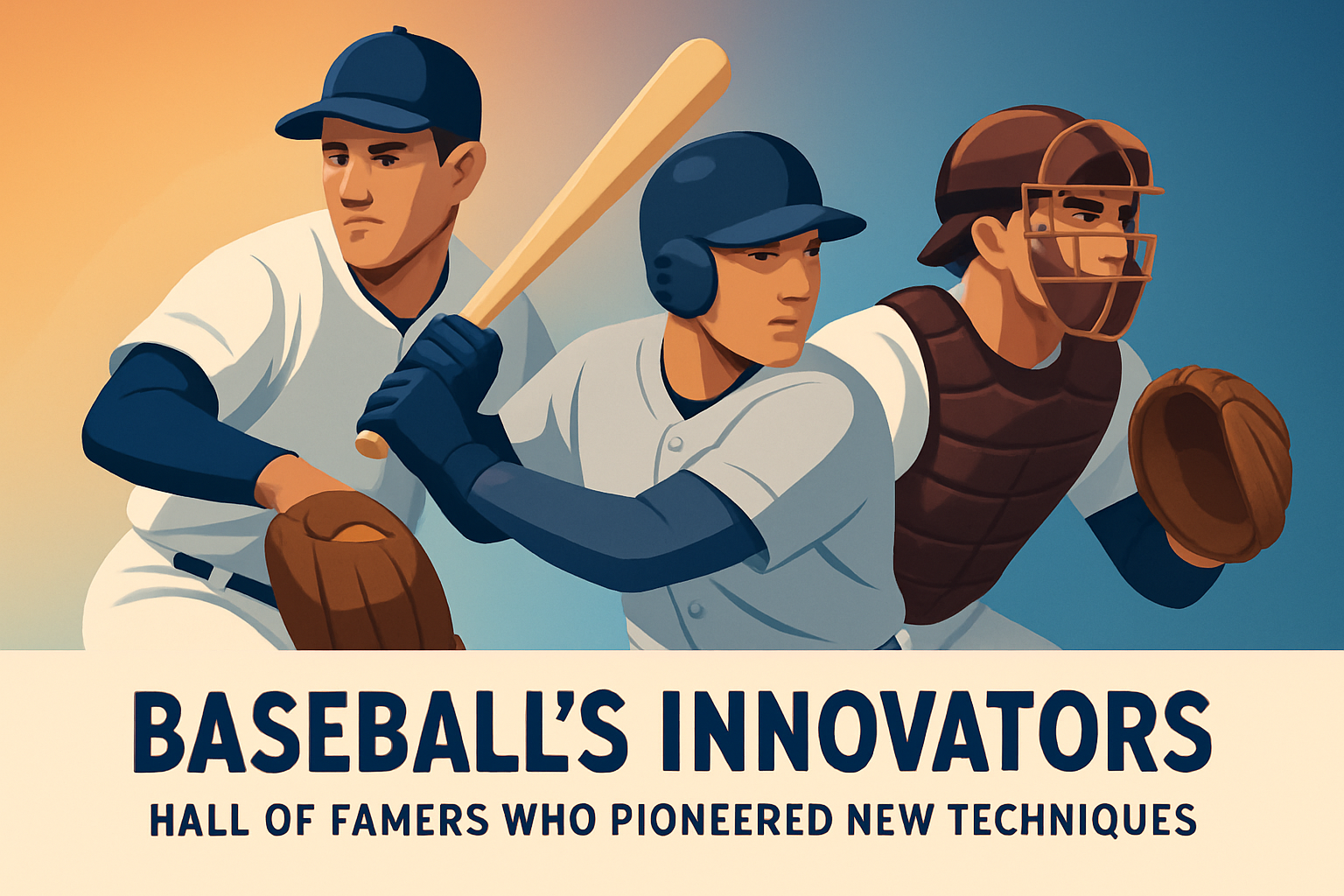
Baseball history is usually told through pennants, batting titles, and October moments, but the sport evolves just as much through invention as through victory. “Baseball’s Innovators: Hall of Famers Who Pioneered New Techniques” is really a story about players and managers who changed how the game is played, taught, and understood. In baseball, a technique is not just a style choice. It is a repeatable method that alters outcomes, influences coaching, and forces opponents to adapt. When that method spreads from one dugout to another and survives across generations, it becomes part of the sport’s permanent language.
I have spent years studying how baseball ideas move from outliers to orthodoxy, and the pattern is consistent. First, an individual solves a practical problem: how to hit tougher pitching, how to create a more deceptive delivery, how to turn speed into pressure, or how to position defenders more intelligently. Then skepticism follows. Traditionalists call the change unorthodox, risky, or unsound. Finally, results accumulate, younger players imitate the method, and what once seemed radical becomes fundamental. Many Hall of Famers are enshrined not only because they excelled within baseball’s rules, but because they quietly rewrote the operating manual.
This matters because innovation explains why the sport never stands still, even when the field dimensions and basic rules remain familiar. The modern emphasis on pitch framing, launch angle, relief specialization, data-informed defense, and strength-driven power did not emerge from nowhere. Earlier Hall of Famers created the blueprint for experimentation by proving that technique can be a competitive advantage. Their breakthroughs also reveal a broader truth for coaches, players, and fans: baseball rewards observation, adaptation, and precision. Talent opens the door, but technique often separates the merely great from the transformative.
To understand baseball innovation clearly, it helps to define the categories. Some pioneers introduced mechanical techniques, such as new grips, deliveries, swings, or baserunning methods. Others changed tactical technique, including bullpen management, defensive positioning, lineup construction, and situational decision-making. A third group transformed training and preparation by introducing routines that improved durability, repeatability, and performance under pressure. The Hall of Fame contains examples from each category, and the most influential figures often combined all three. Their impact can still be seen in player development systems, broadcast analysis, and front-office decision-making today.
The following Hall of Famers stand out because their ideas were not small variations. They represented meaningful departures from accepted practice and produced copycat effects across eras. From Christy Mathewson’s scientific pitching to Branch Rickey’s institutional innovation, from Jackie Robinson’s disruptive baserunning to Tony Gwynn’s obsessive bat control, these figures expanded baseball’s technical vocabulary. Looking closely at what they changed and why it worked offers a better answer than nostalgia ever could to a central baseball question: how does a game with such deep traditions keep reinventing itself?
Pitching pioneers who changed the craft
Few Hall of Famers illustrate technical innovation better than Christy Mathewson. At a time when pitchers relied heavily on speed variation and basic movement, Mathewson’s famous “fadeaway,” now recognized as a screwball variant, gave him a signature weapon that moved in the opposite direction from a conventional curve. The importance of the pitch was not only physical but conceptual. He showed that elite pitching could be built on manipulating spin, angle, and expectation rather than simply overpowering hitters. Modern pitch design labs use high-speed cameras and spin-axis data to pursue the same objective Mathewson pursued by feel: make the baseball behave in ways hitters do not anticipate.
Satchel Paige, whose Hall of Fame legacy bridges the Negro Leagues and baseball mythology, also deserves mention as an innovator, not merely a showman. Paige varied arm slots, changed speeds dramatically, and named pitches to sharpen their identity and purpose. His approach foreshadowed modern sequencing. Today, analysts discuss tunneling, perceived velocity, and disruption of timing. Paige practiced those principles decades earlier. By keeping hitters uncertain about not just what pitch was coming but how it would look out of his hand, he turned deception into a repeatable strategy. That is innovation in its purest form: converting instinct into method.
Nolan Ryan advanced another important idea: power pitching as a year-round discipline tied to conditioning. Ryan’s Hall of Fame career is often reduced to radar-gun readings and strikeout totals, but his deeper influence lies in preparation. He embraced distance running, leg strength, and structured throwing long before individualized performance training became standard. In clubhouses where many pitchers once relied mostly on arm talent and periodic throwing, Ryan treated velocity and durability as trainable assets. Modern pitcher development, from weighted-ball debates to workload planning, operates in a landscape Ryan helped shape by proving that physical process matters as much as game-day adrenaline.
Phil Niekro pioneered in a different direction by sustaining the knuckleball as a legitimate major league survival tool. The knuckleball existed before him, but Niekro demonstrated that a low-spin pitch could anchor a Hall of Fame career and neutralize hitters even when conventional velocity faded. He also highlighted a central baseball lesson: innovation sometimes means maximizing an inefficiency everyone else overlooks. In today’s terms, Niekro identified an undervalued skill that created weak contact, poor timing, and roster flexibility because it placed less strain on the arm. Teams still revisit the knuckleball whenever they search for unconventional pitching value.
Offensive innovators who redefined hitting and pressure
Ted Williams belongs in any discussion of baseball innovation because he turned hitting into an explicit science. His book The Science of Hitting did more than explain swing mechanics. It organized ideas about strike-zone discipline, pitch selection, and contact quality into a coherent framework. Williams insisted that hitters should hunt pitches they could drive and refuse to expand the zone merely to appear aggressive. That principle sounds obvious now because elite offensive development is built around swing decisions, on-base percentage, and damage on contact. In Williams’s era, however, many evaluations still romanticized broad bat control over selective destruction. He helped shift the standard.
Tony Gwynn pioneered almost the opposite offensive style while displaying the same analytical rigor. Gwynn was not just a natural contact hitter; he was one of the first stars to study extensive video of his own swing and opposing pitchers with near-obsessive intent. Long before tablet-based dugout review, he used video to isolate timing flaws, hand path inconsistencies, and release-point cues. His technique emphasized balance, barrel control, and all-field contact, allowing him to manipulate the bat face with remarkable precision. Modern hitters often use bat sensors and motion-capture systems to chase the same repeatability Gwynn built through relentless visual feedback.
Rod Carew changed perceptions of what a batting champion could look like. Rather than relying on one dominant slugging zone, he mastered bat control, late adjustment, and placement. Carew’s technique against inside pitches, especially his ability to keep the barrel in the zone while serving the ball to left field, remains instructional gold. He showed that offensive innovation is not always about harder contact; it can also be about expanding the geometry of possible hits. For youth coaches and professional hitting coordinators alike, Carew remains evidence that elite hand-eye coordination paired with disciplined mechanics can pressure every inch of the defense.
Jackie Robinson’s influence went far beyond historic significance and stolen-base totals. He pioneered a style of aggressive, psychologically disruptive baserunning that changed the game’s tempo. Robinson took leads that unsettled pitchers, challenged infielders with hard turns, and treated every ball in play as an opportunity to manufacture stress. His innovation was not simple recklessness. It was calculated pressure based on reading feet, shoulders, transfer times, and defensive hesitation. Today, when coaches teach secondary leads, jump optimization, and first-to-third decision models, they are formalizing a principle Robinson demonstrated vividly: speed matters most when paired with fearless, intelligent intent.
Defensive and tactical innovation that reshaped team strategy
Ozzie Smith revolutionized public understanding of infield defense by making range, footwork, and body control central parts of player value. Before advanced fielding metrics, many fans and executives still treated defense as secondary to offense unless errors became glaring. Smith showed that shortstop technique could prevent runs in ways box scores barely captured. His pre-pitch setup, first-step quickness, internal clock, and throwing angles made difficult plays routine. Modern metrics such as Defensive Runs Saved and Outs Above Average quantify what Smith demonstrated intuitively: elite defenders change innings, pitcher confidence, and roster construction because run prevention is created, not merely inherited.
Brooks Robinson did something similar at third base. He refined positioning, reaction training, and angle management at the hot corner, turning a brutally demanding position into a showcase for anticipation. Robinson’s genius lay in preparation. He studied hitters, recognized swing patterns, and adjusted depth and lateral shading accordingly. That looks strikingly contemporary in an era of spray charts and pre-pitch alignment cards. While he worked without Statcast heat maps, the governing idea was the same: defenders should stand where contact is most likely to go. His career helped legitimize defense as an information-driven craft rather than a purely instinctive art.
Innovative technique is not limited to players. Casey Stengel, a Hall of Fame manager, transformed tactical thinking through platooning and roster specialization. He recognized that handedness advantages could be exploited more deliberately, and he managed his bench and bullpen with a flexibility that often frustrated traditional observers. Stengel’s methods helped normalize matchup-based deployment long before modern front offices armed managers with exhaustive split data. His strategic creativity matters because it introduced a new expectation: a manager should not simply set a lineup and hope talent carries the day; he should actively manufacture marginal advantages across nine innings.
| Hall of Famer | Primary innovation | Why it mattered | Modern baseball parallel |
|---|---|---|---|
| Christy Mathewson | Advanced breaking-ball manipulation | Showed movement and deception could dominate hitters | Pitch design and spin-axis optimization |
| Ted Williams | Scientific strike-zone discipline | Reframed hitting around selectivity and damage | On-base focus and swing-decision training |
| Jackie Robinson | Aggressive intelligent baserunning | Turned speed into constant defensive pressure | Jump metrics and run-value baserunning models |
| Ozzie Smith | Elite shortstop range and technique | Elevated defense as measurable run prevention | Defensive Runs Saved and Outs Above Average |
| Casey Stengel | Platoons and flexible deployment | Normalized matchup-based strategy | Bullpen specialization and split-driven lineups |
Branch Rickey deserves special attention because he innovated at the organizational level, which ultimately changed on-field technique too. Rickey helped formalize the farm system, creating a developmental pipeline where skills could be taught systematically rather than improvised at the major league level. He also promoted statistical thinking before sabermetrics had a name. Rickey understood that efficient player development and sober performance evaluation were competitive tools. In practical terms, this meant more deliberate instruction, better role definition, and more scalable improvement methods. Every modern player development complex, analytics department, and integrated coaching model owes something to Rickey’s architecture.
How Hall of Fame innovation still shapes the modern game
The clearest proof of lasting innovation is adoption. Techniques pioneered by Hall of Famers now appear in amateur instruction manuals, major league analytics reports, and broadcast explanations aimed at casual fans. Ted Williams’s strike-zone control became the foundation for modern plate-discipline metrics such as chase rate and walk percentage. Jackie Robinson’s pressure-oriented baserunning now shows up in sprint-speed data, jump scores, and run expectancy models. Ozzie Smith’s defensive artistry is tracked through reaction times and route efficiency. What was once described through anecdote is now reinforced by technology, but the underlying baseball logic remains unchanged.
Another lasting effect is that innovation broadened baseball’s definition of value. Older debates often separated players into simplistic categories: hitter, fielder, speedster, ace, or tactician. The Hall of Famers discussed here blurred those boundaries by proving that technique can create hidden value. A selective hitter raises team offense without leading the league in batting average. A defender with elite positioning saves runs that never become highlights. A manager using platoons squeezes production from an otherwise ordinary roster. A pitcher with unusual movement can outlast a flamethrower. Modern roster construction depends on those insights because wins are built from accumulated edges.
There is also an important caution in studying baseball innovators: not every novel idea works, and even great techniques have limits. The knuckleball is difficult to command and difficult to catch. Hyper-aggressive baserunning can become wasteful if reads are poor. Platooning can reduce lineup continuity if overused. Video study helps hitters, but too much mechanical thinking can freeze natural rhythm. The best Hall of Fame innovators understood this tradeoff. They did not chase novelty for its own sake. They refined methods that matched their own skills, then applied them with discipline. That balance is why their ideas lasted while countless fads disappeared.
For coaches, players, and serious fans, the practical lesson is straightforward. Baseball innovation rarely begins with a grand declaration. It usually starts with careful observation, a willingness to question convention, and the patience to repeat a better method until results become undeniable. Hall of Famers such as Mathewson, Williams, Robinson, Smith, Stengel, Rickey, Gwynn, Carew, Ryan, Paige, Niekro, and Brooks Robinson did more than compile statistics worthy of Cooperstown. They expanded what baseball considered possible. Study their techniques closely, and you do more than honor history. You gain a sharper understanding of how the game keeps moving forward. Watch today’s stars through that lens, and you will start spotting the next innovator before the plaque is cast.
Frequently Asked Questions
What makes a Hall of Famer an innovator in baseball, rather than simply a great player?
A Hall of Famer becomes an innovator when his impact goes beyond statistics and awards and extends into the methods of the game itself. Great players dominate within the existing framework of baseball, but innovators reshape that framework. They introduce a new pitch, refine a defensive approach, alter batting mechanics, rethink base running, or develop teaching principles that other players, managers, and coaches adopt. In other words, innovation in baseball is measured by influence as much as performance. A player may win batting titles or MVP awards, but if his techniques do not spread, they remain individual accomplishments rather than transformative ideas.
That is why certain Hall of Famers stand out as pioneers. They changed what opponents had to prepare for and what future generations were taught. Satchel Paige’s command of timing and deception elevated pitching into a craft of disruption, not just velocity. Willie Keeler’s emphasis on bat control helped define an entire philosophy of contact hitting. Branch Rickey’s role in formalizing farm systems and player development turned baseball into a more organized, teachable profession. These figures matter because their ideas lasted. Their techniques became part of baseball’s vocabulary, influencing scouting, instruction, and strategy long after their own careers ended.
Which Hall of Famers are most often credited with pioneering new techniques in baseball?
Several Hall of Famers are regularly identified as true baseball innovators because their ideas changed how the sport was played and taught. Candy Cummings is traditionally associated with developing the curveball, a pitch that altered hitter expectations forever by proving that movement could be as valuable as speed. Christy Mathewson helped bring scientific pitch sequencing and refined control into the spotlight, showing that elite pitching involved intelligence, precision, and planning. On the offensive side, Wee Willie Keeler became famous for his emphasis on controlled contact, a hitting style built around placement and consistency rather than pure power.
There are also innovators whose influence reached beyond one skill. Jackie Robinson changed base running aggression, pressure tactics, and the psychological dimensions of the game while also transforming the sport culturally and competitively. Rickey Henderson, though from a later era, elevated lead-offs, jumps, and stolen-base efficiency into an art form that teams studied in detail. Among managers and executives in the Hall of Fame, Branch Rickey remains one of the clearest examples of institutional innovation because he revolutionized player development through the farm system and championed analytical, forward-looking approaches to roster building. Together, these figures show that innovation in baseball can come from pitching, hitting, running, coaching, or even organizational design.
How did pioneering techniques from Hall of Famers change the way baseball was coached and taught?
When a Hall of Famer introduces a technique that works consistently, that technique often moves from personal habit to standard instruction. This is one of the clearest signs of genuine innovation. Once coaches see a method produce repeatable success, they begin breaking it down, naming it, and teaching it to younger players. A pitcher’s grip becomes part of bullpen instruction. A hitter’s approach becomes a model in batting cages. A base runner’s timing becomes film-study material. Over time, what started as one player’s advantage becomes a shared teaching principle across amateur, minor league, collegiate, and major league baseball.
That pattern is visible throughout baseball history. The curveball, for example, did not remain a novelty once it proved effective; it became a foundational pitch taught at every competitive level. The same is true of advanced pickoff moves, defensive positioning concepts, and nuanced hitting philosophies such as staying inside the ball or using the whole field. Hall of Fame innovators often supplied not just a skill, but a language for that skill. Their methods gave coaches something concrete to explain and players something structured to practice. In that way, the innovators in baseball history did more than win games. They expanded the curriculum of the sport.
Why are some baseball innovations considered controversial at first?
Baseball has always balanced tradition with adaptation, so new techniques often face skepticism before they gain acceptance. Players, managers, and fans can be wary of anything that challenges established wisdom, especially in a sport so deeply attached to historical continuity. An unconventional batting stance, a deceptive pitch, an aggressive base running strategy, or a new system of player usage may initially look risky, unnatural, or even disrespectful to the “right way” of playing. That resistance is common because innovation forces people to reconsider habits they once treated as permanent truths.
Many now-celebrated techniques were once viewed with doubt. The curveball was controversial because some early observers questioned whether it was physically possible or even proper. Aggressive stealing philosophies were criticized when they seemed reckless rather than calculated. Organizational changes such as Branch Rickey’s farm system disrupted older talent pipelines and challenged how clubs had traditionally operated. What ultimately settles the debate is not novelty alone, but results. When an innovation repeatedly produces success and can be taught to others, opposition tends to fade. In baseball, skepticism often greets new ideas first, but sustained effectiveness is what turns controversy into convention.
Why does baseball innovation matter so much when discussing Hall of Fame legacies?
Innovation matters because it reveals a deeper level of greatness. Hall of Fame recognition certainly honors production, championships, and individual excellence, but the most enduring legacies often belong to those who left the game different from how they found it. A player or manager who pioneers a new technique influences not only his own era, but also generations that follow. His value continues in the mechanics players repeat, the strategies managers deploy, and the lessons coaches pass on. That kind of impact is larger than a résumé. It is structural, lasting, and woven into the sport’s ongoing evolution.
In an article about baseball’s innovators, that perspective is essential. The history of the sport is not only a record of who won, but also a record of who changed what winning looked like. Hall of Famers who pioneered new techniques helped redefine efficiency, preparation, deception, athleticism, and instruction. They made baseball more sophisticated and more teachable. Their stories remind readers that progress in the game does not happen only through rule changes or technology. It also happens when extraordinary baseball minds discover better ways to pitch, hit, run, defend, and lead. That is why innovation is not a side note in Hall of Fame history. It is one of the clearest signs of true influence.